


Where do I find a fractional VP of Sales in New Mexico in 2027?
Quality
Certified

Source nationally rather than locally. New Mexico's economy centers on federal labs, energy, and tourism, so the resident pool of recent B2B SaaS revenue leaders is thin. Post in Pavilion and RevOps Co-op, work investor and founder referrals, filter for Mountain Time overlap, and budget ten to twenty working days monthly.
The end-to-end process from decision to signed retainer
The search works when you treat it as a defined sequence rather than a vague hunt, and the whole thing compresses into two to four weeks if you run it deliberately. Step one is diagnosing the bottleneck honestly before you write a single line of a job post. Sit down and name, in one sentence, the specific revenue problem you are buying help for. "Reps aren't hitting quota" and "I cannot forecast within thirty percent" are sales-execution problems that a fractional VP of Sales solves. "Marketing hands me junk leads" and "we do not know how to price the new tier" are revenue-architecture problems that belong to a fractional CRO. Founders who skip this step buy the wrong title and then wonder why ninety days produced nothing.
Step two is writing the stage description that will actually attract the right respondents. Titles are ambiguous across the fractional market — one person's "VP of Sales" is another's "sales consultant" — so the post has to carry the specifics that let a qualified operator self-select. Include your current ARR band, headcount on the revenue team, who is closing deals today, your average contract value, your sales cycle length, and what the first ninety days must produce. A post that says "seeking fractional VP of Sales, remote" gets fifty generalist applicants. A post that says "$900K ARR, two AEs plus me, founder still closes half of everything, ACV around $24K, ninety-day goal is a documented qualification process and a forecast I can trust within twenty percent" gets six applicants, four of whom are genuinely relevant.
Step three is distribution. Post into the national revenue communities where operators actually gather rather than a New Mexico job board or a generic freelancer marketplace. In parallel — same day, not after the post goes cold — email every investor on your cap table and four or five founder peers with a two-sentence ask and the same stage description. Warm introductions consistently surface stronger candidates than public posts because the best fractional operators are usually booked through referral before they answer anything public. A portfolio-level introduction from a VC carries weight that a cold application never will.

Step four is screening. Expect to talk to five to eight candidates to find two you would seriously trial. Keep a lightweight tracker with the candidate name, the community or person they came from, the strength of that referral, and a one-line note on stage fit. The pattern in that tracker is worth as much as the hire itself, because it tells you where to concentrate the next search when you eventually need a second fractional leader or a full-time replacement.
Step five is the paid discovery sprint, which is where most of your real information comes from. Step six is the retainer with an agreed three-month minimum. Move quickly through all six — good fractional operators carry a waitlist, and a slow, indecisive process signals that your company will be slow and indecisive to work with, which is exactly what repels the people you most want to hire.
Why searching inside New Mexico leaks the revenue you are trying to fix
New Mexico's economy leans on federal contracting, the national laboratories at Sandia and Los Alamos, oil and gas in the Permian, hospitality, and tourism. It is not a venture-backed SaaS hub, and that structural fact has a direct consequence for your search: the number of people living in Albuquerque, Santa Fe, Las Cruces, or Rio Rancho who have personally scaled a B2B recurring-revenue engine in the last twenty-four months is small enough that you may not find a single stage-appropriate match. Insisting on residency does not get you a better hire. It gets you a longer search, and then a compromise hire whose experience does not match your stage.

The revenue leak is the search itself. Every month you spend hunting for a local candidate is a month your pipeline stays undisciplined, your forecast stays unreliable, and your reps keep working deals that were never qualified. If your company is doing $1M ARR, a quarter of drift while you interview the wrong people is a quarter of compounding process debt — bad CRM data that someone eventually has to clean, closed-lost deals nobody diagnosed, and a founder still spending half their week closing instead of building. That opportunity cost dwarfs any imagined benefit of having the person twenty minutes away.
The second leak is stage mismatch. When the local pool is thin, the temptation is to take the best available local person even when their background is wrong — a career enterprise seller from a hardware or services company, or a sales manager who has only ever run an inherited team inside a larger organization. Neither has built a sales motion from near-zero. A fractional VP whose entire pattern library comes from one or two companies gives you one or two plays. A leader who has operated inside a dozen companies across a decade of fractional work has seen a dozen versions of your exact problem and knows which fixes hold.
Where the geography genuinely helps you is time zone, and that is the part worth optimizing. New Mexico sits in Mountain Time, which overlaps cleanly with the largest concentrations of fractional revenue talent outside the coasts. A leader in Denver is on your exact clock. Salt Lake City is the same zone. Phoenix is within an hour depending on the season, Austin is one hour ahead, and even a Bay Area operator is only one hour behind — meaning a 9 a.m. Mountain pipeline review is 8 a.m. Pacific, which is workable. Compare that to a New York founder hiring a leader in California and losing the entire morning. The practical cost of going remote from New Mexico is close to zero, while the gain in candidate quality is large.
What you actually trade away is the hallway conversation and the impromptu whiteboard session. Both are recoverable with deliberate cadence: a standing weekly video block, recorded deal reviews, and a dedicated channel for daily unblocks. Frame the search as "who has scaled a company at my stage and will commit to my meeting rhythm," not "who lives here." If the on-the-ground presence genuinely matters for field selling or key accounts, buy it explicitly as a monthly travel line rather than as a residency requirement — you will get a far better operator for the same money.
Where to actually source, and what each channel gives you

Because supply is national, the channels that work are the ones where vetted revenue operators already congregate. Pavilion is a membership organization for revenue leaders with an active job board and member directory; roles posted there land in front of people who lead sales and revenue for a living rather than generalists chasing any open req. RevOps Co-op is a community of RevOps and revenue practitioners with channels where fractional and project engagements surface, and it skews toward people who think in systems, process, and data rather than pure closing charisma. Fractional-specific networks and CRO collectives round out the list, connecting you to operators who explicitly want project-based work rather than a full-time seat.
LinkedIn is worth using but only with a tight search. Filter on people whose current headline already says "fractional" or "interim," located in Mountain and Pacific time zones, with two or more concurrent advisory roles listed. Someone running three fractional engagements is a professional fractional operator; someone between full-time jobs who has added "fractional" to their headline is job-hunting and will leave the moment a salaried offer appears. That distinction matters enormously for continuity, and it is visible in about thirty seconds of profile reading.
The highest-yield channel is almost always warm referral. Ask your investors for portfolio introductions — most funds keep an informal list of fractional operators who have worked well inside their companies, and that list is pre-vetted by people with money at stake. Ask four or five founder peers at a similar stage the same question. Ask your existing advisors. The strongest fractional leaders are booked through this network and often never post availability publicly at all.

What does not work: local New Mexico job boards, general freelancer marketplaces, and recruiters who charge a percentage-of-salary fee for a fractional placement. The first two are wrong-population problems. The third is a structural mismatch — traditional contingency recruiting economics do not fit a part-time retainer engagement, and a recruiter incentivized on placement fee is not the right filter for a role you may want to end after ninety days.
Concrete numbers: days, rates, timelines, and what moves each one
Price a fractional VP of Sales primarily on days per month, not on a vague "retainer." Ten days versus twenty days is roughly a 2x swing in cost, and most founders overestimate how much time they need. Many early companies are well served by eight to ten focused days a month, with the fractional leader driving cadence, running the weekly pipeline review, coaching on live deals, and building process artifacts — while the founder keeps doing meaningful selling in between. If you are asking for twenty days a month, interrogate whether you actually want a full-time VP and are using "fractional" to avoid the commitment. That is a real strategy, but name it honestly, because a leader carrying three other clients cannot give you twenty days without dropping one.
Stage complexity is the second driver. A pre-revenue or sub-$500K company needs more founder coaching and less heavy process construction, and some leaders price that slightly lower because the surface area is small. A company past $2M ARR with five or more reps needs active management, forecast rigor, comp plan work, and territory design — meaningfully more work, and it commands a premium. Ask candidates directly what their rate looks like at your specific ARR and headcount rather than accepting a single blended number.
Cash versus equity is the third. Most true fractional operators want cash, because they carry several clients simultaneously and cannot bet their income on any one company's outcome. Some early-stage leaders will trade a lower cash retainer for a modest equity grant — typically a fraction of a percent, sometimes up to around two percent for a deeply involved leader at a very early stage, with a standard multi-year vest and a one-year cliff. Treat equity as a supplement that aligns incentives, never as a substitute that lets you underpay. A candidate who eagerly accepts mostly-equity compensation at a company with revenue is often signaling weak demand for their time.

Travel is the fourth. If you want the person physically in Albuquerque or Santa Fe once a month for QBRs, team offsites, or key customer meetings, budget it as a separate line covering both their time and expenses, and agree on the cadence in writing. Do not bundle it into the base retainer and then discover you are asking for unpaid travel days.
Two numbers to hold firm on. First, timeline: budget two to four weeks of active sourcing and expect five to eight screening conversations to produce two serious trial candidates. Second, results horizon: genuine pipeline discipline, CRM hygiene, and rep coaching take roughly ninety to one hundred twenty days to produce measurable movement in win rate or forecast accuracy. Anyone promising to fix everything in thirty days is selling a fantasy, and a leader unwilling to commit to a three-month minimum is telling you they do not expect to still be delivering value by the time real results would appear.
Compare honestly against the full-time alternative. A full-time VP of Sales costs base salary plus benefits, payroll taxes, equity, and — critically — the severance and cultural cost of a wrong hire at a small company, where a bad senior hire can consume a quarter of leadership attention on the way out. Fractional buys you short-minimum flexibility, a focused scope, and a wider pattern library. Full-time buys you forty-plus hours, deep ownership, and long-term department building. For a company still discovering what its repeatable sales motion even is, the flexibility is worth paying for even when the monthly number looks high on paper.
Pitfalls that waste a quarter, and how to avoid each one

Asking for a "local discount." Fractional leaders price on the value they deliver and on the opportunity cost of a day of their time, not on New Mexico's cost of living. Requesting a geographic markdown reads as a founder who does not understand what they are buying, and the strong candidates will politely disengage. If budget is the constraint, buy fewer days — that is the honest lever.
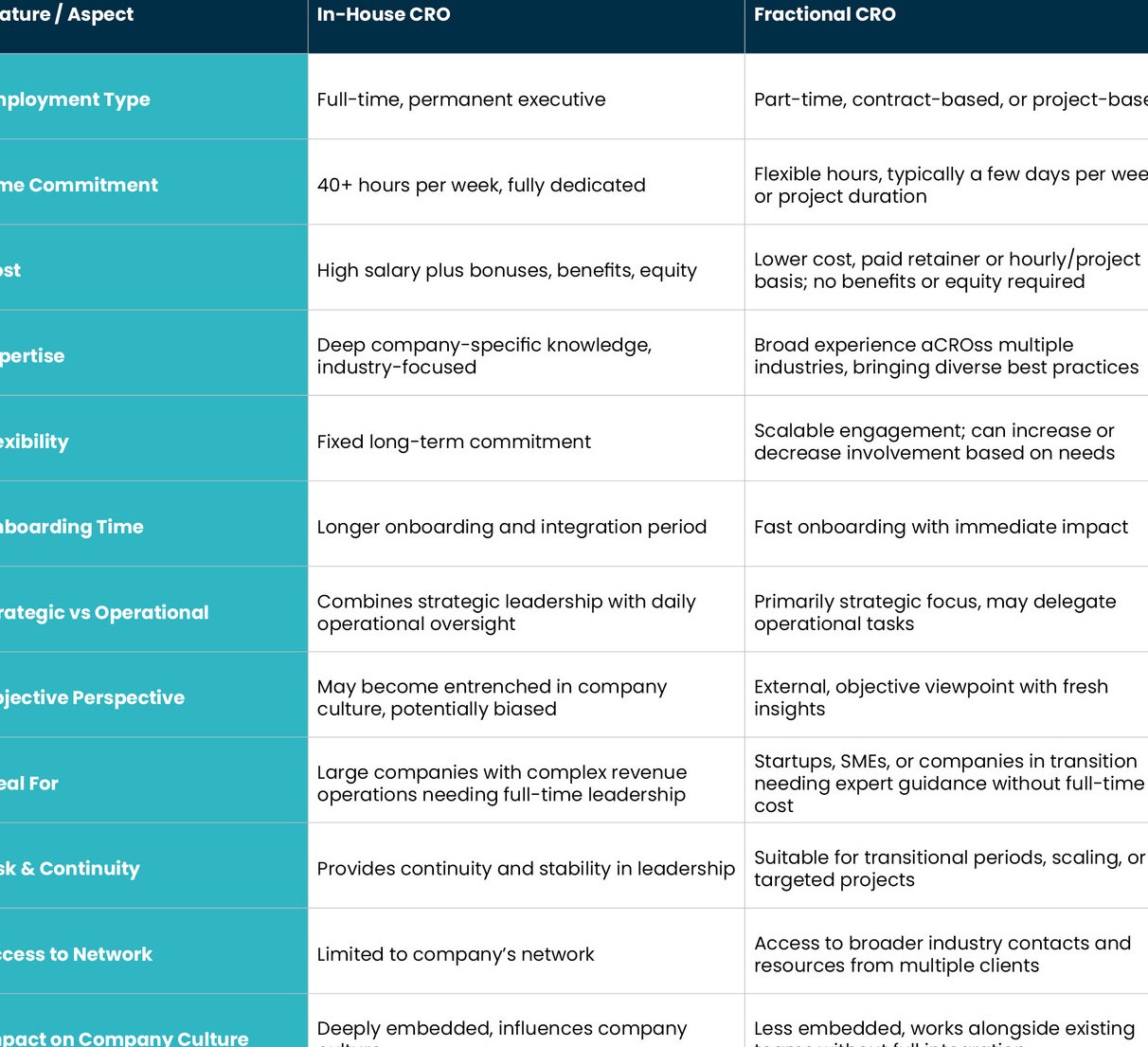
Confusing the VP of Sales and CRO scopes. A fractional VP of Sales owns the sales function: pipeline management, forecasting, rep coaching, deal strategy, CRM discipline, and the closing motion. The work is tactical and process-oriented, and the right hire leaves behind a repeatable system you can staff. A fractional CRO owns the entire revenue engine: sales plus marketing alignment, customer success and retention, pricing, and cross-funnel go-to-market strategy. That scope is strategic and commands the top of the fee range. Below roughly $1M ARR with the founder still closing, you almost certainly need the VP. North of about $2M with a small team and a broken marketing-to-sales handoff, the CRO scope starts to earn its keep. Be skeptical of anyone who claims to do both equally well at one rate — genuine specialists will tell you honestly which bucket they belong in, and that honesty is itself a hiring signal.
Hiring before the infrastructure exists. If your CRM is a mess and you have no call recording, the first six weeks of an expensive engagement get spent on data janitorial work at senior-operator rates. Before day one, have a functioning CRM — Salesforce or HubSpot — with data clean enough to trust, a call-recording platform such as Gong or Chorus so the leader can hear real customer conversations without sitting in every call, and a dedicated Slack channel. If you genuinely cannot get there first, scope the first two weeks explicitly as a cleanup sprint and price it as such, so nobody is surprised.
Expecting instant availability. The most common way a remote fractional engagement sours is a founder who pings at 7 p.m. expecting a reply from someone explicitly working part-time across several clients. Agree on response-time expectations in writing: same-day on the shared channel during business days, immediate only for a defined list of escalations like a deal at risk above a certain value. The one-hour Mountain-to-Pacific gap is trivial to manage when both sides write things down; it becomes a grievance when expectations were never set.

Hiring someone who cannot say no. A fractional VP who agrees to every target and timeline you float is dangerous. The good ones push back on unrealistic pipeline goals, under-resourced marketing, and broken comp plans, because part of what you are paying for is protection from your own optimism. Test this deliberately in the interview: propose a number you know is aggressive and watch whether they interrogate it or nod.
Skipping the paid discovery sprint. Going straight to a multi-month retainer on the strength of a good conversation is the single most expensive mistake available here. A two-week paid audit costs a fraction of a quarter and tells you nearly everything.
The selection checklist that separates real operators from resume decoration
Vet a fractional leader more rigorously than a full-time hire, not less, precisely because you have less runway to correct a mismatch. Run these five checks in order.
Ask for a thirty-day plan rather than a resume. A strong fractional VP will send a concise one-page document within a day or two of your first substantive conversation: their pipeline audit approach, a CRM cleanup plan, and a proposed meeting cadence. Inability to produce that quickly signals they are not organized enough for the compressed nature of fractional work, where structure has to land in week one.
Probe CRM and RevOps fluency directly on the first call. Ask how they structure pipeline stages, how they define lead source attribution, how they set forecast categories, and what specifically makes an opportunity qualified versus interested. Someone experienced articulates a clean process from memory without ever touching your instance. Someone who cannot is borrowing frameworks they have never operated. Ask what they would want reported weekly and why — the answer reveals whether they think in systems or in anecdotes.

Demand a reference from an engagement they ran remotely, and ask that reference one pointed question: did this person document decisions and deals in writing, or did everything live inside calls and evaporate afterward? Remote leadership succeeds on written, async-first discipline. That single question separates a true remote operator from someone who needs to be in the room to be effective.
Test their willingness to push back, as described above, and listen for whether they diagnose before prescribing. A candidate who tells you exactly what is wrong with your business before reviewing any of your data is pattern-matching to their last client, not to you.
Run a paid two-week discovery sprint before any retainer. In it, they review your CRM, interview your top one or two reps, listen to a handful of recorded calls or demos, and deliver a written assessment with specific, prioritized, actionable findings. Judge the output, not the interview: is it specific to your business or generic? Does it prioritize, or is it a list of twenty things? Is it honest about what is broken, including things you did not want to hear? If they cannot surface real insight in two weeks, they will not create value in two months, and you have spent a small bounded amount to learn that instead of burning a quarter.
Once you sign, make the remote engagement work by design. Set a standing weekly ninety-minute video block, protected on both calendars, as the spine of the relationship — pipeline review and decisions, nothing else. Run everything around it asynchronously: recorded deal reviews, call analysis from your conversation-intelligence tool, and the shared channel for daily nudges. Agree up front on what success looks like at ninety days, in specific terms — a documented qualification framework, forecast accuracy within a stated band, a defined number of coaching sessions per rep — so the three-month review is a measurement rather than an argument.
Related questions
Can a fractional VP of Sales work if I am in New Mexico and they are in Denver?
Yes, and it is the common case. Denver is the same time zone, so there is no gap at all. With async-first communication and a standing weekly video call, the arrangement is easily managed. Denver, Salt Lake City, Austin, and Phoenix are frequent bases for Mountain-friendly fractional revenue leaders serving remote clients.
How long does it take to find a qualified candidate?

Roughly two to four weeks if you source through national networks and move decisively, with five to eight screening conversations producing two serious trial candidates. Insisting on a resident New Mexico candidate can stretch that indefinitely, because the local pool may not contain a stage-appropriate match at all.
Should I hire fractional or wait for a full-time VP?
If you are below about $2M ARR, still founder-led in selling, and not ready to carry a senior salary plus equity and severance risk, fractional is usually the better first step. It buys process and coaching at lower commitment and can bridge you toward a full-time hire later.
Do I need to offer equity?
Usually not. Most fractional leaders are cash-only because they run several clients simultaneously. If you want equity to align incentives, keep the grant small, vested, and cliffed, and treat it as a supplement to cash rather than a substitute that lets you underpay for senior time.
What if I genuinely need someone on the ground in Albuquerque?
Buy it as an explicit monthly travel line — one or two days on site for QBRs, team sessions, or key customer meetings — rather than as a residency requirement. You will get a far stronger operator for the same total spend than by restricting the search to residents.
FAQ
Where is the best place to post a fractional VP of Sales role?
National, remote-first revenue communities such as Pavilion and RevOps Co-op, plus fractional and CRO collectives, reach vetted operators who lead revenue for a living. Run warm introductions from investors and founder peers in parallel on the same day — those often surface the strongest, already-booked candidates faster than any public post.

Why can't I just hire someone local in Albuquerque or Santa Fe?
You can try, but New Mexico's economy centers on federal contracting, the national labs, energy, and hospitality rather than high-growth SaaS, so the pool of leaders with recent subscription-revenue scaling experience is thin. A remote leader with a broader pattern library is usually both the stronger hire and the faster one to find.
How should I think about budget?
Price on days per month first — ten versus twenty days is roughly a 2x swing, and most early companies are well served by eight to ten focused days. Then adjust for stage complexity, any equity component, and travel, which should be quoted as a separate line rather than bundled into the retainer.
What tools should be in place before they start?
A working CRM such as Salesforce or HubSpot with reasonably clean data, a call-recording platform such as Gong or Chorus, and a dedicated Slack channel. Having these ready keeps the expensive first weeks focused on strategy and coaching rather than on data cleanup at senior-operator rates.
How do I protect myself from a bad fit?
Run a paid two-week discovery sprint before committing to any retainer, and judge the specificity, prioritization, and honesty of the written assessment it produces. Then require a three-month minimum, since meaningful pipeline and coaching results take roughly ninety to one hundred twenty days to appear.
Is a fractional VP of Sales the same as a fractional CRO?
No. A VP of Sales owns pipeline, forecasting, coaching, CRM discipline, and closing. A CRO owns the full revenue engine including marketing alignment, customer success, and pricing. Match the scope to your ARR and to your actual bottleneck, and be wary of anyone claiming to do both equally well at a single rate.
Sources
- Pavilion
- RevOps Co-op
- Harvard Business Review
- First Round Review
- SaaStr
- Gong
- HubSpot Sales Hub
- U.S. Bureau of Labor Statistics — New Mexico
- Sandia National Laboratories
Related on PULSE
- Where do I find a fractional VP of Sales in New Jersey?
- Where do I find a fractional CRO in New Mexico in 2027?
- Where do I find a fractional VP of Sales in Kansas?
- Where do I find a fractional VP of Sales in Arkansas?
- Where do I find a fractional VP of Sales in Wyoming?
- Where do I find a fractional VP of Sales in Maine?
This page will be disappearing soon. Save it to your device for $1 — or read it free while it is here.
@Kory-White- · if Venmo asks, the last 4 of my number are 2012
This page is gone.
This one is off the shelf now. $1 keeps it on your phone for good — the whole page, pictures and diagrams included.
 pulse-toolsWhere do I find a fractional CRO in Ohio in 2027?
 pulse-toolsHow do I hire a fractional VP of Sales in Ogden in 2027?
 pulse-toolsIs there a fractional Chief Revenue Officer available near me in Houston in 2027?
 pulse-toolsWhere do I find a fractional CRO in North Dakota in 2027?
 pulse-toolsDo I Need a Fractional CRO for My Franchise in 2027?
 pulse-toolsShould I Hire a Fractional CRO If I Need to Build a Partner Channel in 2027?
 pulse-toolsHow do I hire a fractional CRO for an e-commerce business in 2027?
 pulse-toolsHow do I evaluate a fractional Chief Revenue Officer in Chicago in 2027?
 pulse-toolsHow do I hire a fractional CRO in Phoenix in 2027?
 pulse-toolsShould I Hire a Fractional CRO If I Need to Rebuild Trust After a Failed CRO in 2027?