
How much does a fractional CRO cost for a real estate company in 2027?
 Curated byKory White · Fractional CRO · Maryland
 PULSEKNOWLEDGE LIBRARY
Quality
Certified

For a real estate company in 2027, a fractional CRO typically costs $6,000 to $18,000 per month on a retainer, or $150 to $400 per hour for lighter engagements. Annualized, most firms budget $80,000 to $200,000, well below the $300,000-plus total compensation a full-time CRO commands. Final pricing depends on scope, market, and whether equity is included.
This vs. the common alternatives
A real estate company weighing revenue leadership options in 2027 usually compares four paths: a fractional CRO, a full-time CRO, a RevOps consultant, and a sales coach or agency. Each carries a different cost curve, commitment level, and failure mode, and choosing the wrong one is the most common way brokerages, proptech firms, and iBuying operations burn six figures without fixing the underlying revenue problem.
A full-time CRO is the most expensive and the slowest to land. Base salary for a CRO at a mid-market real estate company generally runs $220,000 to $320,000, with total compensation including bonus and equity reaching $350,000 to $500,000 or more. Add benefits, payroll taxes, and a 3-to-6-month search, and the true first-year cost can exceed $450,000. That is justified only when the company has a large, stable revenue team (typically 20-plus quota carriers) and enough complexity to keep a senior leader busy full time. For a 40-agent brokerage or a Series A proptech with eight sellers, that spend is hard to defend to a board.
A RevOps consultant is the cheapest but narrowest option. Rates run $100 to $250 per hour, and engagements usually focus on CRM architecture, data hygiene, forecasting models, and compensation design. The consultant fixes the plumbing but does not own the number. If the problem is that nobody is accountable for pipeline coverage, a RevOps consultant will document the gap and leave.

A sales coach or agency sits in the middle on price but often misses on context. Coaches typically charge $2,000 to $8,000 per month, and agencies working on lead generation or outbound can run $5,000 to $25,000 per month plus ad spend. These work well when the go-to-market motion is already proven and the team just needs reps or volume. They fail when the issue is structural — wrong ICP, broken handoffs between marketing and sales, or a listing pipeline that does not convert.
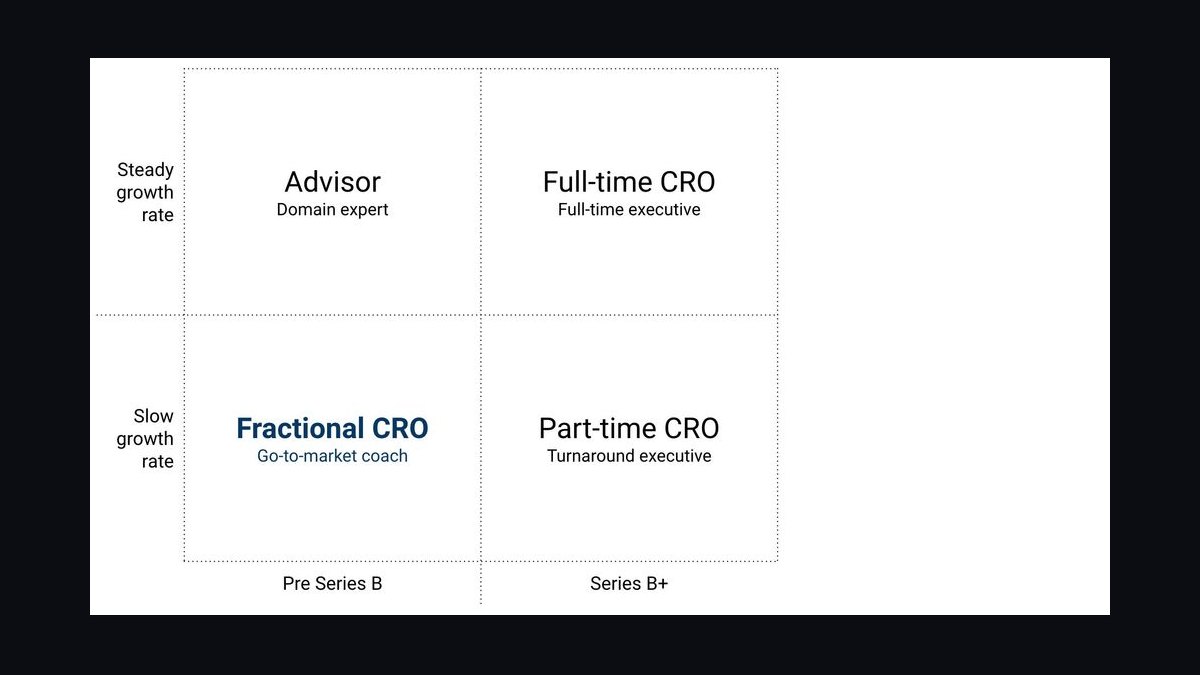
The fractional CRO occupies the gap between consultant and full-time hire. A fractional CRO owns the revenue number across marketing, sales, and customer success, but works 10 to 30 hours per week on a retainer. For a real estate company, this matters because revenue leadership in the sector requires specific fluency: 12-month lease cycles, seasonal Q4 slowdowns, listing-to-closing ratios, agent retention economics, and the difference between transactional brokerage revenue and recurring property management fees. A generalist SaaS fractional CRO will spend the first 90 days learning your business on your dime.
The decision usually comes down to three questions. First, is the revenue problem strategic or operational? Strategic problems — market positioning, pricing model, channel mix — need a CRO. Operational problems — CRM hygiene, reporting, sequence execution — need RevOps. Second, is there enough work to fill 30-plus hours a week? If yes, hire full time. If the work is real but intermittent, fractional wins. Third, does the company need someone to own the number, or someone to advise the person who owns it? Fractional CROs own it; consultants advise.

A practical middle path many real estate companies use in 2027: hire a fractional CRO for 20 hours per week at $10,000 to $14,000 per month, and pair that with a part-time RevOps contractor at $3,000 to $5,000 per month. Total monthly spend of $13,000 to $19,000 buys revenue leadership plus execution capacity, still less than half the fully loaded cost of a full-time CRO.
How to choose between them
The choice between fractional, full-time, and consultant models is not primarily about budget. It is about the shape of the problem, the timeline to impact, and whether the company can absorb a senior leader's full attention. A firm that hires a full-time CRO when the real need was 15 hours a week of strategic direction will overpay by $200,000 or more in year one. A firm that hires a consultant when nobody owns the number will get a beautiful deck and no revenue change.
Start by mapping the revenue gap. If the company is missing plan by more than 20 percent and leadership cannot articulate why, the problem is strategic and a fractional CRO is the right first hire. If leadership knows exactly why — pipeline coverage is thin, conversion dropped, churn spiked — and the fix is execution, a RevOps consultant or a sales manager is cheaper and faster.
Next, assess internal capacity. A fractional CRO needs a counterpart inside the company: usually a VP of Sales, a Head of Marketing, or a founder who still runs revenue. If no such person exists, the fractional CRO will spend most of their hours doing rather than leading, and the retainer will feel expensive for what it delivers. In that case, either hire a full-time leader or expand the fractional scope and budget accordingly.
Then evaluate the market. In dense proptech and brokerage hubs — New York, San Francisco, Austin, Miami, Dallas — fractional CRO supply is deeper and pricing is more competitive. In smaller markets, candidates are more likely to work remotely, and rates may actually be higher because the local supply is thin. Remote fractional work is now standard, so geography affects price less than it did five years ago, but it still affects how quickly a candidate can be on-site for agent meetings, listing presentations, or board reviews.
Finally, pressure-test the candidate against real estate specifics. Ask them to walk through how they would forecast a pipeline built on 12-month lease cycles with a 30 percent close rate and a seasonal Q4 slowdown. Ask how they would set quotas for a brokerage where agent productivity varies 5x between top producers and the long tail. Ask what metrics they would put on the Monday dashboard for a property management company versus a listings-led brokerage. A candidate who answers fluently has done the work. A candidate who pivots to generic SaaS funnel language has not.
The flow above is deliberately blunt. Most real estate companies that get this wrong skip the first question and jump straight to "we need a CRO." The result is a search that takes four months, costs $30,000 in recruiter fees, and ends with a full-time hire who is overqualified for the actual workload. Running the two-question filter first saves that cycle.
One more consideration: the fractional model works best when the company is willing to give the fractional CRO real authority. If the fractional CRO cannot hire, fire, set quotas, or change the comp plan, they are a consultant with a bigger title. Before signing, agree in writing on decision rights: what the fractional CRO owns outright, what they recommend, and what requires founder or board approval. This single step prevents most of the friction that kills fractional engagements in months three and four.
Costs, timelines, and expected impact
Pricing for a fractional CRO in 2027 breaks into four common structures, and real estate companies see all four.
Monthly retainer, fixed scope. The most common structure. $6,000 to $18,000 per month for 10 to 30 hours per week. A 10-hour-per-week strategic engagement at a mid-size brokerage typically lands at $6,000 to $9,000 per month. A 20-to-25-hour engagement with hands-on pipeline management, hiring support, and board reporting runs $10,000 to $15,000. A near-full-time fractional engagement at 30-plus hours per week can reach $16,000 to $18,000 per month.
Hourly. $150 to $400 per hour. Hourly works for diagnostics, one-off forecasting projects, or a short 30-day assessment before committing to a retainer. It is a poor fit for ongoing leadership because the meter creates perverse incentives — the fractional CRO is penalized for delegating and rewarded for doing everything themselves.
Base plus performance bonus. Some fractional CROs will take a lower retainer, $5,000 to $9,000 per month, in exchange for a bonus tied to revenue outcomes: 5 to 15 percent of incremental revenue above a baseline, or a fixed bonus of $20,000 to $60,000 if the company hits plan. This aligns incentives but requires a clean baseline and a measurement system the company trusts. If the CRM data is unreliable, performance bonuses become arguments.
Cash plus equity. Equity of 0.25 percent to 2 percent of common stock can reduce the cash retainer by 20 to 40 percent. Real estate companies should only offer equity when the fractional CRO is committing to 12 months or more and the company has a credible path to a liquidity event or a defined valuation. Equity for a 90-day engagement is a waste of cap table.
Beyond the retainer, budget for these line items. A CRM cleanup or migration, $5,000 to $30,000 depending on data volume and stack. Sales enablement and training content, $3,000 to $15,000. Compensation plan redesign, often $8,000 to $20,000 if done with benchmarking data. A part-time SDR or sales admin to execute what the fractional CRO designs, $2,500 to $5,000 per month. Total first-year all-in spend for a fractional CRO engagement at a real estate company usually lands between $110,000 and $260,000, versus $400,000-plus for a full-time CRO with the same supporting costs.
Timelines matter as much as price. Expect the following pattern. Weeks 1 to 2: diagnostic. The fractional CRO interviews the team, reviews CRM data, reads win-loss notes, and audits the funnel. Weeks 3 to 4: findings and plan. A written revenue plan with the top three constraints and a 90-day action list. Months 2 to 3: first changes. Territory or quota adjustments, pipeline stage definitions, a weekly forecast cadence, and often one or two personnel decisions. Months 4 to 6: measurable impact. Pipeline coverage improves, forecast accuracy tightens, and the company can see whether the model is working. Months 7 to 12: scale or convert. Either the fractional CRO moves to full time, the engagement extends at the same scope, or the company hires a full-time leader and the fractional CRO helps with the transition.
Expected impact depends heavily on starting conditions. A real estate company with no forecast discipline often sees forecast accuracy improve from plus-or-minus 40 percent to within 15 percent in two quarters. Pipeline coverage ratios typically move from under 2x to 3x or better within six months once stage definitions and exit criteria are enforced. Win rates improve 3 to 8 percentage points when the fractional CRO tightens ICP definition and disqualifies poor-fit deals earlier. These are directional benchmarks, not guarantees — the actual result depends on market conditions, team quality, and how much authority the fractional CRO is given.
What a fractional CRO will not do: replace a missing sales team, fix a broken product-market fit, or generate demand without marketing investment. Companies that hire a fractional CRO expecting lead volume will be disappointed. The role is revenue leadership, not revenue generation.

One cost trap to avoid: scope creep without a rate adjustment. Fractional engagements often start at 15 hours per week and quietly expand to 30 as the company piles on requests. Build a scope review into the contract at 90 days, with a defined rate for additional hours. Otherwise the effective hourly rate drops and the fractional CRO disengages or exits.
Implementation and handoff details
Getting a fractional CRO engagement to produce results requires more operational discipline than most real estate companies expect. The first 30 days set the trajectory, and the handoff at the end determines whether the gains stick.
Before the start date. Clean up access. The fractional CRO needs read and write access to the CRM, the marketing automation platform, the BI or reporting layer, and the call recording tool if one exists. Missing access in week one costs a week of diagnostic time. Also prepare a data room: historical revenue by month for 24 months, pipeline by stage for the last four quarters, win-loss reasons, comp plans, org chart, and any board or investor decks that describe the revenue strategy. A company that cannot produce these documents has just identified its first problem.
Weeks 1 to 4: diagnostic and baseline. The fractional CRO should produce a written baseline document that states current revenue, pipeline coverage, conversion rates by stage, average deal size, sales cycle length, and rep-level productivity distribution. For a real estate company, this baseline must be segmented correctly: listings versus buyer-side, lease versus sale, new development versus resale, or property management versus brokerage. Aggregating these into one number hides the actual problem.
Weeks 5 to 8: plan and first changes. The revenue plan should name no more than three constraints and assign an owner and a deadline to each. Common first changes include redefining pipeline stages with explicit exit criteria, introducing a weekly forecast call with a standard template, adjusting quotas to reflect territory potential rather than historical performance, and pausing or restructuring an underperforming channel.
Months 3 to 6: cadence and accountability. The fractional CRO runs the revenue operating cadence: weekly pipeline review, monthly business review, quarterly plan refresh. This is where most of the value is created, because it is the first time the company has a consistent rhythm for inspecting and adjusting the revenue engine.
Months 6 to 12: handoff or conversion. If the company hires a full-time CRO or promotes an internal leader, the fractional CRO should run a structured handoff: documented processes, a live transition of key relationships, and a 60-day overlap where both are involved. Skipping the overlap is the most common reason gains evaporate after the fractional engagement ends.
Two handoff details matter more than the rest. First, document the operating cadence, not just the strategy. A new leader inheriting a strategy deck will reinvent the meeting structure; a new leader inheriting a documented weekly forecast template and a stage-definition guide will keep the machine running. Second, transfer relationships deliberately. In real estate, revenue depends on relationships with top agents, developers, lenders, and referral partners. The fractional CRO should introduce their successor to each of these contacts in person or on a call, not over email.
Finally, set the exit criteria at the start. A well-run fractional engagement has a defined end state: either the company is ready for a full-time leader, or the fractional CRO has become permanent at a reduced scope, or the engagement concludes because the problem is solved. Engagements that drift for years without a defined end state tend to lose momentum and become expensive maintenance.
Related questions
Does a fractional CRO cost less than a full-time CRO in total?
Yes, usually by 50 to 70 percent in year one. A full-time CRO at a real estate company costs $350,000 to $500,000 fully loaded. A fractional engagement at 20 hours per week typically runs $120,000 to $180,000 annually before supporting costs, though the company also absorbs CRM and enablement spend either way.
Can a fractional CRO work for a small brokerage under 20 agents?
Yes, but scope should stay narrow. At that size, a 10-hour-per-week engagement at $6,000 to $9,000 per month focused on pricing, ICP, and pipeline discipline is usually enough. Hiring full time at that scale is rarely justified.
Do fractional CROs in real estate require equity?
Most do not require it, but many will accept equity in place of 20 to 40 percent of cash. Equity only makes sense if the engagement is 12 months or longer and the company has a credible valuation path.
How long does a typical fractional CRO engagement last?
Six to 18 months is the common range. A diagnostic-only engagement can be 30 to 60 days. A full transformation with handoff typically runs 12 to 18 months before converting to a full-time hire or ending.
What is the biggest cost mistake real estate companies make?
Hiring a fractional CRO without decision rights. If the fractional CRO cannot change quotas, comp, or personnel, the engagement becomes advisory and the company pays leadership rates for consultant output.
FAQ
How much does a fractional CRO cost per hour in 2027? Hourly rates typically range from $150 to $400, with most real estate engagements landing between $200 and $300 per hour. Hourly is best for diagnostics and short projects; ongoing leadership is almost always priced as a monthly retainer.
Is a fractional CRO cheaper than a RevOps consultant? No, a fractional CRO is more expensive per hour and per month. RevOps consultants run $100 to $250 per hour and focus on systems and data. A fractional CRO costs more because they own the revenue number across marketing, sales, and customer success.
What does a fractional CRO do in the first 90 days? They run a diagnostic, build a revenue baseline segmented by real estate product line, produce a plan with three named constraints, and implement the first changes: stage definitions, forecast cadence, and quota or territory adjustments.
Can a fractional CRO help a real estate company raise capital? Indirectly. A fractional CRO who tightens forecasting and pipeline reporting makes the revenue story more credible to investors, but fundraising is not the core deliverable and should not be the primary reason to hire one.
How do I measure whether the fractional CRO is worth the cost? Track four numbers: forecast accuracy, pipeline coverage ratio, win rate by segment, and revenue per rep. If those four improve within two quarters, the engagement is working. If they are flat at month six, re-diagnose.
Should I hire a fractional CRO or a full-time CRO for a proptech company? If the company has fewer than 15 quota carriers or the revenue problem is strategic and intermittent, start fractional. Move to full time when the workload consistently exceeds 30 hours per week and the company can support a senior leader's full compensation.
Sources
- Sales Management Association — Sales Force Compensation and Cost Benchmarks
- Harvard Business Review — Why Sales Leaders Fail
- Gartner — Sales Execution and Revenue Operations Research
- Pavilion — Revenue Leadership Community and Compensation Data
- RevOps Co-op — Revenue Operations Resources
- U.S. Bureau of Labor Statistics — Sales Managers Occupational Outlook
- National Association of Realtors — Industry Statistics and Research
- McKinsey & Company — B2B Sales and Revenue Growth Insights
Related on PULSE
- How to build a revenue operating cadence for a brokerage
- Fractional vs. interim revenue leadership: which fits your stage
- Designing comp plans for real estate agents and proptech sellers
- RevOps metrics every real estate company should track weekly
- When to convert a fractional CRO into a full-time hire
- Pipeline forecasting for long-cycle real estate sales
This page will be disappearing soon. Save it to your device for $1 — or read it free while it is here.
@Kory-White- · if Venmo asks, the last 4 of my number are 2012
 pulse-toolsHow does a fractional CRO build pipeline for a B2B SaaS company in 2027?
 pulse-toolsWhat KPIs should a fractional CRO own at a dev tools company in 2027?
 pulse-toolsShould I Hire a Fractional CRO If I Need to Build My First Sales Playbook in 2027?
 pulse-toolsWhat does a fractional CRO cost in Delmar in 2027?
 pulse-toolsHow do I evaluate a fractional CRO in Tulsa in 2027?
 pulse-toolsDo I Need a Fractional CRO for My Roofing Company in 2027?
 pulse-toolsShould I Hire a Fractional CRO If I Am a PE Operating Partner Standardizing a Portfolio Company in 2027?
 pulse-toolsShould I hire a fractional CRO in Snow Hill in 2027?
 pulse-toolsIs there a fractional CRO available near me in the Gulf Coast in 2027?
 pulse-toolsShould I hire a fractional CRO in Stanton in 2027?