
Where do I find a fractional head of revenue in North Carolina in 2027?
 Curated byKory White · Fractional CRO · Maryland
 PULSEKNOWLEDGE LIBRARY
Quality
Certified

Source fractional revenue leaders in North Carolina through revenue-executive communities (Pavilion, RevOps Co-op), targeted LinkedIn searches, fractional-executive marketplaces, and referrals from local VCs, accelerators, and Triangle or Charlotte founder networks. Local supply is thin, so most engagements run remote or hybrid with monthly on-site visits. Budget a monthly retainer for five to ten days.
What a fractional head of revenue actually is, and what it is not
The title "fractional head of revenue" gets stretched to cover four different jobs, and the confusion is the single biggest reason these engagements fail in the first sixty days. Get precise about which one you are buying before you post anything anywhere.
A fractional CRO owns the revenue number. They sit in leadership meetings, set quota and territory design, run the forecast, manage sellers directly or through a manager, and carry accountability when the quarter misses. They will ask for your P&L, your CAC payback math, your churn cohort data, and your board deck. If you are not prepared to hand those over, you are not buying this.
A fractional VP of Sales is narrower. They own the sellers, the pipeline, and the process, but not marketing, not customer success, not pricing. For a company between roughly $1M and $5M in ARR with two to five reps and no revenue leader, this is usually the correct hire, and it is cheaper than a CRO because the surface area is smaller.

A sales consultant or advisor gives you a diagnosis and a recommendation, then leaves. They do not own execution. Two days a month, a written playbook, a few coaching calls. Useful when you already have a competent sales manager who needs a sounding board, and actively harmful when what you actually needed was someone to fire an underperforming rep.
A RevOps contractor is a different animal entirely. They fix your Salesforce or HubSpot instance, build the reporting layer, clean the data, wire the routing rules, and stand up forecast hygiene. They do not manage people and do not carry a number. Many North Carolina companies think they need a fractional head of revenue when the real problem is that nobody can trust the pipeline report, which is a RevOps problem with a much smaller price tag.
There is a fifth category worth naming because it shows up constantly in the Carolina market: the interim executive. This is a full-time-equivalent person filling a seat for three to six months while you run a permanent search, usually after a sudden departure. Interim is not fractional. It costs close to full-time and it exists to hold the line, not to build something new.
Write down which of these five you are hiring, in one sentence, before you talk to anyone. The single-sentence brief is the artifact that makes the entire search work — it filters candidates, it sets the retainer, and it tells you at day ninety whether the engagement succeeded.

This versus the common alternatives
Every company weighing a fractional revenue leader is really weighing it against three or four other uses of the same money. Lay them side by side honestly.
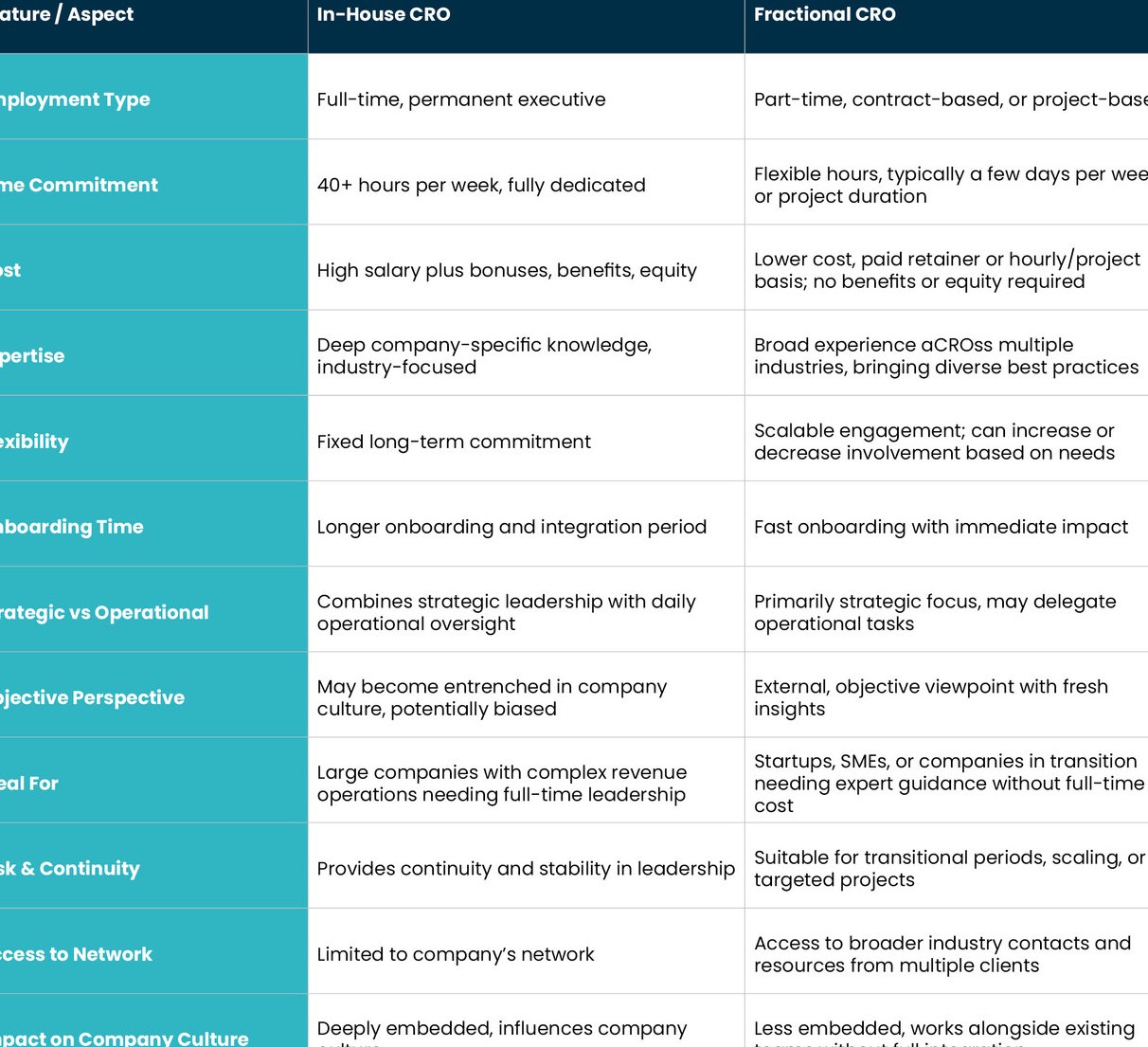
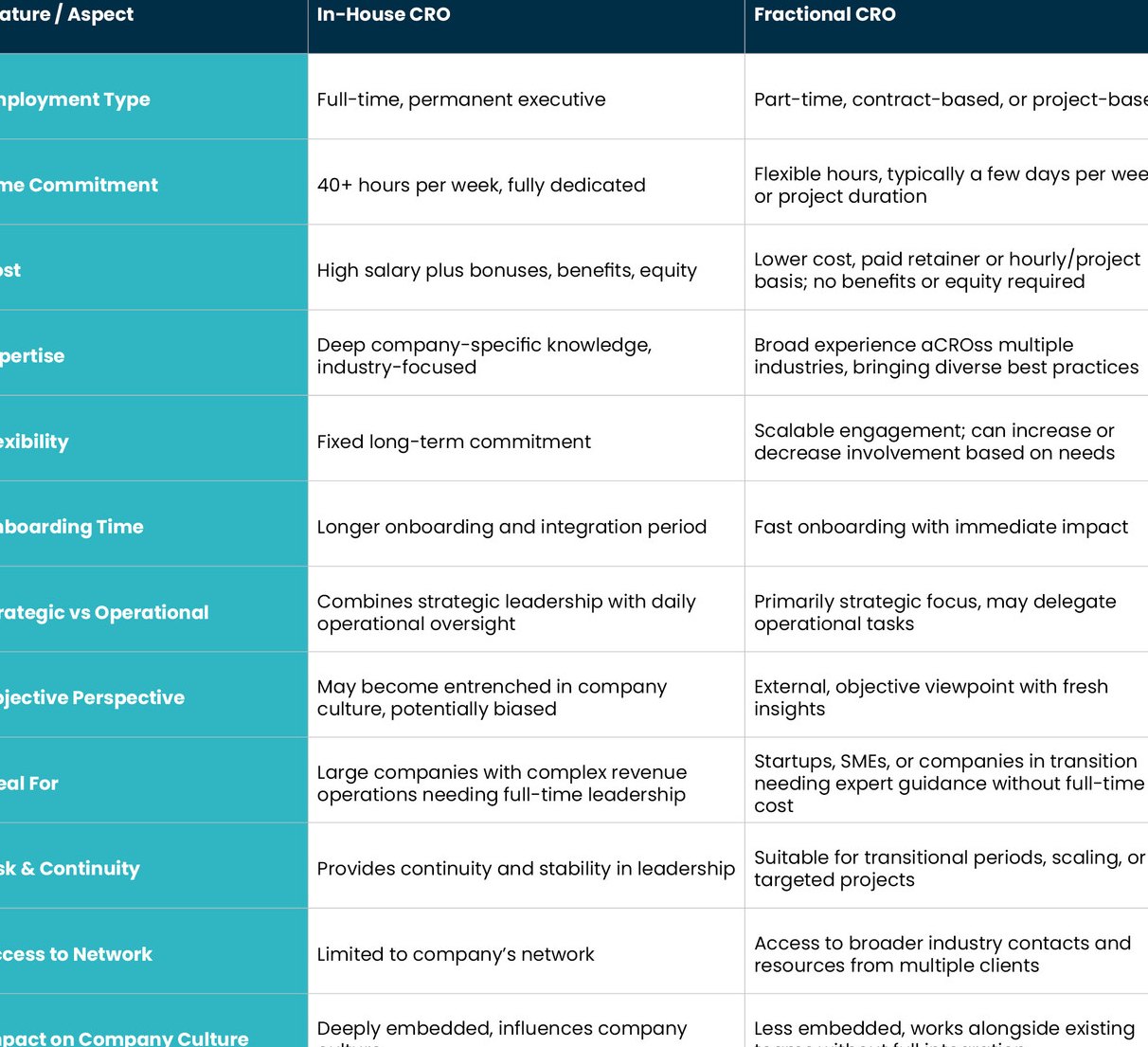
Against a full-time VP of Sales. The full-time hire gives you a person whose entire attention belongs to you, who is in every Slack thread, who builds culture with the team over months. The cost is not just base salary — it is base plus variable, plus benefits, plus payroll taxes, plus equity dilution, plus the recruiting fee if you use a search firm, plus the three-to-five-month search timeline, plus the very real risk of a bad hire that you discover at month seven and unwind at month nine. Sales leadership has notoriously high early-tenure turnover. A fractional engagement compresses the decision: you learn in thirty days whether this person's judgment is any good, and the exit is a contract clause rather than a severance negotiation. The trade-off is attention. Someone working five days a month is not going to notice that your best AE has quietly checked out.
Against promoting your top rep. Tempting, cheap, and usually a mistake at the exact moment you most want to do it. The skills that make someone close deals — personal charisma, working a room, tolerance for rejection — overlap only partially with the skills that make someone build a forecast, design compensation, and manage out a friend. A common and much better structure: promote the rep to a player-coach title and bring in a fractional leader for six months explicitly to train them. You get the loyalty and product knowledge of the internal person plus the pattern recognition of the outside executive, and the fractional cost is now doubling as a leadership-development budget.

Against a sales agency or outsourced SDR shop. Agencies sell activity — meetings booked, emails sent, dials made. They can genuinely work when your problem is top-of-funnel volume and your close motion is already proven. They do not work when the problem is that your ICP is wrong, your pricing is wrong, or your demo does not land, because an agency has no mandate and no ability to change any of those. Founders in the Triangle burn money on outsourced SDRs every year trying to solve a positioning problem with more dials.
Against a RevOps hire or contractor. If your honest complaint is "I don't know what's in the pipeline," "our forecast is always wrong," or "the CRM is a graveyard," start here, not with a revenue leader. A capable RevOps person, full-time or contract, can rebuild the data foundation in six to ten weeks. Hiring an expensive fractional CRO to discover that your data is unusable means paying executive rates for cleanup work.
Against doing nothing for another two quarters. Sometimes correct. If you are pre-product-market-fit and the founder is still the best salesperson in the building, a fractional revenue leader will produce process where you needed discovery. The signal that you are ready: the founder can point to five to ten closed deals that look alike, and the constraint has shifted from "will anyone buy" to "can someone other than me sell it."

Against a fractional CMO. Some companies present with a revenue problem that is actually a demand problem — the sellers convert well but there is not enough at the top. If your win rate on qualified opportunities is healthy and volume is the constraint, a fractional marketing leader may be the higher-leverage spend.
How to choose between them, and how to run the search
Start from the symptom, not from the title. Below is the decision path most North Carolina founders should walk, followed by the mechanics of actually finding the person.
Once you know the shape, run the search in parallel across five channels rather than sequentially through one.
Revenue-executive communities. Pavilion is the largest membership organization for revenue leaders and has an active job board plus member directory; many members explicitly list fractional availability. RevOps Co-op skews toward operations talent and is the better channel if the role leans systems and forecasting. Both work best when you post the one-sentence brief plus a short scope document rather than a generic job description.

LinkedIn, used properly. The naive search for "fractional CRO" returns mostly people marketing themselves as one. Better approach: search for VP of Sales and CRO titles at companies in your ARR band and industry that were acquired or wound down in the last eighteen months. Those executives are frequently between roles and open to fractional work, and they have not yet built a personal brand around the word "fractional." Filter by the Raleigh-Durham, Charlotte, and Greensboro metro areas, then widen to remote.
Investors and lenders. If you have raised, your investors keep informal bench lists. North Carolina has an active early-stage ecosystem — regional venture funds, angel groups, and the state's economic development network all maintain founder and operator networks. Ask your lead investor directly: "who have you seen do this well at our stage?" This is the highest-signal channel because the referrer has watched the person work.
Accelerators and university-linked programs. The Triangle's research-university density means there are structured entrepreneurship programs, incubators, and mentor networks around Raleigh, Durham, and Chapel Hill, plus a separate fintech-oriented network in Charlotte. Mentors in these programs are often the exact profile you want and are already predisposed to part-time engagements.

Fractional-executive marketplaces and boutique firms. Several firms specialize in placing fractional revenue leaders and pre-vet candidates. They cost more — typically a markup or placement fee — but they compress the search from weeks to days and usually offer a replacement guarantee. Worth it when the seat is urgent.
Two Carolina-specific realities to plan around. First, the local pool of people who do this full-time is genuinely small compared to Austin, Boston, or the Bay Area, so plan on a remote or hybrid arrangement with one or two on-site days a month; write the travel expectation into the contract rather than assuming it. Second, the state's industry mix skews toward banking and fintech in Charlotte, life sciences, biotech, and enterprise software in the Triangle, and manufacturing and logistics in the Piedmont Triad — domain fit matters more here than in a generic SaaS market, because a leader who has only sold horizontal software will struggle to run a sale into a hospital system or a contract manufacturer.
Costs, timelines, and what impact to expect
Pricing for fractional revenue leadership is negotiated, not listed, and anyone quoting you a single national number is guessing. What you can reason about reliably are the variables that move the price and the structures the market actually uses.
The four cost drivers. Days per month is the dominant one — five days a month is roughly the floor for anything beyond advisory, eight to twelve is typical for a leader who is genuinely running the function. Scope is second: strategy-and-coaching costs materially less than a mandate that includes hiring, firing, carrying a number, and joining customer calls. Company stage is third, because a growth-stage overhaul demands more senior pattern recognition than an early-stage first-process build. Geography is fourth and weakest — most fractional executives price to a national market, so a Carolina-based leader is not dramatically cheaper than a coastal one, and pursuing that discount is not worth narrowing your candidate pool.

The structures you will actually be offered. A flat monthly retainer for a defined day count is the most common and the easiest to manage. A day-rate arrangement with a monthly minimum gives flexibility during a lumpy quarter but invites scope disputes. A retainer plus a performance component tied to pipeline or bookings sounds attractive and mostly is not, because attribution over a three-month window is nearly impossible to agree on and the argument poisons the relationship. Equity in lieu of part of the cash fee occasionally makes sense at pre-revenue stage where the executive is genuinely taking risk; it rarely makes sense once you have real revenue, and issuing equity for a six-month engagement creates a cap-table artifact you will explain to every future investor.
Budget the surrounding costs too. The retainer is not the whole number. Add travel for on-site days, a seat license in your CRM and sales-engagement tools, possibly a Gong or conversation-intelligence license so they can review calls, and the internal time your team spends in onboarding — realistically twenty to thirty hours of founder attention in the first month. Companies that skip the tool access end up with a revenue leader working from screenshots.
Timeline expectations, month by month. Month one is diagnosis: pipeline audit, call reviews, rep one-on-ones, CRM assessment, a written findings document. Expect very little output that looks like revenue. Month two is installation: stage definitions, qualification framework, forecast cadence, weekly pipeline review, a hiring scorecard if you are adding reps. Month three is where behavior starts to change and leading indicators move — meeting volume, stage-conversion rates, forecast accuracy. Lagging indicators such as closed-won revenue typically do not move until months four through six, and if your sales cycle is ninety days or longer, arithmetic alone guarantees it.

What to measure, and when. At thirty days: a written diagnostic and a prioritized plan. At sixty days: forecast accuracy within a defined band, documented and adopted stage definitions, and a clean pipeline report you actually believe. At ninety days: measurable movement in one or two leading indicators — stage-to-stage conversion, average deal size, sales-cycle length, or pipeline coverage ratio. At six months: bookings impact and a functioning team that would survive the leader's departure. Agree on these thresholds in writing before the engagement starts. The most common failure mode is not a bad executive; it is two parties who never wrote down what success looked like.
Duration and the exit. Three to six months is the standard initial term, with month-to-month continuation after. Build in a thirty-day termination clause for both sides and a paid thirty-day pilot at the front. Most experienced fractional leaders will agree to a pilot, and a candidate who refuses one is telling you something. Plan the ending from the beginning: the engagement should conclude either with a permanent hire whom the fractional leader helped recruit and onboard, or with an internal promotion into the seat.
Implementation, onboarding, and the handoff
Finding the person is maybe forty percent of the work. The rest is structuring the engagement so it produces something durable rather than a consultant's slide deck.

Give real authority or do not hire. This is the rule that breaks more engagements than pricing ever will. A fractional leader who cannot make a hiring decision, cannot change a comp plan, cannot remove an underperformer, and cannot say no to a bad-fit deal is an advisor wearing an executive title. Announce the person internally with a clear scope statement — what they decide, what they recommend, and who they report to. Ambiguity here shows up as your sales team quietly routing around them by week three.
Open the books early. Pipeline data, win-loss history, churn cohorts, CAC and payback math, comp plans, the board deck, and the current forecast. An executive working from partial information will produce partial recommendations, and you will pay executive rates for them.
Set the operating cadence in week one. A weekly pipeline review with a fixed agenda, a monthly forecast call, a standing founder one-on-one, and a written monthly summary to the board or investors. The cadence is the deliverable in the early weeks — it is what persists after the engagement ends.
Fix the data layer in parallel. Nearly every engagement stalls at the same place: the CRM cannot answer the questions the new leader is asking. Budget for RevOps support concurrently, whether that is an internal ops person, a contractor, or a partner firm. Stage definitions with exit criteria, required fields enforced at stage change, a source-of-truth dashboard, and a documented forecast methodology. Without this, month two is spent arguing about numbers instead of acting on them.

Manage the internal politics deliberately. If you have an existing sales manager, define the relationship explicitly and tell them yourself before the fractional leader arrives. If you have a long-tenured top rep, bring them into the process early — their public buy-in is worth more than any org chart. Introduce the leader to marketing, customer success, and finance in the first week, because revenue leadership that stops at the sales team's edge cannot fix handoff problems, which is where most mid-funnel leakage actually lives.
Plan the handoff from day one. Write into the agreement what documented artifacts transfer at the end: playbook, comp plan design, hiring scorecards, CRM configuration notes, territory model, forecast methodology, and a short written assessment of each team member. Many of the best engagements end with the fractional leader running the search for their own replacement and staying on two days a month for a quarter to onboard them. That taper is worth paying for — it converts a temporary intervention into a permanent capability.
Watch for the failure signals. The leader who is unreachable between scheduled days. The one who never talks to a customer. The one whose recommendations are all tooling purchases. The one who cannot produce a specific number when asked about a prior engagement. And on your side: the founder who overrides pricing decisions in Slack, the leadership team that keeps the fractional executive out of strategy conversations, and the quiet assumption that five days a month buys twenty days of output.
Related questions
How is a fractional CRO different from a fractional VP of Sales?
A CRO owns the entire revenue function — sales, marketing alignment, customer success, and pricing — and carries the number. A VP of Sales owns sellers, pipeline, and process only. Below roughly $5M ARR with a small team, the VP scope is usually the right and cheaper fit.
Do I need someone physically located in North Carolina?
Rarely. Most fractional revenue leaders work remotely with one or two on-site days a month. Insisting on local residence shrinks your candidate pool sharply for little benefit. Write the travel expectation into the contract instead of assuming proximity.
Can a fractional revenue leader help me raise a round?
Yes, and it is a common trigger. They can build the revenue model, tighten the forecast, produce cohort and unit-economics analysis, and prep the go-to-market section of the deck. Investors also read a credible revenue leader as a de-risking signal.
What if my real problem is RevOps, not leadership?
Then hire RevOps first. If you cannot trust your pipeline report or your forecast is consistently wrong, a revenue leader will spend months on cleanup at executive rates. A contractor or ops hire can rebuild the data foundation in six to ten weeks for far less.
How quickly should I expect revenue to move?
Leading indicators — conversion rates, meeting volume, forecast accuracy — typically shift by month three. Closed-won revenue usually lags to months four through six, longer if your sales cycle exceeds ninety days. Judge the first ninety days on process and pipeline quality, not bookings.
FAQ
How long does a typical fractional engagement last?
Three to six months is the standard initial term, often continuing month-to-month afterward. Twelve months happens when a company is scaling quickly and wants continuity through a hiring ramp. Beyond a year, the arrangement usually should have converted to a full-time hire or an internal promotion — the fractional model is designed as a bridge, not a permanent structure.
How many days per month should I buy?
Five days is the practical floor for anything beyond advisory work. Eight to twelve days is typical for a leader genuinely running the function, including a weekly pipeline review, a monthly forecast call, rep one-on-ones, and customer involvement. Buying three days and expecting operational ownership is the most common way these engagements disappoint both parties.
Should I offer equity instead of cash?
Usually no. Equity in lieu of cash makes sense mainly at pre-revenue stage where the executive is taking genuine risk alongside you. Once you have real revenue, a cash retainer is cleaner, and a small grant for a six-month engagement creates a cap-table line item you will explain to every future investor. Cash with a clear exit clause is simpler for both sides.
What should I ask in the interview?
Ask for specifics tied to your stage: "Walk me through building a sales process at a company under $5M ARR." "What did the forecast look like when you arrived and when you left?" "Describe an engagement that did not work and why." Then check references with founders who hired them fractionally, not just former full-time employers. Vague answers and universal fixes are the reliable warning sign.
Does industry experience matter more in North Carolina?
More than in a generic software market, yes. Charlotte skews banking and fintech, the Triangle skews life sciences, biotech, and enterprise software, and the Piedmont Triad skews manufacturing and logistics. A leader who has only sold horizontal SaaS will struggle with a regulated hospital-system sale or a long-cycle industrial contract. Weight domain fit heavily if your buyer is specialized.
What is the most common reason these engagements fail?
Withheld authority. The founder hires an executive, then keeps final say on pricing, hiring, and deal approvals. The sales team notices within weeks and routes around the fractional leader, who then either disengages or leaves. The second most common cause is never writing down what success meant at thirty, sixty, and ninety days.
Sources
- Pavilion
- RevOps Co-op
- Harvard Business Review
- First Round Review
- SaaStr
- Y Combinator Library
- a16z
- NC IDEA
- North Carolina Department of Commerce
- U.S. Small Business Administration
Related on PULSE
- [Where do I find a fractional head of revenue in Oregon?](/knowledge/tl10318)
- [Where do I find a fractional head of revenue in Michigan?](/knowledge/tl10338)
- [Where do I find a fractional head of revenue in Montana in 2027?](/knowledge/tl10197)
- [Where do I find a fractional head of revenue in Hawaii?](/knowledge/tl10217)
- [Where do I find a fractional head of revenue in Washington?](/knowledge/tl10983)
- [Where do I find a fractional head of revenue in Missouri?](/knowledge/tl10741)
This page will be disappearing soon. Save it to your device for $1 — or read it free while it is here.
@Kory-White- · if Venmo asks, the last 4 of my number are 2012
This page is gone.
This one is off the shelf now. $1 keeps it on your phone for good — the whole page, pictures and diagrams included.
 pulse-toolsHow do I hire a fractional CRO in Chesapeake City in 2027?
 pulse-toolsWhere do I find a fractional head of revenue in Chattanooga in 2027?
 pulse-toolsShould I Hire a Fractional CRO If I Want a Revenue Audit Before I Commit Budget in 2027?
 pulse-toolsShould I Hire a Fractional CRO If My Agency Is Productizing Into Recurring Revenue in 2027?
 pulse-toolsWho is the best fractional CRO in Annapolis in 2027?
 pulse-toolsHow do I hire a fractional CRO in Oakton in 2027?
 pulse-toolsShould I Hire a Fractional CRO If I Am Moving Upmarket and Deals Got Complex in 2027?
 pulse-toolsHow do I find a fractional CRO in Hampstead in 2027?
 pulse-toolsWhere do I find a fractional VP of Sales in Reston in 2027?
 pulse-toolsHow do I hire a fractional CRO in Colorado in 2027?