


How do I hire a fractional head of revenue in Minneapolis in 2027?
Quality
Certified

Hire a fractional head of revenue in Minneapolis by writing a scope tied to outcomes, not hours, then sourcing through founder referrals, Pavilion, and RevOps communities. Prioritize medtech, manufacturing, or B2B SaaS cycle experience, buy a paid two-hour diagnostic before committing, and sign a 90-day trial with written KPIs.
The end-to-end process from scope to signed engagement
The hiring process runs in six stages, and founders who skip the first one pay for it in month three. Stage one is scope definition, which should take you two to four hours of honest writing. Name the revenue problem in a single sentence — "our win rate dropped from 28% to 15% and we cannot tell why" is a scope; "we need help with sales" is not. Then list the three outcomes you want moved in 90 days, the days per month you will fund, and whether the operator is building process, coaching people, or both. This document becomes your job post, your interview rubric, and your renewal decision criteria all at once.
Stage two is parallel sourcing, which should run two to three weeks. Do not run channels sequentially — post the scope, ask five founders for referrals, and reach into the communities in the same week. Fractional operators with open capacity move fast, and the good ones fill their next slot within a month.
Stage three is the screen, and it is where most founders are too polite. Run every candidate through the same 45-minute structured conversation covering industry fit, tool fluency, and one concrete story of a long-cycle deal they unstuck. Take notes against the same four criteria for everyone so you are comparing operators rather than personalities.
Stage four is the paid diagnostic — a two-hour audit of your pipeline, forecast, and process, paid at their standard rate. This is the single highest-signal step in the whole process and it costs you a fraction of a monthly retainer. A strong operator will name two or three specific gaps inside 90 minutes without full system access. A weak one will hand you a maturity model and a list of best practices.

Stage five is reference calls, and the rule is simple: skip the CEO who hired them and talk to the VP of Sales, the head of marketing, or the sales manager who worked next to them daily. Ask one question above all others — what specifically changed in the first 90 days, and what stayed broken?
Stage six is the agreement itself: fixed monthly fee, defined day range, named deliverables, written KPIs, and a 30-day mutual notice clause. Then a structured 90-day trial with checkpoints at day 30 and day 60 rather than one nervous conversation at day 89.
Total elapsed time from writing the scope to a signed start date is typically four to seven weeks. That is dramatically faster than a full-time VP of Sales search, which commonly runs three to five months from job post to first day once you account for notice periods, and it is the main structural reason founders reach for the fractional instrument in the first place.
What the role actually owns and why that matters in the Twin Cities
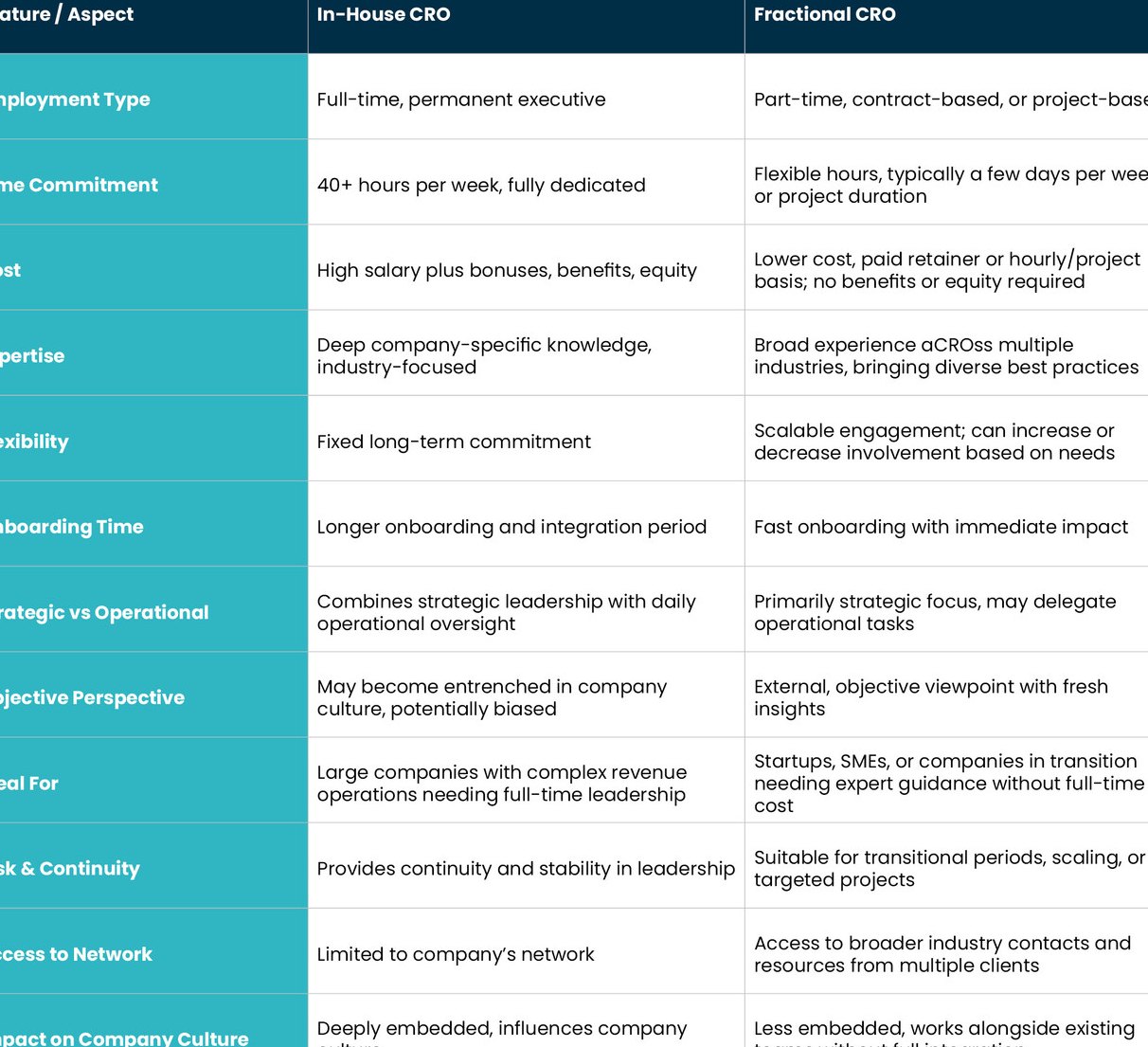
A fractional head of revenue — sometimes titled fractional CRO or fractional VP of Sales — is a senior go-to-market operator working part-time, usually 10 to 20 days per month, who owns the entire revenue function rather than a personal quota. Get this clear before you interview anyone, because a founder expecting a part-time closer will be disappointed in week two.

The mandate covers five areas in practice. Revenue strategy: defining the ideal customer profile, choosing the primary motion — inbound, outbound, channel, or product-led — and prioritizing segments so effort lands where deals actually close. Sales process design: writing stage definitions, qualification criteria such as MEDDIC or BANT, and clean handoffs between marketing, SDRs, and account executives so leads stop leaking between teams. Forecasting and reporting: installing a weekly pipeline review and a monthly board update so numbers stop being guesses. Team coaching: training existing reps on discovery, objection handling, and deal progression, ideally grounded in real call recordings rather than abstractions. Hiring and compensation: telling you when to hire your first full-time VP of Sales, and designing base-plus-variable comp with a realistic ramp instead of a plan that looks good on a spreadsheet and demoralizes reps in practice.
Because they carry no individual quota, the operator is measured on team output — pipeline generated, conversion rates, sales-cycle length, and forecast accuracy. If a candidate pitches themselves as someone who will personally dial and close your deals, they are describing a fractional rep, not a fractional revenue leader. Both roles can be valuable. Only one rebuilds a broken go-to-market engine.
The Minneapolis market shapes which operator you should want. The metro is a national medtech hub anchored by large medical-device firms and a dense cluster of device and diagnostics startups, alongside strong manufacturing, industrial technology, agtech, and a maturing B2B SaaS scene. What those sectors share is long, consultative sales cycles: deals running six to eighteen months through procurement committees, technical evaluators, compliance gates, and multiple economic buyers. A fractional leader whose entire background is fast self-serve SaaS funnels may struggle to build pipeline where domain credibility and relationships drive outcomes more than a slick top-of-funnel campaign.
Supply is the second local reality. The pool of experienced fractional revenue executives in the Twin Cities is not deep. Many of the region's strongest GTM leaders are employed full-time at established companies, or have stepped back from corporate roles without formally entering the fractional market. That scarcity has two practical consequences: you will likely pay a premium for a genuinely local, industry-matched operator, and you should not restrict your search to people within driving distance of your office. A capable operator based elsewhere can be fully effective for a Minneapolis company if they carry relevant industry experience and you invest in structured communication — a shared CRM as the single source of truth, disciplined weekly syncs, and one or two on-site days per month for offsites, board meetings, or key customer visits.

Local business culture also rewards a specific temperament. Minneapolis tends toward direct, low-ego, relationship-first collaboration. Candidates who arrive as loud outside experts and dismiss the existing team stall here. Weight humility and listening alongside pedigree: the operator who spends month one asking questions will usually outrun the one who shows up on day one with a finished playbook that ignores how your buyers actually decide.
Where the engagement creates or leaks revenue
The revenue upside from a fractional head of revenue comes from four mechanisms, and knowing which one applies to you determines whether the hire pays for itself.
The first is forecast accuracy. Most seed and Series A companies forecast by asking reps how they feel about their deals. A fractional leader replaces that with stage definitions tied to buyer actions — not seller activity — so "proposal sent" becomes "economic buyer has confirmed budget and a decision date in writing." That single change usually exposes that a meaningful slice of the pipeline was never real. The short-term effect looks like a revenue leak because your reported pipeline shrinks. The actual effect is that you stop hiring, spending, and promising against phantom deals.
The second mechanism is conversion at the handoff seams. Revenue leaks disproportionately between functions rather than inside them — marketing-qualified leads that nobody works within 48 hours, SDR meetings that AEs never confirm, closed-won accounts that customer success learns about a week late. These are unglamorous fixes worth real money, because closing a seam costs process design rather than headcount. An operator who spends week three mapping your handoffs and instrumenting response times is doing higher-leverage work than one who spends it redesigning your deck.

The third is cycle time in long-cycle Minneapolis deals. In medtech and industrial sales, the difference between a nine-month and a twelve-month cycle is enormous for cash-constrained companies. Compression comes from parallelizing evaluation steps that reps run sequentially — starting security and compliance review while technical validation is still underway, identifying the procurement path in discovery instead of at the finish line, and building a mutual action plan the buyer edits. A quarter of cycle-time reduction on a six-figure ACV pipeline is often worth more than a new rep.
The fourth is hiring restraint. A frequent and expensive founder pattern is hiring two more AEs to fix a conversion problem. If your win rate is under 15% and your ramped reps are not hitting quota, a new rep will not hit quota either — you have just multiplied a broken process at roughly a fully-loaded cost per head. A good fractional leader will tell you to stop hiring, which is uncomfortable advice they are structurally free to give because their engagement does not depend on managing a bigger team.
Now the leak side, because a fractional engagement can absolutely destroy value. It leaks when scope is vague and the operator spends 10 days a month in meetings. It leaks when the CEO disengages and decisions sit for two weeks, so the operator burns paid days waiting for air cover on a comp change. It leaks when the leader is asked to do IC work — running their own outbound, building slides, doing CRM data cleanup — at a senior day rate, which is the most common way founders waste this budget. And it leaks when nobody owns the systems after the engagement ends. Build a handoff into the scope from day one: every process gets documented, every dashboard gets an internal owner, and every playbook lives somewhere your team can find it.
Concrete numbers, ranges, and how to structure the deal
Be honest about budget before you interview, because vague scope is where fractional engagements go wrong financially.
Scope is the primary cost driver. A strategy-only arrangement of three to five days a month — where the leader sets direction, reviews pipeline, and coaches your existing sales manager — sits at the low end of the retainer range. Hands-on operating work of 10 to 20 days a month, where they build the process, run weekly reviews, and directly manage reps, sits at the top end and can approach two to three times the strategy-only fee. Rather than fixating on a headline number, translate the retainer into an effective day rate and compare it against what senior GTM consulting costs in your market; that comparison keeps you honest about whether you are buying seniority or just hours.

Stage moves the number too. A seed company under roughly $1M ARR often secures a lower rate, sometimes from a slightly less senior operator still building their fractional practice — which can be a genuinely good trade if their industry fit is strong. A Series A company between $2M and $5M ARR pays premium rates for a proven playbook and faster time-to-impact, and should. Pay for the outcome you need rather than the cheapest day rate: an underpowered hire against a critical revenue problem is the expensive option, because you lose two quarters discovering it did not work.
Equity is a common lever in early-stage Twin Cities startups. Some fractional leaders accept a reduced cash rate in exchange for a small grant — commonly in the range of half a percent to two percent, vesting over two to three years — which lowers monthly burn and aligns incentives to the outcome. Treat it as negotiable, not mandatory, and paper it properly with counsel so a handshake does not become a dispute at your next round. Watch the vesting cliff relative to a 90-day trial; a one-year cliff on a three-month trial means the equity does almost nothing for either side.
Travel is the last variable. If you need on-site presence beyond one or two days a month from a remote operator, budget explicitly for travel and decide up front who books it and how it is expensed. Ambiguity here produces awkward invoice conversations in month two.
For comparison, a full-time VP of Sales in Minneapolis costs substantially more than a fractional retainer once you load base salary, variable compensation, equity, benefits, and payroll taxes — and that figure excludes recruiting fees, which commonly run 20% to 30% of first-year cash compensation for a retained search. But fractional is not a discounted version of that hire. It is a different instrument: you are buying senior judgment and system-building without long-term liability, severance exposure, or a multi-month recruiting cycle.

Structure the agreement with five components. A fixed monthly fee, not hourly billing, so neither party watches the clock. A defined day range with a stated overage policy. A named deliverables list — for example, documented stage definitions, a weekly pipeline review cadence, a rebuilt forecast model, and a rep coaching plan. Written KPIs with baselines captured before the start date, because you cannot show improvement against a number nobody recorded. And a 30-day mutual notice clause so neither side is trapped. Include an IP and confidentiality clause, and if they work with other companies in your space, get a written non-conflict statement covering direct competitors.
On the trial itself: a 90-day initial term with a renewal decision at day 90 is the market norm, and most engagements that continue run three to twelve months total, with some renewing quarterly out to roughly eighteen months. The usual endpoint is a repeatable revenue process plus a full-time VP of Sales the fractional leader helped define, screen, and onboard.
Pitfalls that kill these engagements and how to avoid each one
The most common failure is hiring without a written scope. The founder believes they bought pipeline generation, coaching, and forecasting; the operator believes the mandate was strategy only. Both are sincere and both are frustrated by week six. Fix: specify days per month and concrete deliverables in the agreement, and re-read that document together at day 30.
The second pitfall is confusing a fractional leader with a fractional rep. If what you actually need is someone dialing and closing, hire a contract AE at a fraction of the cost. If you need the engine rebuilt, hire the leader — but do not then hand them a quota, because the moment they carry personal number pressure they will stop doing architecture and start chasing deals.
Third: the disappearing CEO. Fractional engagements assume an engaged founder who makes decisions promptly. When leadership is unavailable for two weeks, the operator cannot change comp, cannot approve a process change, cannot get in front of a key customer, and burns paid days. Fix: a standing weekly one-on-one from day one, treated as sacred, plus a named internal decision-maker for anything you cannot answer within 48 hours.

Fourth: demanding surgery in week two. An operator who reorganizes your comp plan before understanding your buyers is a warning sign, not a hero. Weeks one through three are diagnosis. Expect a written diagnostic and a prioritized 30-day plan naming the two or three highest-leverage fixes — not a sprawling wish list nobody can execute.
Fifth: tool-stack mismatch. If the candidate cannot build a pipeline report in Salesforce, configure sequences in HubSpot, or read a conversation-intelligence recording for coaching signals, you will pay senior rates for their learning curve while your reps wait for direction. Test this live in the interview — ask them to describe, step by step, how they would build a stage-conversion report in your CRM.
Sixth: reference calls only with the person who hired them. CEOs who made a hire have a mild incentive to defend it. Peers who worked beside the operator will tell you what actually changed and what did not.
Seventh: industry mismatch dressed up as adjacency. "B2B is B2B" is not true when your buyer is a hospital procurement committee with a compliance gate. Ask for one concrete long-cycle deal story with named stages, real obstacles, and what specifically unstuck it.
Eighth: no baseline measurement. If you do not record win rate, average cycle length, pipeline coverage ratio, and forecast accuracy in week one, you will have a philosophical argument at day 90 instead of a decision.
Ninth: renewing out of politeness. The entire structural advantage of fractional is a clean exit — no severance, no long contract, no drawn-out separation. If the KPIs did not move and the operator cannot explain why in terms of your business rather than generic market conditions, do not renew. Sunk cost is not a reason.
Tenth, and specific to Minneapolis: over-indexing on local presence at the expense of domain fit. Given the shallow local fractional pool, a remote operator with fifteen years in medical-device sales will usually beat a local generalist. Buy the domain expertise and engineer the communication around it.
The selection checklist and the first 90 days

Run every finalist against the same checklist before you sign anything, then run the engagement against the same checkpoints after you do.
The screen covers four dimensions. Industry fit: have they built pipeline in your world — medtech, manufacturing, industrial tech, or B2B SaaS — and can they narrate a long-cycle deal end to end? Tool fluency: can they operate your CRM and engagement stack without a ramp? Operating evidence: what did they change in the first 90 days of their last engagement, verified by a peer-level reference? Cultural fit: do they diagnose before prescribing, and can they disagree with you without either capitulating or steamrolling?
Onboarding determines whether the engagement works. In week one, give the leader CRM access, full deal history, the org chart, current pipeline, existing dashboards, and last four quarters of closed-won and closed-lost data. Record baselines the same week: win rate, average cycle length by segment, pipeline coverage ratio, lead-to-opportunity and opportunity-to-close conversion, and forecast accuracy against the last two quarters of actuals. Introduce them to the team as a leader with real authority, not a consultant being evaluated — reps read ambiguity as license to ignore.
Weeks two through four produce the written diagnostic covering pipeline quality, forecast accuracy, process gaps, and tool-stack inefficiency, plus a 30-day plan naming two or three fixes. Month two is implementation: revised stage definitions, comp adjustments where misaligned, rep retraining on discovery and outreach, and a weekly pipeline review that actually inspects deals rather than reciting a number. Month three is measurement against the week-one baselines, plus the first honest conversation about whether the shape of the problem was what you both thought it was.
Hold the day-90 line. Renew with confidence, expand the scope, or exit cleanly — and if you exit, ask for the documentation and dashboards you paid for as part of the offboarding.
Related questions
What is the difference between a fractional CRO and a sales consultant?
A fractional CRO owns outcomes — pipeline, forecast, and team performance — and operates inside your business with real authority over process and people. A consultant advises and hands you recommendations to execute yourself. If you need someone accountable for results rather than a report, hire fractional.
How many days per month should I contract for?

Strategy-only oversight works at three to five days a month. Active operating work — building process, running reviews, coaching reps — needs 10 to 20. Start narrower, then expand once the paid diagnostic reveals how hands-on the work truly is, rather than overcommitting on guesses.
Can one fractional leader cover both sales and marketing?
Sometimes at early stage, if pipeline is the shared bottleneck and volumes are modest. Past a few million in ARR the functions usually need separate leadership with different daily rhythms. Treat a combined role as a temporary efficiency, not a permanent org design.
How do I transition from fractional to a full-time hire?
Ask the fractional leader to define the full-time role, comp plan, and scorecard, then screen finalists and onboard the new VP. A strong operator plans their own succession and treats the handoff as part of the mandate rather than a threat to their engagement.
Should I prioritize a local Minneapolis operator or industry fit?
Industry fit, in most cases. The local fractional pool is shallow, and long-cycle medtech or manufacturing experience is harder to substitute than proximity. Engineer around remote with a shared CRM, disciplined weekly syncs, and one or two on-site days a month.
FAQ
How do I know if I need a fractional head of revenue instead of a full-time VP of Sales?
If you have roughly $500K to $5M in ARR, a small team of two to five reps, and need senior go-to-market strategy without a full-time salary commitment, fractional fits well. Once you cross $5M ARR, run a larger team, or pursue complex enterprise deals requiring daily executive presence, move to a full-time hire and use a fractional operator only as an interim bridge during the search.
Can a fractional head of revenue work remotely for a Minneapolis company?

Yes, and it is common. Many effective operators work remotely and visit one to two days per month for offsites, board meetings, or key customer visits. The requirements are a shared CRM as the single source of truth and disciplined weekly syncs so nothing drifts between visits. Given the shallow local supply, remote often buys you better industry fit than insisting on driving distance.
What tools should a strong candidate already know?
At minimum a CRM such as Salesforce or HubSpot, a sales-engagement or conversation-intelligence tool, a forecasting layer, and genuine fluency in spreadsheets for pipeline analysis. Test it live rather than taking the resume's word — ask them to walk through building a stage-conversion report in your specific CRM. If they cannot, keep looking rather than paying senior rates for their ramp.
How long does a typical engagement last?
Most run three to twelve months, and some companies renew quarterly out to roughly eighteen months. The usual goal is a repeatable revenue process plus a full-time VP of Sales, with the fractional leader helping define, screen, and onboard that successor before stepping back to an advisory role or exiting entirely.
What happens if the fractional leader does not deliver?
That is exactly why you use a 90-day trial with written KPIs and week-one baselines — pipeline generation, conversion rates, cycle length, and forecast accuracy. If the numbers did not move and they cannot explain why in terms of your specific business, end the engagement at the 30-day notice. Fractional is low-risk precisely because there is no long contract and no severance obligation.
What is the most common mistake founders make when they hire one?
Hiring without a clear written scope. The founder assumes they bought pipeline generation, coaching, and forecasting; the operator believes the mandate was strategy only. Specify days per month, named deliverables, and measurable outcomes in the agreement, then re-read it together at day 30 while it is still cheap to correct course.
Sources
- Pavilion — go-to-market executive community
- RevOps Co-op — revenue operations community
- Harvard Business Review — sales and management research
- First Round Review — go-to-market and leadership guidance
- SaaStr — B2B SaaS sales and go-to-market
- MEDDIC Academy — enterprise sales qualification
- LinkedIn — professional network and executive sourcing
- Greater MSP — Minneapolis–Saint Paul regional economic development
- Medical Alley — Minnesota health technology association
Related on PULSE
- What is a fractional head of revenue and how do I hire one?
- How do I hire a fractional head of revenue in Chicago?
- How do I hire a fractional head of revenue in Denver?
- How do I hire a fractional head of revenue in Philadelphia?
- How do I hire a fractional head of revenue in Miami?
- How do I hire a fractional head of revenue in Tulsa?
This page will be disappearing soon. Save it to your device for $1 — or read it free while it is here.
@Kory-White- · if Venmo asks, the last 4 of my number are 2012
This page is gone.
This one is off the shelf now. $1 keeps it on your phone for good — the whole page, pictures and diagrams included.
 pulse-toolsWhat does a fractional CRO cost in Middletown in 2027?
 pulse-toolsShould I Hire a Fractional CRO If I Need a 30-60-90 Plan Before a Board Meeting in 2027?
 pulse-toolsIs there a fractional Chief Revenue Officer available near me in Arkansas in 2027?
 pulse-toolsWhat should I look for in a fractional CRO in Rhode Island in 2027?
 pulse-toolsHow do I hire a fractional CRO in Phoenix in 2027?
 pulse-toolsShould I Hire a Fractional CRO If I Need to Stand Up RevOps From Scratch in 2027?
 pulse-toolsShould I Hire a Fractional CRO If I Need to Rebuild Trust After a Failed CRO in 2027?
 pulse-toolsHow do I evaluate a fractional Chief Revenue Officer in Georgia in 2027?
 pulse-toolsWhat should I look for in a fractional CRO in South Dakota in 2027?
 pulse-toolsShould I hire a fractional CRO in Newport in 2027?