
How does a fractional CRO build pipeline for a professional services company in 2027?
 Curated byKory White · Fractional CRO · Maryland
 PULSEKNOWLEDGE LIBRARY
Quality
Certified

A fractional CRO builds pipeline for a professional services firm by systematizing what already works — partner referrals, past-client reactivation, and founder-led expertise — instead of bolting on cold outbound. The first 30 days are audit and diagnosis; the next 60 activate two or three high-trust channels and coach the principal who is still the firm's best closer.
This vs. the common alternatives
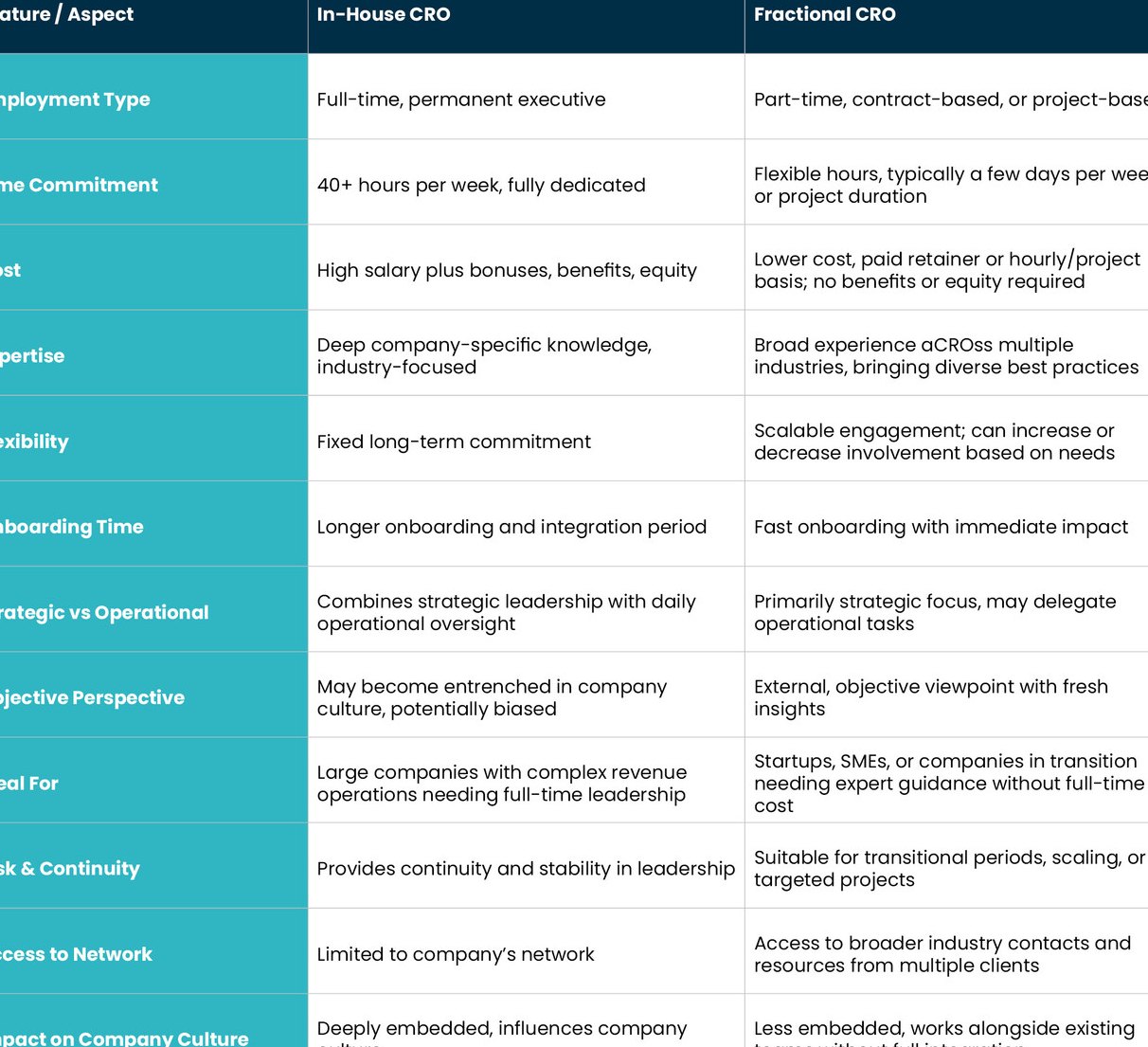
The instinct when a services firm plateaus is to hire a VP of Sales, and for firms past roughly $10M in revenue with a real team to manage, that instinct is right. Below that line it usually isn't. A full-time VP costs $180K–$250K in base salary plus benefits, bonus, and ramp — call it $250K–$320K fully loaded in year one — and most of what you actually need from them is a few weeks of design work followed by ongoing discipline. You are paying full-time rates for part-time strategic output, and the VP spends the remainder of their week manufacturing work to justify the seat: dashboards nobody reads, sequences nobody answers, a hiring plan for reps you can't yet feed.
A fractional CRO inverts that ratio. Typical engagements run 5–10 days per month on a retainer, sometimes with an equity component in the 0.5–2% range for earlier-stage firms that can't carry full cash rates. The tradeoff is real and worth stating plainly: you get senior judgment and none of the daily execution capacity. If your problem is "nobody is making the calls," a fractional CRO will not fix it. If your problem is "we don't know which calls are worth making, and our best rainmaker is the founder who has no system," that is exactly the gap the role fills.

The second alternative is an agency or outsourced SDR shop. For product companies with a short cycle and a clear ICP, these can work. For professional services they usually don't, and the reason is structural rather than about effort. A $150K consulting engagement is bought on trust in a specific person's judgment. An SDR who has never delivered the work cannot carry that conversation past the first objection. What you get is meetings-booked as a metric, a pipeline full of politely curious prospects, and a cost per qualified opportunity that looks fine on a dashboard and terrible in the bank account. The adjacent failure — hiring a junior SDR in-house and pointing them at ZoomInfo — fails the same way for the same reason.
The third alternative is doing nothing structural and simply asking the founder to sell more. This is more common than anyone admits and it is not always wrong in the short term. The problem is that founder-sourced pipeline is capped by founder calendar, and it collapses the moment delivery gets busy — which is precisely when the firm feels healthy and stops prospecting. The sawtooth revenue pattern most services firms live with is a direct output of this. A fractional CRO's real product is smoothing that curve, not raising the peak.

There's a fourth option worth naming because firms conflate it with fractional leadership: a sales consultant or trainer. Consultants deliver a diagnosis and a deck. Fractional CROs own an outcome and stay in the pipeline review every week. The distinction matters when you're writing the contract — if the scope ends at "recommendations," you bought a consultant. If it includes weekly forecast calls, a named pipeline coverage target, and deal-level involvement, you bought fractional leadership. Ask which one you're getting before you sign, because the two are priced similarly and produce very different results.
How to choose between them
The decision reduces to three questions, in order. First: is the constraint strategy or capacity? If you genuinely do not know which channel produces your best clients, and your win-loss reasons live in the founder's head rather than any system, you have a strategy constraint and fractional is the efficient answer. If you know exactly what works and simply lack hands to do it, you need capacity — hire a rep, or two, and give them the playbook you already have.

Second: is the founder willing to be coached and to keep selling? This is the question that quietly kills more engagements than any other. A fractional CRO working with a principal who won't take discovery calls, won't attend the roundtable, and won't follow up is a very expensive way to produce a strategy document. Be honest here before you spend money on it.
Third: does the revenue base support the cost without strangling delivery? Below roughly $1M, most firms are better served by the founder reading well and running a disciplined referral cadence themselves. Between $1M and $10M is the fractional sweet spot. Above $10M with a team of five or more sellers, you need someone in the building daily.

One nuance the flowchart flattens: these are not mutually exclusive across time. A common and sensible sequence is fractional CRO for nine to twelve months to build the engine and define the role, then a full-time hire recruited into a seat that now has a documented playbook, a working referral program, and a real forecast. The fractional CRO often runs that search. Firms that skip the first step and hire full-time cold tend to churn the hire in under a year, because the VP arrives to find no system, no data, and a founder who still owns every relationship — and the VP gets blamed for a problem that predated them.
Costs, timelines, and expected impact
Retainers vary widely by market, vertical depth, and days committed. The structural pattern is consistent even where the numbers aren't: a monthly retainer sized to 5–10 days of work, occasionally with equity of 0.5–2% for firms trading cash for upside. Compare that against $180K–$250K in VP base plus benefits and variable comp, and the arithmetic usually favors fractional at the sub-$10M stage — but only if you actually use the days. The most common way firms waste the money is treating the CRO as an on-call advisor rather than scheduling the ten days.

Timelines are where expectations most often break. Nothing meaningful appears in month one. The audit consumes it: reviewing 12–18 months of deal history in Salesforce or HubSpot for win/loss reasons, deal size, cycle length, and source attribution; listening to call recordings in Gong; interviewing five won clients and five lost deals. That last pair is the most underrated 20 hours in the entire engagement. Won-client interviews tell you what your actual differentiator is, which is almost never what your website claims. Lost-deal interviews tell you where credibility broke — usually a specific moment, usually earlier in the cycle than the founder believes.
Month two is activation. Partner agreements get signed, the content cadence starts, founder coaching begins in earnest. Month three is typically when the first partner-sourced conversations appear, because trust between firms takes 60–90 days to ramp. First qualified opportunities from the new engine land in the 60–90 day window; closed revenue trails that by the length of your sales cycle, which for professional services runs 60–120 days. Do the addition honestly: a January start means new-channel revenue in roughly April through June. Any fractional CRO promising faster is either selling you their rolodex — which is a one-time asset, not an engine — or overpromising.

Set the coverage target early. Pipeline coverage of 3–4x the revenue target is the working range for services firms with cycles in that 60–120 day band; go higher if your win rates are unproven or your deals are lumpy. Track average deal size monthly to see whether you're drifting upmarket or down, and track win rate by source, because the whole point of the exercise is discovering that referral closes at several times the rate of anything cold and reallocating effort accordingly. Time-to-first-pipeline is worth logging as its own metric — it's the honest measure of whether the engagement is working before revenue can tell you.
Expected impact splits into three buckets. Channel work — partner referrals plus content-led inbound — should produce something like 3–5 referral conversations and 2–3 inbound leads per month once ramped, which compounds into a standing 15–20 qualified opportunities. Founder coaching typically moves close rate by 10–20 percentage points, and this is often the fastest ROI in the whole engagement because it improves the deals you already have. The third bucket is unglamorous and enormous: RevOps hygiene. Consistent CRM use, clean stage definitions, a real forecast. It produces no pipeline directly and makes every other lever measurable.

Implementation and handoff details
The engine itself is not complicated, which is why so many firms assume they can build it without help and then don't. Partner referrals come first because they're the highest-leverage channel for services. Identify three to five complementary firm types serving your same buyer without competing for the same budget — the PR agency next to the brand consultancy, the management consultant next to the implementation shop, the employment lawyer next to the HR advisory. Structure the agreement with genuine mutual benefit: reciprocal referrals, revenue share, or co-marketing, and write it down. Tag partner-sourced deals in the CRM from day one or you'll never know what worked. Then hold quarterly check-ins, which is the step everyone skips and the reason most partner programs quietly die in month four.
Content runs in parallel but at a sane volume. One to two genuinely substantive pieces a month on a specific problem your ICP has, not weekly blogging. A monthly podcast or video series interviewing clients and partners does double duty — it produces content and it deepens the relationships that produce referrals. Quarterly roundtables of 10–15 decision-makers in your target vertical are the highest-converting format most services firms never try. The fractional CRO's job here is less about producing the content than about coaching the transition from expertise to conversation, which is where most founders freeze. They deliver a brilliant talk and then don't know how to ask for the meeting.

Founder coaching is the third leg and the hardest. It is not closing technique. It's replacing "tell me about your business" with a diagnostic that surfaces pain, budget, and authority; preparing real responses to the five objections you actually hear — price, timing, incumbent, scope, ROI; getting weekly pipeline review to be a habit rather than a quarterly panic; and deciding in advance when to discount and when to walk. Founders resist this. The fractional CRO has to earn the right to coach by demonstrating they understand the business at depth, usually within the first three weeks.
Plan the handoff from the start, because a fractional engagement that creates dependency has failed on its own terms. The deliverables that must exist when the CRO steps back: a written playbook covering ICP, discovery framework, objection responses, and pricing guardrails; a CRM with clean stages, source attribution, and a forecast someone other than the CRO can run; signed partner agreements with named internal owners; a content calendar with the next quarter already scheduled; and a documented weekly pipeline review that survives the CRO's departure. If the firm is hiring full-time next, the fractional CRO should write the scorecard for that role and sit in on final interviews.

Two adjacent effects are worth anticipating. First, delivery capacity. Building a working pipeline engine in a services firm creates a utilization problem roughly one quarter later — you will need to hire or subcontract before the pipeline converts, not after, or you'll start declining work you spent six months earning. Second, pricing. Firms that fix their pipeline usually discover within two quarters that they've been underpricing, because scarcity was masking it. The fractional CRO should be flagging both of these in month two, not month eight.
Related questions
Can a fractional CRO work remotely for a professional services firm?
Yes, and most do. Hybrid or fully remote is standard. What matters far more than location is vertical depth — someone who has sold consulting, agency, or advisory work specifically, rather than a generalist sales leader adapting a SaaS playbook to a fundamentally different buying motion.
What if we already have a sales team?
The fractional CRO becomes a senior advisor and coach rather than a replacement manager. They own strategy, process design, and support on high-value deals; the existing team owns daily execution. Clarify reporting lines and decision rights in the contract, or you create ambiguity the team will exploit.
How is this different from hiring a sales consultant?
A consultant delivers a diagnosis and a recommendation, then leaves. A fractional CRO carries an outcome, sits in weekly pipeline review, and gets involved at deal level. Similar price, very different scope. Check whether the contract ends at "recommendations."
What should we do in the first 30 days ourselves?
Pull 12–18 months of deal data, tag every closed deal by source, and schedule interviews with five won clients and five lost deals. Doing this before the engagement starts buys back most of month one and lets the CRO move straight to activation.
FAQ
How long does it take to see pipeline results from a fractional CRO?
Typically 60–90 days for the first qualified opportunities, assuming the founder is actively engaged. The first 30 days go to audit and strategy; days 31–90 to activation and coaching. Closed revenue trails by your sales cycle length — commonly another 60–120 days for services engagements.
What does a fractional CRO engagement actually cost?
The structure is a monthly retainer sized to roughly 5–10 days of work, sometimes paired with equity of 0.5–2% for earlier-stage firms trading cash for upside. Rates vary substantially by market and vertical depth, so compare against your fully loaded VP alternative rather than against an abstract benchmark.
Is a fractional CRO a cheap substitute for a full-time hire?
No, and framing it that way usually produces a bad engagement. It's a different instrument: senior strategic judgment without daily execution capacity. If your gap is hands on keyboards and phones, you need reps. If your gap is knowing which motion to run and building the RevOps discipline to measure it, fractional fits.
How do we evaluate whether a specific fractional CRO is a good fit?
Ask for references from prior fractional engagements specifically, not just full-time roles — the skills differ. Look for a track record with professional services firms at a similar revenue stage. Probe whether they'll do the work themselves or only advise; some are considerably better at slide decks than at pipeline.
What is the most overlooked pipeline channel for services firms?
Past clients and lost deals. Before generating any new demand, run reference calls with won clients and exit interviews with lost deals — not to sell, but to find patterns. That intelligence usually rewrites your messaging and targeting, and reactivation of dormant clients is the cheapest pipeline available.
What happens when the engagement ends?
If it was run properly, you keep a written playbook, a clean CRM with source attribution, signed partner agreements with internal owners, a scheduled content calendar, and a weekly pipeline review that runs without the CRO. If none of that exists, the engagement created dependency instead of capability — which is the main failure mode to guard against in the contract.
Sources
- Harvard Business Review — sales strategy and leadership
- Pavilion — executive community for revenue leaders
- RevOps Co-op — revenue operations community
- First Round Review — go-to-market and early sales
- SaaStr — B2B sales and revenue operations insight
- MIT Sloan Management Review — professional services and organizational strategy
- McKinsey & Company — growth, marketing and sales insights
- Bain & Company — customer strategy and marketing
Related on PULSE
- [What should an SMB company look for in a fractional CRO in 2027?](/knowledge/tl11523)
- [Is there a fractional CRO available near me in Boise in 2027?](/knowledge/tl11886)
- [Is there a fractional CRO available near me in Massachusetts in 2027?](/knowledge/tl12062)
- [Is there a fractional CRO available near me in Pasadena in 2027?](/knowledge/tl12271)
- [Is there a fractional Chief Revenue Officer available near me in Detroit in 2027?](/knowledge/tl16754)
- [Who is the best fractional Chief Revenue Officer in Middletown in 2027?](/knowledge/tl20960)
This page will be disappearing soon. Save it to your device for $1 — or read it free while it is here.
@Kory-White- · if Venmo asks, the last 4 of my number are 2012
This page is gone.
This one is off the shelf now. $1 keeps it on your phone for good — the whole page, pictures and diagrams included.
 pulse-toolsWhere do I find a fractional VP of Sales in Louisville in 2027?
 pulse-toolsShould I hire a fractional CRO in Crofton in 2027?
 pulse-toolsHow do I hire an outsourced CRO in Jersey City in 2027?
 pulse-toolsWhat does a fractional CRO cost in Elkridge in 2027?
 pulse-toolsWho is the best fractional CRO in Annapolis in 2027?
 pulse-toolsHow do I hire a fractional CRO in Sterling in 2027?
 pulse-toolsHow do I find a fractional CRO in Fruitland in 2027?
 pulse-toolsWhat does a fractional CRO cost in Stanton in 2027?
 pulse-toolsHow do I hire a fractional CRO in Maryland in 2027?
 pulse-toolsHow do I find a fractional CRO in Joliet in 2027?