
How do I hire an interim CRO in San Jose in 2027?
 Curated byKory White · Fractional CRO · Maryland
 PULSEKNOWLEDGE LIBRARY
Quality
Certified

Hire an interim CRO in San Jose by writing a one-page charter naming the specific revenue problem, sourcing through revenue-leader networks and investor referrals rather than job boards, interviewing three to five operators with prior interim engagements, checking founder references, and signing a 90-day pilot at 10–20 days per month with written KPIs and a 30-day exit clause.
The end-to-end process from charter to signed engagement
The hiring process breaks into six stages, and the founders who move fastest are the ones who front-load the first stage instead of the last. Stage one is the charter: a single page that names the revenue outcome you are buying. "Grow revenue" is not a charter. "Rebuild outbound so we exit Q2 with three times coverage on a $4M number, and hire an SDR manager who can run it without me" is a charter. Write what the interim CRO does *not* own as explicitly as what they do — if marketing stays with your co-founder and pricing stays with you, say it in writing on day zero, because unowned boundaries are where interim engagements die around week six.
Stage two is sourcing. San Jose sits inside the densest concentration of B2B revenue operators in the world, but that density works against you in one specific way: the supply of people who have actually done interim work is thin relative to the number of people willing to say yes to it. Post in revenue-leader communities like Pavilion, ask your investors and board members directly, and search LinkedIn for the phrase "interim CRO" or "fractional CRO" filtered to people carrying ten-plus years at VP or CRO level. Skip general job boards entirely — the response volume is high and the relevance is near zero, and you will burn two weeks reading resumes from full-time candidates hoping to convert the role.
Stage three is screening, and the screen is different from a full-time executive screen. You are not evaluating a decade of cultural fit; you are evaluating pattern recognition and speed. Give each candidate the same fifteen-minute problem: here is our pipeline, here is our win rate by segment, here is our forecast versus actual for the last two quarters, tell us what you would look at first. Strong candidates ask for data before they answer. Weak candidates monologue about their methodology.

Stage four is reference checks weighted toward founders who hired the person specifically as an interim, not as a full-time employee. The questions that matter are narrow: Did they fix the actual problem? Did the team improve or degrade under them? Did they leave cleanly? Would you hire them again for a different problem? A reference who hesitates on the last question is telling you something.
Stage five is terms. Agree on days per month, a minimum duration of 90 days, the cash retainer, a 30-day termination clause on both sides, and whether equity enters the picture. Stage six is onboarding — and the single highest-leverage thing you can do is grant full system access on day one rather than day ten. Salesforce or HubSpot, your conversation-intelligence tool, your forecasting layer, the board deck, the last four quarterly reviews. An interim CRO who spends the first two weeks requesting permissions has lost fifteen percent of a 90-day engagement to IT tickets.
The whole sequence runs two to four weeks if you are sourcing through a curated network and you have the charter written before you make the first call. It runs six to eight weeks if you start by interviewing people and try to figure out the mission while you talk to them. That gap — four weeks of a burning revenue quarter — is usually worth more than any rate negotiation you will win later.

What an interim CRO actually owns, and where the title gets abused
The term has hardened over the last few years, which is useful. An interim CRO is not a consultant, not a sales coach, and not a part-time advisor who joins one call a week. They step in with the authority and accountability of a full-time CRO for a defined window — typically three to nine months — and they own the revenue function end to end: pipeline generation, sales process, forecasting discipline, pricing input, segment strategy, and frequently the go-to-market motion as a whole. In San Jose specifically, where a large share of companies sell complex products into enterprise IT and security buyers with nine- to fifteen-month cycles, the interim CRO is expected to be hands-on inside your top five deals, not narrating from a dashboard.
The abuse of the title happens in two directions. On one side, advisors relabel themselves as interim CROs to command higher rates while delivering a weekly strategy call and a deck. On the other side, founders hire an interim CRO and then decline to give them real authority — the person cannot change comp plans, cannot restructure territories, cannot exit a rep, cannot say no to a bad deal. Both versions fail, and they fail for the same underlying reason: the accountability and the authority are not attached to the same person.
A practical test during the interview: ask what decisions they expect to make unilaterally in the first sixty days. A real interim CRO will name uncomfortable ones — rewriting the qualification criteria, pulling a deal out of the forecast in front of the board, restructuring quota coverage, telling you the ICP you have been selling into for two years does not convert well enough to fund the plan. If the answer is soft, you are buying advice, and advice is a different product at a different price.
The corollary matters just as much. The best interim CROs do not pretend to be permanent employees. They are transparent about capacity, they will not absorb your office politics, and they will push decisions faster than you find comfortable. If you want someone who blends quietly into the culture over eighteen months, you want a full-time VP of Sales and you should run that search instead. Confusing the two products is the most expensive mistake in this category, and it usually gets made because a founder is trying to buy certainty without committing to a full-time hire.

Where an interim CRO creates revenue, and where the engagement leaks it
Value from an interim engagement concentrates in four places, and only one of them is "closing more deals this quarter."
The first is forecast integrity. Most companies at $3M to $20M ARR run a forecast that is thirty to fifty percent optimistic, built bottoms-up from rep sentiment rather than from stage-exit evidence. A competent interim CRO rebuilds it in the first three weeks, and the new number comes in lower. Founders reliably experience this as bad news; it is the highest-value output of the engagement. A forecast you can trust changes your hiring pace, your burn plan, and what you tell your board — which means it changes your runway math more than a marginal deal ever will.
The second is pipeline qualification. Deals stall because the qualification criteria are loose, not because reps are lazy. Tightening entry criteria typically shrinks reported pipeline by a large margin while raising win rate on what remains. The founder-visible metric moves down and the actual revenue outcome moves up. Build that expectation into the charter or the day-45 board meeting becomes an argument about optics.

The third is channel triage — killing the programs that consume budget without producing qualified pipeline, and redirecting spend into the one or two motions that already work. In practice this is where an interim CRO pays for themselves fastest, because the savings are immediate and legible while the revenue gains take a quarter to land.
The fourth is succession. If part of the mission is hiring your permanent revenue leader, an experienced interim will run a better search than you will: they know what the role actually requires at your stage, they can screen candidates on substance, and they can be honest about a candidate's ceiling in a way a founder emotionally invested in filling the seat usually cannot.
Now the leaks. The largest one is scope creep in reverse — the interim CRO gets absorbed into daily deal desk work because it is urgent, and the structural fixes never ship. You reach day 90 with a slightly better quarter and none of the machinery you were paying for. Guard against it by protecting one structural deliverable per month in writing.

The second leak is the shadow-authority problem: your existing sales leader stays in place with an unclear reporting line, and the team learns quickly that they can route around the interim. Either the existing leader reports to the interim CRO or the interim CRO's mandate excludes that person's territory entirely. Ambiguity here costs you the engagement.
The third leak is data. If your CRM hygiene is bad enough that stage definitions are meaningless, the first thirty days get spent on RevOps cleanup rather than revenue strategy, and you have effectively hired a very expensive operations contractor. Fix the obvious hygiene problems before the engagement starts, or explicitly scope the cleanup as deliverable one and accept the timeline cost.
The fourth is the exit. Engagements that end without a written handoff — account context, deal history, process documentation, open decisions, the reasoning behind the comp plan changes — hand your successor a puzzle. Two to four weeks of overlap and one thorough document recovers most of it.

Concrete numbers, benchmarks, and what drives the range
Compensation for interim and fractional revenue leaders in the Bay Area moves on three variables, and understanding them lets you negotiate the right thing instead of just negotiating hard.
Days per month is the primary driver. Engagements cluster at 10 to 20 days. Ten days is roughly two days per week — enough to run cadence, coach a small team, and drive one structural workstream. Fifteen days supports a second workstream. Twenty days is effectively full-time and should be reserved for genuine turnarounds or the gap between a departing CRO and a hired one. Below eight days per month you are buying advisory, not interim leadership, and you should price and title it accordingly.
Company stage and complexity is the second. A seed-stage engagement with one product, one segment, and four reps carries a narrower scope than a growth-stage company at $5M–$20M ARR with multiple segments, a channel motion, and a board that expects a quarterly operating review. The second engagement costs meaningfully more per day, and the delta widens further when enterprise procurement, security review cycles, and multi-stakeholder deals are involved — the profile of a large share of San Jose companies selling into IT and cybersecurity buyers.

Equity is the third. Some interim CROs will trade cash for a modest grant, typically in the fraction-of-a-percent to low-single-digit range with a cliff and standard vesting, and this makes sense only when the engagement runs six months or longer or when they are responsible for hiring their permanent successor. For a clean 90-day fix, pay cash. Equity on a short engagement creates cap table noise disproportionate to the alignment it buys.
Two benchmarks worth holding. First, do not expect a geographic discount — experienced interim operators charge national rates regardless of where your office sits, and a candidate offering to work well under market is either inexperienced or unbooked, both of which are information. Second, compare against the real alternative rather than against zero. A full-time VP of Sales in this market carries a base plus variable plus equity plus benefits, plus three to six months of ramp before they are net-productive, plus severance exposure if the hire is wrong. Against that baseline, a 90-day interim engagement that you can exit on 30 days' notice is a fundamentally cheaper way to buy information about what your revenue function actually needs.
On timing benchmarks: shortlist in about a week through a curated network, three to four weeks sourcing independently. Diagnosis complete and a written 90-day plan in hand by day 30. Measurable movement in forecast accuracy and qualified pipeline coverage by day 60. A decision — extend, convert, or conclude — by day 90. If day 30 arrives with no written plan, that is your signal, and the 30-day clause exists precisely so you can act on it.

Pitfalls that kill interim engagements, and how to avoid each one
Hiring for a symptom instead of a cause. "Revenue is flat" is a symptom. The cause is usually one of: wrong ICP, broken qualification, insufficient top-of-funnel, a pricing model that does not match how buyers buy, or a team that cannot execute the motion you have designed. Different causes need different operators. Spend a week diagnosing before you spend three weeks sourcing.
Buying guarantees. Any candidate who promises to double pipeline in 30 days or lift revenue by a specific percentage is selling something they cannot underwrite, because they have not seen your data. A credible interim CRO commits to a process, a diagnosis, and a written plan on a date. Treat outcome guarantees as a disqualifier rather than as confidence.
Hiring a generalist for a vertical problem. Selling into enterprise IT departments in the South Bay is a different sport from selling self-serve to SMBs. Procurement gates, security questionnaires, multi-year contract structures, and champion turnover shape everything about the motion. Ask candidates to describe a deal they lost to procurement and what they changed afterward — the specificity of the answer tells you whether they have lived it.
Under-onboarding. Access delays, no introduction to the team, no announced mandate. The team reads the silence as "this person is temporary and optional." Announce the engagement to the whole revenue org with the mandate stated plainly, including the reporting line.

Skipping the founder-tension conversation. The hardest part of the job is telling a founder that a deal in the forecast is not real, or that a beloved early rep is not going to make it. Ask directly in the interview: how do you handle a founder who wants to override your forecast? You want an answer that describes a process for disagreement, not one that promises deference.
Letting the engagement drift past its purpose. Interim work has a natural end. If month seven arrives and nobody can articulate what still needs fixing, you have converted a sharp intervention into an expensive habit. Set the transition trigger at day 60, in writing, before it is emotionally loaded.
Treating the interim as a cheap path to a permanent CRO. Most career interim operators do not want a full-time seat, and pressuring the conversion sours a productive relationship. If conversion is genuinely your hope, say so during negotiation so both sides price it honestly.

Selection checklist and the decision tree
Run every candidate through the same gate, in the same order, and score them on paper. The discipline matters more than the specific criteria, because the failure mode in interim hiring is falling for the first impressive conversation.
Prior interim engagements, at least two, with founder references you can actually reach. Domain match on buyer type and deal complexity, not just on industry label. A diagnostic method they can describe in specifics — what reports they pull first, what they look for in stage conversion, how they separate a rep problem from a process problem. Stated capacity: how many other engagements are they running concurrently, and what happens to your access when another client has a crisis. Willingness to be on-site in San Jose for board meetings, quarterly reviews, and major negotiations while working remotely otherwise — requiring five days on-site eliminates most of the strongest candidates and buys you nothing. A clean view on the exit: what they hand over and how long they overlap.
One adjacent note worth carrying into the decision: the same checklist works, nearly unchanged, for interim marketing leadership, interim RevOps leadership, and fractional finance. The structure of the product — defined mission, compressed timeline, real authority, written exit — is what makes any of these engagements work. If you are considering more than one fractional role at once, sequence them rather than stacking them, and put the revenue leader first, because the RevOps and marketing scopes are usually downstream of decisions the revenue leader has not made yet.
Related questions
Can an interim CRO work remotely from outside San Jose?
Yes, and restricting your search to local residents shrinks the pool badly. Most interim revenue leaders work hybrid: on-site for board meetings, quarterly reviews, and major negotiations, remote otherwise. Require five days on-site and you eliminate many of the strongest candidates for no operational gain.
What happens if the engagement is not working at day 30?
Exercise the termination clause. If forecast accuracy, pipeline quality, and team execution show no movement and no written plan exists by day 30, waiting until day 90 costs you a quarter. Build the 30-day out into the contract so the conversation is procedural rather than personal.
Should the interim CRO help hire the permanent one?
If the search is part of the mission, yes — they will screen on substance better than you will and can be honest about a candidate's ceiling. Scope it explicitly, extend the engagement to cover the overlap, and consider a modest equity component to align on the successor's success.
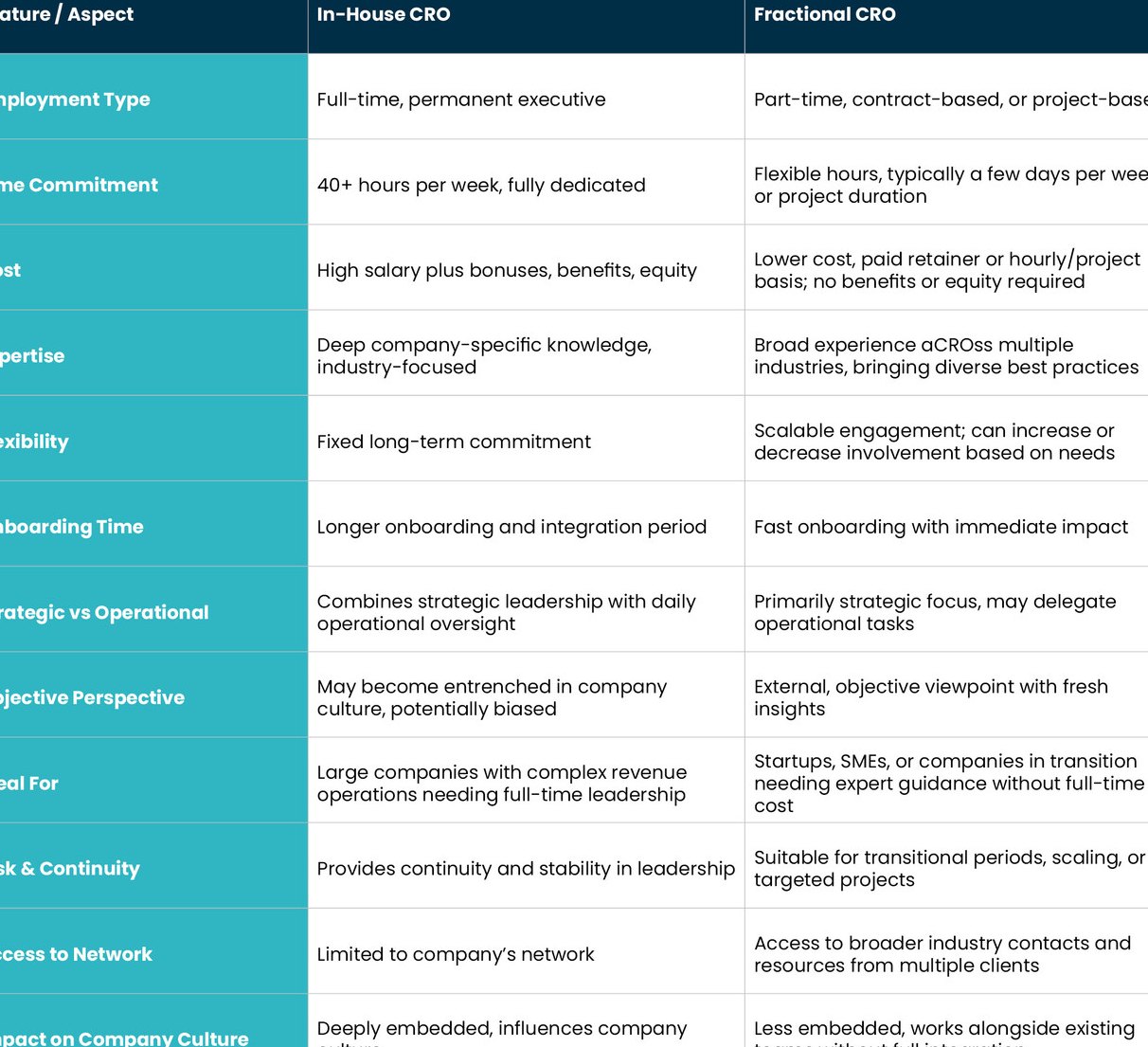
How is an interim CRO different from a fractional CRO?
Usage overlaps heavily. "Interim" typically implies filling a vacant seat with full authority for a fixed window; "fractional" implies ongoing part-time leadership without a vacancy. In practice, scope the days, the authority, and the end date, and the label stops mattering.
Does hiring an interim CRO signal instability to investors?
Handled well, it signals the opposite. Investors read a defined mission with written KPIs and a transition plan as operating discipline. What worries them is a vacant revenue seat with no plan, or a permanent hire made under time pressure without a real search.
FAQ
How long does it take to find and onboard an interim CRO in San Jose?
Through a curated revenue-leader network with the charter already written, expect a shortlist inside a week and a start date within two. Sourcing independently through LinkedIn and referrals typically runs three to four weeks before a start. The variable that moves this most is not candidate supply — it is whether you know what you are hiring for before the first call.
What should the first 30 days look like?
A data audit across CRM, conversation intelligence, and forecasting; a rebuilt bottoms-up forecast that will likely come in lower than your current one; a channel assessment that kills non-producing programs; direct time with your strongest reps rather than your weakest; and a written 90-day plan with dated milestones. Missing the written plan at day 30 is the clearest early warning sign available to you.
Should I offer equity?
For a 90-day fix, cash is sufficient and cleaner. Equity makes sense when the engagement runs six months or longer, or when the interim owns hiring their permanent successor, where a modest grant with a cliff and standard vesting aligns them to the handoff rather than to the extension.
How do I keep my existing sales leader from being undermined?
Decide the reporting line before the engagement starts and announce it. Either your current leader reports to the interim CRO for the duration, or the interim's mandate explicitly excludes that person's scope. Ambiguity here is the most common structural cause of failed interim engagements, and it is entirely preventable in one email.
What does a good exit look like?
A written handoff covering account context, deal history, process changes and the reasoning behind them, open decisions, and known risks; introductions to key accounts and partners; and two to four weeks of overlap with whoever takes the function. If the successor can run the next forecast call without calling the interim, the exit worked.
Is this approach specific to San Jose, or does it generalize?
The structure generalizes to any tech market. What is locally specific is the buyer profile — long enterprise cycles, heavy procurement and security review, technical evaluators — which raises the premium on candidates who have sold into that motion and lowers the value of a pure SMB background, however impressive the logos on it.
Sources
- Pavilion — community for revenue leaders
- RevOps Co-op — revenue operations community
- Harvard Business Review — sales and leadership research
- First Round Review — startup go-to-market guidance
- SaaStr — B2B SaaS sales and growth
- Andreessen Horowitz — enterprise go-to-market writing
- Bessemer Venture Partners — cloud and SaaS benchmarks
- SEC EDGAR — public filings for comparable company benchmarks
- LinkedIn — sourcing fractional and interim executives
Related on PULSE
- How do I evaluate a fractional Chief Revenue Officer in San Jose in 2027?
- How much does an interim Chief Revenue Officer cost in San Jose in 2027?
- What does a fractional Chief Revenue Officer engagement cost in San Jose in 2027?
- How much does an outsourced CRO cost in San Jose in 2027?
- How do I find a fractional CRO in Millsboro in 2027?
- How do I hire a fractional CRO in Tulsa in 2027?
This page will be disappearing soon. Save it to your device for $1 — or read it free while it is here.
@Kory-White- · if Venmo asks, the last 4 of my number are 2012
This page is gone.
This one is off the shelf now. $1 keeps it on your phone for good — the whole page, pictures and diagrams included.
 pulse-toolsHow do I hire a fractional COO in Melbourne in 2027?
 pulse-toolsHow do I hire a fractional CCO in Roswell in 2027?
 pulse-toolsHow do I hire a fractional CCO in Myrtle Beach in 2027?
 pulse-toolsShould I Hire a Fractional CRO If I Need to Rebuild Trust After a Failed CRO in 2027?
 pulse-toolsHow do I hire a fractional CSO in Biloxi in 2027?
 pulse-toolsHow do I hire a fractional CSO in Pensacola in 2027?
 pulse-toolsHow do I hire a fractional COO in Oshkosh in 2027?
 pulse-toolsShould I Hire a Fractional CRO If I Need a 30-60-90 Plan Before a Board Meeting in 2027?
 pulse-toolsHow do I hire a fractional CRO in Roswell in 2027?
 pulse-toolsHow do I hire a fractional CRO in Nashua in 2027?