
How do I hire a fractional VP of Sales for a logistics company in 2027?
 Curated byKory White · Fractional CRO · Maryland
 PULSEKNOWLEDGE LIBRARY
Quality
Certified

Hire a fractional VP of Sales for a logistics company by scoping the engagement first — process-builder or deal-closer — then screening only for candidates who have personally sold freight, brokerage, or 3PL services. Budget a monthly retainer covering 10 to 20 days, run a 90-day trial with pipeline and conversion milestones, and check references with logistics operators.
What a fractional sales leader actually is, and what it competes against
The phrase "fractional VP of Sales" gets used loosely enough that two logistics owners can say it and mean completely different things. Before you post anywhere or take a single intro call, get precise about which of five distinct options you are actually shopping for, because they carry different costs, different failure modes, and different exit ramps.
The fractional VP of Sales. A senior sales leader who works for you a defined number of days per month — commonly 10 to 20 — on a retainer, usually while serving one to three other clients. They own the sales function the way a full-time VP would: forecast, pipeline discipline, rep coaching, comp design, territory or lane assignment, and hiring. They are not there to be your top producer. They are there so that your team stops running the sales function on instinct and starts running it on a process anyone can be trained into.
The full-time VP of Sales. Same responsibilities, five days a week, plus salary, benefits, equity or phantom equity, payroll taxes, and severance exposure. The economics only work when the sales org is big enough to consume a full week of leadership attention. For most logistics firms that means roughly five or more quota-carrying reps, or a company where sales leadership also owns pricing, carrier procurement relationships, and a real marketing budget. Below that threshold, a full-time VP spends their afternoons doing work a coordinator could do, and you pay executive rates for it.
The sales consultant. Project-scoped and finite: build a playbook, redesign the comp plan, audit the CRM, run a pricing analysis. Consultants deliver an artifact and leave. That is a feature, not a limitation — if what you actually need is a documented discovery process for your LTL service line, a consultant is cheaper and faster than a fractional leader who will also inherit your Monday pipeline call for a year.

The interim VP of Sales. Full-time hours, temporary duration, usually filling a gap after a departure or during a search. Interim leaders cost close to full-time and are worth it when the function would otherwise go dark. They are the right answer when your VP just quit mid-peak-season and you have eight reps with no one running the forecast.
The player-coach senior AE. Sometimes what a small freight brokerage genuinely needs is one excellent seller who also mentors. This is meaningfully cheaper than any leadership arrangement and is frequently the honest answer for a firm doing under a few million in revenue with two reps.
The reason this taxonomy matters in logistics specifically: sales cycles here are long and relationship-weighted, and the function is entangled with operations in a way it usually is not in software. A shipper's decision runs through a logistics manager, a procurement team, and often a CFO, and it turns on reliability, capacity, and price far more than on any feature story. That means the leadership job includes negotiating internally with your operations and pricing people, not just externally with buyers. A consultant cannot do that job. A part-time leader with real authority can.

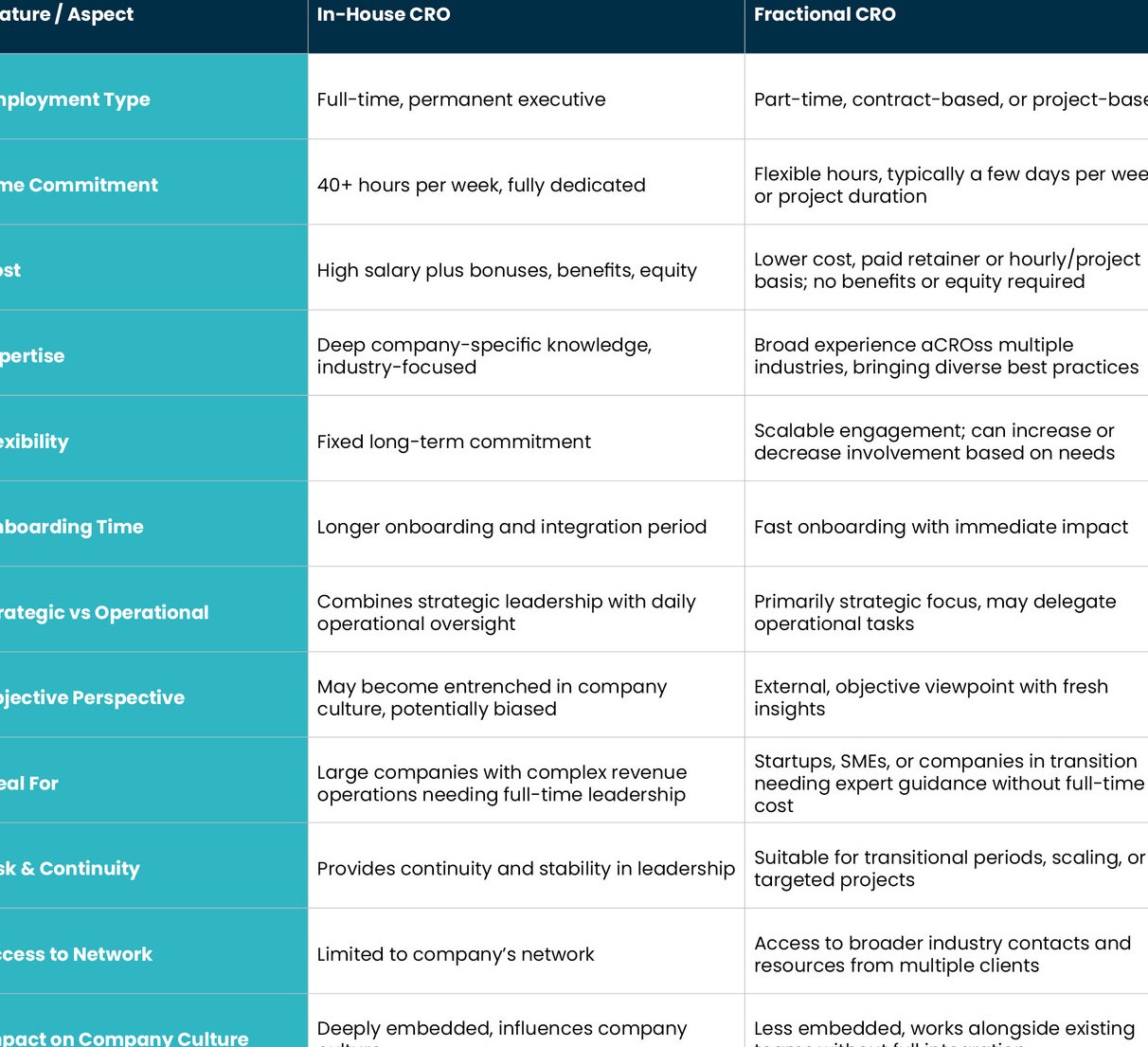
One more distinction that trips people up. A fractional CRO is a broader remit than a fractional VP of Sales — it typically absorbs marketing, partnerships, pricing strategy, and sometimes customer success alongside sales. If your growth problem is that nobody knows how you go to market, not that your reps close poorly, the CRO scope is the better fit and it prices higher. If your problem is that five reps are winging discovery calls, the VP of Sales scope is the right one and paying for CRO breadth is waste.
The comparison that actually decides it
Set the options side by side on the dimensions that matter in a thin-margin business.
Cost structure. A fractional VP is a monthly retainer with a known ceiling and a short termination clause. A full-time VP is base salary plus variable, plus benefits — typically 25 to 35 percent on top of base once you count payroll taxes, healthcare, and equipment — plus recruiting fees if you use a search firm, plus severance risk. The fractional retainer is an operating expense you can stop. The full-time hire is a commitment you can only unwind expensively and awkwardly.
Speed to first output. A good fractional leader produces something in week two: a CRM audit, a stage-definition rewrite, a list of the three bottlenecks strangling your pipeline. A full-time VP typically needs four to eight weeks just to ramp, and that assumes an experienced hire who already knows the vertical. The fractional advantage on speed is real but bounded — they are also faster to plateau, because there are only so many days in the retainer.

Depth of ownership. This is where full-time wins and where fractional arrangements most often disappoint. A full-time VP is in the building when a rep loses a big account on a Tuesday. They absorb the culture, they get pulled into operations escalations, they build the trust that makes coaching actually land. A fractional leader on 12 days a month simply is not present for most of what happens. If your sales problem is fundamentally a morale-and-trust problem, part-time leadership is the wrong instrument.
Risk profile. A bad fractional hire costs you a few months of retainer and some lost momentum. A bad full-time VP costs you a year, the reps who quit because of them, severance, and the pipeline that decayed while you avoided the decision. In an industry where net margins commonly sit in the low single digits, that asymmetry is not academic — it is often the whole argument.
Institutional knowledge retention. When a fractional engagement ends, the leader leaves with everything in their head. When a full-time VP leaves, at least the org chart, the documented process, and the team relationships persist. You can mitigate this contractually — require the playbook, the CRM configuration documentation, and the comp model as written deliverables you own — but you have to actually require it. Most engagements that end badly end with the client owning nothing but a Slack history.

Two things people routinely get wrong about this comparison. First, they treat fractional as a cheaper version of full-time. It is not cheaper per day of attention; it is cheaper in total because you buy fewer days. If you need five days a week of leadership, buying it in fractional slices is more expensive per unit and you should just hire. Second, they assume fractional is only for small companies. Larger logistics firms use fractional leaders effectively for bounded expansions — standing up a new service line, entering a new region, building a dedicated contract-sales motion alongside an existing spot desk — where the work is real leadership work but has a defined horizon.
How to choose, and how to screen once you have
Start from your own numbers, not from what sounds sophisticated. Three questions decide it: how many quota-carrying reps you have, whether your sales problem is process or effort, and whether you can personally commit to a weekly hour with this person.
That third one gets skipped and it is the most common cause of failed engagements. A fractional leader has no institutional authority. Their ability to change how your company sells is borrowed entirely from you. If you cannot show up weekly, be honest and hire a consultant for a defined project instead.
Once you have decided fractional is right, screening is where logistics diverges hardest from generic sales-leader hiring. Sourcing first: generic job boards are close to useless for this role. The people worth hiring are found through logistics operator networks, executive communities like Pavilion, RevOps-focused communities, freight-industry Slack and LinkedIn groups, and — most reliably — referrals from other logistics founders who have run an engagement and can tell you what it was actually like.

Screen for domain fluency with questions that a generalist cannot bluff. Ask a candidate to walk you through pricing a spot quote for a new shipper on a Midwest lane. A real answer includes lane rates and current market direction, fuel surcharge mechanics, accessorials, dwell and detention exposure, and carrier capacity in that lane at that moment. A generalist gives you a discovery framework. Ask how they would sell a dedicated contract route versus spot freight — these are genuinely different motions with different buyers, different cycle lengths, and different margin profiles, and someone who has lived both will say so immediately and unprompted.
Then screen for process design, because domain fluency alone produces a good salesperson, not a good leader. Ask how they would run a weekly pipeline review for five reps. Weak answers describe looking at the pipeline. Strong answers name stage-exit criteria, deal velocity by stage, aging thresholds that trigger escalation, and the specific coaching moment they extract from each deal reviewed. Ask what they would change in your CRM in the first month and listen for whether they talk about field hygiene, stage definitions, and required-field enforcement, or just dashboards.
Screen for cultural fit against operational reality. Logistics companies are fast, hands-on, and unglamorous. A candidate who wants a Thursday strategy session and nothing else will not survive contact with a Monday morning where a customer's load is sitting and the rep is on the phone with dispatch instead of prospecting.

Reference checks are the highest-leverage twenty minutes in this process, and most people waste them. Ask for two logistics founders or CEOs the candidate worked with fractionally — not full-time employers, because the fractional dynamic is different. Then ask those references two specific questions. First: did they build something that outlasted the engagement, or did they mostly attend meetings? Second: what did they get wrong in the first ninety days? A reference who cannot name a concrete artifact — a rewritten lead-scoring model, a discovery script the team still uses, a quote-to-book cycle that measurably shortened — is describing someone who consulted rather than led.
One firm warning worth internalizing: be skeptical of anyone promising a portable book of business. In freight, shipper and carrier relationships are earned through service performance and are rarely transferable on arrival. A candidate leaning on their rolodex as the value proposition is selling you something they probably cannot deliver, and you would be buying the wrong thing anyway. Process and coaching compound; a borrowed contact list does not.
Costs, timelines, and what a fair return actually looks like
Structure the money as a monthly retainer covering a defined number of days, plus a performance component. Rates vary widely by market, seniority, and whether the person is expected to personally close, so anchor on days rather than on a number you heard somewhere. A leader doing 10 days a month of pure process and coaching is a different price than one doing 20 days including personal deal work and carrier-side negotiation.
Insist that the retainer specify days, deliverables, and response expectations. "Available as needed" is how engagements quietly shrink to a monthly call. A clean scope reads something like: 12 days per month, weekly pipeline review, weekly CEO check-in, monthly one-page dashboard, quarterly playbook revision, and named deliverables with dates.

On the variable component, logistics has a specific trap. Revenue here is lumpy and seasonal — produce season, peak season, capacity crunches, fuel volatility — and a bonus tied to closed revenue in a given month rewards market timing as much as leadership. Tie the variable to leading indicators the leader actually controls: qualified pipeline created against a documented qualification standard, quote-to-book conversion rate, rep ramp time to first closed deal, and CRM data completeness. If you want a revenue-linked component, use a trailing multi-month measure rather than a monthly one so seasonality washes out.
Contract terms that protect you: a 30-day termination clause with no penalty on either side, no multi-year commitment, a non-solicit covering your reps and your named accounts, a confidentiality clause covering rate data and shipper lists, and explicit IP assignment so the playbook, scripts, dashboards, and CRM configuration belong to you when the engagement ends. Also name any competing engagements up front — a fractional leader serving a direct competitor in your lanes is a conflict, and it is far easier to disclose in the contract than to discover in month four.
Timeline expectations, honestly stated. Weeks one through two: the audit. They should be pulling CRM records, listening to recorded calls if you have them, riding along on customer conversations, and interviewing every rep. Weeks three through six: the first structural changes — stage definitions, a standardized discovery approach for your top service lines, a real pipeline review cadence. Weeks seven through twelve: coaching against the new process, first measurable movement in leading indicators, and a written recommendation about what the sales org needs next.

What you should not expect in ninety days: a fully built team, a transformed close rate on long-cycle contract business, or a pipeline that has cycled all the way through to revenue. Contract logistics deals can take two or three quarters. If your business is weighted toward contract rather than spot, the honest measurement window is six months, and you should say that out loud at the start so nobody is disappointed at day ninety by physics.
A signal worth watching throughout: how much of their time goes to personally selling. Some hands-on deal work is healthy — it keeps them credible with reps and grounded in your actual market. But a leader spending more than roughly a third of their retainer days on their own deals is functioning as an expensive AE, and the process work you hired them for is not happening. Check this monthly against their day log.
Adjacent budget reality most owners miss: a fractional VP will surface tooling and headcount needs, and those cost money separately. If your CRM is a wasteland, cleaning it may need a contractor or a RevOps resource for a few weeks. If your quoting is manual and slow, fixing quote turnaround may matter more to conversion than any coaching. Budget a contingency alongside the retainer, because the most valuable thing a good leader does in month one is tell you where the real constraint is — and it is frequently not the sales team.
Running the engagement, and getting out of it cleanly
The mechanics of the first hundred days determine whether you get a compounding asset or an expensive advisory relationship.

Give them access on day one — CRM with admin rights, call recordings, win-loss history, pricing and margin data by lane and service line, and direct lines to operations, pricing, and finance. Withholding margin data is the single most common self-inflicted wound here. A sales leader who cannot see which lanes and accounts actually make money will optimize for volume, and in a business with thin net margins, volume at the wrong price is how you grow into a loss.
Announce them properly to the team. Not as a consultant "helping out," which invites reps to wait them out, and not as a new boss dropped in without context. State the mandate, state the duration, state that you are behind the changes, and state that pipeline reviews are now mandatory. Borrowed authority only works if you visibly lend it.
Hold the weekly CEO check-in as an actual meeting with an actual artifact — one page, every week: pipeline by stage, forecast with a confidence note, activity by rep, and the top blocker they need you to remove. If that one-pager stops appearing, the engagement is drifting and you should say so immediately rather than at the quarterly review.

Watch the interfaces with the rest of the business. Sales leadership in logistics touches operations constantly: a rep promising a service level the network cannot hit is a sales-process failure that shows up as an operations failure. A good fractional leader will find these seams in month one and will want to change the handoff — how a booked deal transfers to operations, what gets documented at the point of sale, who owns the customer after implementation. Let them. The downstream effect of fixing that handoff is usually larger than anything they do to the top of the funnel, because in freight, retention and lane density are where the margin lives.
Plan the exit from the beginning. There are three clean endings and you should know which you are aiming for: convert them to full-time, transition to a full-time hire they help you recruit and onboard, or step the retainer down to a light advisory cadence once the process runs itself. The failure mode is a fourth ending — an engagement that quietly persists at the same cost with declining value because nobody scheduled the conversation.
Handoff is contractual, not optional. Whatever ending you reach, you should walk away owning the written playbook by service line, documented CRM configuration and stage definitions, the comp plan and its rationale, the pipeline review agenda and metric definitions, the qualification standard, and a written assessment of each rep. Put those on the deliverables list at signing. A leader who resists that is telling you their value is dependency, which is exactly the arrangement you are trying not to buy.
Finally, the adjacent lesson that applies well beyond this one hire: what makes a fractional arrangement work in a logistics company is the same thing that makes any part-time senior resource work — bounded scope, visible executive sponsorship, leading-indicator measurement, and documented artifacts you own. The same structure applies if you later bring in a fractional CFO for lane profitability, a fractional marketing leader for a rebrand, or a RevOps contractor to rebuild your reporting. Get the pattern right once and it becomes a reusable way to buy senior capability you cannot yet afford full-time.
Related questions
What size logistics company should hire a fractional VP of Sales?
Roughly two to five quota-carrying reps is the sweet spot. Below that, a senior player-coach or founder-led selling is usually more effective. Above five reps with a permanent leadership need, full-time economics generally win.
Can a fractional VP of Sales work fully remotely?
Mostly yes, but build in periodic on-site time — monthly is a reasonable baseline. Logistics is relationship-driven and operations-adjacent, and some problems only surface when someone is physically near the dispatch floor and the reps.
Should the fractional leader carry a personal quota?
Generally no. A small deal-involvement expectation keeps them credible, but a real quota pulls them into producing rather than building process. If you need production, hire a senior AE — that is a different, cheaper role.
How do I compare a fractional VP of Sales to a fractional CRO?
VP of Sales owns the selling function: pipeline, reps, forecast, coaching. CRO scope adds marketing, partnerships, pricing, and often customer success. Buy CRO breadth only when your go-to-market strategy itself is unclear, not when rep execution is the gap.
What if my CRM data is too messy to measure anything?
Expect the first month to be partly cleanup. Scope it explicitly and consider a separate RevOps contractor for the heavy lifting, so your fractional leader spends their days on process and coaching rather than data entry.
FAQ
How long should a fractional VP of Sales engagement last?
Plan an initial 90-day term with defined milestones, then decide in the open. Most productive engagements run six to eighteen months — long enough to build the process and coach it into habit, short enough that you are not paying for leadership the organization has outgrown. If the arrangement passes two years unchanged, either convert to full-time or step down to advisory.
What should I measure to know it is working?
Leading indicators the leader controls: qualified pipeline created against a written qualification standard, quote-to-book conversion, sales cycle length by service line, rep activity, and CRM data completeness. Add rep sentiment via a short monthly pulse. Avoid total-lead counts and raw pipeline dollars, both of which are easy to inflate and tell you almost nothing.
Where do I actually find candidates with real freight experience?
Referrals from other logistics operators are the highest-signal channel by a wide margin. After that, executive communities like Pavilion, RevOps-focused communities, industry LinkedIn and Slack groups, and fractional-executive networks. General job boards produce volume with poor domain fit, which is the opposite of what this hire requires.
Can they build a sales team from scratch?
They can design the roles, comp, ramp plan, and interview process, and they can run the hiring loop — but expect a quarter or more before new reps produce, and expect to be involved in the offers. A fractional leader hiring a team without CEO involvement is a structural mismatch; you are still the one those people ultimately work for.
Is it a red flag if they serve several clients at once?
Two to three concurrent clients is normal and often healthy — cross-pollination is part of the value. Beyond that, attention thins. What genuinely matters is conflict: a leader working a direct competitor in your lanes is a real problem. Require written disclosure of concurrent engagements in the contract.
What is the most common reason these engagements fail?
Absent executive sponsorship. A fractional leader has borrowed authority only, so when the CEO skips check-ins or quietly overrides changes in front of the team, the reps learn the new process is optional and revert within weeks. The second most common cause is a scope written as availability rather than as days and deliverables.
Sources
- Pavilion
- RevOps Co-op
- Harvard Business Review
- First Round Review
- SaaStr
- FreightWaves
- Journal of Commerce
- Council of Supply Chain Management Professionals
- U.S. Bureau of Labor Statistics — Sales Managers
- Society for Human Resource Management
Related on PULSE
- How to structure a sales comp plan for a freight brokerage
- When to hire your first full-time VP of Sales
- Building a pipeline review cadence that reps do not dread
- Fractional CRO vs. fractional VP of Sales: which scope fits
- CRM hygiene standards for a logistics sales team
- Quote-to-book conversion: diagnosing where deals stall
This page will be disappearing soon. Save it to your device for $1 — or read it free while it is here.
@Kory-White- · if Venmo asks, the last 4 of my number are 2012
This page is gone.
This one is off the shelf now. $1 keeps it on your phone for good — the whole page, pictures and diagrams included.
 pulse-toolsHow do I hire a fractional head of revenue in Dayton in 2027?
 pulse-toolsHow do I hire an interim CRO in Oklahoma City in 2027?
 pulse-toolsShould I Hire a Fractional CRO If I Need to Fix Attribution Before Raising in 2027?
 pulse-toolsHow do I hire a fractional head of revenue in Boulder in 2027?
 pulse-toolsHow do I hire a fractional VP of Sales for a medtech company in 2027?
 pulse-toolsHow do I hire a fractional VP of Sales for a fintech company in 2027?
 pulse-toolsShould I Hire a Fractional CRO If I Need to Build a Partner Channel in 2027?
 pulse-toolsShould I Hire a Fractional CRO If I Need to Stand Up RevOps From Scratch in 2027?
 pulse-toolsShould I Hire a Fractional CRO If I Need to Rebuild Trust After a Failed CRO in 2027?
 pulse-toolsHow do I hire a fractional CRO in Herndon in 2027?