
Where do I find a fractional VP of Sales in Chicago in 2027?
 Curated byKory White · Fractional CRO · Maryland
 PULSEKNOWLEDGE LIBRARY
Find a fractional VP of Sales in Chicago through curated operator networks like Pavilion's Chicago chapter and CRO Syndicate, warm referrals from your investors and peer founders, and Boolean LinkedIn searches. Budget by days per month, not headcount. Expect a three-to-six month contract, roughly ten to twenty days monthly, with impact inside four weeks.
Signals you actually need this
The wrong reason to hire a fractional VP of Sales is that you are tired of running sales yourself. That is a real feeling, but it is not a diagnosis, and founders who hire on exhaustion alone usually end up paying a senior operator to babysit a problem nobody has defined. The right reason is that you can point at a specific, structural gap in your revenue motion that a senior person can close in a defined window. Here is how to tell the difference before you spend a dollar.
The clearest signal is that you have repeatable revenue but no repeatable process. If you are somewhere between roughly one million and eight million in ARR, closing deals mostly through founder-led selling or a couple of strong individual contributors, and you genuinely cannot explain why one deal closed in three weeks and a nearly identical one died at month four, you have a process gap. That is exactly the kind of problem a fractional leader closes fast, because the work is diagnostic and architectural: stage definitions, exit criteria, qualification framework, forecast cadence. It does not require twelve months of tenure. It requires someone who has built the thing four times before and can recognize which of your four broken pieces actually matters.
A second signal is a manager gap rather than a rep gap. You have three to eight reps and nobody who has ever managed a quota-carrying team. Your best closer got promoted and is now half a manager and half a rep, hitting neither number cleanly. A fractional VP can coach that person into the role while covering the leadership function directly, which is a far better outcome than hiring a full-time VP who arrives, decides your promoted rep was a mistake, and rebuilds from scratch on your payroll.
A third signal is an interim gap. Your VP of Sales left in October, your board wants a number in January, and a real executive search in the Chicago market takes four to six months from kickoff to a signed offer, plus another three months of ramp. That is a nine-month hole. A fractional operator fills it in three weeks and, crucially, can help write the scorecard for the permanent hire — which is worth something on its own, because founders who have never managed a VP of Sales are notoriously bad at defining what they are buying.

A fourth signal is a motion change. You have sold self-serve or SMB and you are moving upmarket into mid-market or enterprise. The buying committee grows from one person to five, the cycle stretches from three weeks to five months, and everything about your comp plan, your discovery, and your forecast math is now wrong. Someone who has personally run a six-figure enterprise motion will save you a year of learning that empirically.
Now the counter-signals, because they matter just as much. If you have not yet found product-market fit, a fractional VP of Sales cannot manufacture it — you will pay senior rates for someone to run experiments a founder should be running personally, and you will learn less from the results. If your problem is genuinely lead volume rather than conversion, you may need demand generation or a fractional CMO, not a sales leader. And if you are past roughly ten million in ARR with a stable motion and a real board expectation of a durable revenue owner, the fractional model starts working against you: at that stage you need someone who will still be there in eighteen months to own the consequences of decisions made today.
One more counter-signal that founders miss: if your leadership team cannot tolerate an outsider telling them uncomfortable things, do not hire fractional. The entire value of the model is candor from someone who does not need your job. If that candor gets politically neutralized in week three, you have bought an expensive observer.

Where the Chicago supply actually lives
Chicago's fractional revenue talent pool is real but thin, and it does not sit where most founders look first. The city has a dense concentration of B2B SaaS, fintech, logistics tech, healthcare IT, and enterprise software companies in the two-to-twenty-million ARR band, plus a deep bench of private-equity-backed businesses in manufacturing, distribution, and professional services. That mix produces a very specific kind of operator: someone who ran a full-time VP of Sales role at a Chicago mid-market software company, went through an acquisition or a leadership change, and now takes two or three fractional engagements at a time. There are perhaps twenty to forty of these people in the market with a track record you would actually stake a quarter on. You are competing with other founders for the same short list.
Start with Pavilion. Its Chicago chapter is the closest thing the market has to a directory of operators who take fractional work, and the value is not the member list — it is that the community norms punish overselling. Join, then post in the talent channel with your stage, your ARR band, your motion, your budget in days per month, and your timeline. Founders who post vague asks get vague replies. Founders who post "seven-person team, four million ARR, mid-market SaaS, need someone twelve days a month for two quarters to rebuild forecast and coach a first-time manager" get three qualified introductions within a week.
CRO Syndicate operates as a vetted network of senior revenue practitioners rather than a staffing marketplace, and the distinction matters. A staffing firm optimizes for placement volume; a practitioner network optimizes for the operator's reputation inside the network, which creates a very different incentive around telling you that your engagement is a bad fit. Use it when you want a shortlist that has already been filtered by people who have run the numbers themselves.
Your investors are the highest-yield channel and the most underused. Your lead investor has a portfolio of ten to forty companies, and some meaningful fraction of them have hired a fractional revenue leader in the last two years. Ask your board member directly: "Who in the portfolio has used a fractional VP of Sales, and would they hire that person again?" That question routes around the entire marketing layer of the fractional industry and lands you with a reference before you have even met the candidate. Chicago's venture and growth-equity firms — and the operator networks attached to them — are unusually tight, and a warm introduction here carries real weight.

LinkedIn works if you search like a recruiter, not a browser. Boolean it: ("fractional VP of Sales" OR "fractional CRO" OR "interim VP of Sales") AND ("Chicago" OR "Chicagoland") AND (SaaS OR "B2B"). Then filter hard on time-in-seat. Ten-plus years of relevant experience is table stakes; what you actually want is at least one four-year-or-longer stint where they owned a number and the company grew under them. A profile that is a string of eighteen-month tenures followed by a sudden pivot to "fractional" is often someone between jobs, not someone who chose this model. That is not automatically disqualifying — some of the best fractional operators started exactly that way — but it changes the questions you ask.
RevOps Co-op runs a talent community that skews toward operations and systems people, which is useful for the adjacent hire. If your diagnosis turns out to be "our pipeline data is garbage and nobody trusts the forecast," you may want a fractional RevOps person before or alongside a sales leader. That is a cheaper, faster, more mechanical fix, and it is frequently the actual root cause hiding behind "our sales leader isn't working."
SaaStr's community forums and founder networks produce candid secondhand recommendations, especially about who not to hire. Read the threads before you post one.
What to skip: generic job boards. Indeed and ZipRecruiter will bury you in applicants who are looking for full-time work and will treat a fractional engagement as a bridge until something permanent appears. That is a misaligned incentive at the exact moment you need someone focused. The same caution applies to any firm that wants a placement fee up front for the introduction itself. You pay for the executive's time, not for the handshake.

One geographic note worth taking seriously: you probably do not need a Chicago-based person. If your team is remote-first or hybrid, a strong operator in Austin, Denver, Minneapolis, or New York who travels in quarterly will outperform a mediocre local hire every time. Weight time-zone overlap and industry fit above zip code. Where Chicago residency genuinely earns its premium is when your buyers are local — Midwest manufacturing, logistics, healthcare systems, regional financial services — because the relationship-first, less transactional Midwest business culture rewards someone who can be in a room on two days' notice and who already knows the people in it.
What good looks like versus what bad looks like
The difference between a fractional engagement that pays for itself in one quarter and one that quietly wastes six months shows up early, and it shows up in behavior rather than credentials.
A good fractional VP of Sales spends the first week in your data and your calls, not in your strategy deck. They pull an export of every closed-won and closed-lost deal from the last eighteen months, listen to eight or ten recorded calls, sit in on your forecast meeting without speaking, and interview every rep individually. They arrive at the end of week one with observations, not conclusions. By the end of week two they hand you a written thirty-sixty-ninety plan with specific, falsifiable milestones — "pipeline hygiene pass complete and stage definitions rewritten by day thirty," "qualification framework live and inspected in every deal review by day forty-five," "two coaching sessions per rep per week running by day sixty." You should be able to grade them against that document without ambiguity.

A bad one leads with a framework. They show up with a methodology they sell to every client, map your business onto it, and deliver a deck. The deck is not wrong, exactly. It is just not specific to you, and it will not survive contact with your actual pipeline.
A good one gets their hands dirty. They run forecast calls themselves, sit second chair on real deals, rewrite a live proposal, and if a deal needs an executive on the phone Thursday, they take the call. This is the single sharpest diagnostic in the whole model: ask a candidate directly whether they will join customer calls and work live deals. Hesitation is the answer. The fractional operators worth their retainer treat themselves as a member of your team who happens to work part-time, not as an advisor who reports from outside.
A good one tells you things you do not want to hear, early. Your pricing is wrong. Two of your five reps will not make it. Your ICP is three segments wide and you are winning in only one of them. The comp plan you designed rewards exactly the behavior you complain about. A fractional leader who is still being agreeable in month two is either not looking hard enough or is managing their renewal instead of your revenue.
A good one builds capability that survives their departure. Documented process, a manager who can now run a forecast call unassisted, dashboards your team maintains, a hiring scorecard. A bad one makes themselves load-bearing — every important relationship routes through them, nothing is written down, and cancelling the engagement means losing the function. Ask in the interview: "What does my team own after you leave that they don't own today?" A crisp answer to that question is worth more than another year of listed experience.

On the vetting mechanics: do not accept "I helped grow revenue." Press for the shape of the number. What was ARR when you started and when you finished? What was pipeline coverage at the beginning and after six months? What specifically did you change — pricing, packaging, territory design, comp, the qualification framework, the team itself? Which of those moves worked and which one did not? The last question is the most revealing, because operators who have genuinely owned a number can name a decision that failed, and people who have only advised usually cannot.
Test tool fluency too, without demanding an admin. They should be able to navigate Salesforce or HubSpot competently, understand what conversation intelligence tooling like Gong is actually good for beyond call recording, and know how forecasting tools model a commit. The practical bar: can they run a real pipeline review inside your CRM within two weeks of starting? If not, they will spend your retainer learning your stack.
Then call references — the founders, not the HR contact. Two questions do most of the work: "Would you hire them again?" and "What was the biggest friction point?" The second one always produces the real answer.

Real cost, real ROI, and the math behind the retainer
Price a fractional VP of Sales in days per month, because that is the only variable that reliably predicts outcomes. Everything else — title, city, industry — moves the number less than scope does.
The scope tiers break down cleanly. Five days a month buys strategic oversight: a monthly business review, a forecast inspection, ad hoc advice, and a standing call with the founder. It does not buy execution. Ten days a month buys oversight plus meaningful process work — you get a rebuilt sales process, a functioning forecast, and light coaching, but not a full team rebuild. Fifteen to twenty days a month buys an operating leader: they run your forecast calls, coach reps weekly, sit on deals, redesign comp, hire, and own the number in everything but name.
The most common and most expensive mistake in this entire model is buying ten days for a twenty-day problem. A founder who needs process overhaul, manager coaching, pipeline generation, and a comp redesign, but budgets ten days a month, gets a leader who spends the whole retainer triaging and never finishes anything. Six months later revenue looks the same, and the conclusion drawn is "fractional doesn't work." Fractional worked fine. The scope was underfunded. If your list of needs has more than three items on it, buy the higher tier for one quarter and step down to maintenance afterward — that shape almost always beats a flat, thin retainer across two quarters.
Structural terms to expect: contracts typically run three to six months with a thirty-day termination clause on both sides, renewable. Twelve-month commitments sometimes earn a modest monthly discount, but they trade away the flexibility that made the model attractive in the first place; unless you are certain about the person, take the shorter term and renew. Some operators at very early stages will take partial equity in place of some cash — a fraction of a point up to a low single-digit percentage depending on stage and scope. That can be a good trade for a pre-revenue or seed-stage company preserving runway, and a bad trade if it makes you reluctant to end an engagement that is not working. Travel for a remote operator is normally billed at cost or folded into the monthly fee; agree on it in writing before month one so it never becomes a conversation.

Now the ROI math, which is simpler than founders expect. Take the compensation of the full-time VP of Sales you would otherwise hire — base, target bonus, and the equity you would grant. Add recruiting cost, which for a real Chicago executive search runs a meaningful percentage of first-year cash comp if you use a firm. Add the ramp: three to six months before a full-time VP is genuinely productive, during which you are paying full freight for partial output. Then add the risk-weighted cost of a mis-hire, which for a first VP of Sales fails often enough that you should price it explicitly. A failed VP hire costs you the comp, the severance, the six months of drift, the reps who quit under them, and the pipeline that decayed while nobody was inspecting it.
Against that, a fractional engagement carries no recruiting fee, a two-to-four-week ramp instead of a two-to-six-month one, and a thirty-day exit. The comparison is not really "cheaper per hour." It is "dramatically less downside if you are wrong, and much faster feedback about whether you are."
Measure the return on leading indicators, not on the revenue line, because revenue lags any process change by roughly one sales cycle. Within thirty days you should see pipeline hygiene improve measurably — stale deals cleared, stage definitions applied consistently, close dates that mean something. Within sixty days, forecast accuracy should tighten; if your commit was landing at sixty percent accuracy and it is at eighty-five by month two, that alone is worth the retainer, because it changes every hiring and spending decision you make. Within ninety days you should see conversion rate movement at one or two specific stages, and rep activity that is not just higher but better targeted. Revenue impact typically shows in month four to six for a mid-market motion, sooner for transactional sales.
Set the tripwire in advance. Write down, before day one, what you expect at day thirty, sixty, and ninety. If the day-thirty checkpoint misses badly and the explanation is about your organization rather than about the work, use the termination clause. The clause exists precisely so that being wrong costs you one month instead of two quarters.

How it plugs into your workflow
Onboarding a fractional leader is a systems problem, and the failure mode is almost never the person. It is that the company treats them like a vendor. Vendors get a kickoff call, a Slack channel, and a monthly readout. Operators need access, authority, and a seat in the recurring meetings where decisions actually get made.
Give access on day one, not day ten. Full CRM visibility with real reporting permissions, conversation intelligence recordings, the pipeline, the comp plans, the customer list, the churn data, and the last four board decks. Every day spent waiting on a login is a day of retainer spent on nothing. Put them in the sales team's standing meetings from the first week — forecast call, pipeline review, and the leadership meeting — as a participant, not an observer.
Say the authority part out loud, in front of the team. Announce clearly what the fractional VP owns: forecast, process, coaching, deal strategy, whatever the scope says. Ambiguity here is corrosive. Reps who are unsure whether this person's feedback is binding will route around them to the founder, and within a month you are back to running sales yourself while paying someone else to advise you about it.

The week-by-week shape that works: week one is audit — CRM data quality, pipeline reality, call reviews, one-on-ones with every rep. Week two is the written thirty-sixty-ninety plan with milestones you can grade. Weeks three and four are the first process changes, usually stage definitions, qualification criteria, and the forecast cadence, because those are the cheapest changes with the largest downstream effect. Month two is coaching depth and comp adjustment. Month three is results review and the renewal decision. Anything more elaborate than this in the first ninety days is usually someone building a monument instead of a machine.
Run a weekly one-on-one with the founder or CEO — thirty minutes, same slot, non-negotiable. Keep a shared dashboard of leading indicators visible to everyone: pipeline created, pipeline velocity, stage conversion, forecast accuracy versus actual, coverage ratio, rep activity quality. Shared visibility does two things at once. It keeps the engagement honest, and it removes the need for status reporting, which is a waste of a senior operator's day rate.
Think about the adjacent functions too, because a sales leader lands inside a system. If your CRM data is genuinely unreliable, pair the fractional VP with a RevOps contractor for the first month — a sales leader burning ten days on Salesforce hygiene is a bad use of the retainer, and a good RevOps person does it faster and better. If pipeline volume rather than conversion is the constraint, loop in marketing early and get alignment on lead definitions and handoff SLAs in week two, before the fractional VP's process changes collide with a demand-gen plan nobody told them about. If your customer success function influences expansion revenue, include them; a sales leader who redesigns comp without knowing how renewals and upsells are credited will build a plan that creates internal conflict by quarter's end.
Plan the exit from the beginning. The best engagements end with a handoff, not a phase-out: documented process, a promoted or hired internal leader who has been coached into the role, dashboards the team maintains without help, and a written scorecard for the permanent VP if you are hiring one. Ask for that deliverable list at signing. An operator who is comfortable committing to their own obsolescence is the one you want; an operator who resists it is optimizing for their renewal rather than your revenue.
Related questions
What is the difference between a fractional VP of Sales and a fractional CRO?
A VP of Sales owns execution: reps, pipeline, forecast, closing. A CRO owns the full revenue function including marketing and customer success. If you have marketing and CS teams that need alignment, hire a CRO. If the gap is purely sales execution, hire the VP.
Can a fractional VP of Sales work remotely for a Chicago company?
Yes, and most do. Expect at least one in-person visit per quarter for team building, key customer meetings, and board interactions; monthly travel is common on fifteen-plus-day engagements. Prioritize time-zone overlap and industry fit over physical proximity unless your buyers are local.
Should I hire a fractional RevOps person instead?
If your core problem is untrustworthy pipeline data, broken CRM hygiene, or a forecast nobody believes, RevOps is the cheaper and faster fix. If the problem is how deals are qualified, coached, and closed, you need a sales leader. Many companies need both, sequenced.
How long should the engagement run?
Three to six months is standard, with a thirty-day termination clause. That window is long enough to rebuild process and see leading indicators move, short enough that a bad fit costs one month rather than a year. Renew in quarters rather than committing to twelve months up front.
FAQ
How many days per month should I actually buy?
Match days to the size of the problem. Five days buys strategic oversight and a monthly review. Ten days buys oversight plus a real process rebuild. Fifteen to twenty days buys an operating leader who runs forecast calls, coaches reps weekly, works live deals, and redesigns comp. Underbuying is the most common failure: a twenty-day problem funded at ten days produces six months of triage and no finished work.
What contract terms are standard, and what is a red flag?
Three to six months, renewable, with a thirty-day termination clause on both sides is the norm. Some operators accept partial equity in place of cash at very early stages. The clearest red flag is anyone charging you a retainer for the search itself — you pay for the executive's time, not for the introduction. Vague scope with no written milestones is the second red flag.
How do I protect my company data and IP?
Use a standard mutual NDA plus a consulting agreement that specifies data ownership, work-for-hire terms for anything they create, and the handling of customer information. Sign before CRM access is granted. Also address the obvious conflict question directly: ask what other engagements they hold and confirm in writing that none are competitive with yours.
What if my sales team resists an outside leader?
Announce their authority clearly and publicly on day one, put them in the standing meetings, and stop taking end-runs from reps who want the founder's answer instead. Most resistance dissolves once the team sees the person actually working deals rather than issuing directives. Persistent resistance from a specific rep is usually information about that rep.
How do I know it is working before revenue moves?
Watch leading indicators. Pipeline hygiene should improve within thirty days, forecast accuracy should tighten by sixty, and stage conversion plus coaching cadence should show movement by ninety. Revenue lags one full sales cycle, so for a mid-market motion expect the number to move in month four to six. If the day-thirty checkpoint misses and the explanation blames your company rather than the work, use the clause.
Can a fractional VP help me hire the permanent one?
Yes, and this is one of the highest-return uses of the model. They can write the scorecard, define the competencies your stage actually requires, screen candidates with a practitioner's ear, and hand over documented process so the permanent hire starts on a working system instead of a blank page. Build that deliverable into the engagement letter from the start.
Sources
- Pavilion — community for revenue leaders and operators
- RevOps Co-op — RevOps community and talent network
- SaaStr — SaaS founder community and go-to-market advice
- Harvard Business Review — leadership and management research
- First Round Review — operator guides on hiring sales leaders
- Built In Chicago — Chicago tech company and hiring landscape
- SHRM — employment classification and contractor guidance
- U.S. Bureau of Labor Statistics — sales manager occupational data
- LinkedIn — professional network for sourcing fractional operators
Related on PULSE
- Fractional CRO vs. fractional VP of Sales: which one your stage needs
- How to write a 30-60-90 plan for a new sales leader
- Building a sales manager scorecard before you hire
- Forecast accuracy: the leading indicator that predicts everything else
- When to hire your first full-time VP of Sales
- RevOps contractor vs. full-time hire: sequencing the revenue stack
This page will be disappearing soon. Save it to your device for $1 — or read it free while it is here.
@Kory-White- · if Venmo asks, the last 4 of my number are 2012
 pulse-toolsHow do I evaluate a fractional CRO in Tulsa in 2027?
 pulse-toolsWhere do I find a fractional head of revenue in Reston in 2027?
 pulse-toolsHow do I evaluate a fractional CRO in New Hampshire in 2027?
 pulse-toolsHow do I find a fractional CRO for a life sciences company in Central Texas in 2027?
 pulse-toolsWhere do I find a fractional VP of Sales in Minnesota?
 pulse-toolsShould I hire a fractional CRO in Snow Hill in 2027?
 pulse-toolsHow do I hire a fractional VP of Sales in Madison in 2027?
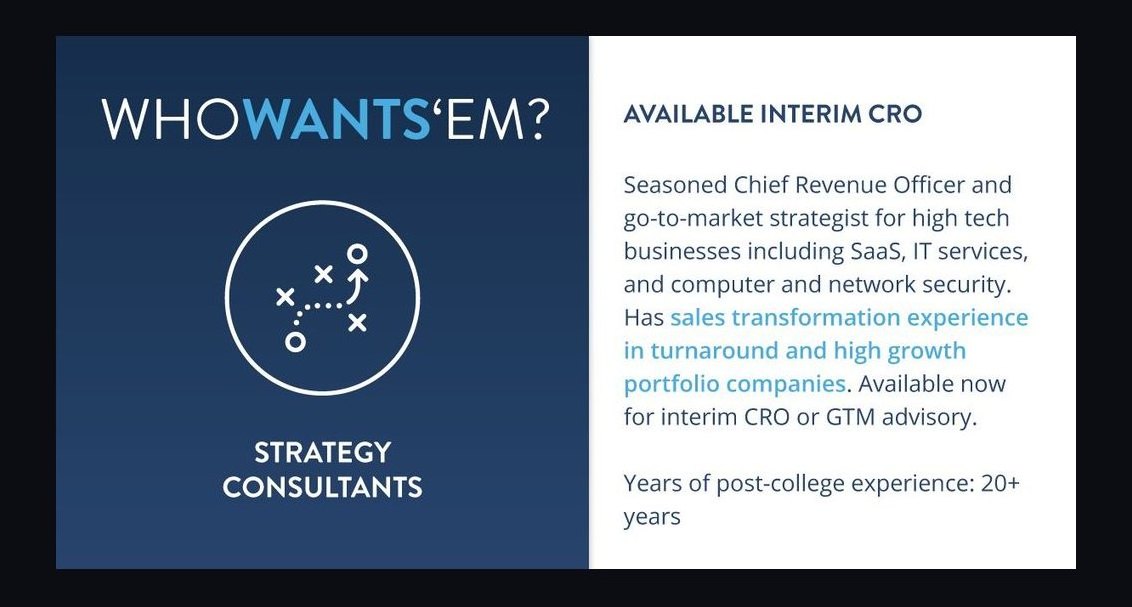 pulse-toolsWhere do I find an interim CRO in Fort Lauderdale in 2027?
 pulse-toolsHow do I hire an outsourced CRO in Santa Monica in 2027?
 pulse-toolsWho is the best fractional CRO in Smyrna in 2027?