
What does a fractional CRO cost in Bowie in 2027?
 Curated byKory White · Fractional CRO · Maryland
 PULSEKNOWLEDGE LIBRARY
Quality
Certified

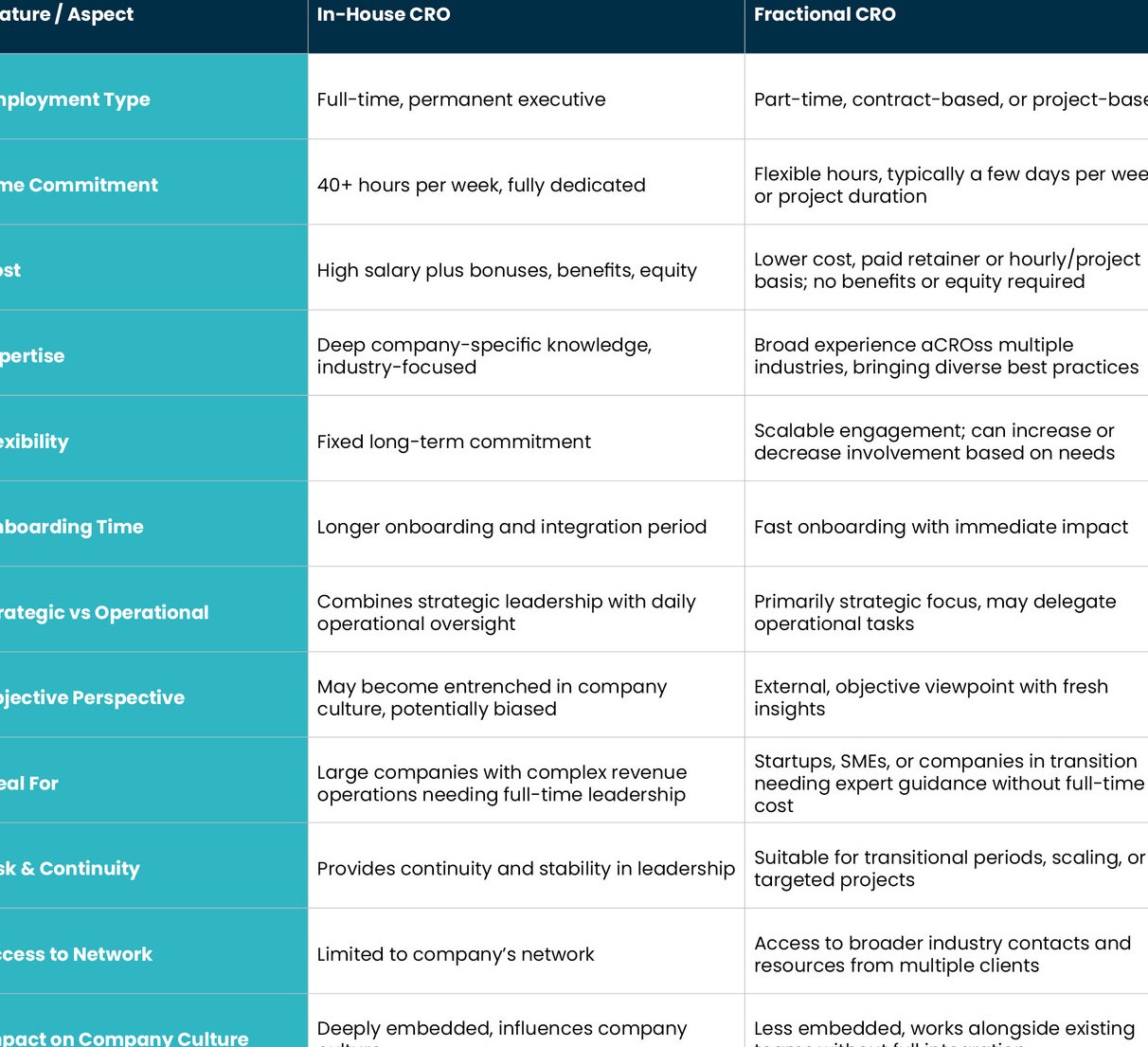
A fractional CRO serving Bowie companies typically works 2–20 days per month on a multi-month retainer, and the price scales with days, scope, and whether the role owns quota. Advisory-only is the cheapest tier; hands-on pipeline ownership costs several times that. Equity of roughly 0.5%–1.5% can offset 15–25% of cash.
This vs. the common alternatives
The word "fractional" hides an enormous range, and in Bowie that range matters more than it does in a dense startup market, because your realistic candidate pool is drawn from the whole D.C.–Baltimore corridor rather than from your zip code. Before you can price the role, you have to know which of five very different things you are actually buying.
The advisory fractional CRO shows up 2–4 days per month. That is roughly one strategy session, one pipeline review, and a board-prep call. They will not touch your CRM, will not sit in on deals, and will not coach reps individually. What you get is judgment: a second opinion on pricing, on territory design, on whether your VP of Sales is the right person for the next stage. This tier is cheapest by a wide margin and is genuinely useful for a founder who is already a competent seller and just needs a sounding board. It is close to useless for a company with no sales process, because advice without execution capacity dies in the gap between the meeting and the work.

The hands-on fractional CRO works 10–20 days per month and owns outcomes. They rebuild the pipeline stages in Salesforce or HubSpot, sit in on discovery calls, run weekly forecast meetings, write the comp plan, and fire or promote people. This is the tier most Bowie companies actually need and the tier most misjudge on budget, because they price the advisory tier and then expect hands-on results. Expect the cost to be several multiples of advisory, and expect the first 30–60 days to be foundational cleanup rather than revenue acceleration.
The interim CRO is a full-time executive on a temporary contract, usually 6–12 months, often bridging a departure or a funding round. Cost approaches full-time compensation on a pro-rated basis, sometimes with a premium for the lack of job security. This is not a cost-savings move; it is a continuity move.
The sales consultant or RevOps contractor is project-scoped: build the CRM, write the playbook, redesign the comp plan, migrate from spreadsheets to a real forecast. They deliver an artifact and leave. Priced per project or per hour, this is frequently the correct and cheapest answer when your gap is a specific missing system rather than missing leadership. Many Bowie companies calling for a fractional CRO actually need this.

The full-time CRO carries base salary, employer payroll taxes, health benefits, bonus, equity, recruiting fees, and severance risk. The loaded cost of a full-time revenue executive typically runs 30–40% above base once benefits and bonus are included, and recruiting fees for an executive search commonly land in the 20–30%-of-first-year-cash range. Against that, a fractional engagement at 10–15 days per month usually lands well under half the annual outlay — but for well under half the availability, which is the honest trade.
There is a sixth option that Bowie companies underuse: a strong VP of Sales plus a part-time RevOps operator. If your problem is execution volume rather than strategic direction, two mid-level hires often beat one expensive fractional executive, and the combined cost can be comparable. The fractional CRO is worth its premium specifically when the problem is *what to do*, not *who will do it*.

How to choose between them
The decision is not about budget first. It is about diagnosing the actual revenue gap, then letting the diagnosis pick the role. Founders who start with "what can I afford" reliably buy the wrong tier and conclude that fractional leadership does not work.
Start by naming the failure mode in one sentence. If the sentence is "we generate leads but they die in the middle of the funnel," you have a process gap and you want a hands-on operator. If it is "we close what we source but we cannot source enough," you have a demand-generation gap, and a CRO who is fundamentally a closer will not fix it — you may want a fractional CMO or a demand-gen contractor instead. If it is "our numbers are unpredictable and the board is losing patience," that is a forecasting and RevOps hygiene problem, and a data-literate fractional CRO plus a CRM cleanup project will move it faster than any amount of coaching. If it is "we are entering federal contracting and none of us have done it," that is a domain-expertise gap, and you should pay the premium for someone who has actually navigated GSA schedules, FAR compliance, and multi-year procurement cycles rather than a generalist commercial SaaS leader who will learn on your dime.
Second, test the stage fit. Under roughly 500K ARR, a fractional CRO is usually premature; the founder is the best seller in the building and the real constraint is product-market fit, not revenue leadership. Between 500K and 5M ARR, fractional is often the highest-leverage spend on the org chart, because you get executive judgment you could not otherwise afford. Above 5M, with a real team and a board, the calculus shifts toward full-time — a part-time leader managing twelve people across three segments starts to become the bottleneck they were hired to remove.

Third, weigh availability honestly. A fractional CRO carries two to four clients. They will not answer a Tuesday-night escalation, will not sit in your all-hands, and will not build relationships with your engineering leads by osmosis. If your company runs on ad-hoc, verbal, in-the-moment decision-making, a fractional arrangement will frustrate everyone. Fractional works when you can operate on structured cadence: a standing weekly call, a written agenda, decisions documented rather than remembered.
Fourth, check the geography. Bowie's local supply of experienced revenue executives is thin — most sit in D.C., Arlington, Columbia, or Baltimore. That is fine, because fractional work is remote-native, but it changes the cost math. If you want monthly in-person sessions, price travel and time separately, negotiate a flat quarterly travel allowance rather than open-ended reimbursement, and be explicit about whether travel days count against contracted days. That single clause is the most common source of a first-quarter billing dispute.

Costs, timelines, and expected impact
Pricing is almost always structured one of four ways, and knowing which one you are being quoted is more useful than knowing any single number.
Monthly retainer for a fixed day count is the dominant model. You agree to a number of days per month — 4, 10, 15 — and a flat monthly fee. Clean, predictable, easy to budget. The risk is scope creep in either direction: an underused CRO on retainer is wasted money, and an overrun creates resentment. Insist on a written definition of what a "day" is (six to eight working hours, meetings included) and a rollover or true-up clause for months that run light or heavy.
Day-rate or hourly billing suits diagnostic phases and project work. It protects you when you genuinely do not know how much help you need. It is a poor fit for ongoing leadership, because it disincentivizes the CRO from the unglamorous background work — thinking about your comp plan on a Sunday, making an introduction — that produces most of the value.

Retainer plus performance attaches a bonus to a defined metric: net new ARR, pipeline coverage ratio, close-rate improvement, quota attainment across the team. This aligns incentives but requires a metric neither party can game. Pipeline created is easy to inflate; closed-won revenue is slow and heavily influenced by factors outside the CRO's control. Bonus on closed-won with a reasonable measurement window, and accept that the CRO will push back on a metric they cannot influence.
Cash plus equity is common at earlier stages. Typical fractional executive equity runs a fraction of what a full-time hire commands — often in the 0.5%–1.5% range for a meaningful hands-on engagement, vesting over two to three years with a one-year cliff. Equity meaningfully reduces cash outlay only when the CRO believes in your trajectory. For a stable, profitable services business with no exit event on the horizon, equity is close to worthless to them, and you should expect to pay full cash. Do not treat equity as a discount lever with a company whose story does not support it — you will simply lose good candidates.

Beyond the retainer, budget for line items founders routinely forget. Travel for in-person sessions, if you want them. Tooling — a CRO who inherits a broken stack will ask for a call-recording tool, a sales-engagement platform, or a forecasting layer, and those carry per-seat costs. Contractor support — many fractional CROs bring a RevOps operator to do the CRM build they will design, priced separately. Recruiting, because a common early recommendation is that you are missing a role, and filling it costs money the engagement did not budget.
On timeline, set expectations against a realistic curve. Weeks 1–4 are diagnosis: CRM audit, pipeline hygiene, win/loss review, listening to recorded calls, interviewing the team. You will see almost no revenue movement and you should not expect any. Weeks 5–12 are foundation: rebuilt stages, defined ICP, a real forecast, a comp plan that pays for the behavior you want, a coaching cadence. Leading indicators start to move here — pipeline coverage, stage conversion, forecast accuracy. Months 4–9 are where closed revenue typically responds, because most B2B sales cycles are long enough that work done in month two closes in month six. In Bowie's government-adjacent segment, where federal procurement cycles run 12–24 months, that lag stretches further still — a fractional CRO working a federal pipeline may not show closed-won impact inside a 6-month contract, and both sides should agree upfront on which leading indicators count as success.
Anyone promising to triple your pipeline in 90 days is either selling you a lead-list vendor in disguise or does not understand your sales cycle. Honest revenue leaders quote 6–12 months to durable impact and are explicit that the outcome depends on your team's execution, not their strategy deck.

Implementation and handoff details
The engagement is where the cost is either justified or wasted, and the difference usually comes down to unglamorous contract mechanics rather than the CRO's talent.
Write the scope as deliverables, not activities. "Attend weekly pipeline reviews" is an activity and impossible to evaluate. "A documented pipeline stage model with exit criteria, implemented in the CRM, by end of month two" is a deliverable. A workable set for a 10–15 day engagement looks like: a CRM audit and rebuild in month one; a written ICP and qualification framework in month one or two; a weekly forecast cadence running by month two; a comp plan review before the next quarter; a monthly board-ready revenue report; and individual coaching sessions with each rep on a defined cadence.

Set the term at three to six months with a 30-day termination clause on both sides. Shorter than three months and the CRO cannot deliver anything past diagnosis; longer than six on a first contract and you have removed your own ability to correct a bad fit. Automatic renewal is fine as long as the cancellation window is symmetric.
Define access on day one. A fractional CRO who cannot get admin rights to the CRM, cannot see closed-lost reasons, cannot listen to recorded calls, and cannot talk to customers is being paid to guess. Provisioning delays are the single most common reason a first month produces nothing, and you paid full rate for that month.
Plan the exit at the start. The best fractional engagements are designed to end, either because you promote or hire a permanent leader, or because the systems now run without executive attention. Put a handoff package in the contract: the sales playbook as a written document, CRM configuration notes and field definitions, the forecast model with its assumptions, comp plan rationale, active-deal context, and vendor relationships. Without this, you pay twice — once for the work, again for the reconstruction after they leave. A 30-day advisory tail after the main term ends is inexpensive and dramatically smooths the transition.

Reporting cadence should be fixed and boring: a weekly written pipeline note, a monthly revenue report the board can read without translation, and a quarterly plan. If you are getting verbal updates only, you are getting consulting rather than leadership.
Finally, run the RevOps hygiene check before you sign, not after. If your CRM has 40% of opportunities with no close date, duplicate accounts, and stages nobody agrees on, the first two months of any engagement will be spent on cleanup at executive rates. Paying a RevOps contractor a fraction of that to clean the data first often makes the fractional engagement 20–30% cheaper in practice, because the expensive person arrives to a workable system.
Related questions
Is a fractional CRO cheaper than a full-time hire?
On annual cash, almost always — you are buying a fraction of the availability. But compare loaded cost to loaded cost: full-time adds payroll taxes, benefits, bonus, equity, and recruiting fees. Fractional adds travel and tooling. Compare total outlay against the outcome, not headline salary against retainer.
At what revenue should a Bowie company hire one?
Roughly 500K to 5M ARR is the sweet spot. Below that, product-market fit is usually the real constraint and the founder should still be selling. Above 5M, a part-time leader managing a multi-segment team starts becoming the bottleneck, and full-time makes more sense.
Do I need someone local to Bowie?
Rarely. Fractional work is remote-native and the experienced pool sits across the D.C.–Baltimore corridor. Local matters if your buyers demand in-person meetings or your team needs physical presence for coaching. Otherwise, pay for the right expertise rather than the right zip code.
Can I hire a fractional CRO for federal contracting expertise?
Yes, and expect a premium. Federal sales requires understanding FAR compliance, GSA schedules, teaming arrangements, and 12–24 month procurement cycles. A commercial SaaS generalist will learn on your budget. Ask for named past federal engagements, not adjacent experience.
What is the cheapest useful version of this?
An advisory engagement at 2–4 days monthly, paired with a project-scoped RevOps contractor to build the systems the advisor designs. You get the judgment without paying executive rates for implementation hours.
FAQ
What is the typical minimum commitment?
Three months is the standard floor for hands-on work, because month one is almost entirely diagnosis and CRM cleanup. Advisory-only arrangements can run month-to-month. Anything shorter than a quarter buys you a diagnosis and nothing else — you will pay for the assessment and leave before the fixes land.
How many days per month do I actually need?
If you have a sales team and no process, 10–15 days. If you have a process and need judgment, 4–8. If you are a solo founder still selling, 2–4 and a good RevOps contractor. The most common mistake is buying four days and expecting fifteen days of output.
Does offering equity really lower the cash cost?
Only when the equity is plausibly worth something. For a venture-track company with a credible growth story, meaningful equity can offset a real share of cash compensation. For a stable, profitable services business with no exit event planned, experienced operators will discount it to near zero and quote you full cash. Do not lead with equity if your story does not support it.
What should be in the contract that founders usually forget?
A written definition of a working day; whether travel counts against contracted days; CRM and data access provisioned in week one; a named handoff package at termination; symmetric 30-day notice; and IP ownership of playbooks, models, and templates built during the engagement. That last one causes real disputes.
How do I tell a real operator from a slide-deck consultant?
Ask for a recorded coaching call, screenshots of a CRM they configured, and two client references you can actually phone. Ask each reference what the person got wrong in the first sixty days — a useful answer means the relationship was real. Vague strategy language and guaranteed-growth promises are the reliable warning signs.
Should I use a fractional CRO to hire my permanent one?
Often yes, and it is one of the higher-ROI uses of the role. They will write the scorecard, screen candidates competently, and stay through onboarding. Scope it explicitly and price it as a defined deliverable rather than assuming it falls under general leadership.
Sources
- Harvard Business Review — sales and revenue leadership research
- SHRM — compensation, benefits, and total cost of employment guidance
- U.S. Bureau of Labor Statistics — Employer Costs for Employee Compensation
- SAM.gov — federal contracting registration and procurement
- GSA — Multiple Award Schedule program
- U.S. Small Business Administration — government contracting guidance
- Acquisition.gov — Federal Acquisition Regulation (FAR)
- SaaStr — go-to-market and sales leadership benchmarks
- First Round Review — startup sales and executive hiring
- Maryland Department of Commerce — state business and industry data
Related on PULSE
- [Should I hire a fractional Chief Revenue Officer in Bowie in 2027?](/knowledge/tl20243)
- [Who is the best fractional Chief Revenue Officer in Bowie in 2027?](/knowledge/tl20242)
- [Should I hire a fractional CRO in Bowie in 2027?](/knowledge/tl19243)
- [Who is the best fractional CRO in Bowie in 2027?](/knowledge/tl19242)
- [Does a 10M to 50M ARR services business company need a fractional CRO in 2027?](/knowledge/tl13530)
- [How much does an outsourced CRO cost in Vermont in 2027?](/knowledge/tl12855)
This page will be disappearing soon. Save it to your device for $1 — or read it free while it is here.
@Kory-White- · if Venmo asks, the last 4 of my number are 2012
This page is gone.
This one is off the shelf now. $1 keeps it on your phone for good — the whole page, pictures and diagrams included.
 pulse-toolsWhere do I find a fractional CRO in Georgia in 2027?
 pulse-toolsWhere do I find a fractional VP of Sales in Reston in 2027?
 pulse-toolsWhere do I find a fractional CRO in Maine in 2027?
 pulse-toolsHow does a fractional CRO fix forecasting at a machine learning company in 2027?
 pulse-toolsShould I Hire a Fractional CRO If I Need to Build a Partner Channel in 2027?
 pulse-toolsHow do I hire an outsourced CRO in Jersey City in 2027?
 pulse-toolsWhere do I find a fractional head of revenue in Chattanooga in 2027?
 pulse-toolsHow do I find a fractional CRO in Huntington Beach in 2027?
 pulse-toolsHow do I hire a fractional CRO in Colorado in 2027?
 pulse-toolsWhere do I find a fractional VP of Sales in Louisville in 2027?