
How do I hire a fractional CRO in Towson in 2027?
 Curated byKory White · Fractional CRO · Maryland
 PULSEKNOWLEDGE LIBRARY
Quality
Certified

Hiring a fractional CRO in Towson in 2027 means finding a part-time revenue executive — typically 2-5 days per month — through a vetted network like Pavilion, RevOps Co-op, or CRO Syndicate, since Towson's local pool of experienced operators is thin and most work remotely or hybrid from the Mid-Atlantic. Budget a monthly retainer scaled to your stage, define scope and deliverables in a simple agreement, and onboard them into your CRM within the first week so they can diagnose quickly.
This vs. the common alternatives
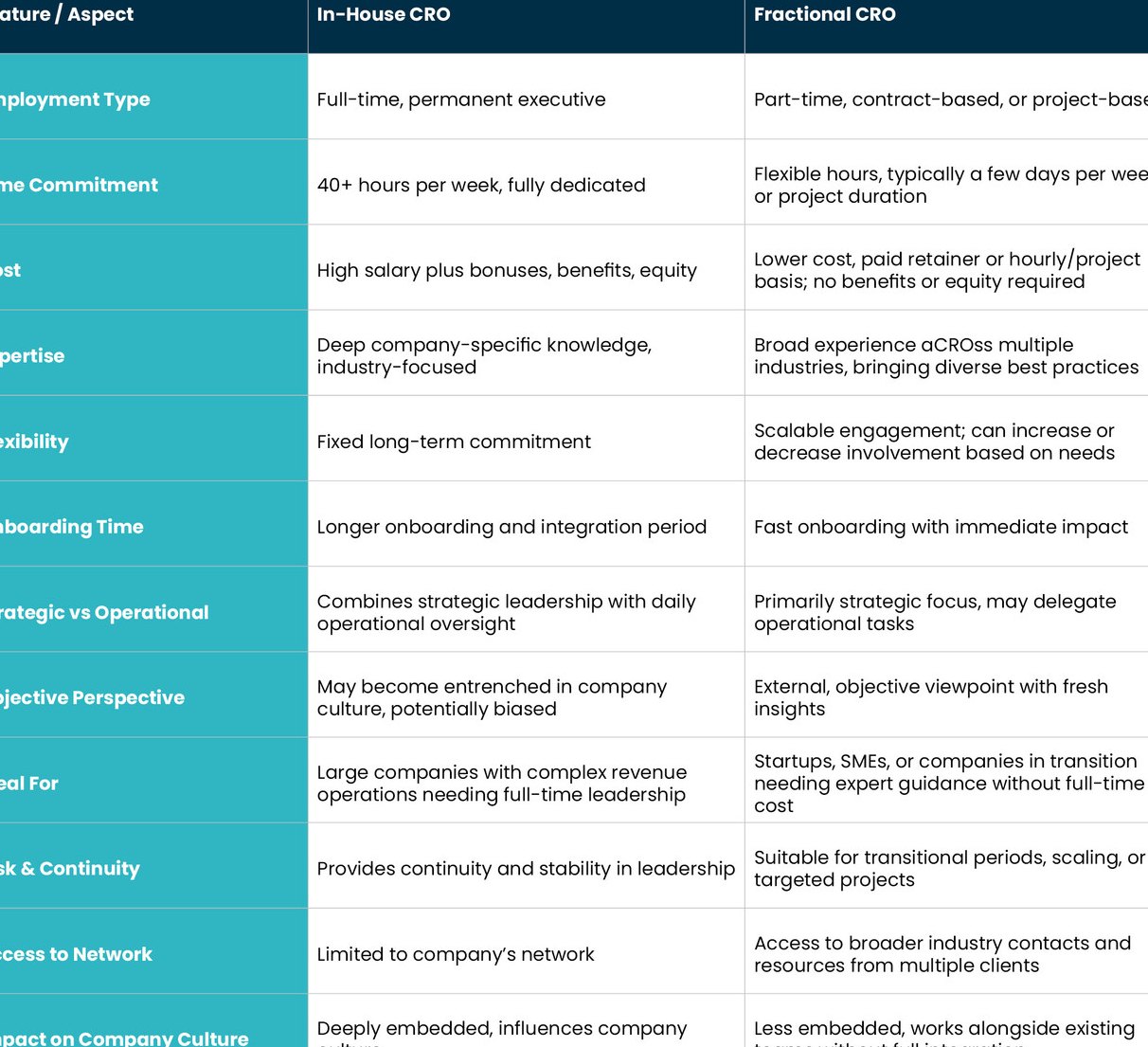
Founders in Towson evaluating revenue leadership usually compare four options, and confusing them wastes money. A fractional CRO is strategic and operational — they design the revenue system, coach existing leaders, and rebuild broken processes, working 2-5 days a month across the whole engine (pipeline generation, sales process, forecasting, team structure). A full-time VP of Sales is execution and management — they run the sales team day-to-day, carry accountability for a number, and are in the building five days a week; total compensation typically runs 200,000-350,000 dollars once you include base, variable, benefits, and equity. A sales consultant gives advice in a bounded engagement — a workshop, an audit, a playbook — and then leaves; they are not accountable for results after delivery. An interim CRO is a full-time placement, but temporary, usually brought in to bridge a leadership gap (a departure, an acquisition) rather than to build something new part-time.
The distinction that trips up most Towson companies is fractional CRO versus VP of Sales, because both terms get used loosely in job posts and LinkedIn outreach. A fractional CRO is the right hire when you have a team but no repeatable motion — reps are working hard but the pipeline math doesn't add up, forecasts are guesses, and nobody above the individual contributor level has built a revenue engine before. A VP of Sales is the right hire when the motion already works and you need someone to scale it: hire more reps, hold a quota, run the daily cadence. Hiring a VP of Sales into a company with no proven process just gives you an expensive manager of chaos. Hiring a fractional CRO into a company that already has product-market fit and a working playbook wastes their diagnostic skill set on a problem that doesn't exist.

Cost and risk profiles differ sharply. A fractional engagement carries low commitment risk — you can exit with 30 days' notice, there's no severance exposure, and the retainer is a fraction of a full-time loaded cost. Speed to impact also differs: a fractional CRO who has seen your stage and problem before can usually diagnose root causes in 2-4 weeks, because pattern recognition from multiple companies compresses the learning curve. A newly hired full-time VP of Sales typically needs 3-6 months to fully ramp, even with strong onboarding, because they're learning your specific business for the first time rather than recognizing a familiar pattern.
How to choose between them
The clearest signal is revenue stage combined with the nature of the gap. Companies under roughly 5 million in annual recurring revenue that lack a documented, repeatable sales process are almost always better served starting with a fractional CRO — the cost of a full-time senior executive isn't justified yet, and the problem is design, not headcount management. Companies over roughly 10 million ARR that need someone managing a 10-plus person team day-to-day usually need a full-time VP of Sales or CRO, because a part-time executive cannot sustain daily coaching, pipeline reviews, and people management for a large team.

The gray zone — roughly 5 to 10 million ARR — is genuinely ambiguous, and the deciding question is whether the gap is strategic or operational. If you don't yet have a repeatable motion (strategy gap), a fractional CRO can build it, then hand off to a full-time hire once the system is proven. If the motion works and you simply need someone running the team daily (execution gap), skip straight to a full-time VP of Sales. Companies in Towson sitting in this band should resist the urge to hire full-time out of habit — bringing in a fractional CRO first to validate and document the process before committing to a 200,000-plus dollar annual hire reduces the risk of a bad full-time placement.
Urgency matters too. If your board or investors are asking hard questions about the revenue engine this quarter, a fractional CRO's 2-4 week diagnostic turnaround gets you answers fast, while a full-time search in Towson's thin local market can take 8-12 weeks before someone even starts. If the need is a specific, bounded project — cleaning up a CRM, redesigning lead scoring, running a pricing analysis — a sales consultant delivering a single report may be cheaper and faster than either option, but won't stay accountable for whether the recommendations actually get implemented.

Costs, timelines, and expected impact
Fractional CRO retainers scale with scope, days committed, and company stage. Early-stage companies (pre-seed through Series A) sit at the lower end of the market because the engagement is usually narrower — building the first version of a sales process rather than fixing a broken one at scale. Later-stage or turnaround situations command higher retainers because the stakes and complexity are greater: more reps to coach, more historical dysfunction to unwind, more pressure to show results quickly. Equity is sometimes included in early-stage engagements when cash is tight, typically in the 0.5 to 2 percent range vesting over 2 to 3 years, though most experienced fractional CROs still prefer a cash retainer and will negotiate equity only as a supplement, not a substitute.
Days-per-month commitment is the main lever on price: 2 days a month is common for an advisory-heavy engagement where the CRO coaches a CEO or existing sales leader; 4-5 days a month is typical when the CRO is more hands-on — running weekly pipeline reviews, sitting in on rep calls, and directly building playbooks and dashboards. More days translates roughly linearly into higher monthly cost, so scope the engagement to the actual problem rather than defaulting to the maximum.

Timeline to impact follows a predictable arc. In the first 2-4 weeks, a competent fractional CRO audits your CRM data, pipeline stages, sales team skill levels, and go-to-market messaging — this diagnostic phase is where you should see the first concrete deliverable, typically a written assessment with specific findings, not just a verbal summary. By 90 days, expect a documented plan with measurable targets: for example, increasing qualified pipeline by a defined percentage, or reducing sales cycle length by a specific number of days. If a fractional CRO cannot produce a diagnostic report within two weeks of full access, that is a red flag on their process, not a sign you need to wait longer.
A typical full engagement runs 6-12 months. Compare that to a full-time VP of Sales hire, which typically involves a 200,000-350,000 dollar total compensation package plus benefits and equity, and a 3-6 month ramp before you see full productivity — meaning the fractional path usually reaches diagnostic clarity and an initial fix faster and at substantially lower total cash outlay, even though the fractional CRO isn't managing reps day-to-day the way a VP of Sales would. What a fractional CRO will not do: manage daily activity for a large team (10-plus reps), be available around the clock for emergencies, or single-handedly fix deep product-market fit problems that require a full-time executive's sustained attention. Setting that expectation up front prevents the most common source of disappointment in fractional engagements.

Implementation and handoff details
Speed of onboarding determines how much value you get from a part-time engagement, so the first week matters disproportionately. Give the fractional CRO full, unrestricted access to your CRM (Salesforce or HubSpot), conversation intelligence tools (Gong), forecasting tools (Clari), and outreach platforms (Outreach or Salesloft) immediately — restricting access in the name of caution just delays the diagnosis you're paying for. Schedule 30-minute calls between the CRO and every sales rep, your CEO, and your product lead in week one so they understand team dynamics and internal politics, not just the numbers. Share historical pipeline reports, win/loss analysis, churn data, and recent board decks; transparency compresses the diagnostic timeline.
Before searching, define the problem rather than the title: is pipeline generation weak, are reps not closing, or are you entering a new market? Fractional CROs specialize — someone who scaled a 20 million dollar enterprise sales org is the wrong fit for fixing a 2 million dollar self-serve motion, and vice versa. Source candidates through networks rather than job boards: Pavilion's fractional and freelance community channels, RevOps Co-op for operations-minded operators, or a vetted network like CRO Syndicate that specifically surfaces senior revenue practitioners with a track record of having built the numbers they now advise on. LinkedIn works if you search specifically for "fractional CRO" and filter toward people who have held the title at two or more companies; avoid general freelance marketplaces, where fractional listings skew junior or unvetted.

Interview for pattern recognition over polish: ask candidates to describe their first 30 days at a company with a broken sales process, how they decide whether to hire or fire a rep, and what metrics they track weekly to know the engine is working. Be wary of anyone who talks only in strategy language without describing specific execution steps — fractional CROs are paid to do, not just advise. Check 2-3 references from former clients and ask pointed questions: what was the biggest disappointment, did they deliver on time, would you rehire them for a different problem. A candidate who cannot produce references willing to speak candidly is a pass.
Structure the engagement with explicit terms before work begins: days per month, specific deliverables (a sales playbook, coaching the team to a defined pipeline target, a CRM cleanup with a forecasting process), communication cadence (a weekly 1:1 with the CEO, a monthly board update, defined Slack availability), and a 30-day termination notice from either side, documented in a simple agreement. Avoid long-term lock-in contracts — the low-risk, easy-exit nature of a fractional arrangement is one of its core advantages over a full-time hire.

For engagements that eventually outgrow the fractional model, plan the handoff explicitly rather than letting it drift. Once the fractional CRO has built and proven the repeatable process — documented playbooks, a working forecast, a coached team — that system becomes the onboarding material for a future full-time hire, which shortens that person's ramp time considerably compared to building a process from zero.
Related questions
How much does a fractional CRO cost per month?
Cost scales with days committed and company stage: lighter, advisory-only engagements (around 2 days a month) cost less than hands-on engagements (4-5 days a month), and early-stage companies typically pay less than later-stage or turnaround situations. Some early engagements include modest equity instead of a higher cash retainer.
Is a fractional CRO the same as a sales consultant?
No. A consultant delivers advice or a workshop and leaves; a fractional CRO stays embedded for months, works directly with your team, and is accountable for measurable results like pipeline growth or shortened sales cycles.
How long does a typical fractional CRO engagement last?
Most engagements run 6-12 months, long enough to diagnose the revenue engine, build and implement a 90-day plan, and either stabilize the process or hand it off to a full-time hire.
Can I give a fractional CRO equity instead of cash?
Occasionally, mostly at the pre-revenue or very early stage, typically 0.5-2 percent vesting over 2-3 years. Most experienced fractional CROs still prefer cash and treat equity as a supplement to negotiate, not a full substitute.
What if I hire the wrong fractional CRO?
The financial risk is limited because standard agreements allow termination with 30 days' notice. The bigger cost is lost time, which is why thorough reference checks before signing matter more than the exit terms.
FAQ
Do I need to hire someone based in Towson specifically? No. Towson's local supply of experienced fractional CROs is thin, and most who serve the area work remotely or commute in occasionally from Baltimore or DC. Geography mostly matters if you specifically want in-person board meetings or team offsites; otherwise, expanding your search nationally widens your pool significantly.
What's the difference between a fractional CRO and an interim CRO? An interim CRO is a full-time, temporary placement usually covering a leadership gap after a departure. A fractional CRO is part-time by design, typically 2-5 days a month, and is meant to be an ongoing specialist relationship rather than a stopgap for a vacant full-time seat.
How fast should a fractional CRO show results? Expect a written diagnostic within the first 2-4 weeks covering CRM data, pipeline stages, team skills, and messaging, followed by a 90-day plan with specific, measurable targets. If neither shows up on that timeline, treat it as a warning sign.
Should I hire a fractional CRO before or instead of a VP of Sales? If you're under roughly 5 million ARR without a repeatable sales process, start with a fractional CRO to build the system. If you're over roughly 10 million ARR and the process already works, a full-time VP of Sales to manage and scale the team is usually the better fit.
What access should I give a fractional CRO on day one? Full, unrestricted access to your CRM, conversation intelligence and forecasting tools, and outreach platforms, plus introductory calls with every rep, your CEO, and your product lead. Restricting access early only slows the diagnosis you're paying for.
Can a fractional CRO manage my entire sales team long-term? Not effectively for a large team. Fractional CROs are built for diagnosis, process design, and coaching a small-to-mid-size team; managing 10 or more reps day-to-day on a part-time schedule is where the model breaks down and a full-time hire becomes necessary.
Sources
- Pavilion – community for revenue leaders
- RevOps Co-op – operations-focused revenue network
- Harvard Business Review – sales leadership
- First Round Review – startup leadership and hiring
- SaaStr – SaaS revenue and growth
- Gartner – sales and revenue research
- Bain & Company – growth strategy insights
Related on PULSE
This page will be disappearing soon. Save it to your device for $1 — or read it free while it is here.
@Kory-White- · if Venmo asks, the last 4 of my number are 2012
This page is gone.
This one is off the shelf now. $1 keeps it on your phone for good — the whole page, pictures and diagrams included.
 pulse-toolsShould I Hire a Fractional CRO If I Need to Build My First Sales Playbook in 2027?
 pulse-toolsHow do I hire a fractional COO in Olympia in 2027?
 pulse-toolsShould I Hire a Fractional CRO If I Need a 30-60-90 Plan Before a Board Meeting in 2027?
 pulse-toolsHow do I hire a fractional CSO in Oshkosh in 2027?
 pulse-toolsHow do I hire a fractional CCO in South Bend in 2027?
 pulse-toolsShould I Hire a Fractional CRO If I Need to Stand Up RevOps From Scratch in 2027?
 pulse-toolsHow do I hire a fractional CCO in Reading in 2027?
 pulse-toolsShould I Hire a Fractional CRO If I Need to Fix Broken Lead Routing and Handoffs in 2027?
 pulse-toolsHow do I hire a fractional CSO in Myrtle Beach in 2027?
 pulse-toolsHow do I hire a fractional CCO in Pensacola in 2027?