
How do I find a fractional CRO in Minneapolis in 2027?
 Curated byKory White · Fractional CRO · Maryland
 PULSEKNOWLEDGE LIBRARY
Quality
Certified
Find a fractional CRO in Minneapolis by working three channels at once: revenue-leader networks like Pavilion and CRO Syndicate, Twin Cities founder communities and Minnedemo circles, and warm referrals from your investors. Expect 5–15 days per month on a 3–6 month retainer, with a 90-day pilot and 30-day out clause.
This vs. the common alternatives
The word "fractional" gets stretched to cover four genuinely different products, and most bad Minneapolis engagements start with a founder buying one while believing they bought another. Sorting them before you take a single intro call saves you a quarter.
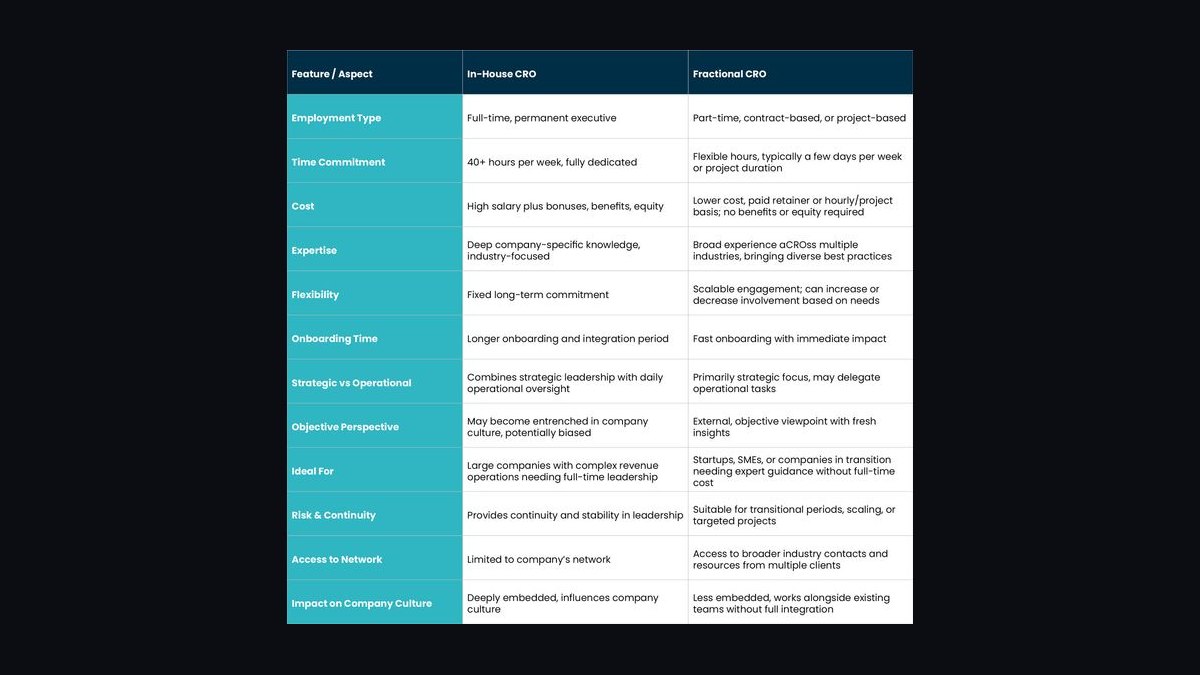
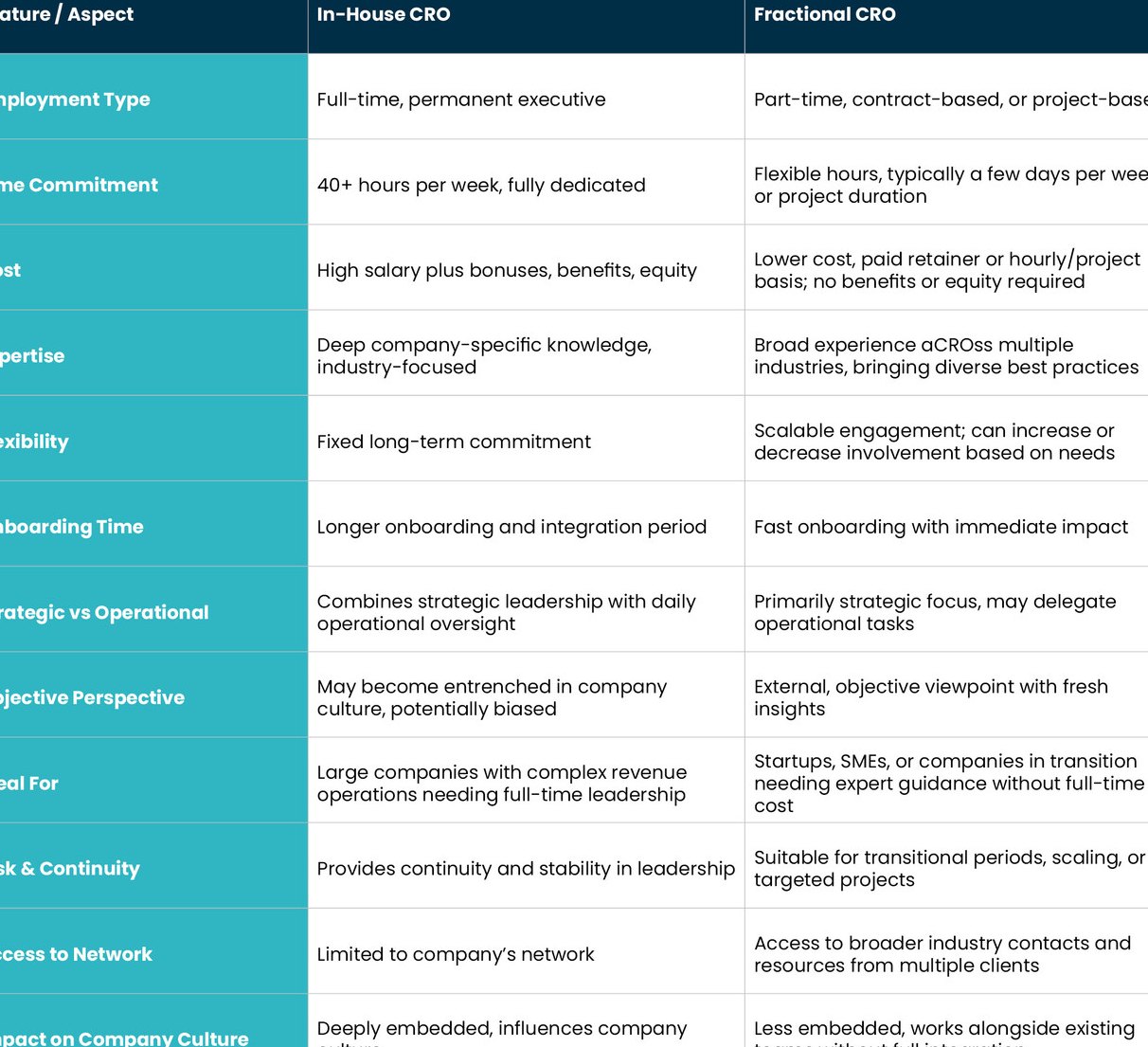
Fractional CRO. A senior revenue operator who takes 2–4 concurrent clients, allocates you a fixed 5–15 days a month, and holds standing authority inside your company: they run the pipeline review, they sit in the weekly forecast call, they have an opinion on who gets fired. The engagement is ongoing and renewable, usually monthly after an initial 90-day term. This is the right shape when you have revenue but no revenue *system* — reps closing on personality, a forecast nobody believes, and a founder who is still the best closer in the building.
Interim CRO. Superficially similar, structurally different. Interim is full-time or near-full-time, single-client, and explicitly temporary: your CRO left, you have a board meeting in eleven weeks, and someone has to own the number while you run a search. Interim rates run materially higher than fractional per month because the person has no other clients to spread fixed cost across. If you are searching "fractional" but what you actually have is a vacancy with a deadline, you want interim, and hiring fractional into that hole produces a person who is present two days a week for a problem that needs five.
Sales consultant or GTM advisory firm. Deliverable-driven. You buy a diagnostic, a territory model, a comp plan redesign, a messaging framework. The artifact arrives, it is often genuinely good, and then it sits in Google Drive because nobody inside the company owns the behavior change. Consultants are excellent when your problem is *analysis* — you cannot see why win rates fell — and weak when your problem is *execution*, which is most of the time. The tell: a consultant's contract lists documents; a fractional CRO's contract lists outcomes and meetings they will personally run.
Player-coach VP of Sales, full-time. Cheaper per hour than any fractional arrangement and permanently available, which matters more than founders expect. The catch is the hiring market: a real Twin Cities VP of Sales search runs 8–14 weeks from opening the req to a signed offer, plus 30–60 days of notice at their current employer, plus a 90-day ramp. You are five to seven months from productive output. Fractional's entire economic argument is that it collapses that timeline to about two weeks.
Sales-as-a-service and outsourced SDR shops. These solve top-of-funnel volume, not revenue leadership. They will book you meetings. They will not fix your discovery process, tell you your pricing is wrong, or rebuild a comp plan that is quietly paying reps to discount. Some Minneapolis founders buy outsourced SDR when the actual constraint is late-stage conversion, then conclude "outbound doesn't work here" after two quarters.
RevOps contractor. Worth naming because the confusion is common and expensive. A RevOps contractor fixes the machinery — Salesforce hygiene, lifecycle stages, routing rules, attribution, forecast fields that actually roll up. A fractional CRO decides *what the machine should do*. If your CRM is a swamp, hiring a CRO first means paying executive rates for someone to discover that your data is unusable. Sequence the RevOps cleanup first, or scope both and let the CRO direct the contractor.

How to choose between them
The decision is mostly a function of three variables: ARR, whether you have a revenue team or just reps, and whether your gap is thinking or doing.
Under roughly $2M ARR, fractional is almost always correct. You cannot carry a full-time executive comp package, and honestly you do not need forty hours of executive attention a week — you need someone senior to tell you which twelve things not to do. Between $2M and $10M, it depends entirely on whether the work is design or management. Building a playbook, standing up a first sales team, fixing a leaky funnel: fractional handles that. Managing eight reps day to day with daily coaching and deal-level involvement: that is a full-time job and fractional will underserve it. Above $10M with a multi-function revenue org — SDRs, AEs, CS, enablement, ops — you need a permanent CRO who owns the org chart and sits in front of the board.
Minneapolis adds a wrinkle to this math. The metro's B2B economy skews toward medtech, industrial and manufacturing software, ag-tech, fintech, and enterprise SaaS serving large regional employers — sectors with long, committee-driven, relationship-weighted sales cycles. That profile changes the calculus: a nine-month regulated enterprise cycle rewards continuity and relationship depth, which argues for full-time sooner than the raw ARR number suggests. Conversely, a Twin Cities product-led SaaS company with a two-week cycle can run fractional considerably further up the revenue curve because the system, not the relationships, does the closing.
One more filter that founders skip: ask whether the problem is actually revenue. A shocking share of "we need a CRO" conversations are really product-market fit conversations wearing a costume. If your churn is 4% monthly, no revenue leader on earth fixes that — you are pouring water into a bucket with a hole. A good fractional CRO will tell you this in the first call and decline the engagement. That refusal is a strong buy signal about the person, even though it means they will not be taking your money.

Where the Minneapolis supply actually lives
The practical question is not "should I hire fractional" but "where are these people." Six channels, ranked by hit rate in my experience of how these searches actually resolve.
Investor and board referrals. Highest quality, lowest volume. If you have institutional money — Arthur Ventures, Bread and Butter, Great North, M25, or any of the Midwest funds active in the Twin Cities — your partner has watched a dozen portfolio companies hire fractional leaders and knows who delivered. Ask for two names and, crucially, one anti-referral: who did they see fail. That second question gets you far more signal than the first.
Revenue-leader communities. Pavilion is the largest and most structured; its members are working revenue executives, and its job board and member directory both surface fractional availability. CRO Syndicate is a smaller network specifically organized around senior revenue practitioners taking fractional and interim work. RevOps Co-op skews toward operations rather than leadership but is a fast way to find the RevOps contractor half of the equation. Expect to spend a few weeks inside these communities before referrals flow — they reward participation, not extraction.

Twin Cities founder and tech groups. Minnedemo and the broader Minnestar orbit, Beta.MN, the local SaaS and B2B founder Slack groups, and the medtech-adjacent operator networks around the Medtronic and Boston Scientific alumni diaspora. This last one is underrated: Minneapolis has an unusually deep bench of people who sold complex, regulated, long-cycle products, and a meaningful number of them have gone independent. If you sell into hospitals, health systems, or regulated industrial buyers, that alumni network is your best channel and almost nobody outside the Twin Cities can access it.
LinkedIn, used properly. Not "fractional CRO Minneapolis" as a search string — that surfaces mostly people marketing themselves rather than people booked solid. Instead, search for VP Sales and CRO titles at Minneapolis companies in your sector that exited or were acquired in the last three years, then filter for who currently lists independent or advisory work. The people who are actually good are usually two or three degrees away and not advertising.
Fractional marketplaces and talent platforms. Continuum, Bolster, and Toptal's executive tier all place fractional revenue leaders. Marketplaces are fast and give you a vetted-ish shortlist within days, but you pay a platform margin and the matching is coarser than a warm referral. Useful as a parallel track, rarely as your only one.
Boutique search firms. Some Twin Cities recruiting shops now run fractional placement alongside permanent search. Worth a call if your first two channels come up dry, though the fee structure often makes little sense for a six-month engagement.

Run at least three channels simultaneously. A single-channel search takes six weeks and yields three candidates; a three-channel search takes the same six weeks and yields twelve, which is the difference between choosing and settling.
Costs, timelines, and expected impact
Fractional pricing is national, not local. Do not expect a Minneapolis discount — the market for senior revenue talent cleared into a remote-first equilibrium years ago, and a strong operator in St. Paul prices against San Francisco demand, not against Twin Cities cost of living. What varies is the *shape* of the deal, not the geography.
How pricing is structured. Nearly every fractional CRO prices as a monthly retainer tied to a committed day count, not hourly. Three common tiers:

- *Strategic advisory, roughly 4–6 days a month.* A standing weekly call with the founder, a quarterly revenue plan, review of pricing and comp changes, and availability for ad hoc decisions. Appropriate when you have a functioning sales motion and need judgment, not hands.
- *Operating leadership, roughly 8–12 days a month.* The common midpoint for a Series A or early Series B B2B company. Includes weekly pipeline reviews they personally run, rep coaching, interviewing and scoring candidates for your first hires, a rebuilt sales process, and a board-ready monthly revenue report.
- *Deep engagement, roughly 14–20 days a month.* Approaching interim territory. Direct deal involvement, board presentations, full ownership of the revenue calendar. Priced at a meaningful premium per day because it crowds out their other clients.
Equity. Some fractional CROs will take 0.5%–2% equity, typically on a shorter vest than an employee grant — often two to three years with a six-month or one-year cliff — in exchange for a cash reduction of roughly 20–40%. Two guardrails. First, only offer equity to someone committing at least six months; equity to a three-month engagement is dilution for nothing. Second, insist on a cliff. The purpose of the cliff is to make the first ninety days a real test rather than a formality.
What actually goes on the invoice beyond the retainer. Travel, if they are remote and visiting quarterly, typically lands on you and should be capped in writing. Tooling they request — a Gong seat, a Clari license, a data provider — is yours. Contract review for a new MSA template is yours. None of these are large, but unbudgeted they generate friction in month two, which is the worst possible moment.
Timeline to signal. Search takes 4–8 weeks from decision to signed contract if you run multiple channels; longer if you insist on someone physically in the Twin Cities. First 30 days is diagnostic — CRM audit, listening to twenty recorded calls, interviewing every rep and two lost customers. Do not expect pipeline movement in month one and be suspicious of anyone who promises it. Days 30–90 is where you should see leading indicators move: meeting-to-opportunity conversion, stage-progression velocity, forecast accuracy against actual. Lagging indicators — bookings, win rate, ACV — realistically take 90–180 days, and in a nine-month medtech cycle they take longer than the engagement itself, which is exactly why you must agree in advance on which *leading* metrics constitute success.
What "good" looks like at day 90. A written revenue plan you could hand a board member. A documented sales process with defined stage-exit criteria that reps actually use. A forecast within roughly 15% of actual, which for most companies is a dramatic improvement. A hiring scorecard and at least one hire made or one underperformer exited. If none of those exist at day 90, the pilot failed, and the 30-day out clause exists so that failing costs you three months rather than a year.
Vetting: the questions that separate operators from the recently unemployed
The single biggest failure mode is hiring someone who is between jobs and calling it fractional. Real fractional practitioners have a portfolio, a waitlist, and a habit of turning down work. Five questions that surface the difference fast.
"What were the ARR ranges of your last three clients?" You want overlap with yours. Someone whose entire portfolio is $30M+ companies will bring processes that crush a $2M team under governance it cannot carry. Someone whose portfolio is entirely pre-revenue lacks the rigor you need at $6M. Stage fit beats industry fit almost every time.
"Tell me about an engagement that didn't work, and why." A confident operator has one and will describe it in structural terms — wrong stage, founder wouldn't delegate, product problem masquerading as sales problem. Someone who has only glowing outcomes across a decade is either lying or has never taken a hard engagement. Ask to speak to that client. The reference call where things went sideways teaches you more than three happy ones.
"How many clients do you have right now, and how many days are genuinely uncommitted?" "Unlimited availability" is a red flag, not a feature. It means either no demand or an intent to overcommit. You want a specific number of days and a specific week they can start.
"Walk me through your tech stack fluency." They should be able to audit Salesforce or HubSpot at a working level, read Gong or Chorus call data, and have opinions about Clari or Outreach without needing to be an admin. If they cannot open your CRM and tell you within an hour why the forecast lies, they will be dependent on whoever can — and that dependency slows everything.
Industry adjacency, not identity. You do not need someone from your exact vertical. You need someone who has sold to a structurally similar buyer. Enterprise software sold into hospital systems maps well onto medtech. Long-cycle industrial sold to plant managers maps onto manufacturing software. SMB e-commerce sold self-serve maps onto neither. For Minneapolis specifically, ask directly about regulated and committee-driven buying: FDA-adjacent procurement, IT security review, multi-stakeholder consensus. A candidate who has only sold into fast-moving West Coast tech buyers will misread the Midwest pattern where three additional internal meetings before signature is normal rather than a stall signal.
Implementation and handoff details
Signing the contract is where most engagements are quietly decided, because scope, authority, and access get set in that document and are painful to renegotiate later.
Authority. Write it down. A fractional CRO needs the standing of a full-time one inside their domain: they run the pipeline review, not attend it; they have veto over revenue hires; they can recommend termination of an underperformer and expect that recommendation to carry weight; they attend board meetings or at minimum author the revenue section of the board deck. Founders who withhold this get consultant-quality output at CRO prices and then blame the model.
Access, granted on day one. CRM read/write, Gong or equivalent call recording, Slack including the sales channels, the data warehouse or BI layer, marketing automation, and the board materials for the last four quarters. Every day of access delay is a day of the diagnostic window burned. If your security posture makes this slow, start the process before the contract is signed.

Scope fence. Write down what they are *not* doing. Common over-scoping traps: customer support escalations, marketing content production, product roadmap prioritization, fundraising support, and recruiting outside the revenue function. Each is reasonable in isolation and collectively they consume the entire retainer. Also be explicit about whether they carry a bag. Most fractional CROs coach and build; direct closing is a premium service and should be scoped and priced separately if you want it.
Cadence. Weekly founder 1:1, weekly pipeline review they run, weekly team standup they attend, monthly written revenue report, quarterly on-site if remote. That on-site matters more than it sounds — trust with a sales team is built in person, and a leader nobody has met in a room struggles to hold reps accountable in a way that sticks.
Plan the exit at the start. Fractional is by design temporary. Beyond twelve months you are either paying a premium for something that should be permanent, or you have built dependency on a person rather than a system. The good version of month nine is a documented playbook, a trained internal owner, a functioning forecast process someone else runs, and a hiring plan for the permanent leader — with the fractional CRO helping you interview their own replacement. Write that into the contract as a deliverable. The operators who resist it are optimizing for retainer duration, and that is a different set of incentives than yours.
A note on the RevOps handoff. Whatever the fractional CRO builds — stage definitions, scoring, forecast categories, comp mechanics — needs an owner inside your company once they leave. If you do not have a RevOps person, that owner is realistically your finance lead or a senior AE with an operations streak. Identify them in month two and have them shadow the process build. The failure pattern is a beautiful revenue system that decays within a quarter of the CRO's departure because nobody was ever taught to maintain it.
Related questions
What does a fractional CRO cost compared to a full-time hire?
Fractional retainers are meaningfully cheaper in total cash than a full-time CRO once you count base, bonus, benefits, payroll tax, and equity — but far more expensive per hour. The value is speed and optionality: no severance risk, no 90-day ramp, and you can exit on 30 days.
Do I need someone physically located in Minneapolis?
Not usually. Remote-first is standard and the strongest candidates are national. What matters more is whether they understand Midwest buying behavior — consensus-driven, relationship-weighted, slower to sign. Require a quarterly on-site visit and treat local residence as a mild preference, not a filter.
Should I hire RevOps or a fractional CRO first?
If your CRM data is untrustworthy, fix operations first or scope both together. A CRO whose first month is spent discovering that pipeline stages are meaningless has burned executive-rate time on a contractor-rate problem.
How do I know the engagement is working before revenue moves?
Watch leading indicators: meeting-to-opportunity conversion, stage-progression velocity, forecast accuracy versus actual, and rep activity quality on recorded calls. In a long medtech or industrial cycle, bookings will not move inside 90 days even when everything is going right.
Can a fractional CRO convert to full-time?
Sometimes, and it is a clean outcome — you have effectively run a six-month working interview. But many career fractional operators genuinely prefer portfolio work and will decline. Ask early whether conversion is on the table so you are not planning around an unavailable option.
FAQ
How is a fractional CRO different from a sales consultant?
A consultant delivers documents; a fractional CRO delivers behavior change. The consultant hands you a diagnostic and a recommended territory model, then leaves. The fractional CRO runs your Monday pipeline review, coaches the rep who keeps skipping discovery, and personally owns whether the forecast is accurate. If your problem is that you cannot see what is wrong, hire a consultant. If you can see it and nothing changes, hire a fractional CRO.
How long should the engagement run?
Three to six months is the standard initial term, structured as a 90-day pilot with a 30-day out clause and then monthly renewal. Twelve months is a reasonable ceiling for a company growing fast. Past that point you should either convert to a full-time leader or accept that you have made a permanent hire at a premium rate without the permanence.
What if it is not working?
That is what the 30-day termination clause is for, and any fractional CRO who refuses one should be passed over. Before pulling the trigger, though, check whether the failure is theirs or structural: withheld authority, blocked CRM access, a founder still running deals in parallel, or an underlying product problem will all produce a stalled engagement regardless of who you hired.
Will a fractional CRO close deals for us?
Usually not, and you should not want them to. Most fractional operators are coaches and system-builders, and a leader who becomes your best closer creates exactly the dependency you were trying to escape. Some will carry a bag as a premium add-on; scope and price that separately rather than assuming it is included.
How many clients will they have besides us?
Two to four is typical and healthy — it is evidence of demand and it means they see patterns across companies. What matters is the committed day count in writing and a named start week. Someone claiming full availability is either not in demand or planning to overcommit, and both end the same way.
Is Minneapolis pricing lower than coastal markets?
No. Fractional revenue leadership prices nationally, and a strong operator competes for remote engagements against San Francisco, New York, and Austin demand regardless of where they live. Budget against national benchmarks. What Minneapolis does give you is access to a deep medtech and industrial-software operator bench that other metros simply do not have.
Sources
- Pavilion — membership community for revenue leaders, with member directory and job board
- RevOps Co-op — community for revenue operations practitioners
- Harvard Business Review — research and analysis on executive employment models and interim leadership
- First Round Review — practitioner guidance on startup executive hiring and go-to-market leadership
- SaaStr — benchmarks and operator content on SaaS sales leadership and hiring stages
- Minnestar — organizer of Minnedemo and Twin Cities technology community events
- Bolster — marketplace for fractional and on-demand executives
- LinkedIn — professional network search for revenue leadership and independent operator profiles
Related on PULSE
- [What does a fractional Chief Revenue Officer engagement cost in Minneapolis in 2027?](/knowledge/tl16618)
- [How much does an interim Chief Revenue Officer cost in Minneapolis in 2027?](/knowledge/tl16486)
- [Is there a fractional Chief Revenue Officer available near me in Minneapolis in 2027?](/knowledge/tl16149)
- [How much does an outsourced CRO cost in Minneapolis in 2027?](/knowledge/tl12487)
- [How do I hire a fractional CRO in Tulsa in 2027?](/knowledge/tl9705)
This page will be disappearing soon. Save it to your device for $1 — or read it free while it is here.
@Kory-White- · if Venmo asks, the last 4 of my number are 2012
 pulse-toolsHow do I evaluate a fractional CRO in San Diego in 2027?
 pulse-toolsHow do I find a fractional CRO for a life sciences company in Central Texas in 2027?
 pulse-toolsWhat KPIs should a fractional CRO own at a clean energy company in 2027?
 pulse-toolsShould I Hire a Fractional CRO If I Need a 30-60-90 Plan Before a Board Meeting in 2027?
 pulse-toolsHow do I hire a fractional head of revenue in Seattle?
 pulse-toolsHow do I find a fractional CRO in Frederica in 2027?
 pulse-toolsIs there a fractional CRO available near me in the Gulf Coast in 2027?
 pulse-toolsWhere do I find a fractional head of revenue in Orlando in 2027?
 pulse-toolsHow do I find a fractional CRO in Christiana in 2027?
 pulse-toolsShould I Hire a Fractional CRO If I Need to Stand Up RevOps From Scratch in 2027?