
How do I hire a fractional revenue leader for a real estate company in 2027?
 Curated byKory White · Fractional CRO · Maryland
 PULSEKNOWLEDGE LIBRARY
Quality
Certified

Hire a fractional revenue leader for a real estate company by scoping outcomes first, then recruiting someone with genuine real estate deal fluency — commission splits, broker relationships, multi-year cycles — not a generalist SaaS operator. Run a 30-60 day paid assessment, then a 6-18 month execution retainer with a defined days-per-month commitment and a 30-day exit clause.
What a fractional revenue leader actually is, and what it competes against
A fractional revenue leader is a senior operator — usually someone who has carried a real number as a CRO, VP of Sales, or GM — who sells you a slice of their week instead of their whole week. In practice that slice runs anywhere from one or two days a month for pure advisory work up to fifteen days a month for an embedded, hands-on engagement where they are effectively running your sales floor part-time. They are not a consultant who produces a deck and leaves, and they are not a recruiter's stopgap. The defining characteristic is that they hold accountability for revenue outcomes while being paid on a retainer rather than a salary.
For a real estate company, the alternatives you are realistically weighing look like this:
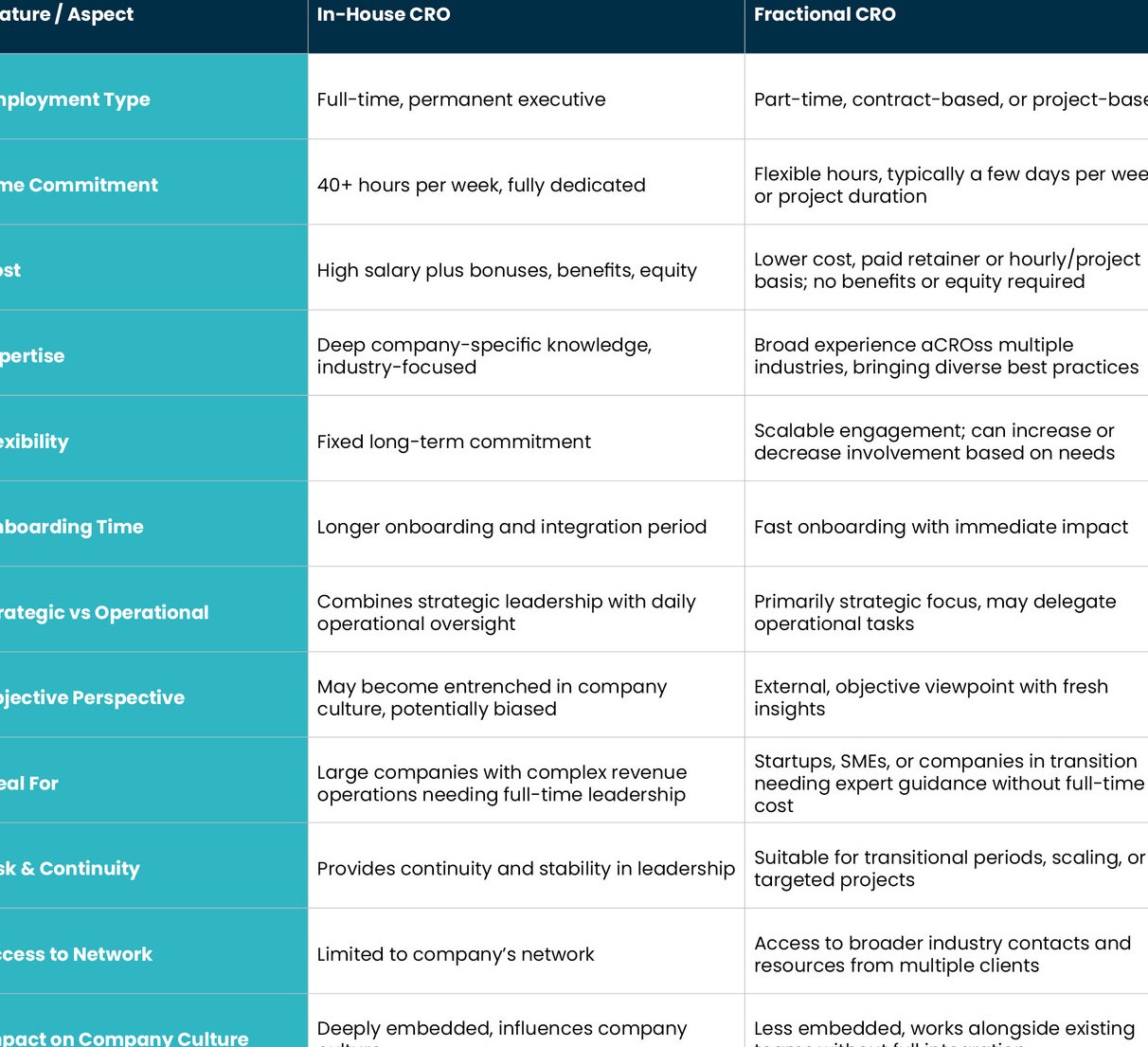
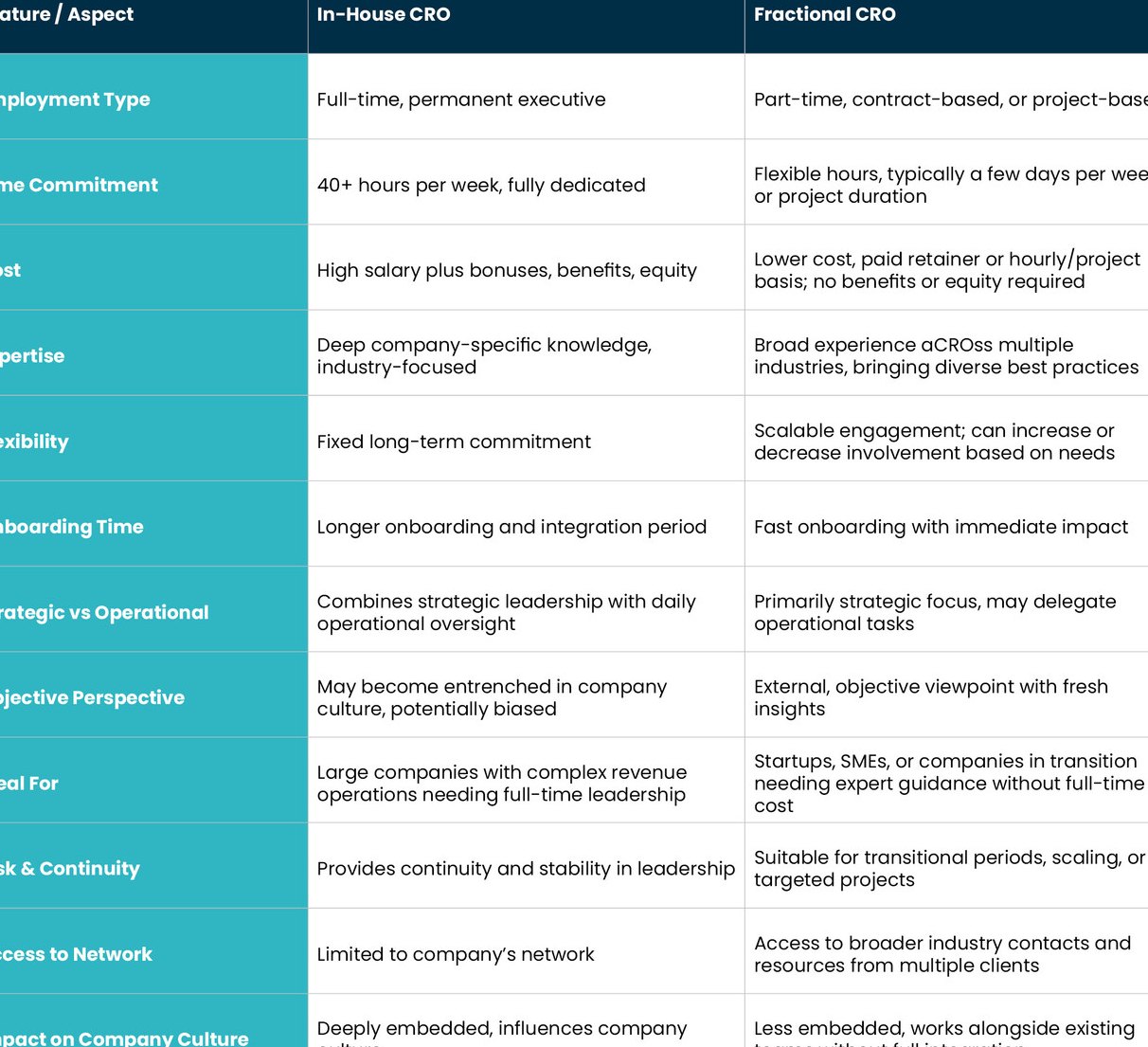
A full-time VP of Sales or CRO. Forty-plus hours a week, all of it yours. Add salary, equity, benefits, payroll tax, recruiting fees (often 20-25% of first-year comp through a search firm), and a four-to-eight week search followed by a three-month ramp. The upside is total focus and permanence. The downside is that you are making a multi-year bet on a single person before you know whether the role you wrote is the role you actually need.
A sales manager promoted from inside. Your top-producing agent or broker gets a title. Cheap, fast, culturally safe. The failure mode is well documented across industries: the best individual producer is frequently the worst manager, because the skills that close a deal are not the skills that build a system that closes deals repeatedly. In real estate this is especially acute because your top producer's book of business is personal — promoting them often costs you production without buying you leadership.

A traditional management consultant or agency. They will audit, benchmark, and hand you a strategy document. Useful when you genuinely do not know what is wrong. Less useful when you already know what is wrong and need someone to stand in the room every week and make it happen. Consultants generally do not own a number.
A RevOps contractor or systems implementer. Someone who configures your CRM, wires up reporting, and builds the pipeline hygiene layer. This is a real and valuable role, and it is not the same job. A RevOps specialist makes your data trustworthy; a revenue leader decides what to do about what the data says. Small companies often confuse the two, buy the implementer, and then wonder why revenue did not move. If your problem is "our pipeline data is garbage," hire the RevOps contractor. If your problem is "we have no repeatable way to source and close deals," hire the fractional leader — and expect them to bring or recommend a RevOps resource underneath them.
Doing nothing and having the founder keep running sales. Legitimate for a very long time in real estate, where the founder's relationships often *are* the pipeline. The moment to stop is when the founder becomes the bottleneck — when deals are stalling because one person cannot be in enough rooms, or when the founder's time is worth more on capital, land, or entitlement work than on chasing broker follow-ups.

The honest framing: fractional leadership wins when you need senior judgment more than you need senior hours. Real estate companies under roughly $3-5M in revenue with fewer than five sellers usually fit that description exactly.
How the real estate context changes the hire
Do not skip this section by assuming revenue leadership is portable. Some of it is. A meaningful chunk is not.
Cycle length reshapes everything. A commercial lease, a land acquisition, or a development-adjacent sale can run six to eighteen months from first conversation to signature. That means the feedback loop on any change your fractional leader makes is brutally slow. You cannot judge them on closed revenue in month three — there is no closed revenue in month three that they influenced. You judge them on leading indicators: qualified pipeline created, meetings held with the right buyer profile, stage-conversion movement, forecast accuracy. Anyone who does not immediately reframe the scorecard toward leading indicators either has not worked in a long-cycle business or is planning to take credit for deals that were already in flight.
The buyer is not one person. In a SaaS deal you have an economic buyer, a champion, and a procurement gate. In real estate you may be simultaneously managing a broker who controls access, an investor with return thresholds, a tenant with operational needs, a lender with underwriting constraints, and a municipality with entitlement timelines. Each has a different definition of "yes." A revenue leader who has only run a single-threaded software motion will build a pipeline model that cannot represent this, and your CRM will start lying to you within a quarter.

Compensation is structurally different. Splits, tiers, referral fees, and desk fees are the water your producers swim in. Redesigning comp is one of the highest-leverage things a revenue leader does — and one of the fastest ways to destroy a brokerage if done carelessly. Ask any candidate directly: have you ever changed a commission split at a company where the producers could walk to a competitor next week and take their book with them? The answer to that question separates real estate fluency from theory.
Cyclicality is not an edge case, it is the operating condition. Rate moves, cap-rate compression, a major tenant downsizing, a zoning change, a local employer leaving town — these reset your plan mid-year. What you are testing for is whether the candidate has actually replanned a revenue target inside a down cycle rather than only riding a good one. Ask for the specific story: what got cut, what got protected, how the team was told.
Where the good candidates come from. Realistically: commercial brokerage leadership, proptech go-to-market roles, property management or multifamily operators with a real sales function, title and mortgage sales leadership, and construction or development business-development heads. A pure enterprise-software CRO can absolutely succeed here, but only if they are humble about the domain and you budget three extra months of ramp for it. Be explicit with yourself about which trade you are making — domain fluency or systems rigor — because very few candidates are top-decile at both, and the one who claims to be is usually overselling.
Adjacent industries worth borrowing from. If your local supply of real-estate-native fractional leaders is thin, widen the net to businesses with structurally similar motions: commercial insurance, equipment leasing, wealth management, franchise development, and construction services. All of them feature long cycles, relationship-gated access, referral economics, and producer-style comp. A candidate from one of those worlds will transfer far better than someone from a transactional, high-velocity motion.

How to choose between the options
Work the decision in order — scope, then structure, then person. Most bad fractional hires are bad scoping decisions wearing a person's face.
Step one: write the outcomes, not the role. Three to five specific outcomes with dates. "Build a repeatable broker-referral engine that produces twelve qualified opportunities a month by day 120." "Get the CRM to a state where the forecast is within 15% two quarters running." "Train four agents on the lease-renewal conversation and lift renewal rate off its current baseline." If you cannot write outcomes at that resolution, you are not ready to hire — you are ready to buy a two-week diagnostic from someone, which is a different and much cheaper purchase.
Step two: audit what already exists. Pipeline by stage and age. Where leads actually come from, honestly measured, not as the founder remembers it. What tools you own and which ones people actually open. Skill gaps by person. This audit determines whether you need strategy (you know what to do, execution is failing) or diagnosis (you genuinely do not know where revenue leaks).
Step three: pick the engagement shape — advisory, embedded, or player-coach. Advisory is one to three days a month, heavy on planning and coaching, light on doing. Embedded is five to fifteen days a month with real management responsibility. Player-coach is the early-stage answer: the leader personally works deals alongside building the system, which is the only model that makes sense when you have almost no team to lead yet.

Step four: source deliberately. Operator communities such as Pavilion, RevOps-focused networks, fractional-executive marketplaces, and your own investor and board network. LinkedIn works if you search by prior-title-plus-industry rather than by the words "fractional CRO," which surface a lot of people who are between jobs rather than committed to the model. Referrals from other founders in property-adjacent businesses are the highest-yield channel by a wide margin.
Step five: interview for fluency, then reference for behavior. Scenario questions beat resume questions. And when you check references, call companies in real estate specifically — a glowing reference from a Series B software company tells you little about whether this person can hold a room full of brokers.
Costs, timelines, and what impact to actually expect
Pricing for fractional revenue leadership is set by three variables: days committed per month, depth of accountability, and the seniority of the operator. Rather than quoting a number that will be wrong for your market, price the engagement the way the market actually prices it — build up from days.

Ask every candidate for their day rate or their monthly retainer at a stated number of days, and normalize all your candidates to the same unit so you can compare them. Then sanity-check that monthly figure against what a full-time hire at the same seniority would cost you fully loaded — salary plus equity plus benefits plus payroll tax plus recruiting fee amortized over expected tenure. Fractional is usually a meaningful discount on that fully loaded number, but not always, and it is emphatically not a discount if you scope fifteen days a month. At that point you are paying near-full-time money for part-time presence and you should just hire someone.
Common structures you will encounter:
- Flat monthly retainer for a fixed day commitment. Cleanest, easiest to budget, most common.
- Retainer plus performance component tied to a defined metric — qualified pipeline, closed volume, or a milestone like "CRM live and adopted." Make the metric measurable before you sign it, and make sure it is a metric the leader genuinely controls.
- Retainer plus small equity grant, typically with a short vest, common in early-stage and founder-friendly arrangements. Reasonable when cash is tight, but understand you are trading a cheap month now for a permanent slice of the company.
- Assessment-priced-separately, where the diagnostic phase is a fixed fee and the execution phase is a larger retainer. This is the structure most worth pushing for, because it gives both sides a low-cost exit before anyone is committed.
On timeline, plan for this shape:

Days 1-30. Access, listening, and data. The leader is in your CRM, sitting on calls, interviewing your producers, and reading your contracts. You should see a written diagnostic — specific, not "improve your sales" — by the end of it.
Days 30-90. First structural changes land. Usually pipeline stage definitions, a qualification standard, forecast cadence, and a weekly operating rhythm. Leading indicators start moving here: meeting volume, opportunity creation, stage aging.
Months 3-9. The heavy build. Playbook, comp adjustments if warranted, hiring or upgrading seller roles, dashboard build, coaching cadence. Closed-revenue impact begins showing up in this window, and in long-cycle real estate it may not show meaningfully until the back half of it.
Months 9-18. Either you renew with a narrower scope, or you transition to a full-time leader. Both are good outcomes. What is not a good outcome is a fractional engagement drifting into year three with no plan.

On expected impact: be deeply skeptical of anyone promising to double revenue in ninety days. In a business with six-to-eighteen-month cycles, that promise is arithmetically implausible. When a candidate makes a growth claim, make them walk the math out loud — how many deals, at what average size, at what stage-conversion rate, arriving over what period? A candidate who can do that on the spot is telling you how they think. A candidate who deflects is selling.
Reasonable early expectations are qualified-pipeline growth, better forecast accuracy, shorter time-in-stage, and clearer producer accountability inside the first two quarters. Revenue follows, later, and its timing is governed by your cycle length, not by the leader's effort.
Budget for the hidden costs too: CRM licenses and possible migration, a data-cleanup effort that almost always turns out bigger than expected, sales enablement or call-recording tools, and the internal time your team spends being coached. A fractional leader who does not surface these costs in the first month is not being straight with you.
Implementation, governance, and the handoff
The engagements that fail rarely fail on talent. They fail on access, cadence, and exit.

Access. On day one the leader needs CRM admin, pipeline history, the actual comp plans, win-loss context, and permission to talk to producers without the founder in the room. If you are not willing to grant that, you do not want a revenue leader, you want an advisor — which is fine, but scope it that way and pay accordingly.
Cadence. Weekly leadership sync, weekly pipeline review with the sellers, monthly business review with the founder against the written outcomes, quarterly replan. Put an on-site visit on the calendar at some interval — monthly if your business runs on in-person broker relationships, quarterly if it does not. Remote fractional work is entirely normal now, but real estate is a handshake business in more markets than not, and a leader who never appears in the room loses standing with producers fast.
Conflict rules, written down. A fractional leader has other clients. Agree explicitly on what happens when another client has a crisis in your week, how much notice you get, and whether unused days roll forward. Ask the question in the interview — "what happens in a month where you can only give us two of the five agreed days?" — because the answer reveals whether you are hiring a partner or a contractor.

Documentation as a deliverable, not a favor. Every process, playbook, dashboard definition, and comp rule lives in your systems, in your account, owned by you. Write it into the agreement. The single most common failure mode in fractional engagements is that the leader leaves and the operating system leaves with them, because it lived in their head and their Google Drive.
Governance against your own optimism. Review at the 30-day mark against the diagnostic, at 90 days against leading indicators, and at 180 days against outcomes. Use the exit clause without drama if two consecutive reviews miss. A 30-day out is standard and is protection for both parties.
The handoff. Plan it from the start, because a good fractional leader is trying to make themselves unnecessary. When you are ready for a full-time hire, the fractional leader should write the role definition, sit on the interview loop, and stay engaged for one to three months of overlap to transfer relationships and context. That overlap is cheap insurance — losing the playbook in the gap between two leaders is how companies give back a year of progress.
Downstream effects worth anticipating. A real revenue leader will surface problems that are not sales problems: marketing that generates unqualified volume, a services or property-management team that creates churn, pricing that is set by feel, a founder who overrides the process on their favorite deals. Expect that. The engagement is worth more when it produces those uncomfortable findings than when it produces a tidy dashboard. Decide in advance that you want the truth, because the fastest way to waste this hire is to bring in a senior operator and then protect every sacred cow they identify.
Related questions
Should the fractional leader manage marketing too?
Only if you scope and pay for it. Many revenue leaders can oversee demand generation, but real estate marketing spans listings, brand, and community presence. If marketing is genuinely broken, either widen the scope explicitly or hire a separate marketing resource who reports into the revenue function.
What if my team resists an outside leader?
Expected, especially with tenured producers. Mitigate it by having the founder announce the hire personally, framing the leader as building infrastructure rather than policing people, and giving the leader a visible early win that helps producers earn more rather than one that adds admin work.
Can one fractional leader serve multiple property types?
Yes, if the underlying motion is similar. Residential brokerage and commercial leasing are genuinely different businesses with different buyers and cycles. If you operate across both at scale, prioritize the segment that drives the most revenue and staff the other separately.
How do I know the engagement is working before revenue moves?
Watch leading indicators: qualified opportunities created per month, meetings with the right buyer profile, time-in-stage, forecast accuracy, and whether your weekly pipeline review has become a real decision meeting instead of a status recital.
Is a fractional leader worth it if I only have two salespeople?
Often yes, in player-coach form. With two sellers you are buying system design and personal deal help, not management overhead. Keep the day commitment low, keep the scope on process and pipeline, and revisit once headcount grows.
FAQ
How do I know if I need a fractional revenue leader versus a full-time VP of Sales?
Use revenue, team size, and clarity of the role. Under roughly $3M with fewer than five sellers, or when you are still discovering what the leadership role should be, fractional is the lower-risk purchase. Above $5M with a stable team that needs daily management and long-term ownership, hire full-time. The other tiebreaker is urgency: fractional can start in about two weeks, while a full-time search plus ramp typically consumes a quarter or more.
What should I look for in a candidate's real estate experience?
Specifics, not adjacency. Have they worked with brokerages, developers, property managers, or proptech companies? Can they explain how they handled commission splits, multi-year lease cycles, or a market downturn that reset their plan? Ask them to describe a comp change they made where producers could have walked. Candidates whose entire background is transactional software sales can succeed, but budget extra ramp and test their humility about the domain.
How long does a typical engagement last?
Most run six to eighteen months: a 30-60 day diagnostic, three to twelve months of execution, then a one-to-three month transition if you move to a full-time leader. Shorter than six months rarely produces durable change in a long-cycle business. Longer than eighteen months without a narrowing scope usually means the engagement has become a dependency rather than a build.
Can a fractional revenue leader work remotely for a real estate company?
Yes, and most do — weekly video calls, shared dashboards, and periodic on-site visits are the norm. The caveat is relationship density. If your business runs on in-person broker and investor relationships, insist on at least monthly on-site presence and treat local market familiarity as a real selection criterion rather than a nice-to-have.
How does a fractional revenue leader relate to RevOps?
They are complementary. RevOps builds and maintains the systems, data, and reporting that make performance legible; the revenue leader sets strategy, owns the number, and coaches the team. A fractional leader will frequently specify what the RevOps layer must deliver and either bring a contractor or direct an existing internal resource. Hiring only the systems half and expecting revenue leadership is a common and expensive mistake.
What is the single biggest reason these engagements fail?
Undefined outcomes. When nobody wrote down what success looks like with dates attached, the engagement drifts into open-ended advisory, both sides feel vaguely dissatisfied, and the relationship ends without a clear verdict. The second biggest reason is undocumented work — the leader leaves and the operating system leaves with them.
Sources
- Pavilion — community of revenue leaders and executives, including fractional operators
- Harvard Business Review — research and practice writing on sales leadership, compensation design, and executive hiring
- MIT Sloan Management Review — management research on organizational design and go-to-market strategy
- First Round Review — practitioner guides on hiring and scaling revenue teams
- SHRM — guidance on employment classification, contractor arrangements, and total compensation cost
- NAIOP — commercial real estate development association research and market context
- Urban Land Institute — real estate industry research and market cycle reporting
- National Association of Realtors — residential real estate market data and brokerage business research
- SaaStr — revenue leadership frameworks, adaptable with care to longer-cycle businesses
- LinkedIn — sourcing channel for operators by prior title and industry
Related on PULSE
- [How do I hire a fractional head of revenue for a real estate company in 2027?](/knowledge/tl14680)
- [How do I hire a fractional revenue leader for a financial services company in 2027?](/knowledge/tl13864)
- [How do I hire a fractional revenue leader for a dev tools company in 2027?](/knowledge/tl15217)
- [How do I hire a fractional revenue leader for a clean energy company in 2027?](/knowledge/tl14794)
- [How do I hire a fractional revenue leader for a government contracting company in 2027?](/knowledge/tl15263)
- [How do I hire a fractional revenue leader for a B2B SaaS company in 2027?](/knowledge/tl15114)
This page will be disappearing soon. Save it to your device for $1 — or read it free while it is here.
@Kory-White- · if Venmo asks, the last 4 of my number are 2012
This page is gone.
This one is off the shelf now. $1 keeps it on your phone for good — the whole page, pictures and diagrams included.
 pulse-toolsHow do I find a fractional CRO in San Antonio in 2027?
 pulse-toolsShould I Hire a Fractional CRO If I Need to Build a Partner Channel in 2027?
 pulse-toolsWhere do I find an outsourced CRO in Kansas City in 2027?
 pulse-toolsHow do I hire a fractional CRO in Maryland in 2027?
 pulse-toolsHow do I hire a fractional head of revenue in Birmingham in 2027?
 pulse-toolsHow do I hire a fractional CRO in Perryville in 2027?
 pulse-toolsWhat does a fractional CRO cost in Elkridge in 2027?
 pulse-toolsHow do I hire a fractional CRO in Ashburn in 2027?
 pulse-toolsHow do I evaluate a fractional CRO in Bellevue in 2027?
 pulse-toolsWhere do I find a fractional CRO in Maine in 2027?