
How do I hire a fractional VP of Sales in Alexandria in 2027?
 Curated byKory White · Fractional CRO · Maryland
 PULSEKNOWLEDGE LIBRARY
Quality
Certified

Contract a senior sales executive for 10–20 days per month under a written scope with named deliverables, not hours. Source candidates through Pavilion, RevOps Co-op, and founder referrals across the D.C. metro, screen for government-contracting and regulated-B2B deal experience, check two fractional references, and sign month-to-month with 30-day notice.
Running the search end to end
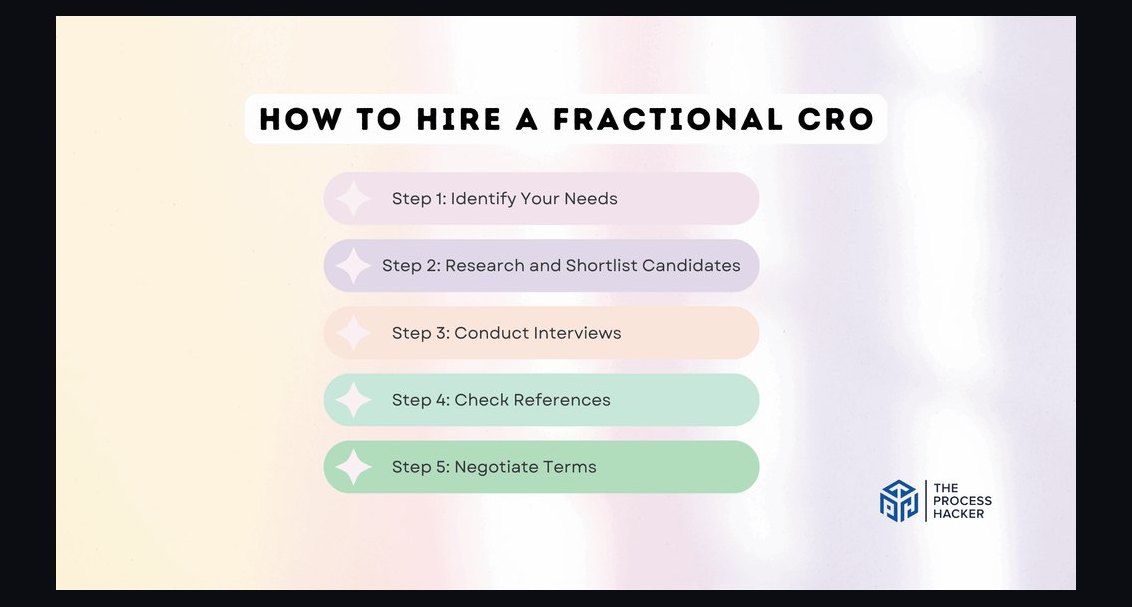
The hiring process breaks into six phases, and the failure almost always happens in phase one. Most founders open a search with "we need help with sales," which produces a candidate pool of generalists and a scope no one can be held to. Start instead by writing the outcomes you are buying. A usable scope statement reads like this: "Build a documented sales process for a $2M ARR SaaS product sold to federal prime contractors, coach three AEs toward $500K quotas each, and deliver a 90-day rolling forecast by day 90." That single paragraph does more filtering work than a job description, because half the candidates who read it will disqualify themselves.
Phase two is sourcing. Pavilion (joinpavilion.com) is the largest community of revenue executives and its member directory and job board are where most fractional VP of Sales engagements in the mid-Atlantic surface. RevOps Co-op covers the operations side and is useful when your gap is systems rather than selling. Beyond communities, the highest-conversion channel is founder referral — ask three founders in your stage who they used, and ask specifically who they used and did not renew. Expect five to ten serious applicants from a well-written scope, and expect two-thirds of them to be consultants repositioning as fractional operators.

Phase three is screening for Alexandria fit, which is a real filter and not geographic vanity. If your buyer is a federal agency, a defense prime, or a subcontractor in that chain, the deal mechanics are structurally different from commercial SaaS: multi-year procurement cycles, contracting officers rather than economic buyers, FAR and DFARS compliance language in every agreement, and personnel requirements tied to security clearances. A candidate who has only sold month-to-month commercial subscriptions will pattern-match your slow deals as pipeline problems and start pushing discount closes that do not work against a government buyer. Ask each candidate for one specific contract cycle they ran that involved procurement or compliance, and listen for whether they can name the vehicle, the timeline, and who actually signed.
Phase four is the interview, and the discipline here is to interview for process rather than stories. Ask the candidate to walk you through exactly how they would audit your pipeline in the first 30 days — what reports they would pull, what stage definitions they would test, which reps they would ride along with. Strong operators answer in nouns and sequence. Weak ones answer with anecdotes about a big deal they closed in 2021.
Phase five is references, and the only question that produces signal is a negative one: "What did they promise that they did not deliver?" Every engagement has one. A former client who cannot name it either did not pay attention or is protecting a friend. Follow it with "how did they handle the first missed month," because that is the month you are actually buying insurance against. Call two clients who used the person fractionally, not two colleagues from a full-time role — the fractional operating mode is different enough that a W-2 reference tells you little.

Phase six is the agreement. Month-to-month with 30-day notice on both sides, a deliverable list rather than an hour count, a stated communication cadence (weekly forecast call, weekly 1:1s with reps, monthly written summary to you or the board), and explicit tool access on day one: CRM, conversation intelligence, and whatever forecasting surface you use. Withholding CRM access for the first two weeks while legal reviews something is the single most common way a good engagement loses its first month.
Where the engagement creates or leaks revenue
The revenue case for a fractional VP of Sales is not "cheaper leadership." It is compressed time-to-competence. A full-time VP hire runs a 3–6 month ramp before they are making independent calls about your pipeline, plus a 60–90 day search before that. A fractional operator who has run this motion before is auditing your CRM in week one and running your forecast call by week three. If your company is doing $3M ARR and growing 40%, four months of leadership vacuum is a material amount of forgone pipeline, and that gap is the actual thing the retainer is buying back.

Value shows up in four concrete places. First, stage definition and exit criteria. Most sub-$10M sales orgs have stages named after internal activities ("demo done," "proposal sent") rather than buyer commitments, which makes every forecast a guess. Rewriting stages around verifiable buyer actions — a technical evaluation scheduled, a security review passed, a contracting officer named — typically moves forecast accuracy from something in the 40–50% range to something you can plan headcount against. Second, deal support on the top five to ten open opportunities. A fractional VP who personally joins those calls influences revenue this quarter, not next year. Third, rep-level coaching, which compounds: a rep at 60% of quota who reaches 90% is worth more than the entire retainer at most deal sizes. Fourth, the hiring assist — a good fractional leader helps you write the scorecard for and interview your eventual full-time VP, which is worth a lot given that a mis-hire at that level costs a year and a severance package.
The leaks are just as predictable. The largest is under-integration. If the fractional VP is treated as a vendor — kept off the exec meeting, given read-only CRM access, briefed secondhand — they cannot see the data that would let them diagnose anything, and you end up paying executive rates for opinions. The second leak is scope creep in the wrong direction: the engagement drifts into the operator personally closing deals every month, which feels productive and generates revenue, but leaves you with no process and a dependency you now have to unwind. Build a written expectation that deal involvement declines from month two to month five while process artifacts increase.
The third leak is duplicate leadership. If you already have a sales manager, and you drop a fractional VP above them without redefining who owns the forecast, the reps will route around whichever one is easier. Decide explicitly: either the fractional VP owns the number and the manager runs daily execution, or the manager owns the number and the fractional VP is a coach with no forecast authority. Both work; ambiguity does not. The fourth leak is measuring the engagement on activity — days worked, calls attended — instead of the deliverables you scoped. Hours are an input you are not actually buying.

There is a government-contracting-specific leak worth naming. In long procurement cycles, an operator new to the motion will try to "accelerate" deals with commercial tactics — discounting, end-of-quarter pressure, escalation to a champion's boss. Against a contracting officer working a defined evaluation timeline, those moves range from ineffective to disqualifying. The right acceleration levers are earlier: getting on the right contract vehicle, being written into requirements at the shaping stage, teaming with a prime who already holds the vehicle. If your candidate does not talk about vehicles and teaming, they will spend your quarter pulling levers that are not connected to anything.
Numbers and benchmarks worth anchoring on
Structure the engagement around days, not a vague retainer. Two common shapes exist. The light engagement is roughly 8–10 days per month: a weekly forecast call, weekly 1:1s with two or three reps, one working session on process, and asynchronous availability for deal escalations. The heavy engagement is 16–20 days per month and adds direct deal participation, hiring work, and board or investor reporting. The difference between them is not price per day so much as whether the person is genuinely inside your business or reviewing it from outside. Below about eight days a month, you get advice; the operator does not have enough surface area to own anything.

Compensation structures vary, and you should ask about all three components rather than a single number: a monthly retainer tied to the day commitment, an optional variable component tied to specific outcomes, and equity in some early-stage arrangements. Equity for fractional leaders is usually a small advisory-style grant with standard vesting and a cliff, not a full executive package. Be careful about tying a large variable component to closed revenue in a business with a 9–18 month government sales cycle — the operator will be paid on deals that were already in motion before they arrived, or they will get nothing during the exact period you need them focused on process. Outcome-based variable tied to artifacts (documented process, forecast accuracy, a hired rep who ramps) matches the fractional model better.
Stage benchmarks for the decision itself: under roughly $500K ARR, a fractional VP of Sales is usually premature, because you do not yet have a repeatable motion for anyone to systematize — the founder still needs to run enough cycles to know what actually closes. Between $1M and $10M ARR, fractional leadership is at its highest leverage: there is real pipeline to fix, real reps to coach, and not yet enough scale to justify a full package. Above roughly $10M ARR, you are usually hiring a full-time VP to build and run a team, and the fractional operator's best contribution is helping you hire that person and then handing off.
The cost comparison that matters is total cost, not salary line. A full-time VP of Sales at this level carries base, variable, benefits, payroll taxes, equity, and recruiting fees, commonly landing somewhere in the $250K–$350K all-in range depending on market and package — plus the ramp period where you are paying full freight for partial output, plus severance risk if the hire is wrong. That last item is underweighted: a wrong VP hire at a 30-person company costs the search, the salary, the team churn they cause, and roughly a year of momentum. The fractional structure converts that into a 30-day exposure.

Set concrete 90-day criteria at signing. Reasonable targets: a written, stage-defined sales process in the CRM by day 45; a 90-day rolling forecast with stated confidence tiers by day 60; documented coaching plans for every rep by day 60; and by day 90, forecast calls where the committed number lands within a defensible band of actual. Also set an activity floor you can observe — for example, the operator has personally been on calls in at least the top five open opportunities. If day 60 arrives with no artifacts and no observable movement, that is your escalation point, and the 30-day clause exists precisely so that conversation has teeth.
Pitfalls that sink these engagements
The consultant trap is the most common. Many candidates market fractional experience but deliver advisory work: a deck, a diagnosis, a recommendation, and no execution. The test question is direct — "If I miss my number in month two, what specifically do you do?" A real operator answers with an intervention they personally run: taking over the top three deals, running the forecast call themselves, sitting in on every discovery for two weeks, restructuring the territory. An advisor answers with what they would recommend that you do. Both answers can be delivered confidently; only one of them is someone who will own the number.

The second pitfall is the portfolio problem. Fractional executives serve multiple clients by design, and that is fine — but ask how many concurrent engagements they carry and what the largest one requires. Someone running five clients at 16 days each is not doing the arithmetic in your favor. Ask which days of the week they hold for you, whether they are reachable for a deal escalation on a non-scheduled day, and what happens if two clients have a crisis in the same week. Get the answer before you sign, not during your first bad month.
Third: hiring for the logo instead of the motion. A candidate who scaled a commercial SaaS org from $10M to $50M has genuine credentials and may still be wrong for you if your buyer is a contracting officer. Conversely, a career federal seller may not know how to build a modern outbound function. Match the candidate to your actual go-to-market, and if you need both — a commercial line and a public-sector line — say so explicitly during screening rather than hoping one person covers it.
Fourth: skipping the reference call because the person came referred. Referrals tell you someone is credible, not that they fit your stage or your motion. Make the two calls anyway, and make at least one to a client whose engagement ended.

Fifth: starting without data access. Agree in the contract that CRM, conversation intelligence, and revenue reporting access are provisioned on day one. If your security posture requires a background check or a clearance-adjacent process, start that before the contract start date, because a three-week access delay eats a third of your diagnostic window and you will still be billed for it.
Sixth: no defined exit. The engagement should have a stated end state — either conversion to full-time, a handoff to a hired VP, or a wind-down to advisory. Engagements without an end state drift into permanent partial leadership, which is the most expensive version of every option on the table. Write the intended endpoint into the agreement even if you expect to revise it.

Seventh, and specific to a thin local market: do not restrict the search to a ten-mile radius. Most experienced fractional revenue leaders in the D.C. metro live across Arlington, the District, and the Northern Virginia suburbs, and they work hybrid or remote by default. Someone based further out who travels in monthly is a completely workable arrangement. Require in-person presence only where it genuinely earns its cost — board meetings, key customer visits, a quarterly team offsite — and write those specific days into the scope rather than imposing a blanket location requirement that shrinks your pool for no return.
Selection checklist before you sign
Run every finalist through the same gate, in the same order, and write down the answers. Consistency across candidates is what lets you compare them; ad-hoc interviews produce a decision based on who was most charming in the room.
Start with motion fit: has this person sold into your buyer type, and can they name a specific cycle with the vehicle, timeline, and signer? Then process depth: can they describe a sales process they built from scratch, with named stages and conversion rates between them? If they cannot name a metric — lead-to-opportunity conversion, stage-to-stage fallout, average cycle length — they managed a process someone else built. Then people management: how do they handle a rep persistently at 60% of quota? The strong answer includes a documented improvement plan, joint calls, a defined timeline, and a willingness to make the replacement decision. Then tooling: they should be fluent in a CRM (Salesforce or HubSpot), a conversation intelligence platform (Gong or Chorus), an engagement tool (Outreach or Salesloft), and a forecasting surface (Clari or a disciplined spreadsheet). "I'll use whatever you have" without any depth behind it is a flag.

Then cross-functional alignment: ask how they work with marketing. Look for a shared qualified-lead definition, a recurring handoff meeting, and a feedback loop where sales reports back on lead quality. Then availability: concurrent client count, committed days, escalation reachability. Then references: two fractional clients, both asked the negative question. Then commercial terms: day commitment, retainer, any variable tied to artifacts rather than to deals already in flight, equity if applicable, 30-day mutual notice, day-one tool access, and a written 90-day success definition.
Rank finalists on motion fit and process depth first — those two are the hardest to coach and the most expensive to get wrong. Availability and tooling are negotiable. Charisma is not a criterion; you are not buying a closer, you are buying someone who will build the thing that closes after they leave.
Related questions
What should a fractional VP of Sales deliver in the first 30 days?
A pipeline audit against the existing CRM, a written diagnosis of where deals stall, revised stage definitions with exit criteria, and attendance on the top open opportunities. Diagnosis in the first 30 days, execution in days 30–90 — expect artifacts, not a turned-around number.
How many days per month should I contract?
Eight to ten days supports forecast ownership, rep 1:1s, and process work. Sixteen to twenty adds direct deal participation, hiring, and board reporting. Below eight days the operator lacks the surface area to own outcomes and the engagement degrades into advisory work.
Do I need someone with government contracting experience?
Only if federal agencies, defense primes, or their subcontractors are your buyers. Then yes — FAR and DFARS language, contract vehicles, teaming, and multi-year evaluation timelines are learned motions. If you sell commercially in the D.C. metro, the broader regional pool applies.
Can a fractional VP of Sales convert to full-time?
Frequently, and it is a low-risk path: you have watched them operate for 90 days. Discuss conversion terms at signing so neither side is renegotiating from a position of pressure later, and expect their full-time compensation expectation to differ from the retainer math.
How do I measure whether the engagement is working?
Against the written 90-day criteria, not activity. Documented process in the CRM, a rolling forecast with stated confidence tiers, per-rep coaching plans, and observable involvement in top deals. Missing artifacts at day 60 is your escalation trigger.
FAQ
What is the difference between a fractional VP of Sales and a sales consultant?
A fractional VP of Sales owns the revenue process and carries accountability for outcomes — they run the forecast call, hold reps to plan, and make calls about deals and people. A consultant diagnoses and recommends, then hands you a document. Both have legitimate uses, but if your gap is leadership rather than analysis, you want the operator. The interview signal is whether their answers describe what they will do or what you should do.
Can I hire a fractional VP of Sales for a government contracting company?
Yes, but the screening bar is different. Look for demonstrated experience with FAR and DFARS terms, contract vehicles, teaming arrangements with primes, personnel requirements tied to clearances, and evaluation cycles measured in quarters rather than weeks. Many strong commercial operators will not fit this motion, and the mismatch usually shows up as an attempt to accelerate deals with tactics that do not apply to a contracting officer.
How do I know whether I need a fractional VP of Sales or a full-time CRO?
A fractional VP of Sales is scoped to the sales function: process, coaching, forecast, deals. A CRO owns sales plus marketing and customer success as one revenue system, with cross-functional authority and a seat in strategic planning. Below roughly $10M ARR, the narrower fractional VP scope is usually what the business actually needs; the CRO scope becomes worth its cost when the handoffs between functions are themselves the bottleneck.
What tools should the candidate be proficient in?
At minimum a CRM — Salesforce or HubSpot — plus a conversation intelligence platform such as Gong or Chorus, an engagement tool such as Outreach or Salesloft, and a forecasting surface, whether Clari or a rigorously maintained spreadsheet. More important than the specific brands is whether they can explain what they instrument and why: which fields they require, which reports they read weekly, and what a number in each one tells them to do next.
Should the search be limited to candidates based in Alexandria?
No. The local supply of senior fractional revenue leaders is thin, and most operators in the region live across Arlington, the District, and the wider Northern Virginia area while working hybrid or remote. A candidate who travels in monthly for board meetings and team sessions is a normal arrangement. Specify the in-person days you genuinely need and let the rest be remote — a strict radius requirement shrinks your pool without improving outcomes.
What contract terms protect me if the fit is wrong?
Month-to-month with 30-day mutual notice, a deliverable list rather than an hour count, written 90-day success criteria, and clear IP and data terms covering anything they build in your systems. Add a stated communication cadence so a quiet month is a contract issue rather than a judgment call. The structural advantage of the fractional model is that a bad fit costs you 30 days instead of a severance package and a year of lost momentum.
Sources
- Pavilion — revenue executive community
- RevOps Co-op
- SaaStr
- First Round Review
- Harvard Business Review
- Acquisition.gov — Federal Acquisition Regulation
- U.S. Small Business Administration — government contracting
- SHRM — cost of turnover and hiring research
Related on PULSE
- How to structure a fractional revenue leadership engagement
- Building a sales process for federal and public-sector buyers
- When to hire your first full-time VP of Sales
- Forecast accuracy benchmarks for sub-$10M ARR sales teams
- Reference-checking senior revenue hires
This page will be disappearing soon. Save it to your device for $1 — or read it free while it is here.
@Kory-White- · if Venmo asks, the last 4 of my number are 2012
 pulse-toolsHow do I find a fractional CRO in Minneapolis in 2027?
 pulse-toolsHow much does a fractional CRO cost for a seed-stage company in 2027?
 pulse-toolsWhere do I find a fractional VP of Sales in Berkeley in 2027?
 pulse-toolsWhere do I find an outsourced CRO in Palo Alto in 2027?
 pulse-toolsWhat does a fractional CRO cost in Delmar in 2027?
 pulse-toolsHow do I evaluate a fractional CRO in South Florida in 2027?
 pulse-toolsHow do I find a fractional CRO in Bridgeville in 2027?
 pulse-toolsIs there a fractional CRO available near me in the Gulf Coast in 2027?
 pulse-toolsHow do I find a fractional CRO in Oakton in 2027?
 pulse-toolsWhere do I find a fractional VP of Sales in Boulder in 2027?