
How do I find a fractional CRO in Suitland in 2027?
 Curated byKory White · Fractional CRO · Maryland
 PULSEKNOWLEDGE LIBRARY
Quality
Certified
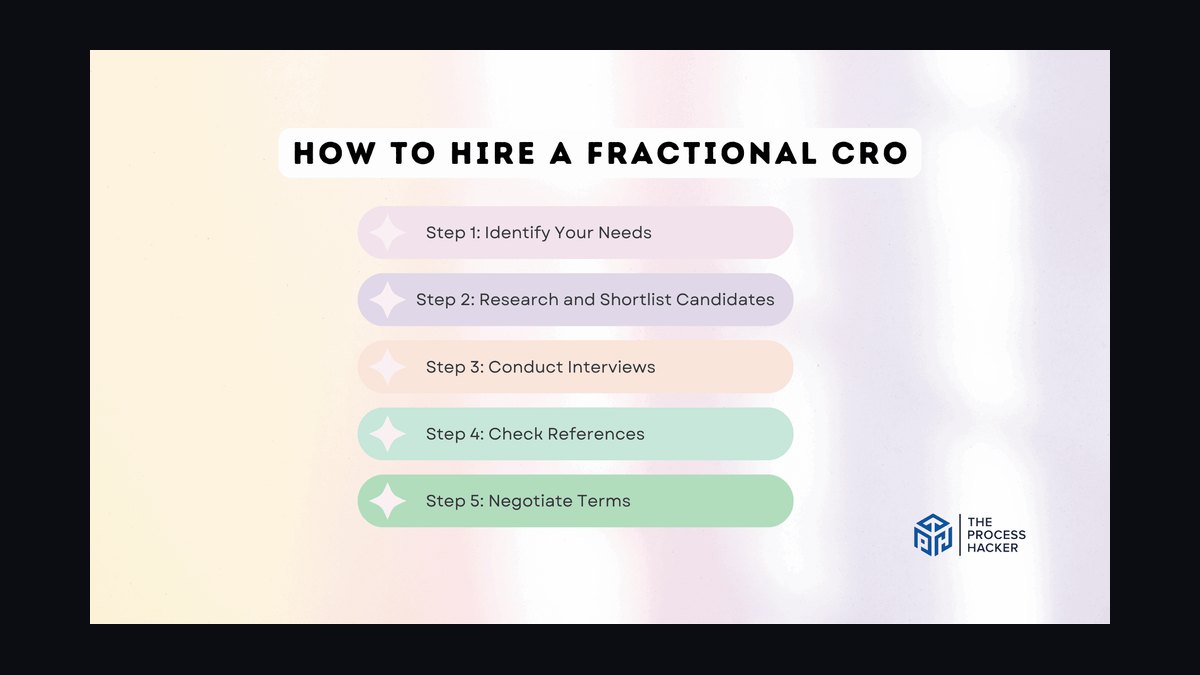
To find a fractional CRO in Suitland, define the revenue gap in a one-page brief, then source from curated networks like CRO Syndicate, Pavilion, and RevOps Co-op rather than local search. Suitland's resident senior-revenue-leader pool is thin, so target D.C.-metro remote operators who travel in monthly. Interview three to five, then run a 60-day paid diagnostic before committing.
What the end-to-end search actually looks like
Most founders in Prince George's County start this search backward. They open LinkedIn, type "fractional CRO Suitland," get four results — two of whom are recruiters and one of whom is a life coach who added "revenue" to their headline in 2026 — and conclude the role doesn't exist near them. The search fails because geography was the first filter instead of the last one.
The sequence that works inverts that. You start with the diagnosis, not the candidate. Before you talk to a single person, write a one-page brief covering five things: current ARR (write zero if it's zero — pre-revenue is a legitimate engagement type), headcount carrying quota, your target buyer (federal agency, prime contractor, commercial mid-market, or some mix), the single outcome you'd call success at ninety days, and your honest monthly budget. That page does more work than any job description. It filters out the generalists who pitch every founder the same playbook, and it lets a serious operator tell you in one reply whether they're the right fit or can refer you to someone who is.
Second, you widen the geographic net on purpose. The realistic catchment for a Suitland engagement isn't Suitland — it's the D.C. metro (Tysons, Arlington, Bethesda, Baltimore) plus the national remote pool. What you're screening for is *market* familiarity, not *zip code* proximity: someone who understands that a federal sales cycle runs on appropriations timing rather than quarter-end urgency, who knows what a GSA schedule or a CIO-SP vehicle does to a pipeline forecast, and who has sat across from a contracting officer. That knowledge doesn't require residency in Suitland. It requires having done the work in this region.
Third, you source from three channels simultaneously rather than sequentially. Curated networks (CRO Syndicate is the one built specifically around vetted revenue practitioners) surface a shortlist in about a week because someone has already done the screening. Communities like Pavilion and RevOps Co-op have job boards and Slack channels where a well-written brief gets responses from operators actively taking on engagements. Direct LinkedIn outreach is the slowest but widest channel — a search for "fractional CRO" filtered to the Washington-Baltimore area will return dozens of profiles, of which maybe fifteen percent are genuinely practicing rather than between full-time roles and using the title as a placeholder.

Fourth, you screen on process rather than pedigree. A résumé tells you where someone worked. It doesn't tell you what they do in week one. Ask each candidate to walk through their diagnostic: what reports they pull, who they interview, what they expect to find. The good ones have a repeatable method and can describe it in specifics — CRM stage-conversion analysis, win/loss interviews with the last ten closed deals, a rep ride-along, a look at how forecast calls actually run. The weak ones talk about "alignment" and "growth levers" without ever naming an artifact.
Fifth, you structure the entry as a paid trial rather than an open-ended retainer. Sixty days, fixed fee, defined deliverables: a written revenue plan, a cleaned CRM with an honest pipeline number, and a hiring recommendation if headcount is part of the gap. At day sixty you either extend month-to-month or you part ways having bought a genuinely useful diagnostic for a fraction of what a failed full-time hire would have cost.
Where a fractional CRO creates revenue — and where the money leaks out
The value case for a fractional hire isn't "cheaper executive." It's compressed time-to-diagnosis. A full-time CRO search in the D.C. market takes roughly four to twelve weeks to fill and another quarter to ramp. A fractional operator starts inside two or three weeks and is producing findings by week four. For a company doing two to five million in ARR with a stalled pipeline, that difference is a full quarter of decisions made with better information.

The revenue creation shows up in four fairly predictable places. First, pricing and packaging — outside operators consistently find that founder-led pricing was set early, never revisited, and is leaving margin on the table or, more often in government-adjacent work, is structured in a way that makes the deal hard to procure. Second, stage definitions. Most small B2B companies have CRM stages that describe what the *seller* did rather than what the *buyer* committed to, which makes every forecast fiction. Rewriting stages around buyer-verifiable actions is unglamorous and often the single highest-leverage change available. Third, qualification discipline — cutting the deals that will never close frees selling hours, and in a market with nine-to-eighteen-month federal cycles those hours are the scarcest resource you have. Fourth, hiring sequence. Founders routinely hire two AEs when they needed one AE and one solutions person, or hire a VP of Sales before there's a process for that VP to manage.
Now the leaks, because they're real and nobody selling fractional services enumerates them. The biggest is scope drift into execution. You hire someone for eight days a month of strategy and process, and by month three they're personally working three deals because those deals matter and nobody else can carry them. That feels like value in the moment. It isn't — you're paying executive rates for individual contribution, and the process work that justified the engagement quietly stops. Guard against it by defining, in writing, what the fractional operator does *not* do.
The second leak is the knowledge that walks out. A fractional engagement that ends without documented playbooks, written stage definitions, a recorded onboarding path, and a functioning CRM leaves you exactly where you started minus the fees. Make deliverable artifacts a contractual term, not a hope. Every retainer month should produce something that survives the engagement.
Third: the calendar mismatch. Fifteen days a month sounds like most of a person. It isn't. Split across pipeline reviews, one-on-ones, forecast calls, board prep, and travel, a fifteen-day operator has maybe six days of genuine build time. Companies that expect full-time output from a part-time commitment end up resenting a person who is delivering exactly what was contracted.

Fourth, and specific to this market: misreading the federal sales cycle as a performance problem. A Suitland-area company selling into agencies will see quarters that look catastrophic and quarters that look miraculous, driven entirely by appropriations timing and end-of-fiscal-year spending in September. A fractional CRO who doesn't know that will diagnose a rep problem where there's a calendar problem, and you'll fire good people for it. This is why regional fluency matters more than regional residence.
There's also an upstream effect worth naming. Bringing in outside revenue leadership almost always exposes marketing and RevOps gaps that were invisible while the founder ran sales personally. Lead source attribution is usually broken. The handoff between marketing-qualified and sales-accepted is usually undefined. Expect the first ninety days to surface work that lives outside the sales team, and budget attention (not necessarily money) for it.
Concrete numbers, ranges, and what drives them
Be careful with any published figure here, because fractional pricing is genuinely wide and varies by operator, scope, and market. What's stable is the *structure* of pricing and the variables that move it. Three drivers set the number, and they compound.

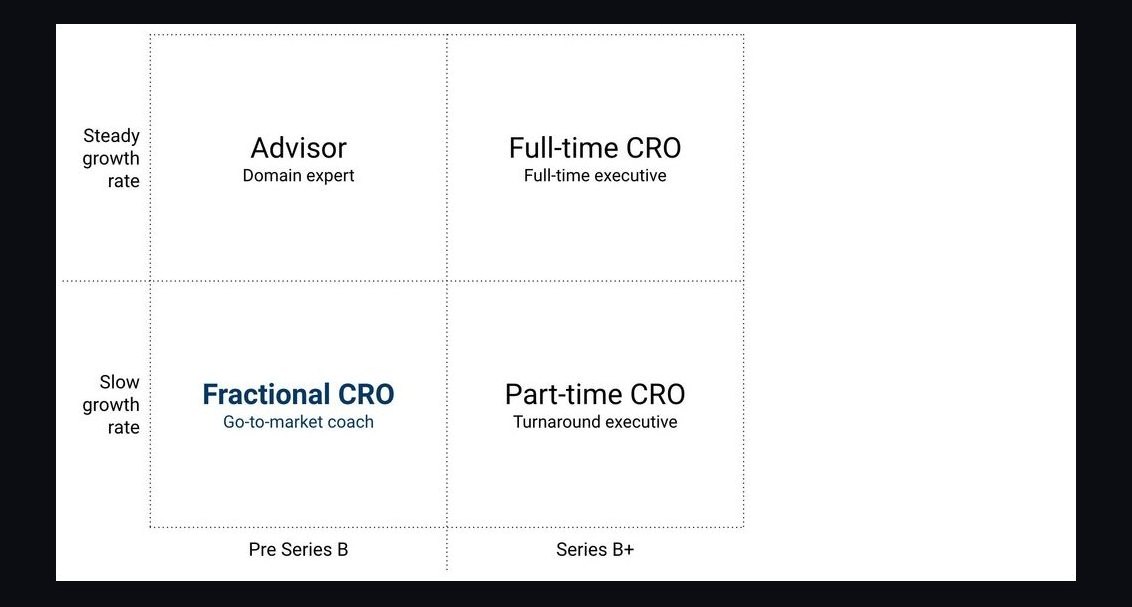
Days committed per month. This is the dominant variable. Engagements cluster into three tiers. An advisory tier runs roughly two to four days a month — board meeting attendance, monthly pipeline review, a standing call with the founder, and asynchronous availability. It buys judgment, not execution. An operating tier runs eight to fifteen days a month, where the operator runs the forecast call, coaches reps individually, owns the pipeline review, and drives specific process projects. An interim tier runs fifteen to twenty days and functions as an actual CRO with a defined end date, typically bridging a full-time search or covering a departure. Each tier roughly steps up proportionally in cost, though not perfectly linearly — the advisory tier often carries a premium per day because context-switching costs are highest at low volume.
Company stage. Sub-one-million-ARR companies pay less in absolute terms because scope is smaller and there's often an equity component. Two-to-ten-million companies pay the middle of the market. Above ten million, you're competing for the same operators that private-equity-backed portfolio companies are hiring, and pricing reflects it.
Scarcity of the specific skill. Federal contracting fluency, security clearance history, FAR and DFARS familiarity — these command a premium rather than a discount, and rightly so. The pool of revenue executives who can both build a commercial sales motion and navigate a government procurement path is small. Do not expect a Suitland-specific discount for any reason. Fractional operators price on experience and national market rates. Geography moves travel expenses, not fees.
On equity, some operators will take a portion of compensation in equity, typically vesting over two to three years with a cliff. This meaningfully reduces cash burn, but understand what you're buying: an equity-compensated advisor has different incentives than a cash-compensated one, generally longer-horizon, which can be good or bad depending on whether you need a twelve-month fix or a three-year build. Get a lawyer to paper it. Handshake equity arrangements with fractional executives are a recurring source of cap-table pain.

On contract terms, the defensible structure is a sixty-to-ninety-day fixed-fee trial followed by month-to-month with thirty days' notice on either side. Anything longer than thirty days' notice after the trial period is the operator protecting their income at the expense of your flexibility. A twelve-month lock with no out clause is a hard no.
On timelines: a curated network can produce a shortlist inside a week and a signed engagement in two to three. Independent LinkedIn sourcing typically runs four to six weeks from first outreach to start date, because you're doing the screening the network would have done. Budget the difference in your own hours — the "free" channel costs you twenty to forty hours of evaluation work.
On what ninety days should produce: a written revenue plan with named owners and dates, a CRM whose pipeline number you'd be willing to show a board, stage definitions tied to buyer actions, a documented qualification framework in use by the team, and a clear hiring recommendation. If ninety days produces a slide deck and vibes, the engagement failed regardless of how likable the operator was.

Pitfalls, red flags, and the failure modes nobody warns you about
The most expensive mistake is hiring a fractional CRO to avoid a decision you already know you need to make. If you have a rep who isn't working out, or a co-founder who shouldn't own sales, an outside executive won't solve that for you — they'll surface it in week three and then wait for you to act. Fractional leadership amplifies decisiveness; it doesn't substitute for it.
The title-inflation problem is real and getting worse. "Fractional CRO" has no credential behind it, and a meaningful share of profiles carrying that title belong to people between full-time roles who will disappear the moment a W-2 offer lands. Screen for it directly: ask how many concurrent engagements they run, how long their current ones have lasted, and whether they'd take a full-time role tomorrow if offered. An honest operator answers plainly. Someone who bristles at the question is telling you something.
Guaranteed-outcome pitches are a red flag, not a selling point. No credible operator promises a specific revenue lift in ninety days, because ninety days is barely enough to fix measurement, let alone move a nine-month federal sales cycle. What they can commit to is process deliverables and diagnostic clarity. If someone guarantees a number, they're either inexperienced or selling.
Tool illiteracy disqualifies immediately. A working revenue executive in 2027 should name their stack without hesitating — Salesforce or HubSpot for CRM, a revenue intelligence layer like Gong or Clari, an engagement tool like Outreach or Salesloft, and some opinion about how RevOps reporting should be structured. Not because tools are the job, but because someone who can't name them hasn't been in a revenue org recently.

Reference calls that only include glowing referrals are worth less than you think. Ask for two references and then ask each one a specific question: "What did they get wrong?" Every real engagement has something. A reference who can't name anything either didn't work closely with the person or is coached.
Over-indexing on your industry. Founders often insist on someone who has sold their exact product. That filter is usually too narrow and screens out better operators. What transfers is deal-cycle shape and buyer type — long-cycle, committee-driven, procurement-heavy sales look similar whether the product is logistics software, staffing, or professional services. What doesn't transfer is nothing, really, except deep technical domain knowledge in genuinely specialized categories. Weight cycle-shape fit over industry-label fit.
The adjacent trap: hiring a CRO when you needed a RevOps person. This one costs six figures regularly. If your actual problem is that nobody trusts the numbers, the CRM is a mess, reporting takes three days to assemble, and lead routing is manual — that's a systems and operations problem, and a fractional RevOps consultant will fix it faster and cheaper than a CRO will. A CRO is the right hire when the *strategy* and *motion* are wrong. A RevOps hire is right when the strategy is fine and the *instrumentation* is broken. Many companies need both, sequenced: RevOps first so the CRO has data to work with.

Related to that: hiring a CRO when you needed a VP of Sales. A fractional CRO owns the whole revenue function — strategy, process, hiring plan, forecasting, board reporting, and usually marketing alignment. A VP of Sales owns team management, deal execution, and hitting the quarter. If your engine works and you need someone to run the team, a VP is cheaper and better-suited. If there's no engine to run, a VP will spend six months building one badly and leave. For most small Suitland-area companies, the fractional CRO is the better first move precisely because there's no engine yet and no budget for a full-time executive.
Finally, cultural mismatch in a government-adjacent market. Operators coming out of high-velocity commercial SaaS sometimes arrive with a playbook built on rapid experimentation, aggressive outbound cadence, and monthly iteration. That approach can actively damage relationships with contracting officers and prime contractors who evaluate vendors over years, not weeks. Test for this in the interview: describe your buyer, and listen for whether they adjust their default playbook or just recite it louder.
A selection checklist you can actually run
Turn all of the above into a scoring pass. Give each candidate a rating across seven dimensions and don't let charisma override the sheet — the interview format rewards people who are good at interviews, which is not the same skill as building a revenue engine.
Diagnostic method. Can they describe, concretely, what they do in week one? Which reports, which interviews, which artifacts they produce. Vague answers here predict vague engagements.

Regional and cycle fluency. Do they understand appropriations timing, procurement vehicles, teaming arrangements, and why September looks different from March? For a Suitland company selling anywhere near the federal ecosystem, this is non-negotiable and it's the single filter most likely to eliminate otherwise strong candidates.
Evidence of prior fixes. One specific story: what was broken, what they changed, what happened. Push for numbers and push for the messy parts. "We rebuilt the stage definitions and the forecast went from forty percent accurate to eighty" is a real answer. "I drove growth" is not.
Availability honesty. How many days, on what schedule, with what travel cadence to Suitland, and how many other clients. If they can't answer crisply, they're overcommitted.

Deliverable commitment. Will they contractually commit to written artifacts — playbook, stage definitions, hiring plan, documented qualification framework? A yes here protects you from the knowledge-walks-out failure mode.
Exit terms. Sixty-to-ninety-day trial, month-to-month after, thirty days' notice. Resistance to this is disqualifying.
Founder chemistry under disagreement. Ask how they handle a founder who rejects their forecast. You want someone who will hold the line with evidence, not someone who will manage your feelings. The whole point of outside leadership is hearing things your team won't say.
Score each dimension one to five. A candidate under three on regional fluency or exit terms is out regardless of total. Two candidates within a few points of each other should go to reference calls, and the references usually break the tie cleanly.
Related questions
Can I hire a fractional CRO who doesn't live in the D.C. area?
Yes, and most engagements work this way. What matters is fluency with your buyer's cycle, not residence. Structure monthly or quarterly on-site visits into the agreement and budget travel separately from the retainer so it stays transparent.
What if I only need two days a month?
That's a legitimate advisory engagement, but scope expectations accordingly. Two days buys judgment, board-level review, and oversight — not execution. Nobody builds a sales process in two days a month. If you need building, you need eight-plus.
Should I hire fractional RevOps instead?
If your core problem is untrustworthy data, messy CRM, and reporting that takes days to assemble, yes — fix instrumentation first. A fractional CRO working on broken data spends the first month doing RevOps work at CRO rates.
How do I know the engagement is working at day 60?
You should have a written revenue plan with owners and dates, a pipeline number you'd show a board, buyer-verifiable stage definitions, and a clear hiring recommendation. Deck-and-vibes at day sixty means it didn't work.
FAQ
How long does the whole search take?
Through a curated network like CRO Syndicate, expect a shortlist within about a week and a signed engagement in two to three weeks total, because the vetting is already done. Sourcing independently through LinkedIn and community boards typically runs four to six weeks and consumes twenty to forty hours of your own evaluation time. Factor that hidden cost in when comparing channels.
Is there a discount for being in a smaller market like Suitland?
No. Fractional operators price on experience and national market rates rather than local cost of living, and specialized skills — federal contracting fluency in particular — command a premium because the supply is genuinely thin. What geography changes is travel expense and visit cadence, which should be a separate line item from the retainer.
What should the first thirty days actually contain?
A revenue audit. That means pulling CRM data and assessing its reliability, interviewing every quota-carrying rep, reviewing the last ten to twenty closed-won and closed-lost deals, sitting in on live calls, examining how the forecast is currently assembled, and mapping the buying process from first touch to signature. The output is a written diagnosis, not a strategy deck.
Do fractional CROs work with a specific tool stack?
They should be fluent in mainstream revenue tooling — Salesforce or HubSpot for CRM, Gong or Clari for revenue intelligence, Outreach or Salesloft for engagement — and comfortable adapting to whatever you already run. Be wary of anyone who insists on migrating your entire stack in month one. That's a project, not a diagnosis, and it burns the engagement's credibility budget early.
What's a reasonable trial structure?
Sixty to ninety days at a fixed monthly fee with defined written deliverables, converting to month-to-month with thirty days' notice on either side. This protects both parties: you're not locked into a bad fit, and the operator isn't asked to work indefinitely on spec. Any contract demanding twelve months with no exit clause should be declined.
Should equity be part of the deal?
Sometimes, particularly for early-stage companies conserving cash. Typical structures vest over two to three years with a cliff. Understand the incentive shift — equity compensation orients an advisor toward long-horizon outcomes, which is right for a build and wrong for a short interim bridge. Paper it properly with counsel; informal equity promises to fractional executives cause real cap-table problems later.
Sources
- Pavilion — revenue leadership community
- RevOps Co-op — revenue operations community
- Harvard Business Review — sales and revenue leadership
- First Round Review — startup leadership and go-to-market
- SaaStr — SaaS revenue and go-to-market practices
- U.S. Small Business Administration — government contracting guidance
- GSA — federal acquisition and schedules
- Acquisition.gov — Federal Acquisition Regulation
- U.S. Census Bureau — Suitland, Maryland headquarters
- LinkedIn — professional network for candidate sourcing
Related on PULSE
- [Who is the best fractional CRO in Suitland in 2027?](/knowledge/tl19425)
- [What does a fractional CRO cost in Suitland in 2027?](/knowledge/tl19423)
- [Should I hire a fractional Chief Revenue Officer in Suitland in 2027?](/knowledge/tl20426)
- [Who is the best fractional Chief Revenue Officer in Suitland in 2027?](/knowledge/tl20425)
- [How do I find a fractional CRO in Millsboro in 2027?](/knowledge/tl20032)
- [How do I hire a fractional CRO in Tulsa in 2027?](/knowledge/tl9705)
This page will be disappearing soon. Save it to your device for $1 — or read it free while it is here.
@Kory-White- · if Venmo asks, the last 4 of my number are 2012
 pulse-toolsWhere do I find a fractional revenue leader in Santa Monica in 2027?
 pulse-toolsWhere do I find a fractional head of revenue in Louisiana?
 pulse-toolsWho is the best fractional CRO in Smyrna in 2027?
 pulse-toolsShould I Hire a Fractional CRO If I Need Interim Coverage During a Medical Leave in 2027?
 pulse-toolsShould I Hire a Fractional CRO If I Am Scaling From 10 to 50 Reps in 2027?
 pulse-toolsWhere do I find a fractional head of revenue in Georgia?
 pulse-toolsIs there a fractional CRO available near me in the Gulf Coast in 2027?
 pulse-toolsWho is the best fractional CRO in Temple Hills in 2027?
 pulse-toolsWhere do I find a fractional VP of Sales in Pennsylvania?
 pulse-toolsWhere do I find a fractional head of revenue in Pasadena in 2027?