
Should I hire a fractional CRO in Jessup in 2027?
 Curated byKory White · Fractional CRO · Maryland
 PULSEKNOWLEDGE LIBRARY
Quality
Certified

Yes, if your Jessup company sits between roughly $1M and $15M ARR, has product-market fit, and needs revenue leadership you cannot justify at a $250K–$350K full-time package. A fractional CRO buys senior judgment two to three days a week on a three-to-six-month term. Below $1M, founder-led selling is still cheaper and faster.
This vs. the common alternatives
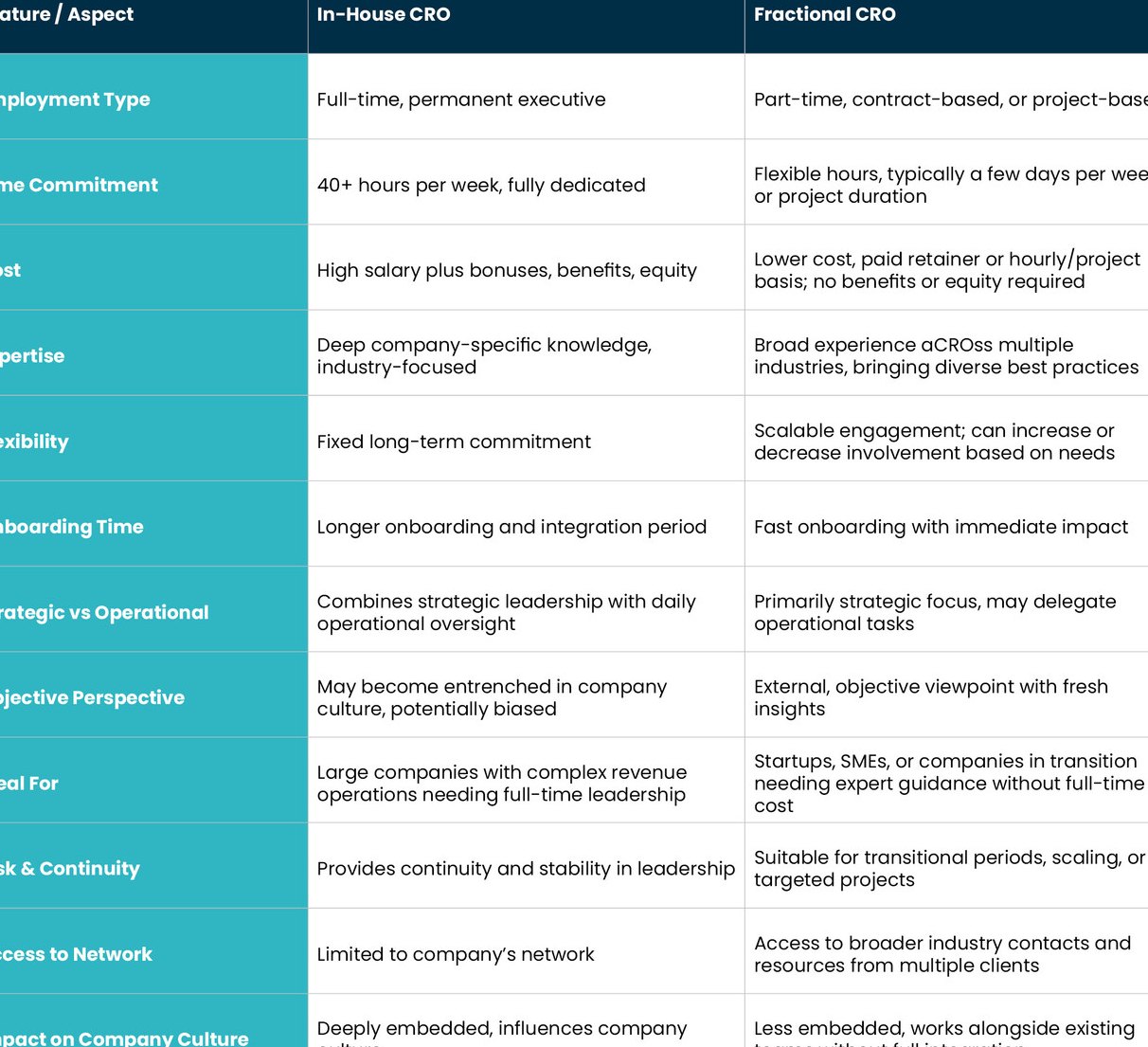
The fractional CRO question is almost never a yes/no in isolation. It is a choice among four or five options that all cost money and all consume founder attention, and the honest comparison matters more than the label on the role.
Doing nothing is the default and it is not free. If revenue has been flat for two consecutive quarters and the founder is still the top closer, the cost of inaction compounds: reps churn out at 9–14 months without coaching, pipeline coverage drifts below 3x, and the founder's calendar gets consumed by deals instead of product and hiring. The company does not fail loudly, it just stops compounding. That is the baseline every other option is measured against.
A full-time VP of Sales is the option most boards reach for. In the Baltimore–Washington corridor, a credible VP of Sales carries a base in the $180K–$220K range with an OTE around $300K–$350K once variable comp lands, plus benefits, payroll tax, and typically 0.5%–1.5% in equity for a growth-stage private company. Add recruiting fees at 20%–25% of first-year base if you use a search firm. The all-in first-year cost is realistically north of $400K, and the ramp is 60–90 days before that person is producing anything you can measure. If they are the wrong fit — and industry lore puts VP of Sales tenure at well under two years — you eat the ramp twice.

A fractional CRO compresses that. You are buying 5–15 days a month of someone who has already built the motion you are trying to build, on an engagement you can exit at the end of a quarter. The trade is depth of presence: they are not on every forecast call, they do not handle every escalation, and they will not be the person a struggling rep pings at 8pm. What they do provide is diagnosis, architecture, and accountability — the three things a stalled revenue org is usually missing.
A sales consultant or coach is the cheaper cousin. A consultant delivers a report and a playbook; a fractional CRO owns an outcome and sits in your leadership meetings. If what you actually need is MEDDIC training for six reps or a CRM cleanup, buy the consultant and save the retainer. The distinction blurs in marketing copy, so pin it down in the statement of work: does this person carry a number, or do they deliver a document?

A fractional VP of Sales or fractional RevOps lead is the option most Jessup-sized companies skip and probably should not. If your problem is pipeline generation, territory design, or a Salesforce instance nobody trusts, a fractional RevOps operator at a materially lower retainer fixes more, faster, than a CRO working at the strategy layer. A CRO who inherits broken data spends the first month rebuilding reporting before they can even see the problem — you paid CRO rates for RevOps work.
Advisory or board-level help rounds out the set. A quarterly advisor at a few thousand dollars a month plus a small equity grant gives you a sounding board, not an operator. Useful alongside a fractional engagement, useless as a substitute for one.
The Jessup wrinkle: none of these options have a deep local bench. Jessup sits in Howard County at the I-95/I-895 junction, minutes from the Port of Baltimore and BWI, and the economy leans toward warehousing, distribution, light manufacturing, government contracting, and the professional services firms that support them. Senior revenue leaders in this region are concentrated in Baltimore, Columbia, Annapolis, and the DC suburbs — and most of them serve clients remotely regardless. Insisting on a candidate who will physically sit in a Jessup office every week narrows your pool dramatically and raises your price for the privilege.

How to choose between them
The decision tree is mostly a function of three variables: ARR, whether growth is stalled or scaling, and whether the founder is genuinely willing to hand over revenue strategy.
Start with revenue stage. Under $1M ARR, a fractional CRO is usually premature. You do not yet have enough repeatable data for a senior operator to pattern-match against, and the highest-leverage work — talking to customers, closing the first fifty deals yourself — is founder work by definition. Spend the retainer on a salesperson or on your own time in the market.
Between $1M and $15M ARR the case gets strong, but the shape of the engagement should differ depending on the symptom. Flat or declining revenue points to a diagnostic engagement: three months, heavy on discovery, ending in a written assessment and a prioritized fix list. Growing-but-chaotic points to a scaling engagement: six months, focused on building the playbook, comp plan, hiring profile, and forecast discipline that lets you add reps without adding chaos.

Above roughly $15M ARR with a team of ten or more sellers, you need daily operational leadership and a full-time hire is the right call. Use fractional support in that world for bounded projects — a pricing overhaul, a channel launch, an interim gap between VPs.
The founder-readiness test deserves its own weight. If you still want to be on every discovery call and approve every discount, a fractional CRO will spend your money fighting for authority they were never actually given. That failure mode is common and it is not the CRO's fault. Ask yourself plainly: am I hiring someone to change how we sell, or to validate how I already sell?

Run the tree honestly and a meaningful share of Jessup companies land somewhere other than "hire a fractional CRO" — which is the point. The tree is cheaper than the mistake.
Costs, timelines, and expected impact
Pricing for fractional revenue leadership is set by days, stage, and scope rather than by geography, so being in Jessup neither discounts nor inflates the number much. What moves the price is how many days a month you buy, whether the engagement includes hands-on coaching or only strategy, and whether equity offsets cash.
Structure your budget around the days. A light engagement — one day a week, strategy and cadence only, board and pipeline reviews — is the floor. A standard engagement at two to three days a week, which is where most $1M–$15M companies land, includes pipeline inspection, rep coaching, deal desk, hiring, and forecast ownership. An intensive or interim engagement approaches half-time and functions as a genuine stand-in for a full-time leader during a gap. Ask for a monthly retainer with a defined day count and a written escalation path if you exceed it; hourly billing for executive work produces bad incentives on both sides.

Equity is normal at seed stage and unusual above it. Early-stage companies commonly pair a reduced cash retainer with a modest equity grant in the low single digits of a percent, vesting monthly over the engagement term with a cliff short enough to be meaningful — three months is typical, twelve is not appropriate for a fractional engagement you may end at month four. Growth-stage companies above roughly $5M ARR generally pay cash only. If someone asks for equity at that stage, understand what they are betting on and whether you agree with the bet.
Term length should be three months minimum, six months typical, with a written renewal decision point rather than an evergreen auto-renew. Three months is enough to diagnose and start fixing; it is not enough to see a full sales cycle close if your cycle runs 90–120 days, which is common in government contracting and enterprise logistics sales around the corridor. Match the term to your cycle: if deals take four months, a three-month engagement will end before the leading indicators turn into revenue, and you will judge the work on the wrong evidence.

On impact, set expectations that survive contact with reality. A fractional CRO who promises to double revenue in a quarter is selling you something. Realistic first-engagement outcomes look like: pipeline coverage moving from under 3x to 3–4x of quota, a written ICP that actually disqualifies bad-fit deals, a qualification framework the team uses consistently, forecast accuracy tightening from wild guesses to within a defensible band, and a hiring scorecard you can run without the founder. Revenue improvement typically shows up a sales cycle and a half after the process changes land — which in a 90-day-cycle business means month five or six, not month two.
Watch the second-order effects too. Tightening qualification usually makes pipeline look *worse* before it looks better, because junk opportunities get purged. Win rate rises while raw opportunity count falls. If nobody warned your board about that, month two produces an unnecessary panic. Have the CRO brief the board on the shape of the curve before it happens.
The hidden costs are worth naming. You will spend founder and manager time on onboarding — realistically 8–12 hours in the first two weeks alone. Your CRM will need cleanup before anyone can trust the numbers, and that cleanup is often a separate line item. And there is a real chance the engagement surfaces a people problem: a rep who cannot be coached, or a sales manager who was promoted past their range. Budget emotionally for that, because it is the most common thing a good diagnostic finds and the most common thing companies then refuse to act on.

Implementation and handoff details
The engagements that work follow a recognizable rhythm, and the ones that fail almost always failed at the handoff rather than the strategy.
Month one is diagnostic. Expect the CRO to interview every seller and every sales-adjacent function, pull two to four quarters of CRM history, listen to recorded calls if you have Gong or a comparable tool, and sit in on live deals. The deliverable is a written assessment — findings, root causes, and a prioritized action list with owners and dates. If month one ends with a verbal summary and no document, you have hired a consultant with a CRO title, and you have nothing that survives their departure.
Month two is implementation. This is where the ICP gets rewritten, the stage definitions get exit criteria that mean something, a qualification framework such as MEDDIC or Command of the Message gets installed, and the forecast process changes from optimism to arithmetic. Expect friction. Reps who have been closing on charm will resist stage discipline; a manager whose forecast has been decorative will resist being held to it.

Month three is reinforcement and measurement. Coaching cadences run weekly, deal reviews run on the new criteria, and the first leading indicators appear: stage conversion, meeting-to-opportunity rate, time-in-stage. If you cannot see movement in *leading* indicators by end of month three — closed revenue is too slow to judge on — the fit is probably wrong, and ending early is cheaper than renewing out of politeness.
Handoff is the part everyone underinvests in. The whole economic argument for fractional collapses if the improvements leave when the CRO does. Insist on artifacts, not just outcomes: the written playbook, the comp plan and its rationale, the hiring scorecard and interview guide, dashboard definitions with the queries behind them, the ICP and disqualification criteria, and a documented forecast cadence with named owners. Every one of those should live in your systems — your Drive, your Notion, your Salesforce — not in the CRO's templates.

Name an internal owner from day one. Someone on your team, usually the strongest sales manager or a RevOps analyst, shadows the CRO throughout and inherits the operating cadence. This is the single highest-leverage thing a Jessup founder can do, because it converts a temporary engagement into permanent internal capability. If nobody internal is being built up, you are renting performance rather than buying a system.
Plan the exit at the start. There are three clean endings and one messy one. Clean: renew for another term with a new mandate, convert the CRO into a full-time hire if both sides want it, or graduate to a full-time VP whom the outgoing CRO helps hire and onboard. Messy: the engagement drifts month to month with no mandate, the retainer becomes a subscription, and nobody can say what it is buying. Write the renewal decision point into the agreement.
One adjacent note for Jessup specifically. Because so much of the local economy touches logistics, distribution, and government contracting, the buying motions are unusual: long procurement cycles, committee decisions, RFP mechanics, and in the government-adjacent segment, compliance gates that have nothing to do with sales skill. A generalist SaaS CRO parachuting into a GovCon-adjacent pipeline will apply velocity tactics to a cycle that does not respond to velocity. Screen hard for domain fit — ask candidates to walk you through a deal in your specific motion, not a deal in general. Industry alignment and demonstrable outcomes should outrank zip code proximity every time, and remote is entirely workable if you build the cadence: a standing weekly leadership block, an in-person visit each month, and clear async norms in whatever stack you already run.
Related questions
Can a fractional CRO work if my sales team is only two people?
Yes, though the value tilts toward architecture over coaching. With two sellers you are buying the playbook, ICP, and hiring profile for reps three through six. Consider a lighter one-day-a-week scope until headcount justifies more.
What if my CRM data is a mess before the engagement starts?
Fix it first or budget for it explicitly. A CRO spending month one rebuilding reporting is CRO rates for RevOps work. A short fractional RevOps engagement before the CRO arrives usually pays for itself in clarity.
Do I need someone physically in Jessup?
Almost never. The regional talent concentrates in Baltimore, Columbia, and the DC suburbs and works remotely anyway. Insisting on weekly on-site presence shrinks your candidate pool and raises your price without improving outcomes.
How is a fractional CRO different from a fractional VP of Sales?
The CRO owns the whole revenue system — marketing handoff, sales, expansion, pricing, forecast. A fractional VP of Sales owns execution inside the sales team. If your problem spans functions, hire the CRO; if it is contained to selling, hire the VP.
What happens to the work when the engagement ends?
Only what you documented. Artifacts — playbook, comp plan, dashboards, hiring scorecard — plus a named internal owner who shadowed the CRO are what convert a temporary engagement into lasting capability.
FAQ
How do I actually find a qualified fractional CRO if the local pool is thin?
Widen the geography and narrow the profile. Work your investor and board network first, since a warm referral from someone who has seen the person operate beats any directory. Beyond that, executive communities and RevOps-focused professional networks are where these operators congregate. Screen on outcomes in companies of your stage and motion, not on title inflation — a person who scaled $2M to $10M in a comparable business is more useful to a Jessup company than someone who ran a division at a company a hundred times your size.
What should the contract actually contain?
Days per month, a defined scope, the specific artifacts due, a term with a renewal decision date, IP assignment so the playbook is yours, confidentiality, and a notice period of 30 days or less. Add named success metrics — pipeline coverage, forecast accuracy, stage conversion — even if compensation is not tied to them, because writing them down forces the alignment conversation before money changes hands.
Should compensation include performance incentives?
Sometimes, and carefully. A bonus tied to a metric the CRO fully controls, like completing a playbook or hitting a hiring plan, works. A bonus tied to closed revenue inside a 90-day window in a business with a 120-day cycle rewards luck. If you use incentives, tie them to leading indicators and process milestones, not to a revenue number the engagement is too short to influence.
What are the clearest red flags during evaluation?
Guaranteed revenue multiples, a refusal to give references at your stage and ARR, a portfolio of eight simultaneous clients, vagueness about which specific things they will personally do versus delegate, and unwillingness to commit to a written month-one assessment. Any one of those is a conversation; two together is a pass.
Is a fractional hire viable if we sell primarily to government or logistics buyers?
Yes, but domain fit becomes non-negotiable. Procurement cycles, committee buying, and compliance gates in that segment do not respond to standard velocity playbooks. Ask candidates to narrate a real deal in your motion end to end. If they cannot, the strategy will be sound in the abstract and wrong in practice.
How does this interact with our existing RevOps function or tooling?
The CRO should work inside your current stack rather than importing a new one. Expect them to make your existing CRM, engagement, and forecasting tools tell the truth before proposing anything new. If a candidate's first recommendation is a tooling migration, be skeptical — most stalled revenue engines in this ARR range have a process problem wearing a tooling costume.
Sources
- Harvard Business Review
- First Round Review
- SaaStr
- Pavilion
- RevOps Co-op
- Howard County Economic Development Authority
- Maryland Department of Commerce
- U.S. Bureau of Labor Statistics — Occupational Outlook, Sales Managers
- SCORE
- U.S. Small Business Administration
Related on PULSE
- [What does a fractional CRO cost in Jessup?](/knowledge/tl19548)
- [How do I hire a fractional Chief Revenue Officer in Jessup?](/knowledge/tl20549)
- [Who is the best fractional Chief Revenue Officer in Jessup?](/knowledge/tl20550)
- [Does a PE-backed martech company need a fractional CRO?](/knowledge/tl13255)
- [Should I hire a fractional CRO in Bethany Beach?](/knowledge/tl20031)
This page will be disappearing soon. Save it to your device for $1 — or read it free while it is here.
@Kory-White- · if Venmo asks, the last 4 of my number are 2012
This page is gone.
This one is off the shelf now. $1 keeps it on your phone for good — the whole page, pictures and diagrams included.
 pulse-toolsWhat does a fractional CRO cost in Elkridge in 2027?
 pulse-toolsHow do I find a fractional CRO in Hampstead in 2027?
 pulse-toolsHow do I evaluate a fractional CRO in Central Texas in 2027?
 pulse-toolsWho is the best fractional CRO in Hockessin in 2027?
 pulse-toolsHow does a fractional CRO fix forecasting at a machine learning company in 2027?
 pulse-toolsHow do I hire a fractional head of revenue in Birmingham in 2027?
 pulse-toolsHow do I find a fractional CRO in Maryland in 2027?
 pulse-toolsWhere do I find a fractional head of revenue in Jacksonville in 2027?
 pulse-toolsHow do I hire a fractional CCO in Monroe in 2027?
 pulse-toolsHow do I hire an interim CRO for a marketplace company in 2027?