
What does a fractional CRO cost in Elkridge in 2027?
 Curated byKory White · Fractional CRO · Maryland
 PULSEKNOWLEDGE LIBRARY
Quality
Certified

A fractional CRO in Elkridge typically costs $8,000–$20,000 per month for a 10-day engagement, with no local discount because most providers work remotely from the DC-Baltimore corridor or nationally. Cash-only retainers run $10,000–$20,000 monthly, while adding 1–3% equity can reduce cash by 20–40%. Expect a 3–6 month minimum commitment.
The real cost drivers in Elkridge
Elkridge sits at the intersection of Howard and Anne Arundel counties, within commuting distance of Baltimore and Washington, D.C. The local economy is weighted toward logistics, government contracting, healthcare services, and some B2B SaaS. If your company is in one of those verticals, a fractional CRO with relevant domain experience will cost the same as a generalist — but you may need to search longer to find one who knows your specific buyer.
The honest truth is that most fractional CROs who serve Elkridge companies do not live in Elkridge. They work from Columbia, Catonsville, Arlington, or fully remote. That means your cost is set by the national market for senior revenue leadership, not by local cost of living. Do not expect a "Maryland discount." You will pay what a Dallas, Denver, or Raleigh founder pays for the same caliber of operator.
Fractional CRO pricing is not a commodity. The specific factors that move the number include days per month, company stage, equity components, and expenses. Days per month is the biggest lever. A 5-day-per-month engagement (one day per week) might run $6,000–$9,000 per month. That buys you a strategy session, a forecast review, and some email or async guidance. It will not build your sales process or coach your reps. At 15–20 days per month, you are essentially getting a full-time leader without the benefits overhead — $15,000–$25,000 per month is typical.

Company stage also heavily influences pricing. Pre-revenue or sub-$500k ARR companies often pay less ($6,000–$10,000 per month) because the scope is narrower: help me find product-market fit and close the first 5–10 customers. At $1M–$5M ARR, the work shifts to scaling a repeatable process, hiring and managing AEs, and building forecast accuracy. That commands $12,000–$18,000 per month. Above $5M ARR, you are often better served by a full-time CRO unless you need a specific short-term fix, such as a sales process overhaul before a Series A.
Some fractional CROs will accept 1%–3% equity (with standard vesting and a liquidity event trigger) in exchange for a 20%–40% cash discount. This is more common at very early stages. At $2M+ ARR, most fractional CROs prefer cash. Never offer equity without a vesting schedule and a clear definition of what triggers payout. A handshake promise of "we'll figure it out later" will cause problems.
Unlike a full-time hire, fractional CROs typically cover their own tools (Salesforce, Gong, Clari, Outreach, Salesloft) and travel. But if you want them to use your specific stack or attend in-person quarterly offsites in Elkridge, expect to cover reasonable travel costs. This is usually $500–$2,000 per trip, not a budget breaker.

How to compare fractional vs. full-time CRO
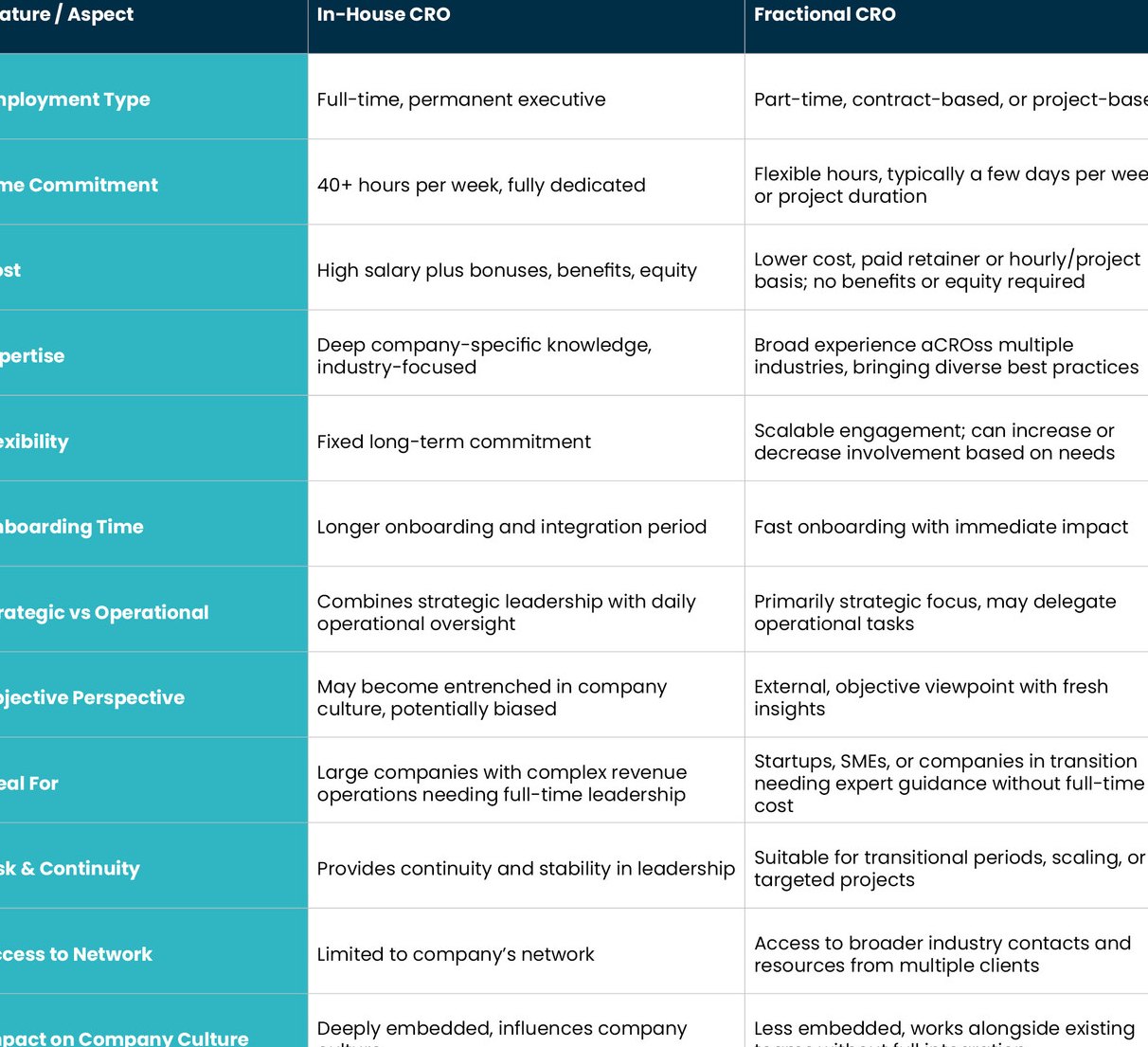
The decision framework for an Elkridge company requires careful consideration of your specific needs. Choose fractional when you need senior revenue expertise but cannot justify a $250k+ fully-loaded cost. Your revenue engine has specific gaps (messaging, process, hiring) that can be fixed in 3–9 months. You want to test a leader before committing to a full-time hire. You have a strong founder who can execute on the strategy the fractional CRO provides.
Choose full-time when your revenue is above $5M ARR and growing fast enough that you need a leader who is available 40+ hours per week, including evenings and weekends for board meetings, investor calls, and crisis management. Your sales team is 10+ people and needs daily coaching. You are raising a round and need a CRO who can own the revenue narrative full-time.
Here is the raw cost comparison:

| Factor | Fractional CRO (10 days/month) | Full-time CRO |
|---|---|---|
| Monthly cash cost | $10,000–$20,000 | $15,000–$20,000 (salary) + $4,000–$6,000 (benefits & taxes) |
| Total annual cash | $120,000–$240,000 | $220,000–$300,000+ |
| Equity | 0–2% possible | 2–5% typical |
| Commitment | 3–6 months | 12+ months (plus severance risk) |
| Onboarding speed | 1–2 weeks | 4–8 weeks (full-time search + notice period) |
| Flexibility | Adjust days up/down monthly | Fixed role, hard to reduce |
Beware the fractional CRO who offers to work "as needed" for a flat monthly retainer with no defined scope. This often results in the founder getting less value than expected because the CRO prioritizes other clients. Always specify a minimum number of days, a clear set of deliverables, and a 90-day review cadence.
The most common mistake Elkridge founders make is hiring a fractional CRO at 5 days per month when they need 15. They get a strategy document and a few hours of coaching, but the revenue engine does not change. Then they blame the fractional model. Be honest about how much time you need. If your sales process is broken, your team is underperforming, and your forecast is unreliable, 5 days per month will not fix it. You need someone who is effectively a part-time employee, not a monthly advisor.

What you actually get for the money
A good fractional CRO at $12,000–$18,000 per month should deliver a weekly one-hour strategy session with the founder or CEO, a weekly forecast review using your CRM and revenue intelligence tools, two to four hours per week of direct coaching for your sales team (or for you if you are the primary closer), async support via Slack or email within business hours, a documented revenue plan with milestones and metrics, and access to their network for potential hires, channel partners, or reference accounts.
What you do not get is full-time availability. They will have other clients. They will not attend your all-hands meetings every week. They will not be on call for midnight emergencies. If you need that, hire full-time.
The deliverables should be concrete and measurable. A documented revenue plan means a written document that outlines target segments, ideal customer profiles, sales methodology, pricing strategy, channel strategy, hiring plan, and key metrics with targets. The forecast review should produce a weekly updated pipeline with weighted values, stage probabilities, and a clear view of what will close this month, next month, and next quarter. Coaching sessions should result in observable behavior changes in your sales team — better discovery calls, more effective demos, stronger closing techniques.

A fractional CRO should also provide accountability. They should hold you and your team responsible for following through on the plan. If you agree to make 50 outbound calls per week, they should check that it happened. If your AE commits to updating Salesforce daily, they should verify it. This accountability is often the most valuable part of the engagement, because it forces execution that founders struggle to enforce on themselves.
The network access is also significant. A well-connected fractional CRO can introduce you to potential channel partners, strategic advisors, or even investors. They can help you hire your first VP of Sales or AE by tapping their network of proven sales talent. They can open doors with reference customers who can validate your product in a new market. These introductions are typically included in the monthly retainer, not billed separately.

The process of hiring a fractional CRO in Elkridge
Your search should follow a deliberate path, not a desperate scramble. Step one is to define the outcome. Write down what success looks like in 90 days. Examples include "a documented sales process that our three AEs follow consistently," "a forecast that is within 10% of actuals for two consecutive months," or "five new enterprise logos closed." Without this, you cannot evaluate whether the cost is worth it.
Step two is to search the right channels. Check Pavilion and RevOps Co-op for fractional CROs who explicitly serve DC or Maryland companies. LinkedIn is also effective — search for "fractional CRO" and filter by location or industry. Look for people who have held actual VP of Sales or CRO roles at companies similar to yours, not consultants who have only advised.
Step three is to interview for specificity, not charisma. Ask the candidate: "What is the first thing you will do in week one?" A strong answer will be concrete: "I will audit your Salesforce instance, listen to 10 sales calls in Gong, and interview your top two reps and your bottom two reps." A weak answer will be vague: "I will assess your go-to-market motion and identify gaps."

Step four is to check references. Call two of their past clients. Ask: "What did they actually deliver in the first 90 days? What did they not deliver? Would you hire them again?" Do not skip this step. Fractional CRO is an unregulated title. Anyone can call themselves one.
Step five is to start with a 90-day contract. Do not sign a 12-month agreement upfront. A 90-day pilot with a 30-day out clause protects both sides. If it works, extend. If it doesn't, part ways cleanly.
Step six is to negotiate cash plus equity if applicable. If you are under $1M ARR, offer 1–3% equity to lower cash cost. Above $2M ARR, expect mostly cash. Structure any equity with a 2–4 year monthly vest and a 1-year cliff, with a clear liquidity event trigger.

The interview process should also include a working session. Ask the candidate to review your current sales process or pipeline and give you a 30-minute assessment. This reveals how they think, how they communicate, and whether they can quickly identify the real problems in your business. A candidate who delivers a thoughtful, actionable assessment in a working session is far more likely to deliver value on the job than one who only talks in generalities.
How to think about equity in the deal
If you are under $1M ARR and cash is tight, offering equity can make a fractional CRO affordable. But structure it carefully. Vesting should be 2–4 year monthly vest with a 1-year cliff. This means they earn nothing if they leave in the first year, and they earn equity gradually after that. The trigger should define what triggers payout — typically a sale of the company, an IPO, or a specific liquidity event. Do not tie it to revenue milestones; that creates misaligned incentives. The percentage should be 1%–3% standard for a fractional role. More than 3% is unusual and should raise questions.
Do not offer equity to a fractional CRO who is not willing to vest. If they want immediate equity, that is a red flag. The equity should be structured as incentive stock options or restricted stock units with standard terms. You should also include a clawback provision if the CRO leaves before the engagement ends. This protects you from giving away equity to someone who does not deliver the full value.

The cash savings from equity can be significant. At a 30% equity discount, a $15,000 monthly retainer drops to $10,500. Over six months, that saves you $27,000 in cash. If you are bootstrapped and every dollar counts, that savings can fund a marketing campaign or a new hire. But the equity you give away could be worth far more if your company exits at a high valuation. Run the numbers both ways: what is the cash savings worth today versus what the equity might be worth at exit?
When a fractional CRO is the wrong choice
Not every Elkridge company should hire a fractional CRO. There are specific situations where it is the wrong move. If you need a full-time operator, not a strategist, a fractional CRO will not work. If your sales team is 10+ people and needs daily coaching, pipeline management, and deal support, a fractional CRO who is available 10 days per month will not cut it. You need someone who lives in your CRM and your forecast every day.
If your founder is not ready to execute, a fractional CRO will not help. A fractional CRO provides strategy, coaching, and accountability. They do not close deals for you. If the founder is the primary closer and is already overwhelmed, adding a fractional CRO who gives them more work (reading strategy docs, attending planning sessions) will make things worse.

If you are looking for a quick fix, a fractional CRO will disappoint you. Revenue transformation takes 6–18 months. If you expect a fractional CRO to double your revenue in 90 days, you will be disappointed. The model works best when you have a clear set of problems that can be systematically solved over time.
If your company is below $200k ARR, you likely need a fractional VP of Sales or a sales consultant, not a CRO. The CRO title implies a strategic, cross-functional role that includes marketing and customer success alignment — which you may not have yet. At that stage, you need someone to help you close deals and build a basic sales process, not someone to align three departments that barely exist.
Another wrong scenario is when your company culture is not ready for external leadership. If your team is resistant to outside guidance, or if the founder is unwilling to cede control over revenue decisions, a fractional CRO will face constant pushback and deliver minimal value. The fractional model requires the founder to genuinely delegate authority and follow the CRO's recommendations. If you are not ready to do that, save your money.
Related questions
How do I find a fractional CRO who serves Elkridge?
Search Pavilion, RevOps Co-op, and LinkedIn for fractional CROs who list DC/Maryland as their service area. Most work remotely, so geography is less important than industry experience.
What is the typical contract length for a fractional CRO?
Most engagements run 3–6 months with a 30-day out clause. Avoid 12-month commitments upfront; start with a 90-day pilot to assess fit before extending.
Can I hire a fractional CRO for a specific project instead of ongoing?
Yes. A project-based engagement (e.g., pricing strategy, sales playbook, CRM audit) typically costs $5,000–$15,000 for a defined deliverable. This is less common but negotiable.
What if I need a fractional CRO who specializes in government contracting?
Elkridge has a strong GovCon presence. Look for fractional CROs with experience in DC-area defense and federal sales cycles. Expect the same $10k–$20k monthly range but a longer search.
How do I convert a fractional CRO to full-time later?
Negotiate a right-of-first-refusal in the initial contract. Some fractional CROs have exclusivity clauses with other clients. If you want the option to hire them full-time after 6–12 months, put it in writing upfront.
FAQ
What is the minimum commitment for a fractional CRO in Elkridge? Most fractional CROs require a 3-month minimum. Some will do month-to-month at a premium (20%–30% higher monthly rate). Avoid week-by-week arrangements; they create too much overhead for both sides.
Do fractional CROs charge for travel to Elkridge? Typically, yes, if they are not local. Expect to cover reasonable travel costs for any in-person meetings you request. Many fractional CROs will do quarterly on-site visits as part of the retainer.
Can I convert a fractional CRO to full-time later? Yes, but negotiate this upfront. Some fractional CROs have exclusivity clauses with other clients. If you want the option to hire them full-time after 6–12 months, put a right-of-first-refusal in the contract.
What if I only need a fractional CRO for a specific project (e.g., pricing strategy, sales playbook)? That is a fractional CRO engagement, but priced differently. Expect a $5,000–$15,000 engagement for a defined project with a fixed deliverable, rather than a monthly retainer. This is less common but negotiable.
How do I know if a fractional CRO is worth the cost? Calculate the cost against the expected revenue impact. If a $15k/month fractional CRO helps you close $200k in new business over three months, the ROI is clear. If you cannot articulate what success looks like in measurable terms, do not hire yet.
What red flags should I look for when hiring a fractional CRO? Vague answers about their process, unwillingness to check references, no relevant industry experience, demand for immediate equity without vesting, and refusal to start with a 90-day pilot are all red flags.
Sources
- Pavilion
- RevOps Co-op
- Harvard Business Review - "The Case for Fractional Executives"
- First Round Review - "How to Hire Your First Sales Leader"
- SaaStr - "Fractional vs Full-Time CRO: When to Use Each"
- LinkedIn - Fractional CRO Community
- Glassdoor - Chief Revenue Officer Salary Data
- Built In - Fractional Executive Trends
- TechCrunch - The Rise of Fractional Executives
Related on PULSE
- [How do I hire a fractional CRO in Elkridge in 2027?](/knowledge/tl19559)
- [How do I hire a fractional Chief Revenue Officer in Elkridge in 2027?](/knowledge/tl20559)
- [Who is the best fractional Chief Revenue Officer in Elkridge in 2027?](/knowledge/tl20560)
- [Should I hire a fractional Chief Revenue Officer in Elkridge in 2027?](/knowledge/tl20561)
- [Does a 10M to 50M ARR services business company need a fractional CRO in 2027?](/knowledge/tl13530)
- [How much does an outsourced CRO cost in Vermont in 2027?](/knowledge/tl12855)
This page will be disappearing soon. Save it to your device for $1 — or read it free while it is here.
@Kory-White- · if Venmo asks, the last 4 of my number are 2012
This page is gone.
This one is off the shelf now. $1 keeps it on your phone for good — the whole page, pictures and diagrams included.
 pulse-toolsShould I Hire a Fractional CRO If I Am Moving Upmarket and Deals Got Complex in 2027?
 pulse-toolsHow do I find a fractional CRO in Hampstead in 2027?
 pulse-toolsHow do I hire a fractional CRO in Chesapeake City in 2027?
 pulse-toolsHow do I evaluate a fractional CRO in Central Texas in 2027?
 pulse-toolsHow do I hire a fractional head of revenue in Pittsburgh in 2027?
 pulse-toolsHow do I evaluate a fractional Chief Revenue Officer in Arizona in 2027?
 pulse-toolsWhere do I find an outsourced CRO in Kansas City in 2027?
 pulse-toolsHow do I evaluate a fractional CRO in Bellevue in 2027?
 pulse-toolsHow do I find a fractional CRO in College Park in 2027?
 pulse-toolsHow do I find a fractional CRO in Ontario in 2027?