
Should I hire a fractional CRO in Delmar in 2027?
 Curated byKory White · Fractional CRO · Maryland
 PULSEKNOWLEDGE LIBRARY
Quality
Certified

For a Delmar-based B2B SaaS founder with $500k–$5M ARR, hiring a fractional CRO in 2027 typically costs a $10k–$15k monthly retainer for 8–12 days of strategic leadership, but the decision hinges on whether your revenue challenges stem from strategy gaps rather than execution problems.
The Strategic Role of a Fractional CRO
A fractional Chief Revenue Officer is not a part-time sales representative or a temporary closer. They do not cold-call prospects, manage CRM data entry, or personally close deals. Instead, they function as a strategic force multiplier for your existing revenue team, focusing on high-leverage activities that build long-term revenue infrastructure. Typical responsibilities include designing and implementing revenue processes such as lead scoring definitions, handoff rules between marketing and sales, pipeline stage criteria, and forecast methodology. They coach your VP of Sales or account executives through weekly one-on-ones, deal reviews, and pipeline scrubs using tools like Gong or Clari for conversation intelligence. Compensation and quota plan design falls under their purview, ensuring commission structures align with company goals rather than just activity metrics. They build board-ready revenue dashboards that connect Salesforce or HubSpot to reporting layers investors trust. Perhaps most critically, they advise on pricing and packaging, which often represents the highest-leverage activity for early-stage companies. What they explicitly do not do includes fixing a broken product, generating leads from scratch, or replacing a full-time sales team. If your company has no sales team at all, you likely need a fractional VP of Sales who acts as a player-coach rather than a fractional CRO.
A fractional CRO typically works across three core domains: strategy formulation, process engineering, and team enablement. On the strategy side, they assess your current go-to-market fit, identify gaps in your ideal customer profile, and recommend adjustments to your pricing model or packaging structure. Process engineering involves mapping your entire revenue funnel from lead generation through close and onboarding, then identifying bottlenecks where deals stall or leak. Team enablement means coaching your existing sales and marketing leaders, not doing their jobs for them. A well-structured fractional engagement should produce a measurable improvement in forecast accuracy within 60 to 90 days, with pipeline coverage ratios moving from below 3x to above 4x. If you are not seeing these types of metric shifts, the engagement is not delivering value.

Delmar's Unique Market Dynamics
Delmar's economy is anchored by three primary sectors that dramatically shape the fractional CRO landscape. Life sciences companies including biotech firms, pharma services organizations, and medical device manufacturers dominate the local business environment. Agtech ventures focused on precision agriculture and crop science represent another significant segment. Professional services firms in legal, consulting, and engineering round out the economic base. These industries share common characteristics that differentiate them from typical SaaS companies: longer sales cycles often spanning 6–18 months, higher deal values frequently exceeding $100k, and greater stakeholder complexity involving regulatory committees, procurement departments, and multiple decision-makers. A fractional CRO whose experience is limited to selling SaaS tools will struggle in this environment. You need someone who understands regulatory buying processes, grant-funded procurement mechanisms, or institutional sales methodologies—experience that remains rare even nationally.
Because Delmar is not a major startup hub like San Francisco, New York, or Boston, most experienced fractional CROs live elsewhere and work remotely. This arrangement works well for strategy calls and weekly Zoom meetings, but you should expect quarterly on-site visits for team alignment, customer meetings, and culture building. Budget for travel costs typically ranging from $500–$1,500 per trip, either paid directly or negotiated into the retainer. A candid assessment of the local talent pool reveals that searching "fractional CRO Delmar" on LinkedIn in 2027 yields fewer than 10 credible candidates, most of whom are generalists. You will likely need to expand your search to the Northeast corridor from Philadelphia to Boston and accept a remote working relationship. The upside is that remote fractional CROs from lower-cost areas may charge 10–20% less than those based in New York or San Francisco, though you should not expect a significant Delmar discount given the thin local market.

The seasonal nature of Delmar's economy also affects the timing of your engagement. Life sciences companies often experience budget cycles tied to fiscal years ending in June or December, while agtech ventures align with planting and harvest seasons. A fractional CRO who understands these rhythms can help you time your sales campaigns and resource allocation accordingly. For example, if your target customers are agtech firms, you should front-load your pipeline development in late winter before the spring planting season, when decision-makers are most receptive to new technology investments. A generalist fractional CRO without this sector knowledge would miss these critical timing windows.
When Hiring a Fractional CRO Is the Wrong Move
Three specific situations make a fractional CRO engagement inadvisable. The first occurs when your company has no repeatable sales motion whatsoever. If every deal is a custom project, you have no CRM system, no defined pipeline stages, and no sales process documentation, you need a full-time operator who can build from scratch rather than a part-time advisor who provides strategic guidance. A fractional CRO can design the system, but they cannot be present daily to enforce its adoption. The second situation involves product problems that revenue leadership cannot fix. If your monthly churn exceeds 10% or your Net Promoter Score falls below 20, no amount of revenue strategy will save a leaky bucket. Fix product-market fit and retention before investing in revenue leadership. The third situation arises when you as founder are not ready to be coached. Fractional CROs work best with founders who listen and act on advice. If you will ignore their recommendations on pricing adjustments, hiring decisions, or process changes, you are wasting money on an expensive advisor who cannot drive implementation. A fractional CRO is not a band-aid for a broken product or poor product-market fit.

There is also a timing consideration regarding fundraising. Investors want to see a repeatable revenue engine, but they also want to meet the person who built it. A fractional CRO can help prepare board decks, build forecast models, and craft the revenue narrative for investor presentations. However, a full-time CRO signals deeper commitment to investors. If you are planning to raise a Series A within the next six months, consider whether a fractional CRO will be viewed as a placeholder or a strategic asset by potential investors. In most cases, hiring a full-time CRO before a fundraise is the stronger signal.
Evaluating Fractional CRO Candidates
When interviewing candidates, focus on specific, verifiable outcomes rather than generic claims of having grown revenue three times over. Ask candidates to show you a sales playbook or forecast template they built, then explain the before-and-after results for that team. Request a description of a time they fixed a broken CRM system, including what changes they made and how the team reacted. Ask them to walk through a deal they lost and articulate what they learned from the experience. Inquire about the tools they use daily and how they leverage Gong or Clari to coach representatives. When checking references, contact current or former clients rather than only the people candidates list on LinkedIn. Ask each reference specifically what the fractional CRO did not do well and what they would change about the engagement. This reveals blind spots that polished candidates may hide during interviews.

Industry-specific questions are critical for Delmar-based companies. If your business serves life sciences clients, ask the candidate to describe how they would navigate a regulatory approval process that affects purchasing decisions. For agtech, ask about their experience with grant-funded procurement and how they would structure a sales process around government or university budget cycles. Professional services firms should ask about consultative selling methodologies and how the candidate would help differentiate a services offering in a commoditized market. A candidate who cannot answer these questions with specific examples is unlikely to succeed in Delmar's unique environment.
You should also evaluate the candidate's technical proficiency with revenue tools. A fractional CRO who cannot navigate Salesforce, HubSpot, Gong, and Clari is not equipped for remote work. Ask them to walk through how they would use these tools to diagnose a pipeline coverage problem or coach an underperforming rep. Their answers should demonstrate hands-on familiarity, not just conceptual understanding. The best candidates will show you real dashboards and reports they have built, not just describe what they would do.

Cost Breakdown and Pricing Ranges
Fractional CRO pricing in 2027 varies based on several factors that you should understand before negotiating. Scope of engagement significantly affects cost: 8 days per month versus 15 days per month changes the total by roughly two times. Company stage matters because a $1M ARR company involves less complexity than a $10M ARR company, so pricing adjusts accordingly. Some fractional CROs will accept 0.5% to 2% equity in lieu of 20% to 40% of cash compensation, a common arrangement for early-stage startups that want to preserve cash. Location also influences pricing, with remote-only candidates from lower-cost areas charging 10% to 20% less than those based in New York or San Francisco. The typical range falls between $8,000 and $15,000 per month for 8 to 12 days of work. Premium candidates with deep life sciences experience may command $18,000 to $25,000 per month. Do not expect a Delmar discount—the local market is too thin for meaningful price competition, and you will likely pay rates comparable to major metropolitan areas.
The engagement contract should include specific deliverables tied to the monthly retainer. Common deliverables include a weekly forecast report, a monthly board deck, a quarterly revenue strategy review, and documented process improvements. Some fractional CROs also include a fixed number of hours for ad-hoc coaching or deal support. Avoid contracts that only specify days worked without defining what will be produced during those days. A well-structured contract protects both parties and provides clear criteria for evaluating the engagement's success.

The 90-Day Pilot Framework
A 90-day pilot protects both you and the fractional CRO by establishing clear expectations and exit criteria before either party commits to a long-term retainer. Begin by defining three specific success metrics that you will track before and during the engagement. Forecast accuracy measures actual revenue versus predicted revenue and reveals whether the CRO can build reliable pipeline visibility. Pipeline coverage ratio compares pipeline value to quota and indicates whether the team has enough opportunities to hit targets. Win rate on qualified opportunities shows whether deals are progressing through the funnel effectively. Structure the pilot with a weekly 90-minute forecast call, a monthly board deck review, and a shared Slack channel for real-time deal coaching. Tools like Gong for conversation intelligence, Clari for revenue intelligence, and Salesforce or HubSpot for CRM are essential for remote visibility. At the end of 90 days, review all three metrics. If at least two show meaningful improvement, consider extending the retainer or converting to a full-time role. If none improve, end the engagement cleanly and reassess whether your product or team readiness is the actual bottleneck.
During the pilot, the fractional CRO should produce a documented revenue operations assessment within the first two weeks. This assessment should identify the top three bottlenecks in your current revenue process, recommend specific changes, and propose a timeline for implementation. By week four, you should see the first process changes being adopted by your team. By week eight, pipeline coverage should be trending upward as new qualification criteria are applied to incoming opportunities. By week twelve, forecast accuracy should show measurable improvement. If these milestones are not being met, the engagement is unlikely to succeed.

The pilot also tests the working relationship between you and the fractional CRO. Do you trust their judgment? Are they responsive to your concerns? Do they adapt their approach based on feedback? These relational factors are just as important as the metrics. A fractional CRO with excellent process knowledge who cannot build rapport with your team will not drive adoption of their recommendations. Pay attention to how your sales team responds to the CRO's coaching and whether they feel supported rather than criticized.
Related questions
What is the difference between a fractional CRO and a sales consultant?
A sales consultant typically delivers a report or playbook and leaves. A fractional CRO stays embedded in your team for months, attends weekly forecast calls, coaches your AEs, and is accountable for pipeline outcomes.
Can a fractional CRO work with a fully remote team?
Yes, but you need structured communication including a weekly 90-minute forecast call, a monthly board deck review, and a shared Slack channel. Tools like Gong, Clari, and Salesforce are essential for remote visibility.
Should I hire a fractional CRO before or after a fundraise?
After. Investors want to see a repeatable revenue engine, but they also want to meet the person who built it. A fractional CRO can help prepare board decks, but a full-time CRO signals deeper commitment.
How do I know if the fractional CRO is actually adding value?
Track three metrics before and after: forecast accuracy, pipeline coverage ratio, and win rate on qualified opportunities. If none improve within 90 days, the engagement is not working.
FAQ
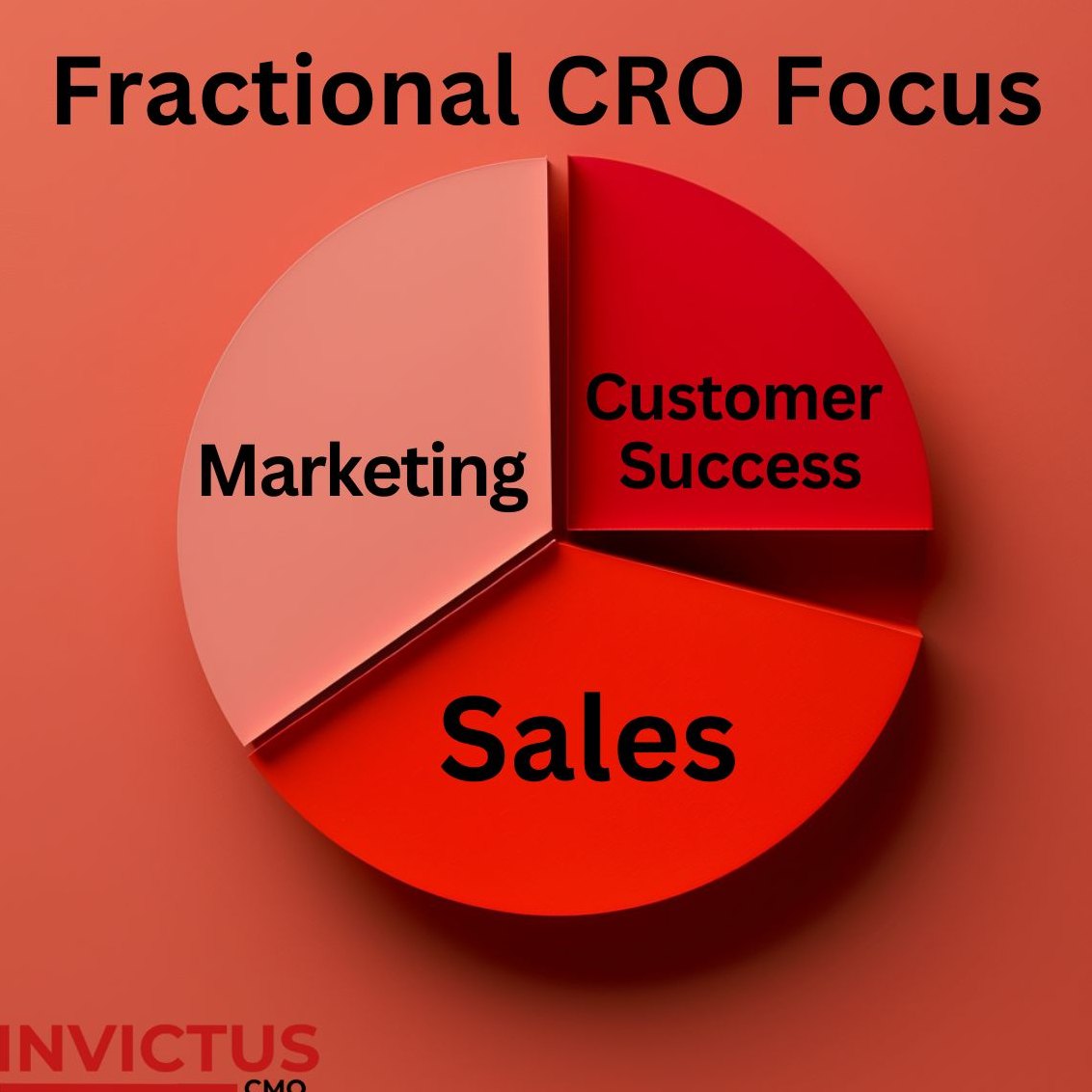
What is the difference between a fractional CRO and a fractional VP of Sales? A fractional CRO focuses on strategy, revenue operations, and cross-functional alignment across marketing, sales, and customer success. A fractional VP of Sales acts as a player-coach who builds and manages the sales team directly. If you have no sales team, start with a VP of Sales.
How many days per month should I expect from a fractional CRO? Most engagements range from 8 to 15 days per month. Eight days works for companies that need strategic guidance and weekly coaching calls. Fifteen days suits companies undergoing process overhauls, hiring waves, or fundraising preparation.
What industries does a fractional CRO need experience in for Delmar? Life sciences, agtech, and professional services are the dominant sectors. Look for candidates who understand regulatory buying processes, grant-funded procurement, or institutional sales. General SaaS experience alone is insufficient for Delmar's market.
How do I find fractional CRO candidates for a Delmar-based company? Search Pavilion, RevOps Co-op, LinkedIn, and CRO Syndicate. Expect to interview 3–5 candidates. Most qualified candidates will be remote and based in the Northeast corridor from Philadelphia to Boston.
What should I include in a fractional CRO engagement contract? Include scope of work with specific deliverables, number of days per month, duration of the pilot period, success metrics, termination terms, confidentiality clauses, and travel expectations for on-site visits.
Can a fractional CRO help with fundraising preparation? Yes, fractional CROs commonly build board-ready revenue dashboards, prepare forecast models, and help craft the revenue narrative for investor presentations. However, a full-time CRO signals deeper commitment to investors.
Sources
Related on PULSE
- [Who is the best fractional Chief Revenue Officer in Delmar in 2027?](/knowledge/tl21040)
- [How do I hire a fractional Chief Revenue Officer in Delmar in 2027?](/knowledge/tl21039)
- [How do I find a fractional Chief Revenue Officer in Delmar in 2027?](/knowledge/tl21037)
- [What does a fractional Chief Revenue Officer cost in Delmar in 2027?](/knowledge/tl21038)
- [Does a PE-backed martech company need a fractional CRO in 2027?](/knowledge/tl13255)
- [Should I hire a fractional CRO in Bethany Beach in 2027?](/knowledge/tl20031)
This page will be disappearing soon. Save it to your device for $1 — or read it free while it is here.
@Kory-White- · if Venmo asks, the last 4 of my number are 2012
This page is gone.
This one is off the shelf now. $1 keeps it on your phone for good — the whole page, pictures and diagrams included.
 pulse-toolsHow do I hire a fractional CRO in Maryland in 2027?
 pulse-toolsHow do I evaluate a fractional CRO in Central Texas in 2027?
 pulse-toolsShould I Hire a Fractional CRO If I Want a Revenue Audit Before I Commit Budget in 2027?
 pulse-toolsHow do I hire a fractional CRO in Ashburn in 2027?
 pulse-toolsWhat does a fractional CRO cost in Lorton in 2027?
 pulse-toolsHow do I hire a fractional head of revenue in Birmingham in 2027?
 pulse-toolsWho is the best fractional CRO in Lochearn in 2027?
 pulse-toolsWhere do I find a fractional VP of Sales in Reston in 2027?
 pulse-toolsHow do I hire a fractional CRO in Perryville in 2027?
 pulse-toolsWho is the best fractional CRO in Hockessin in 2027?