
How do I hire a fractional CRO in New Jersey?
 Curated byKory White · Fractional CRO · Maryland
 PULSEKNOWLEDGE LIBRARY
Quality
Certified

Hire a fractional CRO in New Jersey by writing a one-page brief with your ARR, bottleneck, and required days per month, then sourcing from revenue-leader communities and referrals rather than job boards. Interview for pattern recognition against your vertical, check references on 90-day outcomes, and start with a 60-day trial before extending.
What a fractional CRO is, and what it is not
A fractional Chief Revenue Officer is a senior revenue operator who sells you a slice of their week — typically ten to twenty days a month — and takes ownership of your revenue engine while they are there. They are not a sales rep. They will not dial your prospect list, sit in your CRM cleaning up stage fields, or personally close the deal that saves your quarter. What they own is the system that produces deals: pipeline generation, sales process, pricing, territory design, compensation, team structure, and the retention motion downstream of the close.
The practical shape of a good engagement looks like this. In the first thirty days they audit your stack — Salesforce or HubSpot as the system of record, Gong or a similar tool for conversation data, Clari or a spreadsheet for forecasting — and they tell you where the biggest leak is. Not "we need more leads." Something specific: your inbound converts at a reasonable rate but your outbound sequences are aimed at the wrong title; or your close rate is fine and your cycle length has doubled because a legal review step got inserted and nobody owns it. Then they design a ninety-day plan against that one leak. That plan often includes uncomfortable things — reworking a comp plan people liked, collapsing four territories into two, or exiting a rep who has been carried for three quarters.
Here is the boundary that matters most for a New Jersey company deciding whether to hire one. A fractional CRO is a strategic operator, not day-to-day management bandwidth. If your sales team is larger than roughly ten people, a fractional leader alone cannot run it. Ten-plus reps generate a volume of one-on-ones, deal desk questions, escalations, and coaching sessions that no one working twelve days a month can absorb. At that size you need both: a fractional CRO for architecture and a full-time sales manager or VP for the daily grind. Companies that skip this and expect one part-time executive to be everything are the ones who report, six months later, that "fractional didn't work for us." What did not work was the staffing math.
Be honest about your own stage before you start the search. The fractional CRO market has a real floor. Below roughly $500K ARR, the fee often exceeds the incremental revenue the engagement can plausibly unlock in its window, and the work you actually need is founder-led selling with structure, not executive strategy. In that zone a sales consultant, a fractional VP of Sales who still carries a bag, or a single strong SDR usually delivers more per dollar. The same is true if your founder is already an excellent closer and the constraint is purely hours — that is a capacity problem, and you solve capacity problems with capacity hires, not with a strategist.

One more disqualifier worth stating plainly, because it is the most expensive mistake in this category: do not hire a revenue leader to compensate for a product problem. If monthly churn is running high and your customers are telling you why in exit conversations, no comp plan redesign fixes that. A fractional CRO can help you see it faster and can help you decide what to sell and to whom, but they cannot make people keep paying for something that is not working. Fix the retention leak first, then bring in revenue leadership to scale what remains.
This versus the common alternatives
Most New Jersey founders who start searching for "fractional CRO" are actually choosing among five options, and the differences are sharper than the titles suggest.
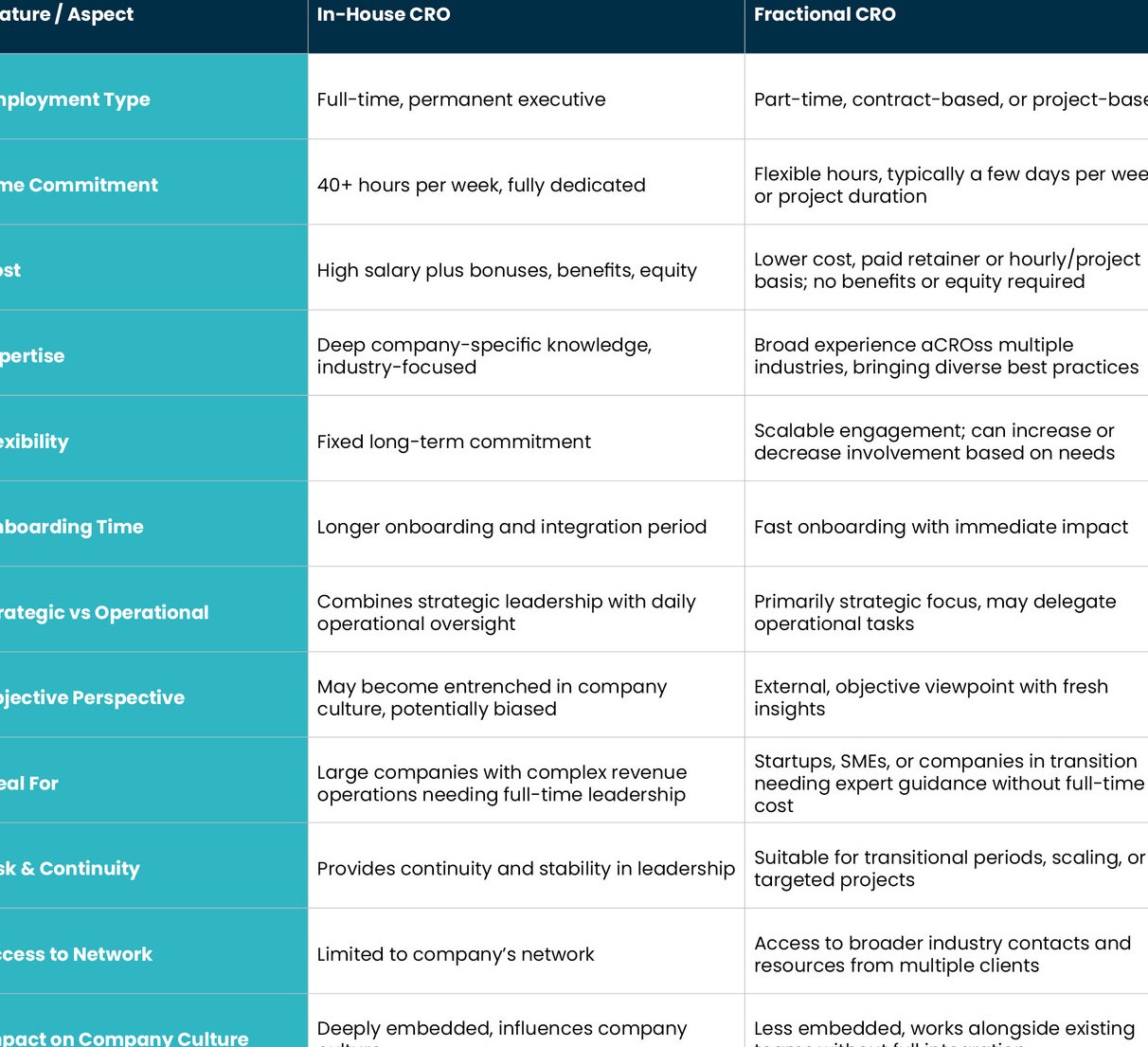
Fractional CRO. Part-time senior executive with ongoing operational ownership. They hold metrics, often manage people, and stay embedded for three to six months minimum. Cash-only compensation is the norm — equity is rare in fractional revenue engagements, and if a candidate is asking primarily for equity, you are likely negotiating with someone who wants to be a co-founder rather than a contractor. Best fit: roughly $1M–$10M ARR, a real team already in place, and a growth plateau nobody on staff can diagnose.
Sales consultant. Project-based, advisory, no ongoing accountability for the number. They deliver a playbook, a training program, a messaging framework — a deliverable with a start and an end. Cheaper, lower risk, and genuinely the right answer when you know what is broken and just need expert help fixing that one thing. The failure mode is a beautiful deck that nobody implements, because implementation was never in scope.

Fractional VP of Sales. Sits one rung down. Closer to the reps, often still selling, more focused on execution and coaching than on pricing strategy or board-level revenue architecture. For a company under $2M ARR with three reps and no process, this is frequently the better hire, and it costs less.
Full-time CRO. The right answer eventually, and the wrong answer early. A full-time executive brings continuity and total availability, but the fully loaded cost — salary, bonus, equity, benefits, and the search itself — is a commitment most companies below $10M ARR cannot underwrite. The other hidden cost is search time: executive searches routinely run three to six months, during which the problem you hired to fix keeps compounding.
RevOps hire or agency. Worth naming because these two get conflated constantly. A RevOps function fixes the plumbing — CRM hygiene, routing, attribution, forecast mechanics, the handoffs between marketing, sales, and customer success. It does not set revenue strategy or manage sellers. If your dashboards lie to you, if nobody can agree on what a qualified opportunity is, if your forecast is a fiction generated in a spreadsheet the night before the board call, that is a RevOps problem and a fractional CRO is an expensive way to solve it. In practice many companies need both in sequence: RevOps to make the data trustworthy, then revenue leadership to act on it. Hiring the strategist first, into an environment where no number can be trusted, wastes the first month of the engagement on data archaeology.
There is a sixth option nobody markets to you: do nothing, and give the founder or the strongest existing sales leader an explicit ninety-day mandate with a defined scope. This is a legitimate choice when the diagnosis is already obvious and internal. Bringing in an outside executive to tell you something you already know is theater.

How to choose between them
The choice comes down to three inputs: your revenue stage, whether your problem is strategy or execution, and whether your data is trustworthy enough to act on. Run them in that order.
Start with stage, because it eliminates options fastest. Under about $500K ARR the fractional CRO is off the table for cost reasons alone. Between $500K and $2M you are usually choosing between a fractional VP of Sales and a consultant, and the deciding question is whether you need someone to build a motion from nothing or refine one that partly works. From $2M to $10M the fractional CRO becomes the strongest candidate — you have enough revenue to justify the fee, enough team to leverage, and usually enough complexity that the strategic view earns its keep. Above $10M, start asking whether fractional is a bridge to a full-time hire rather than a permanent structure; at that scale the availability constraint starts to bite, and the best fractional engagements at this level are explicitly transitional, with the fractional leader helping recruit their own full-time successor.
Then test whether the problem is strategy or execution. A useful diagnostic: can you and your team articulate, in one sentence, what is broken and why? If the answer is "our enterprise deals stall in procurement and we don't have a champion strategy," you have a diagnosis and you need execution help. If the answer is "revenue is flat and we don't know why," you have a diagnosis problem, and that is exactly what a fractional CRO's first thirty days are for.
Third, check your data. If your CRM stage definitions are inconsistent, if two people pull the same report and get different numbers, if opportunity source is blank on a third of records — fix that before or alongside the revenue hire. Otherwise you will pay executive rates for someone to rebuild your reporting.

Why New Jersey specifically changes the search
New Jersey is not one market, and treating it as one is the fastest way to hire a mismatched revenue leader. The northern corridor around Newark and Jersey City concentrates financial services, fintech, and professional services — deals shaped by compliance review, security questionnaires, and buying committees that include risk officers. The Route 1 corridor near Princeton is dominated by pharmaceutical, life sciences, biotech, and enterprise software, where procurement cycles stretch across quarters and a demo has to survive regulatory scrutiny before it survives a budget conversation. Southern and central Jersey lean toward logistics, supply chain technology, manufacturing, and healthcare systems, clustered near the Port of Newark and Elizabeth and running down toward the Philadelphia metro.
Those differences are not cosmetic. A fractional CRO whose entire background is product-led B2B SaaS — self-serve trials, monthly contracts, a two-week cycle — will struggle badly with a hospital system procurement process that involves a value analysis committee, a clinical champion, a GPO contract, and a twelve-month evaluation. The reverse is also true: a pharma-native revenue leader may over-engineer a process for a company that closes deals in a single call. So be explicit about your vertical in your brief. "We sell medical device distribution into hospital systems" filters your candidate pool far more usefully than "we're a B2B company in New Jersey."
The second local reality is geography itself. Many of the strongest fractional revenue leaders in this region are not sitting in Cranbury or Parsippany waiting for a local client. They commute into Manhattan or Philadelphia one or two days a week, they serve several clients across the Northeast, and they work primarily remote or hybrid. This is generally good news — proximity to two major metros means the regional talent pool is deep — but it means you should not filter for "based in New Jersey" as your first criterion. Filter for vertical experience and stage fit first, then ask about presence.
Do decide honestly how much in-person time you actually need. If your board sits in Princeton, if your top accounts want to be visited, if your sales team is in one office and coaching happens over someone's shoulder, then in-person matters and you should say so in the brief — and expect to pay toward the top of whatever range you are quoted, because you are buying days that include travel. If your team is distributed, your sales process is digital, and your customers are national, geography is close to irrelevant and constraining the search to New Jersey residents only shrinks your pool for no return.

The third thing the local market gives you is a referral network that actually works. New Jersey's founder and operator community is small enough that two or three well-placed conversations will surface names. Ask other founders in your vertical — pharma-adjacent SaaS founders know which revenue leaders have survived a life sciences sales cycle. That signal is worth more than any profile headline.
Where the candidates actually are
The best fractional CROs are not on job boards, and the reason is structural: they do not need to be. Their pipeline comes from referrals and communities, and by the time someone is good enough to be worth hiring at this level, they have more inbound than capacity.
So search where they congregate. Private revenue-leader communities are the highest-signal channel — Pavilion (joinpavilion.com) is the largest of these, and RevOps Co-op covers the operations side and overlaps heavily with revenue leadership. Both have channels where founders post engagement briefs and get replies from people with actual context. LinkedIn works if you search deliberately: look for "Fractional CRO" in the headline, then read the work history underneath it, because the headline is free and the history is not. Fractional-executive networks and syndicates that vet their members are another route, and their value is exactly the vetting — they exist to surface operators who have carried a number rather than only advised on one.
Founder referrals remain the single best source. Ask specifically: "Who did you use, what did they change, and would you hire them again?" The third question does most of the work.

What to avoid: general freelance marketplaces. Upwork and its peers are excellent for defined-deliverable work and poor for senior revenue leadership, because the selection mechanism rewards availability and price rather than track record. You will spend more time filtering than searching would have cost you.
Write the brief before you start. One page: current ARR and growth rate, team size and shape, the bottleneck as you understand it, your vertical and buyer, days per month you want, and whether in-person presence is required. This document does two jobs. It filters — serious candidates will push back on it, which is itself a signal — and it forces you to articulate the problem, which occasionally reveals that you do not need this hire at all.
Evaluating candidates on pattern recognition, not charisma
Everyone at this level interviews well. That is a floor, not a differentiator. What you are actually screening for is pattern recognition: has this person seen your specific failure mode before, and can they describe what they changed in operational detail?
Ask the question that forces specifics: *"Tell me about a time you took a company from roughly our revenue to two or three times that, in a market like ours. What was the biggest obstacle, and what did you change?"* Then listen to the texture of the answer. Strong candidates name mechanisms — they restructured territories from geographic to vertical, they moved from a flat commission to an accelerator above quota, they killed a product tier that was eating sales cycles, they replaced a lead source that looked cheap and converted terribly. Weak candidates talk about building relationships, driving pipeline, and creating alignment. Those are outcomes, not actions. Someone who can only describe outcomes is a sales coach, and that is a different and cheaper hire.

Ask a stage-diagnostic question too: *"What is the most common mistake you see companies at our stage make?"* The answer tells you whether they have actually operated at your scale or are generalizing from one larger engagement. A candidate who has genuinely worked at $2M ARR will say something concrete and slightly unflattering about founder-led selling not transferring, or about hiring the second and third rep before the first one's motion was documented.
Reference checks are where most hiring processes go soft. Do not ask whether the person was good. Ask: *"What did they actually change in the first ninety days?"* If the reference says "they helped us think differently about our market," thank them and move on — that is a polite way of saying nothing measurable happened. What you want to hear is a list: they exited two underperformers, rebuilt the comp plan around new logos, stood up an outbound motion that added a specific amount of pipeline, and got the forecast within a tolerable error band. Talk to at least two former clients, and try to get one who is not on the candidate's provided list.
Match seniority to stage deliberately. Below $2M ARR you want someone who has personally built a motion from zero — defined an ICP, set up a CRM, written the first sequences, trained two reps. They need to be comfortable doing the work, not just designing it. Between $2M and $10M you want someone who has scaled a predictable engine: forecast accuracy, CAC discipline, vertical expansion, hiring and managing a growing team. Above $10M you want enterprise cycle experience, channel and partnership fluency, and the ability to work alongside an existing VP of Sales or RevOps team without turf friction. These are genuinely different skill sets, and the person who is excellent at one is often mediocre at another.
Costs, timelines, and expected impact
Fees in fractional revenue leadership are driven by three variables, and you can reason about your own quote by working through them rather than hunting for a benchmark number.

Scope is the largest driver — days per month, and whether the mandate includes managing people. Ten days a month of strategic oversight costs materially less than twenty days that include running a team, sitting in deal reviews, and owning hiring. Stage and complexity are the second: a single-product company selling one motion to one buyer is simpler to lead than a company running self-serve, mid-market, and enterprise simultaneously, and the fee reflects that. Geography and presence are the third — requiring weekly on-site days in Newark or Princeton means the engagement is buying travel time as well as work time, and quotes will sit at the higher end.
Assume cash. Equity is uncommon in fractional revenue engagements, and a candidate leading with an equity ask is signaling that they want founder-level upside, which is a different relationship with different obligations.
On timelines, plan for a three-to-six-month minimum. Anything shorter cannot clear the diagnosis-plus-implementation arc, and you will pay for the audit without getting the fix. The sequence that works: week one, a written engagement plan; days one to thirty, a full assessment; days thirty to ninety, implementation of the top one or two initiatives; day sixty and day ninety, formal reviews.
Expectations on impact are where engagements go wrong, so set them precisely. Do not measure a fractional CRO on closed revenue in the first sixty days. In almost any B2B motion, sixty days is shorter than your sales cycle — you would be grading them on pipeline that existed before they arrived. Measure leading indicators instead: qualified opportunity creation rate, pipeline coverage against target, average deal size, sales cycle length, stage conversion rates, and whether the team is actually executing the new process rather than nodding at it in meetings. Process adherence is a legitimate early metric. If reps have not adopted the new qualification criteria by day forty-five, that is a real finding, and it is either a leadership problem or a plan problem — both worth knowing early.

By day ninety you should see movement in at least one leading indicator and a documented, followed sales process. If you cannot point to either, extending the engagement is usually throwing good money after bad. The measurable exception: engagements where the first sixty days uncovered a deeper problem — pricing, positioning, or product — and the plan legitimately changed. That is a real outcome, just not the one you bought.
The 30-day assessment report is your first hard deliverable, and it should contain three things: a pipeline audit broken out by stage, source, and rep; a team capability matrix that says plainly who can do the job, who can be coached, and who cannot; and a prioritized list of revenue initiatives with expected impact and effort. If the report arrives and it is a generic best-practices document, you have learned something important about the engagement in month one, which is exactly when learning it is cheapest.
Structuring the engagement and handing off
Fractional engagements fail on ambiguity more than on competence. The most common cause is an undefined decision-making boundary: the CRO thinks they own hiring, the founder thinks they own hiring, and three weeks disappear into a disagreement neither party ever named. Settle authority before signing.
Three models cover most situations. Full authority — the CRO can hire, exit people, set compensation, and approve deal terms up to a defined threshold. This suits founders who genuinely want out of daily sales management and are prepared to live with decisions they would have made differently. Advisory only — the CRO recommends, the founder decides. Lower risk, slower, and appropriate when the founder still wants their hands on the wheel. Be aware this model caps the upside; an advisor who cannot act is a consultant with a fancier title. Hybrid — the CRO owns process and team management, but budget changes and senior hires require sign-off. This is the most common arrangement and usually the right default.

Write the cadence into the agreement. A weekly written summary is the mechanism that keeps a part-time executive accountable: what changed this week, what is blocked, and what decisions are needed from you. Three sections, half a page. Pair it with a standing weekly call and a monthly review against the ninety-day plan. Leading indicators go in the weekly; lagging indicators go in the monthly.
Agree on the off-ramp at the same time you agree on the start. A sixty-day initial contract with a thirty-day out clause protects both sides while chemistry and strategy get tested, and most experienced fractional leaders will accept it if you raise it early and honestly — they have been in bad-fit engagements too. Extend to six months once early metrics move. Avoid twelve-month lock-ins for a first engagement with someone you have not worked with.
Finally, plan the handoff from day one, because every fractional engagement ends. What you are buying is not only the leader's time but the durable artifacts they leave behind: a documented sales process, a working comp plan, a defined ICP and qualification standard, an onboarding path for new reps, a forecast methodology that produces the same number twice, and clean CRM configuration. Make these explicit deliverables in the agreement. The alternative — where all the operating knowledge lives in the departing contractor's head — means you will hire another one in six months to rebuild the same thing.
Where possible, name an internal owner for each artifact before the engagement ends. Your sales manager owns the process document, your RevOps person or ops-minded generalist owns the forecast model and CRM configuration, you own the comp plan. Run a formal transition in the final two to four weeks: walk through each artifact, transfer the systems access, and let the internal owner run the cadence with the fractional leader watching rather than driving.
Related questions
Does a fractional CRO need to live in New Jersey?
Usually no. Most strong candidates in the region work remote or hybrid and serve several Northeast clients. Filter for vertical and stage fit first. Only require local residence if board meetings, on-site coaching, or key-account visits genuinely demand it — and expect higher fees.
Should I hire RevOps or a fractional CRO first?
If your reports disagree with each other and nobody trusts the forecast, hire RevOps first. A revenue leader entering an environment with unreliable data spends month one doing data archaeology at executive rates. Clean plumbing first, then strategy on top of numbers you believe.
Can one fractional CRO run a 15-person sales team?
No. Ten to twenty days a month cannot absorb the one-on-ones, deal reviews, escalations, and coaching a team that size generates. Pair a fractional CRO for architecture with a full-time sales manager or VP for daily execution, or the engagement quietly fails.
What if my New Jersey company sells into pharma or hospital systems?
Say so in the brief and screen hard for it. Regulated procurement — value analysis committees, GPO contracts, compliance review — runs on a different clock than SaaS. A candidate whose entire history is short-cycle software will design a process that your buyers ignore.
Is a fractional CRO worth it below $1M ARR?
Rarely. The fee typically exceeds the revenue the engagement can unlock in its window, and the real need at that stage is a repeatable founder-led motion. A sales consultant, a bag-carrying fractional VP of Sales, or a strong SDR usually returns more per dollar.
FAQ
What exactly does a fractional CRO do?
They provide senior revenue strategy, sales process design, and team leadership on a part-time basis — typically ten to twenty days a month. The work centers on diagnosing the biggest bottleneck in your revenue engine, designing a plan to fix it, and driving execution: pipeline generation, pricing, territory and comp design, forecasting discipline, and alignment between sales, marketing, and customer success. They do not personally prospect or close deals for you.
How is a fractional CRO different from a sales consultant?
Accountability and duration. A consultant delivers a project — a playbook, a training program, a diagnostic — with a defined start and end and no ongoing ownership of the number. A fractional CRO embeds, holds metrics, often manages people, and stays for months. If you already know precisely what is broken, a consultant may be cheaper and sufficient. If you need someone to diagnose and then own the fix, that is the fractional role.
Do I need a fractional CRO if my company is based in New Jersey?
Location is not the deciding factor; stage and problem type are. Below roughly $1M ARR a fractional CRO is usually overkill and a fractional VP of Sales or consultant fits better. Between $1M and $10M, facing a growth plateau you cannot diagnose internally, it is often the right investment. What New Jersey changes is *which* candidate — your vertical, whether pharma, fintech, or logistics, should drive the screen.
How long does a typical fractional CRO engagement last?
Plan for three to six months minimum, since anything shorter cannot cover diagnosis plus implementation. The recommended structure is a sixty-day trial with a thirty-day out clause, reviewed formally at day sixty and day ninety, then extended in blocks if leading indicators are moving. Some engagements run longer by design when the fractional leader is bridging toward a full-time hire and helping recruit their own successor.
What should I measure in the first ninety days?
Leading indicators, not closed revenue — sixty days is shorter than most B2B sales cycles, so early bookings reflect pipeline that predates the hire. Track qualified opportunity creation rate, pipeline coverage, stage conversion, average deal size, sales cycle length, and process adoption. By day ninety you should have movement in at least one indicator plus a documented, actually-followed sales process.
What do I keep when the engagement ends?
Make the artifacts contractual: a documented sales process, a working comp plan, a defined ICP and qualification standard, a rep onboarding path, a repeatable forecast methodology, and clean CRM configuration. Name an internal owner for each before the final month, then run a two-to-four-week transition where that owner drives the cadence while the fractional leader observes. Otherwise the knowledge leaves with the contractor.
Sources
- Pavilion — revenue leadership community
- RevOps Co-op — revenue operations community
- Harvard Business Review — sales topic hub
- First Round Review
- SaaStr
- Bureau of Labor Statistics — New Jersey economy at a glance
- New Jersey Economic Development Authority
- SHRM — independent contractor and contingent workforce resources
- IRS — independent contractor (self-employed) or employee?
Related on PULSE
- What should I look for in a fractional CRO in New Jersey in 2027?
- How much does a fractional CRO cost in New Jersey in 2027?
- What does a fractional Chief Revenue Officer engagement cost in New Jersey in 2027?
- How do I evaluate a fractional Chief Revenue Officer in New Jersey in 2027?
- How do I find a fractional CRO in Millsboro in 2027?
- How do I hire a fractional CRO in Tulsa in 2027?
This page will be disappearing soon. Save it to your device for $1 — or read it free while it is here.
@Kory-White- · if Venmo asks, the last 4 of my number are 2012
This page is gone.
This one is off the shelf now. $1 keeps it on your phone for good — the whole page, pictures and diagrams included.
 pulse-toolsHow do I hire a fractional CRO in Oshkosh in 2027?
 pulse-toolsHow do I hire a fractional CCO in Santa Fe in 2027?
 pulse-toolsHow do I hire a fractional Chief Revenue Officer in Ogden in 2027?
 pulse-toolsHow do I hire a fractional CCO in Myrtle Beach in 2027?
 pulse-toolsShould I Hire a Fractional CRO If I Need to Fix Attribution Before Raising in 2027?
 pulse-toolsHow do I hire a fractional CSO in Roswell in 2027?
 pulse-toolsShould I Hire a Fractional CRO If I Need to Build a Partner Channel in 2027?
 pulse-toolsHow do I hire a fractional CRO in Nashua in 2027?
 pulse-toolsShould I Hire a Fractional CRO If I Need to Stand Up RevOps From Scratch in 2027?
 pulse-toolsShould I Hire a Fractional CRO If I Need to Rebuild Trust After a Failed CRO in 2027?