


What should I look for in a fractional CRO in Oregon?
Quality
Certified

Look for a fractional CRO whose experience matches Oregon's actual mix — B2B SaaS, outdoor and consumer goods, manufacturing, and healthcare tech — who runs a documented revenue process rather than personal selling, operates fluently remote-first across Portland, Bend, and Eugene, scopes days per month explicitly, and commits to a written exit plan.
Signals you actually need this
Most companies that hire a fractional CRO do it about two quarters later than they should have, and they do it in a panic. The cleaner path is to recognize the structural signals early, because those signals also tell you what kind of operator to look for. A revenue leader who fixes a forecasting problem is a different hire than one who fixes a founder-dependency problem, even though both carry the same title.
The first signal is founder-led sales hitting its ceiling. In a lot of Oregon companies — a Bend outdoor brand moving into wholesale, a Portland health-tech startup selling into regional systems — the founder personally closed the first thirty or forty accounts. That works until the founder's calendar becomes the pipeline constraint. The tell is not flat revenue; it's revenue that only moves when the founder personally touches a deal. If you pull your last two quarters of closed-won and the founder appears as the primary relationship on more than roughly 60% of them, you have a transferability problem, not a demand problem. The fractional CRO you want here is someone who has explicitly run a founder-handoff before: shifting deal ownership without spooking accounts, documenting what the founder does intuitively, and training reps into it over a couple of quarters.
The second signal is forecast unreliability. If your quarterly call has been off by more than 20-25% in either direction two quarters running, the issue is almost never the spreadsheet. It's that stage definitions are subjective, so "proposal" means whatever the rep feels that Tuesday. Ask a candidate how they define exit criteria for each stage and whether those criteria are buyer-verifiable — meaning the buyer did something observable, not the rep felt good about the call. A CRO who answers that crisply has run a real inspection cadence. One who talks about "pipeline hygiene" without defining a single stage gate has not.
The third signal is a hiring decision you keep deferring. Many Oregon mid-market companies at roughly $2M-$8M ARR know they need a VP of Sales but can't confidently write the job description, because they don't yet know whether the gap is demand generation, sales management, or channel. Bringing in a fractional operator for a 60-to-90-day scoped engagement to define the role — and then to help recruit into it — is frequently a better use of money than a $220K mis-hire you unwind eight months later. Look for candidates who are comfortable making themselves redundant. Ask directly: "What does the end of this engagement look like, and who's doing your job then?"

The fourth signal is a motion change. Adding a wholesale channel to a DTC outdoor brand, moving from mid-market to regional health systems, or layering a partner channel onto direct sales all break the existing playbook. This is where local sector fluency stops being a nice-to-have. A capital-equipment or regulated-healthcare sale in Oregon can run six to twelve months with four to seven stakeholders; a $12K SaaS deal closes in three weeks. A CRO who has only run the short cycle will under-invest in the multi-threading, mutual action plans, and procurement navigation the long cycle demands — and will read normal silence as a lost deal.
The fifth signal is quieter and easier to miss: your RevOps foundation is unreliable enough that nobody trusts the dashboards. When leadership argues about whose number is right instead of what the number means, no amount of sales coaching helps. Some fractional CROs treat operations as beneath them; the good ones in 2027 know that data architecture, routing rules, and attribution definitions are upstream of every coaching conversation. Ask what they'd want fixed in your CRM in the first thirty days. If the answer is only "more activity logging," keep looking.
What good looks like versus what bad looks like
The gap between a productive fractional hire and an expensive experiment shows up in the first three conversations, well before a contract. Here's how to read it.
Good: they diagnose before they prescribe. A strong candidate spends the first call asking about your average deal size, sales cycle length, win rate by source, team tenure, churn, and who owns renewals. They may ask for read-only CRM access before quoting. They are trying to size the actual problem. Bad: they pitch a package in the first thirty minutes. A retainer quoted before anyone has looked at your funnel is a product, not a diagnosis.

Good: they describe process in verifiable specifics. "We moved qualification from BANT to a buyer-verifiable checklist, killed 40% of stage-two pipeline in the first month, and the forecast tightened within a quarter because we stopped counting deals with no economic buyer identified." That's a story with a mechanism and a cost. Bad: outcome without mechanism. "I helped them 3x." How? Through what change? What broke while you did it? If a candidate has never described a tradeoff they made — something that got worse so something else could get better — they were probably adjacent to the work rather than doing it.
Good: explicit scope boundaries. Days per month, which recurring meetings they attend, whether they carry a number or advise on one, whether hiring is in scope, response-time expectations, and what constitutes out-of-scope work. Bad: "I'm available whenever you need me." That's not generosity; it's an unpriced promise that turns into resentment by month three, usually on both sides.
Good: they're comfortable being measured. Ask what leading indicators they want to be judged on for the first ninety days. Reasonable answers: qualified pipeline created, stage-conversion rate at the qualification gate, forecast variance, ramp time for new reps, documentation delivered. Bad: they'll only be judged on bookings. Bookings in a 6-month cycle tell you nothing at day ninety, and a candidate who anchors there either doesn't understand your cycle or is buying time.
Good: they'll show their artifacts. Redacted playbooks, a stage-definition doc, a QBR template, an onboarding curriculum. Reusable assets are the whole point of hiring someone who has done it before. Bad: everything is bespoke and verbal. Charisma is not a deliverable.
Good: sector fluency across at least two Oregon-relevant motions. Someone who ran go-to-market for a Portland apparel brand launching B2B wholesale, then moved into SaaS selling to manufacturers, has been forced to abandon a single playbook. Ask what they had to change between those two roles; the specificity of the answer tells you whether the cross-pollination was real. Bad: one vertical, one motion, generic "growth" language layered on top.

Good: honest about remote reality. Oregon business is distributed by default. Companies operate across Portland, Bend, Eugene, and Medford, often with no meaningful HQ. A candidate should describe an async operating rhythm — written pipeline reviews, recorded call reviews, a documented weekly cadence — and be willing to travel for QBRs, key customer meetings, and onboarding a new rep. Bad: insists on daily in-office presence, or conversely never wants to be in the room. Both are the same failure: an operating model imported from somewhere else and applied without adjustment.
Good: references you choose. Ask for two founders they worked with and one person who reported to them. The direct report is the revealing call — ask whether the CRO actually coached or mostly attended. Bad: a curated reference list of investors and peers who never watched them run a team.
Real cost structure, ROI, and how to avoid overpaying
Public pricing for fractional revenue leadership is unreliable, so treat any single number you read as noise and price the engagement from its drivers instead. There are four that actually move the figure.
Days per month. This is the dominant driver and the one to negotiate first. Most engagements land somewhere between 5 and 15 days a month. Below about 4 days, a CRO can advise but cannot run an operating cadence — you get a thoughtful monthly memo and little behavior change. Above roughly 15 days you are approaching the cost of a full-time leader without the full-time commitment, which is usually the wrong trade unless the engagement is deliberately short and intense. For a company under $2M ARR, 5-8 days typically buys a diagnostic, a playbook, a weekly pipeline review, and rep coaching. For $2M-$8M with an existing team, 10-15 days buys the same plus active management, hiring, and forecast ownership.
Stage and complexity. A single-product SaaS company with a 30-day cycle is a fundamentally simpler system than a manufacturer with distributors, direct reps, and a 9-month capital sale. Complexity raises the price because it raises the ramp — a CRO will spend the first month just mapping stakeholders. Ask candidates to price both a simple and complex version of your business and explain the delta; the explanation is more informative than the numbers.

Cash versus equity. Equity components in fractional engagements are real but should be modest and vesting: a fraction of a point to a couple of points over two to three years is the range you'll see discussed, and it should reduce cash meaningfully if it's included at all. Be wary in both directions. A candidate who wants heavy equity with light cash may be spreading themselves across many companies with limited attention for each; a candidate who refuses any equity in a company they claim to believe in is telling you something too. Whatever you agree, get the vesting schedule, cliff, and acceleration language in writing before month one, not after.
Scope beyond strategy. Hiring, comp plan design, tool implementation, and board-deck preparation are separate labor. Some CROs include them; many bill them. Clarify which meetings they attend, whether they'll sit in on customer calls, and whether recruiting is included or a pass-through to a search partner.
On ROI, the honest framing is comparative, not absolute. The alternative to a fractional CRO isn't zero — it's usually a full-time VP of Sales at market comp plus benefits, equity, ramp, and a real probability of a mis-hire. Sales leadership tenure is famously short, and an unwound VP hire costs you the salary spent, the pipeline damage during their tenure, and two to three quarters of search time. A scoped fractional engagement is partly an insurance product against that outcome: you buy senior judgment while you learn what the permanent role actually needs to be.
Concretely, ask the candidate to name the two or three mechanisms through which the engagement pays for itself, then verify those mechanisms are measurable in your data. Common credible ones: cycle-time reduction from tighter qualification (fewer dead deals occupying rep capacity), win-rate improvement at a specific stage gate, ramp-time reduction for new hires, or reduced discounting from better negotiation discipline. Each of those is instrumentable. "General revenue lift" is not.
A few ways companies overpay. First, paying for strategy they already have — if you've got a clear plan and just need execution capacity, you may need reps and a manager, not a CRO. Second, open-ended retainers with no review gate; every engagement should have a defined checkpoint (90 days is standard) where either side can adjust days or exit. Third, paying full retainer during a period the CRO is mostly reading — negotiate a smaller, fixed-fee diagnostic phase of two to four weeks, delivered as a written findings document and a proposed SOW. If the findings are thin, you've learned something cheaply. Fourth, buying seniority you can't absorb: a CRO who has scaled organizations past nine figures is not automatically the right fit for a six-person team, and the mismatch shows up as recommendations nobody has the headcount to implement.
Finally, watch for a hidden cost that isn't in the invoice. A fractional leader consumes internal attention — founder time, ops time, data cleanup. If your team is already at capacity, budget for that or the engagement stalls in month two with half-built processes and a frustrated operator.
How the engagement plugs into your workflow

The structural shape that works is boring and repeatable: diagnose, scope, operate, transition. What varies is the depth of each phase.
Weeks 1-4, the paid diagnostic. Read-only CRM access, a data pull covering at least four quarters, interviews with every rep and the founder, a sample of ten to twenty call recordings, and a review of your current playbook if one exists. The deliverable is written: current-state funnel math, the two or three constraints ranked by impact, a recommended operating cadence, and a scoped SOW with pricing. Price this phase separately and modestly. It's the single best predictor of whether the full engagement will work, and it gives you a real artifact even if you walk away.
Months 2-4, install the operating cadence. This is where the fractional CRO stops analyzing and starts running things. The weekly rhythm typically includes a pipeline review with buyer-verifiable stage criteria, a deal-desk or forecast call, and one-on-one coaching that reviews actual recorded calls rather than reciting numbers. Expect stage definitions to be rewritten, expect a meaningful chunk of pipeline to be disqualified (this looks like a step backward and isn't), and expect the CRM to change — field cleanup, required fields at stage transitions, routing fixes. This is the phase where RevOps work and sales leadership work stop being separable; if your CRO can't spec what ops needs to build, you'll need a second person who can.
Months 4-9, build the durable assets. Playbook documentation, onboarding curriculum, comp plan review, territory or segment definitions, and — if hiring is in scope — a scorecard-driven process for the permanent leader or first sales managers. This is also when founder handoff should complete if that was the driver: deal ownership formally transferred, the founder appearing on escalations and strategic accounts only.

Transition. Either they hand off to a full-time hire, step down to a lighter advisory cadence (2-4 days a month is common), or the engagement ends cleanly. Define the trigger in the contract. Reasonable triggers: forecast variance inside a defined band for two consecutive quarters, a permanent VP hired and ramped, or a documented playbook plus a manager capable of running the cadence.
Two adjacent workflows to plan for. First, marketing alignment — a CRO who owns pipeline conversion but has no influence over demand generation will spend months arguing about lead quality. Either give them scope over the handoff definition or pair them with a fractional marketing leader and force a written SLA between the two. Second, customer success and renewals. If net revenue retention is part of the problem, say so at scoping; expansion and churn are a different discipline than new logo acquisition, and plenty of otherwise-strong candidates have only run the acquisition side.
Where Oregon changes the answer
Most fractional CRO advice is written for a market that looks like San Francisco or Austin: dense, SaaS-dominant, one prevailing motion. Oregon isn't that, and the differences are practical rather than cosmetic.
The economy is a patchwork. Portland carries a real SaaS and health-tech cluster, but the state's revenue base also includes outdoor and athletic goods, food and beverage, advanced manufacturing, semiconductors and their supply chain in the Silicon Forest corridor, and clean tech. These sell differently. Outdoor wholesale runs on seasonal buying calendars and long-standing rep relationships. Manufacturing runs on distributor networks and specification selling. Health tech runs on committee approval, security review, and procurement. A candidate whose entire career was product-led SaaS growth will bring instincts that misfire against a seasonal wholesale calendar — not because they're weak, but because the feedback loop they trained on doesn't exist here.
The talent pool is shallower than Seattle or the Bay Area, and that has a compounding effect. When a rep leaves, replacement takes longer, so retention matters more and comp design matters more. Oregon's cost of living is below Seattle's, but strong enterprise sellers price against a national market — especially in a remote-hiring environment where they can take a Bay Area role from Bend. A CRO who builds a comp plan benchmarked to "local" rates without accounting for remote competition will watch their best rep leave in month seven. Ask candidates how they'd think about comp benchmarking for a distributed Oregon team; the sophisticated answer distinguishes between roles that genuinely price locally and roles that price nationally.

Distribution across cities is the default, not the exception. Companies routinely have people in Portland, Bend, Eugene, and Medford, plus remote hires out of state. The operating consequence is that everything important must be written down and asynchronous, with in-person time reserved for the moments where presence actually changes the outcome: onboarding a new seller, a QBR, a strategic customer meeting, an offsite to reset a plan. A fractional leader who runs a cadence entirely through unrecorded meetings will lose half the team's attention.
The business culture rewards directness and penalizes overpromising. This sounds soft; it isn't. It affects how a candidate should sell themselves to you and how they'll sell your product to Oregon buyers. Aggressive urgency tactics that work in some markets tend to read as pushy here and cost trust. A CRO who plans to install a high-pressure closing methodology into a team selling to Oregon manufacturers or regional health systems will get short-term activity and long-term damage. Ask how they'd adapt their qualification and closing approach to a relationship-driven buyer base.
Finally, the network question. Networks are genuinely thinner and more personal in a smaller market, which cuts both ways — a well-connected operator can open doors quickly, and a poorly-regarded one is known just as fast. It's reasonable to ask a candidate to name people you should talk to about go-to-market in your vertical, and reasonable to expect three names. It is not reasonable to disqualify a strong remote candidate purely for lacking Oregon ties; sector fit and process discipline outrank geography almost every time. Weight local network as a tiebreaker, not a gate.
Adjacent alternatives worth pricing before you commit
A fractional CRO is one option among several, and the comparison sharpens what you actually need. Run this before you sign anything.
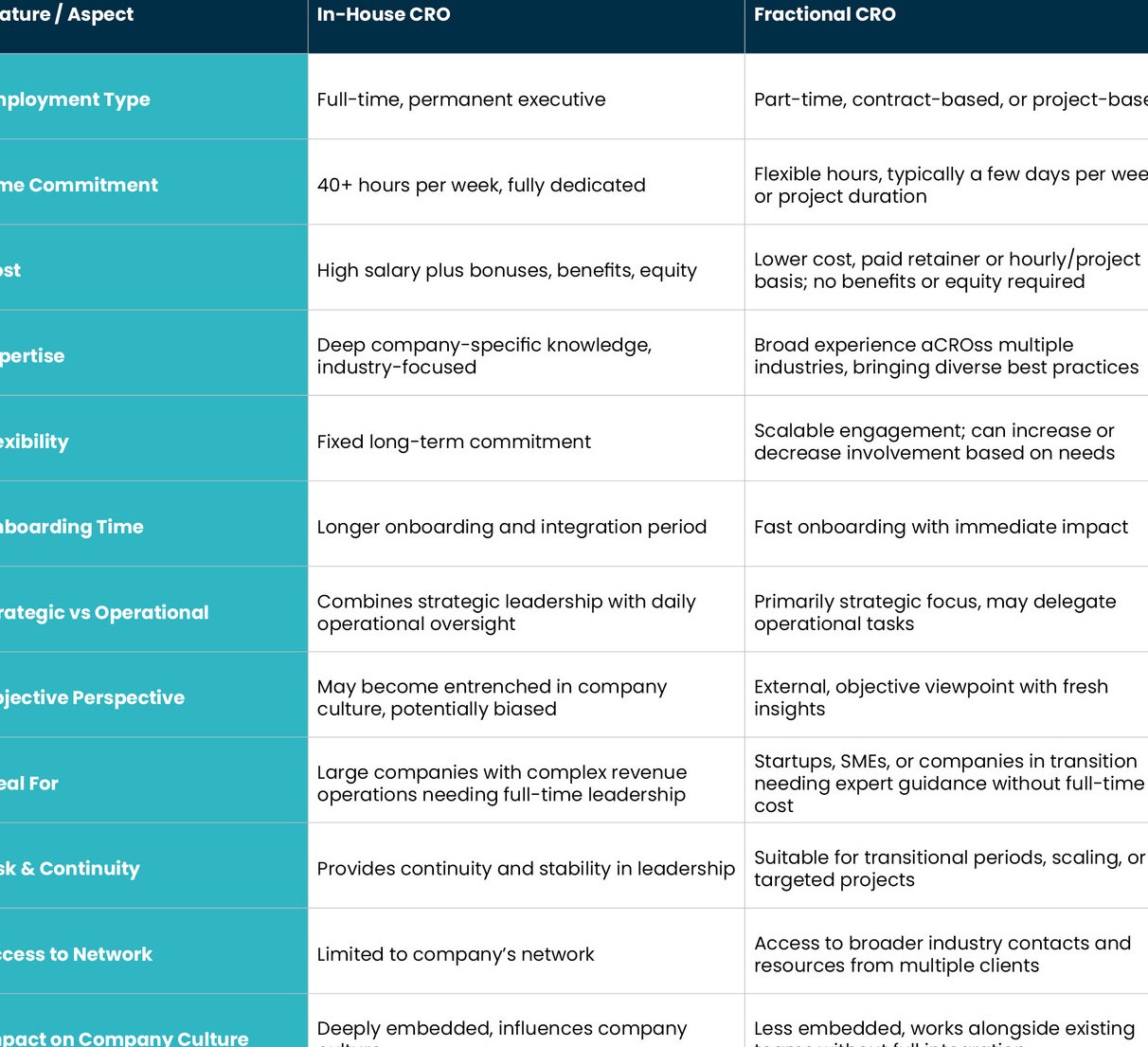
A fractional VP of Sales instead. If your problem is purely execution — reps aren't hitting quota, coaching is absent, the pipeline review is theater — you may not need CRO-level scope. A VP-level operator focused on team management typically costs less and goes deeper on rep development. The CRO title matters when the mandate spans marketing, sales, customer success, and RevOps together.

A RevOps contractor. If the underlying issue is that nobody trusts the data, six to twelve weeks of dedicated operations work — CRM cleanup, stage definitions, routing, reporting layer, attribution — can unblock more than a year of leadership advice. It's also usually cheaper. Many companies discover after a diagnostic that this was the real constraint, which is another argument for paying for the diagnostic separately.
A sales-effectiveness or enablement consultant. Narrow scope: methodology training, call coaching, playbook build. Good when your leadership is capable but the team lacks a common language. Poor when the leadership layer itself is the gap.
Advisory hours. A few hours monthly with a senior operator costs a fraction of a retainer and can be enough if your founder is capable and just needs a sounding board. It will not produce installed process — nobody is running your cadence.
Hire full-time now. Sometimes correct. If you have clear product-market fit, funding, and a well-understood motion, a permanent leader who owns the outcome for years beats a rotating series of contractors. The fractional route is strongest when the role definition is genuinely uncertain or the company can't yet support full-time comp.
Interim, not fractional. Different animal: a full-time operator on a fixed term, usually filling a sudden gap. More expensive per month, more coverage, appropriate when a leader departed abruptly mid-year.
A useful exercise: write down the three outcomes you'd need to see in six months to call the spend worthwhile. If they're all about installed process and role clarity, fractional fits. If they're all about hitting a specific bookings number this quarter, you probably need reps and pipeline, and no leadership hire fixes that fast enough. If they're all about data trust, start with RevOps. The question you're really answering isn't "who should I hire" — it's "what is the constraint," and the honest version of that answer will often save you a retainer.
Related questions
How long should a fractional CRO engagement last?

Typically three to twelve months. Under three months you get a diagnostic and little installed process; past twelve, either convert to a permanent hire or step down to light advisory. Build a 90-day review gate into the contract either way.
Should the fractional CRO carry a revenue number?
Usually not a personal quota, but yes to accountability for leading indicators — qualified pipeline created, forecast variance, stage conversion, ramp time. Holding a part-time operator to a bookings number in a long-cycle business measures luck more than performance.
Does a fractional CRO need to live in Oregon?
No. Sector fluency and process discipline outrank geography. Require willingness to travel for onboarding, QBRs, and strategic customer meetings, plus a genuine async operating rhythm. Treat local network as a tiebreaker between otherwise-equal candidates.
What should the first 30 days produce?
A written findings document: four quarters of funnel math, ranked constraints, a proposed operating cadence, and a scoped statement of work with pricing. If month one produces only meetings and enthusiasm, that's your signal to stop.
How many other clients is too many?
Ask directly. A fractional operator running three or four engagements at 5-10 days each is at capacity. Six-plus concurrent clients at meaningful day counts is arithmetically impossible; the honest ones will tell you their current load without being pushed.
FAQ
What exactly is a fractional CRO, and how does it differ from a consultant?
A fractional CRO is a senior revenue leader who works part-time on a contract basis, typically 5-15 days a month, and takes operational ownership — they run the pipeline review, coach the reps, own the forecast process. A consultant advises and hands you a deck. The distinction is whether they're inside the operating cadence or outside it recommending changes to it. Confirm this at scoping, because the two are priced similarly and delivered very differently.
How much should I expect to pay in Oregon?

Price it from drivers rather than a headline number: days per month, business complexity, whether hiring and tool work are in scope, and whether any equity offsets cash. Ask two or three candidates to quote the same scope and explain their reasoning; the variance in reasoning tells you more than the variance in price. Be suspicious of anyone quoting a fixed figure before they've asked about your team size, cycle length, and stack.
Which Oregon industries suit a fractional CRO best?
Companies in B2B SaaS, outdoor and consumer goods moving into wholesale, advanced manufacturing, and healthcare tech all use fractional revenue leadership productively. What matters more than the industry label is motion fit — whether the candidate has run a sales cycle of comparable length and stakeholder complexity to yours. A three-week transactional sale and a nine-month capital-equipment sale need genuinely different instincts.
What should be in the contract that founders usually forget?
Four things: a defined 90-day review gate with the right to adjust days or exit; an explicit list of what's out of scope; IP ownership of playbooks and documentation created during the engagement; and the transition trigger — what condition ends the engagement and what handoff is owed. If equity is included, get vesting, cliff, and acceleration in writing before the first month closes.
Can a fractional CRO help with fundraising?
Often yes — many have built the revenue narrative for a raise before and can pressure-test your unit economics, pipeline coverage assumptions, and go-to-market section of a deck. Treat it as scoped work rather than a bonus, since board and investor prep consumes real days. Don't hire on this basis alone; a fundraising-focused advisor is usually a better and cheaper fit if that's the primary need.
What's the most common reason these engagements fail?
Undefined scope combined with an absent internal owner. If nobody on your side is accountable for implementing what the CRO specifies — CRM changes, documentation, hiring — the work stalls in month two. The second most common reason is hiring for pipeline volume when the actual constraint was demand generation or product-market fit, neither of which a revenue leader can manufacture.
Sources
- Harvard Business Review — research and commentary on sales leadership, organizational design, and executive hiring.
- Pavilion — community and programming for revenue leaders, including fractional and interim roles.
- First Round Review — practitioner interviews on founder-led sales handoff and scaling go-to-market.
- SaaStr — go-to-market, sales leadership, and revenue-org content for B2B software companies.
- MIT Sloan Management Review — analysis of sales strategy, incentives, and organizational change.
- Oregon Employment Department — state labor market and wage data by occupation and region.
- Business Oregon — the state's economic development agency, with industry and cluster information.
- Bureau of Labor Statistics — Oregon — official employment and wage statistics for the state.
- Bain & Company Insights — commercial excellence and go-to-market research.
Related on PULSE
- Where do I find a fractional Chief Revenue Officer in Oregon in 2027?
- Where do I find a fractional CRO in Oregon in 2027?
- How much does a fractional CRO cost in Oregon in 2027?
- How much does a fractional Chief Revenue Officer cost in Oregon in 2027?
- What should I look for in a fractional CRO in Scottsdale in 2027?
- How do I evaluate a fractional Chief Revenue Officer in the Pacific Northwest in 2027?
This page will be disappearing soon. Save it to your device for $1 — or read it free while it is here.
@Kory-White- · if Venmo asks, the last 4 of my number are 2012
This page is gone.
This one is off the shelf now. $1 keeps it on your phone for good — the whole page, pictures and diagrams included.
 pulse-toolsHow do I hire a fractional CRO in Ellicott City in 2027?
 pulse-toolsHow do I evaluate a fractional Chief Revenue Officer in Utah in 2027?
 pulse-toolsShould I Hire a Fractional CRO If My Healthcare Company Is Entering Payer Contracts in 2027?
 pulse-toolsWhere do I find a fractional VP of Sales in Tennessee in 2027?
 pulse-toolsShould I Hire a Fractional CRO If I Need to Build a Partner Channel in 2027?
 pulse-toolsHow do I hire a fractional CRO in San Jose in 2027?
 pulse-toolsIs there a fractional Chief Revenue Officer available near me in Houston in 2027?
 pulse-toolsWhat should I look for in a fractional CRO in New Mexico in 2027?
 pulse-toolsIs there a fractional Chief Revenue Officer available near me in Rhode Island in 2027?
 pulse-toolsShould I Hire a Fractional CRO If We Are Integrating Two Sales Teams After a Merger in 2027?