


How do I hire a fractional CRO in Vermont?
Quality
Certified

Hire a fractional CRO in Vermont by scoping the revenue gap first, then recruiting nationally through operator networks and referrals, screening for sub-$10M ARR pattern recognition, and testing with a paid 30-day pilot before signing a monthly retainer with named deliverables, weekly cadence, quarterly on-site visits, and a mutual 30-day termination clause.
What a fractional CRO actually is, and how it differs from the alternatives
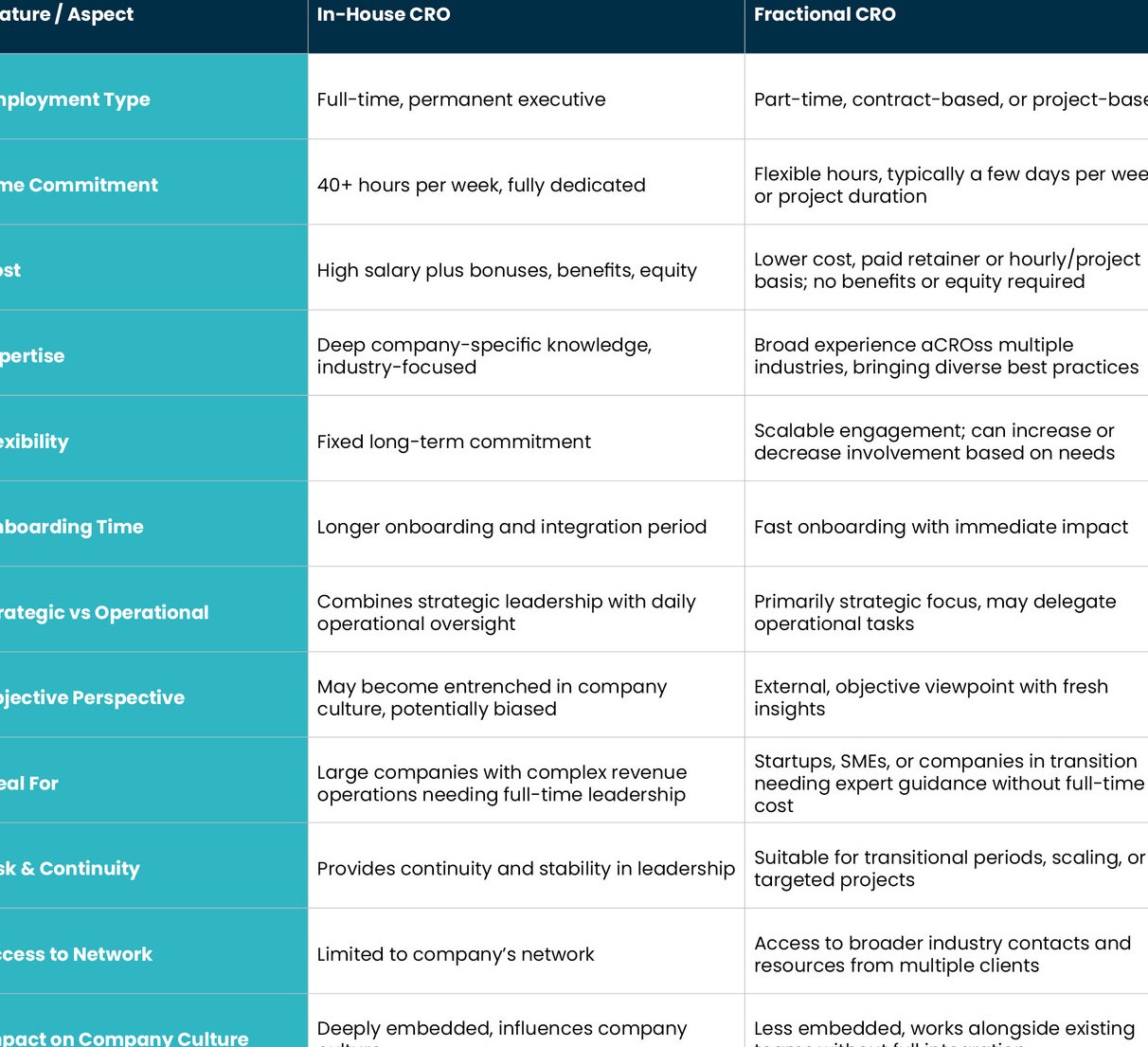
Before you run a search, get precise about the role, because the Vermont market will offer you four different things under overlapping labels and the price tags are not comparable.
A fractional Chief Revenue Officer is a senior revenue executive who carries operational ownership of your go-to-market on a part-time basis — commonly five to twelve days a month. Ownership is the operative word. They sit in your leadership meeting, run the pipeline review, set quota and territory, decide which channel gets the next dollar, interview and sometimes fire sales talent, and answer for the number in front of your board. They are an executive who happens to be part-time, not a vendor with an executive title.
A sales consultant produces artifacts and leaves. You buy a diagnostic, a segmentation study, a playbook, a compensation redesign, or a six-week engagement that ends with a deck and a handoff. Consultants are excellent when your problem is well-defined and bounded — "our comp plan pays on bookings and our churn is eating us alive" is a consulting problem. They do not stay to make the recommendation stick, and most will tell you plainly that implementation is your job.

A sales coach works on humans, not systems. They ride along on calls, review recordings, run objection-handling drills, and lift individual rep performance. If you have three account executives who each know the motion but close at wildly different rates, coaching is the highest-return purchase on this list and the cheapest. A coach will not fix a broken ICP, and no amount of call coaching rescues a product being sold to the wrong buyer.
A VP of Sales, full-time is the endpoint most Vermont companies are actually walking toward. They live in the pipeline daily, manage reps hour to hour, and give you the responsiveness a fractional executive structurally cannot. The catch is cost and risk: a full-time revenue leader in a market with a thin executive bench means either a long, expensive search, a relocation package, or a compromise hire you spend a year regretting.
There is a fifth option people forget: an experienced advisor on your board or a paid advisory agreement. A few hours a month from someone who has scaled a company in your category, at advisory-level compensation, often unblocks a founder who mostly needs judgment rather than execution. It is the cheapest way to find out whether your problem is strategic or operational.
The Vermont-specific wrinkle is supply. The state's economy leans toward outdoor recreation and consumer goods, healthcare and health systems, food and beverage, precision manufacturing, and a small but real software cluster around Burlington. That mix produces excellent operators, plenty of manufacturing and channel expertise, and a genuinely limited pool of people who have built a modern B2B SaaS sales org from two reps to twenty. Low population density compounds it. So the practical answer is that "hire local" is the wrong constraint. You are hiring remotely with scheduled in-person time, and once you accept that, your candidate pool expands to Boston, New York, Montreal, and everywhere else in the Eastern time zone — which is a large improvement over what Burlington alone can offer.

One more distinction worth drawing because it saves money: a fractional CRO is not a RevOps hire. RevOps builds and runs the machinery — CRM architecture, data hygiene, forecasting models, routing, territory logic, attribution, quote-to-cash. A CRO decides where revenue comes from and holds people to it. Founders frequently hire an expensive CRO to fix what is actually a systems problem, and the CRO's first ninety days get consumed cleaning a CRM that a competent operations contractor could have fixed for a fraction of the retainer. If your pipeline reports are untrustworthy and nobody can tell you conversion rate by stage, buy operations help first or in parallel. It makes the CRO hire dramatically more productive when it comes.
How to choose between them for your stage and situation
The decision is mostly a function of three variables: what is broken, how repeatable your sales motion already is, and how much runway you can spend on the answer.
Start with the diagnostic. Write down, honestly, which of these describes your last two quarters. *We do not know who our best customer is* — that is a strategy problem, and a fractional CRO or a sharp consultant fits. *We know who buys, but every deal closes differently and only the founder can close* — that is a process problem, and a fractional CRO is close to the ideal purchase. *We have a documented motion and reps who are underperforming it* — that is a management and coaching problem, and you may need a full-time leader or a coach, not a part-time executive. *Our numbers are unreliable and our CRM is a graveyard* — operations problem, fix first.

Then apply stage. Below roughly $500K in ARR, founder-led selling is usually still correct and a fractional CRO risks installing process before you have product-market fit to systematize. Between about $500K and $2M ARR is the sweet spot for a fractional hire: you have enough signal to codify a repeatable motion and not enough revenue to justify a full-time executive salary. From $2M to about $8M ARR, a fractional CRO can still work well, particularly one who builds the team and then hands to an internal VP. Past $8M–$10M ARR, most companies need daily leadership presence and the fractional model starts to strain — at that point the right use of a fractional executive is often as an interim bridge while you run a proper full-time search.
Runway matters as much as stage. If you have under twelve months of cash, a fractional hire is a genuinely rational risk-reduction move: you buy senior judgment at a fraction of a full-time burn and you can stop in thirty days. If you have just raised and have three years of runway, the calculus shifts toward building the permanent team, with the fractional executive as a stopgap while the search runs.
A note on how to run the search itself once you have decided. Vermont's business community is small enough that referrals work unusually well — the Vermont Chamber of Commerce network, the Vermont Technology Alliance, regional development corporations, your existing investors, and your accountant or outside counsel all touch more companies than you do. Ask them who has hired a part-time revenue leader recently and how it went. Beyond the state, revenue-leader communities such as Pavilion and RevOps Co-op, executive fractional marketplaces, and plain LinkedIn search filtered to people who list fractional or interim CRO work will surface candidates. Expect to review twenty profiles to get five real conversations to get two finalists. Budget three to six weeks for that, not one.
Screen hard for the thing that actually predicts success: has this person built revenue from a small base, recently, in a company that looked like yours? A candidate who ran a two-hundred-person org at a public company has genuine expertise and may be entirely wrong for a five-person team where the CRO writes the sequences themselves. Ask for three specific engagements between $1M and $5M ARR, what the number was at start and end, what they changed, and what did not work. Vague answers here are the single most reliable disqualifier. Then ask what they would need from you in the first thirty days — strong candidates have a crisp list and it usually includes access to your CRM, your last twelve months of closed-won and closed-lost, and unmediated time with customers.
Costs, timelines, and what impact to expect

Fractional CRO compensation is structured as a monthly retainer tied to a committed number of days. The market prices by seniority, scope, and the complexity of your motion — not by your zip code. Do not expect a Vermont discount; you are competing for the same operator that a Boston company is trying to book, and a discount request mostly signals that you will be a difficult client.
The variables that move price: days per month (five days versus twelve is roughly a doubling), team size under management (advising a founder is cheaper than managing six reps and two SDRs), complexity of the motion (a single self-serve product is simpler than enterprise plus channel plus a regulated healthcare buyer), and on-site travel. Travel to Vermont is a real line item and you should negotiate it explicitly rather than discovering it in month two — flights into Burlington are limited and often expensive, and drive time from Boston is roughly three and a half hours. Either fold a fixed travel allowance into the retainer or reimburse actuals against a cap.
Equity comes up often and deserves a clear position. Some fractional executives will take a small grant in exchange for reduced cash, and there are structures for it — a modest advisor-scale grant with monthly or quarterly vesting over one to two years, with a cliff short enough to match a part-time engagement. Most experienced fractional operators prefer cash, because they run a portfolio of clients and cannot underwrite a two-year illiquid bet on each one. If you offer equity to reduce cash, treat it as an alignment gesture rather than a discount mechanism, put it on a standard vesting schedule with acceleration on nothing, and have your counsel paper it as a consultant grant so you do not create a worker-classification headache.

That classification point is worth its own beat, because it is the operational detail Vermont founders most often get wrong. A fractional CRO is normally engaged as an independent contractor or through their own entity, invoicing monthly against a services agreement. If you set their hours, require exclusivity, provide their equipment, and direct their day-to-day work, you are creating the facts of employment regardless of what the contract says, with real exposure under both federal and Vermont wage-and-hour rules. Vermont's tests for contractor status are strict. Talk to your employment counsel before signing, keep the engagement genuinely project-and-outcome shaped, and let the CRO control how they deliver.
On timelines, calibrate expectations to what part-time senior leadership can move. Month one is audit and diagnosis: they read your data, interview your reps and your last ten closed-lost accounts, sit on calls, and come back with a written assessment and a plan. If a candidate promises revenue impact in month one, they are selling. Month two through three is construction — ICP and qualification criteria written down, stage definitions and exit criteria in the CRM, a working sales playbook, an outbound or partner motion tested, comp plan revised, hiring scorecards drafted. Month four through six is where measurable change usually surfaces: win rate, sales cycle length, average deal size, pipeline coverage, and forecast accuracy are the honest leading indicators. Closed revenue movement generally trails by one full sales cycle after any process change, so if your cycle is ninety days, do not judge on bookings until month six.
Set the KPIs in the contract accordingly and make them mostly leading. Reasonable targets for a six-month engagement at the $1M–$5M stage: a documented and adopted sales process, pipeline coverage at a stated multiple of quota, forecast accuracy within a stated band, a specified number of qualified opportunities created per month, two hires made and ramped, and a written ninety-day plan for whoever takes the reins next. Those are things a part-time executive can be held to. "Double revenue" is not a KPI; it is a wish with a number attached.

Budget the total engagement, not the monthly line. A three-month pilot plus a six-month build is nine months of retainer plus travel plus whatever tooling and headcount the plan requires — and the plan will require headcount, because a CRO's most common first recommendation is that you are underbuilt on the front end of the funnel. Founders who budget only the retainer end up with an excellent plan they cannot fund, which is the most expensive possible outcome.
There are adjacent costs worth anticipating. Cleaning a CRM properly takes a contractor several weeks. Conversation intelligence, sales engagement, and enrichment tooling each carry per-seat costs that are trivial at twenty seats and meaningful at four. If the CRO recommends a data or attribution rebuild, that is a RevOps project with its own budget and timeline. Ask candidates during screening what the plan tends to cost beyond their own fee — the honest ones will tell you unprompted.
Implementation, cadence, and the handoff you should plan from day one
The engagements that fail rarely fail on talent. They fail on structure: nobody wrote down what was being delivered, the cadence was improvised, the CRO's other clients absorbed the attention, and six months later there is a Slack channel full of good advice and no system.
Write a scope of work that a stranger could audit. Name the deliverables as artifacts, not activities: a written ICP with three disqualifying criteria; a stage-gated pipeline definition installed in the CRM; a playbook covering discovery, demo, and objection handling; a hiring scorecard and interview loop for account executives; a monthly board-ready revenue report. Artifacts are the difference between an executive who builds something durable and a consultant who attends meetings.

Then install the rhythm of business, and put it in the contract rather than leaving it to good intentions. A cadence that reliably works for a remote fractional executive: a ninety-minute revenue review at the start of each week with the full go-to-market team; a thirty-minute pipeline scrub midweek that is strictly deal-by-deal; a leadership sync at week's end; biweekly one-on-ones with each rep; and a monthly written report covering attainment, coverage, forecast accuracy, and what changed. That structure produces roughly the accountability of a full-time leader from a part-time seat, because the touchpoints are scheduled and visible rather than dependent on hallway presence.
Negotiate on-site time explicitly. Two to four visits per quarter is a common shape, and the visits should not be spent on work that could happen over video. Use them for strategic offsites, joint customer visits with your Vermont-based and regional accounts, new-hire onboarding, and the relationship-building that carries remote work through the rest of the quarter. Winter travel into Vermont is genuinely unreliable — build a fallback into the calendar rather than losing a quarter's on-site to a storm.
Demand transparency in your systems rather than in status updates. Require that the CRO work in your CRM directly, with pipeline changes logged inside twenty-four hours, and pair that with a shared dashboard that refreshes weekly. This single requirement prevents the failure mode where a remote part-time leader becomes a black box between check-ins, and it has a second benefit: when the engagement ends, the institutional knowledge is in your system rather than in their notebook.
Start with a paid pilot. Two to four weeks, paid at the normal rate, with a defined output — usually a written revenue assessment and a ninety-day plan. You learn how they think, how they write, whether they ask your customers hard questions, and whether your team likes working with them. Candidates who resist a paid pilot are telling you something. So are candidates who want the pilot unpaid; senior operators charge for diagnostic work because the diagnostic is the valuable part.
Keep a mutual thirty-day termination clause. A fractional executive who demands a six-month lock with no exit is optimizing for retainer revenue rather than outcomes, and chemistry in a small company is impossible to fully assess in interviews. The clause protects both sides — good operators want it because it lets them leave an engagement that is not working rather than grinding through a contract.

Plan the handoff before you need it. The best outcome of a fractional CRO engagement is that you outgrow it: the motion is documented, the team is built, and an internal leader is ready to own it. Say that out loud at the start and write it into the scope — "by month six, produce a role definition, hiring scorecard, and ninety-day onboarding plan for a full-time VP of Sales, and support the search." A structured wind-down, where the CRO drops to reduced days for a month or two while the internal leader ramps, preserves everything that was built. An abrupt exit loses half of it.
Finally, protect the surrounding machinery. Every process the CRO installs lives in a system someone has to maintain — CRM fields, dashboards, sequences, routing rules, forecast models. If nobody on your team owns that layer, it degrades within two quarters and you will be re-hiring for the same problem in a year. Assign an internal owner on day one, even a part-time one, and have the CRO train them deliberately. That is the difference between buying a system and renting an opinion.
Related questions
Should the fractional CRO live in Vermont?
No. Prioritize relevant stage and industry experience over geography. Most strong candidates for a Vermont company are based in Boston, New York, Montreal, or elsewhere and travel in quarterly. Require Eastern-time overlap and scheduled on-sites; do not filter your shortlist down to Burlington-area residents.
What if I need someone full-time but cannot afford it yet?
Use the fractional hire as a bridge. Scope six months to build the motion and produce the hiring scorecard, onboarding plan, and comp structure for a full-time VP of Sales. When you can fund the role, the fractional executive helps run the search and hands off over thirty to sixty days at reduced days.
How do I check references on fractional work specifically?

Call clients from part-time engagements, not full-time roles. Ask what was delivered in writing, whether responsiveness matched the committed days, how many other clients they carried concurrently, whether the systems survived their departure, and whether the client renewed. Ask directly what they would not hire this person to do.
Is a fractional CRO the same as a fractional VP of Sales?
No. A CRO owns the full revenue picture — sales, marketing alignment, partnerships, pricing, expansion, and retention. A fractional VP of Sales owns the sales team and its execution. If your gap is rep management and quota attainment, the VP scope is cheaper and more focused.
What should I fix before the engagement starts?
Get your CRM to a state where closed-won and closed-lost are accurate for the last twelve months, and assemble your pricing, current comp plans, and any existing sales collateral. Every week the CRO spends on data archaeology is a week not spent on revenue.
FAQ
What exactly does a fractional CRO do day to day? They set go-to-market strategy, define the ideal customer profile and qualification criteria, design and enforce the sales process, run pipeline and forecast reviews, coach reps, participate in hiring and performance decisions, align sales with marketing, and report revenue performance to you and your board. The work is executive judgment plus operating discipline, compressed into a committed number of days each month rather than spread across a full week.
How many days a month should I contract for? Five to eight days suits a pre-revenue or early company where the work is strategy and founder coaching. Eight to ten days fits a company between roughly $1M and $5M ARR that also needs pipeline management and hiring support. Ten to twelve days fits a larger team requiring active leadership, deal review, and board reporting. Start lower than you think you need — you can add days, and scoping down mid-engagement feels like a demotion to everyone involved.

Will a remote fractional CRO understand a Vermont business? Yes, if you screen for it. Ask candidates how they would build pipeline when nearly all target customers sit outside the state, how they would recruit sales talent in a low-density labor market, and what they know about your specific sector — outdoor and consumer goods, healthcare, food and beverage, or manufacturing all have distinct buying journeys. Candidates who hand you a generic template on day one have not listened.
Can I hire a fractional CRO if my team is fully remote? Yes, and it is often easier. Fully remote teams already have the documentation habits, shared dashboards, and asynchronous norms that make part-time leadership work. Set explicit expectations for check-ins, response times, and reporting, exactly as you would for any remote executive, and make sure the CRO works inside your systems rather than alongside them.
What are the clearest warning signs during the search? A candidate who has never operated below $5M ARR; one who refuses a mutual thirty-day out clause; one who cannot name three specific challenges of building revenue for a Vermont-based company; one who proposes a fixed playbook before asking about your customers, deal size, and sales cycle; and one who will not disclose how many clients they currently carry.
How do I know whether the engagement is working at month three? Look for artifacts and leading indicators rather than bookings. Is there a written ICP the team can recite? Are CRM stages defined with exit criteria and actually used? Has pipeline coverage improved against quota? Is the forecast more accurate than it was? Have hires been made against a real scorecard? If those exist at ninety days, the revenue follows. If they do not, exercise the out clause.
Sources
- Pavilion — community for revenue leaders and executives
- RevOps Co-op — revenue operations community and resources
- Harvard Business Review — sales and revenue leadership research
- SaaStr — SaaS go-to-market benchmarks and advice
- First Round Review — startup leadership and hiring guides
- IRS — independent contractor vs. employee classification
- Vermont Department of Labor — employer resources
- Vermont Chamber of Commerce
- Vermont Technology Alliance
- LinkedIn — professional network for sourcing and vetting candidates
Related on PULSE
- How much does a fractional CRO cost in Vermont in 2027?
- What should I look for in a fractional CRO in Vermont in 2027?
- How do I evaluate a fractional CRO in Vermont in 2027?
- How much does an outsourced CRO cost in Vermont in 2027?
- How do I hire a fractional CRO in Tulsa in 2027?
- How do I find a fractional CRO in Millsboro in 2027?
This page will be disappearing soon. Save it to your device for $1 — or read it free while it is here.
@Kory-White- · if Venmo asks, the last 4 of my number are 2012
This page is gone.
This one is off the shelf now. $1 keeps it on your phone for good — the whole page, pictures and diagrams included.
 pulse-toolsWhat does a fractional CRO cost in Middletown in 2027?
 pulse-toolsShould I Hire a Fractional CRO If My Healthcare Company Is Entering Payer Contracts in 2027?
 pulse-toolsIs there a fractional Chief Revenue Officer available near me in Houston in 2027?
 pulse-toolsWhat should I look for in a fractional CRO in New Mexico in 2027?
 pulse-toolsShould I Hire a Fractional CRO If My Sales and Customer Success Teams Do Not Talk in 2027?
 pulse-toolsHow do I hire a fractional CRO in Phoenix in 2027?
 pulse-toolsHow do I evaluate a fractional Chief Revenue Officer in Wisconsin in 2027?
 pulse-toolsHow do I find a fractional CRO in Lexington in 2027?
 pulse-toolsShould I Hire a Fractional CRO If I Need to Build a Partner Channel in 2027?
 pulse-toolsIs there a fractional Chief Revenue Officer available near me in Rhode Island in 2027?