


When should an SMB company hire a fractional CRO in 2027?
Quality
Certified

Hire a fractional CRO when three signals appear together: revenue has plateaued for two or more consecutive quarters, the founder personally touches every meaningful deal, and pipeline forecasts miss badly enough that nobody trusts them. That symptom cluster — not a revenue threshold alone — is the trigger, typically surfacing somewhere between $2M and $5M ARR.
This vs. the common alternatives
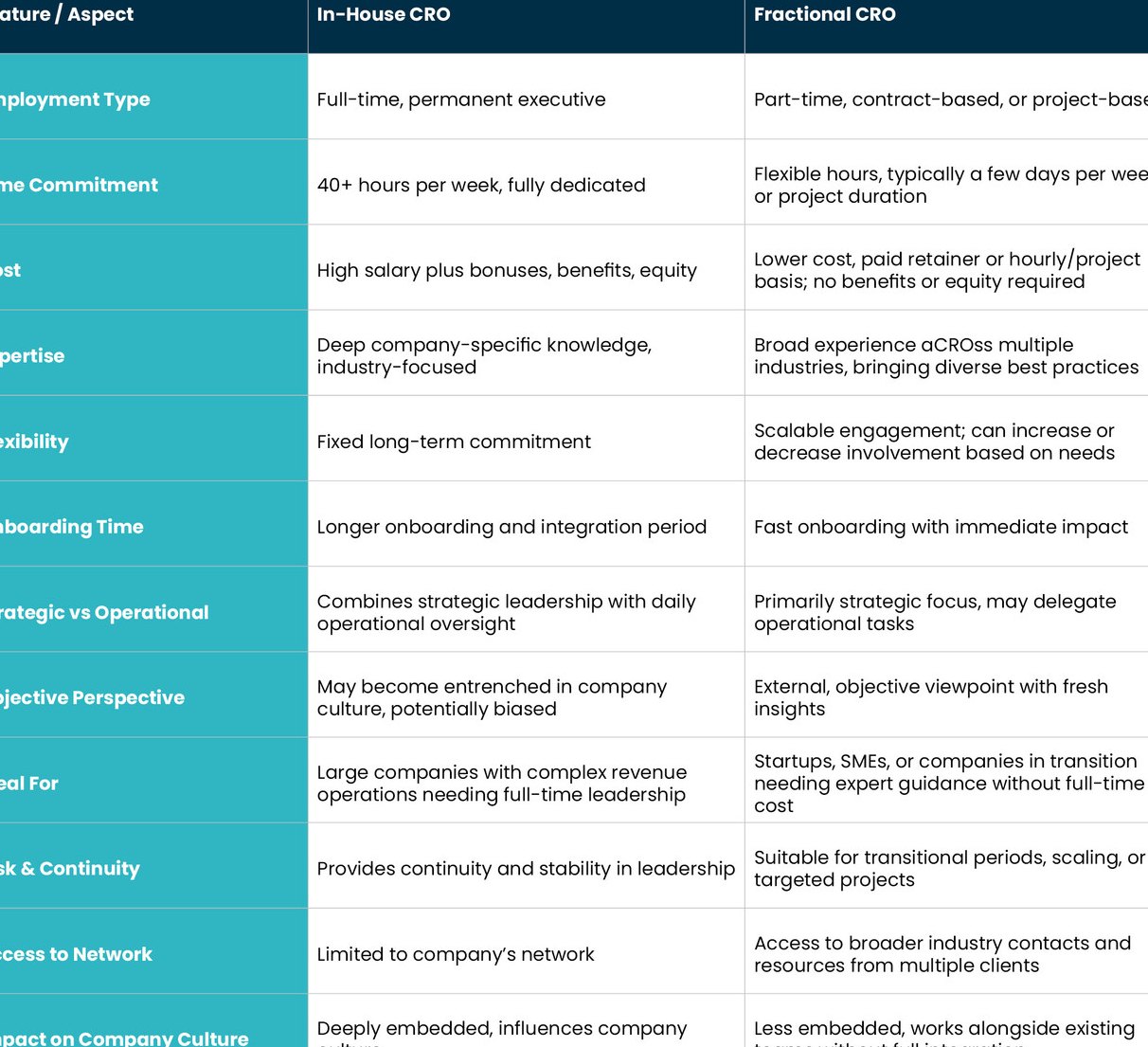
The decision that actually matters is not *whether* to bring in revenue leadership but *which shape* of leadership to buy, because the four realistic options solve genuinely different problems and cost wildly different amounts. Most SMBs that get this wrong don't get the timing wrong — they get the instrument wrong, and then spend two quarters discovering that the person they hired was never scoped to fix the thing that was broken.
A senior account executive. Below roughly $2M ARR, this is almost always the highest-leverage hire. If the founder can still close and the problem is simply that there aren't enough hours in the week, adding one or two strong AEs buys capacity at a fraction of executive cost. The mistake here is confusing a *capacity* problem with a *system* problem. If your win rate is healthy, your deals close in a predictable window, and you simply need more at-bats, you don't need a revenue architect — you need another person carrying a bag. A fractional CRO brought into a company at $1.2M ARR with four customers is being paid senior-operator rates to systematize a motion that hasn't yet demonstrated it's repeatable.
A VP of Sales, fractional or full-time. This is the right hire when strategy is clear and *execution* is the gap. You know who you sell to, you know why they buy, the motion works when it's run properly — you just need someone to run the team day to day, coach reps in one-on-ones, sit in on calls, and own the number. A VP of Sales owns the sales org and its quota. That scope is narrower than a CRO's and it is usually cheaper, both fractionally and full-time. The failure mode is asking a VP of Sales to re-architect revenue operations across three functions they have no authority over. They will try, they will get blocked by marketing and finance, and you'll lose a quarter.

A fractional CRO. The CRO scope is deliberately broader: sales, marketing alignment, and frequently customer success and RevOps as well. The role sits *above* the individual functions, which is exactly why it can arbitrate the marketing-versus-sales blame loop that a VP of Sales structurally cannot. Buy this when the problem is cross-functional and architectural — the data model is broken, no single definition of a qualified opportunity exists, the forecast is fiction, the tech stack has three overlapping tools, and no one person owns the whole revenue picture. The fractional structure fits because most of this work is *build-once*: you are paying for diagnosis and design, not for years of ongoing supervision.
A full-time CRO. The natural endpoint once the motion is proven and you need sustained leadership over years rather than a fixed intervention. Loaded compensation — salary, equity, benefits, ramp — makes this the most expensive option by a wide margin, and the cost of a mis-hire at this level is brutal: you typically lose two to three quarters between the wrong hire's ramp, the recognition that it isn't working, the exit, and the search for a replacement. The single most common expensive mistake an SMB company makes is buying a full-time revenue executive *before* it has the process maturity to make the seat productive. The person arrives, finds no CRM hygiene, no qualification standard, and no reporting they can trust, and spends their first six months doing work a fractional operator could have done in three.
Consultants and agencies deserve a mention as the fifth option, and the distinction is accountability. A consultant delivers a deck and a set of recommendations; a fractional CRO carries the number, sits in the weekly deal review, and is measurable against forecast accuracy and rep-led close rate. If you want analysis, buy consulting. If you want someone who owns an outcome, that's the fractional model.
How to choose between them

Run the symptom count before you run the budget. There are six symptoms that reliably indicate a structural revenue problem rather than a tactical one, and the rule of thumb practitioners use is that roughly three or more appearing together means you have a systems problem that warrants a revenue leader. One symptom in isolation almost always has a cheaper, narrower fix.
Symptom one: the plateau. Two consecutive quarters of flat or declining net-new bookings *despite steady lead volume*. That qualifier matters enormously. If lead volume dropped and bookings dropped with it, you have a demand-generation problem, not a revenue-leadership problem. The diagnostic plateau is the one where reps are busy, marketing is spending, the pipeline dashboard looks full, and the number simply won't move.
Symptom two: the founder bottleneck. The CEO must personally touch every deal above some threshold — often around $50K, though the exact figure varies by average contract value. When that's true, the company hasn't built a sales organization; it has built a dependency on one exceptional seller who also happens to run product, fundraising, and hiring. Growth is capped at that person's calendar, and it collapses the moment their attention is pulled elsewhere.

Symptom three: the black-box pipeline. Marketing insists it's delivering qualified leads. Sales insists the leads are junk. Neither side can prove its case because there is no shared definition of a qualified opportunity and no single source of truth connecting spend to closed revenue. Forecast miss rates of 30-40% quarter over quarter are the numeric tell.
Symptom four: unexplained cycle stretch. Average deal used to close in 60 days, now takes 120 or more, and nobody can say precisely where the extra time goes.
Symptom five: stack sprawl. A dozen point tools, sometimes more than one CRM, no agreement on which report is the real forecast, and shadow spreadsheets competing with the system of record.
Symptom six: an imminent raise. A Series A or B within two to three quarters, where diligence will scrutinize the durability of the revenue engine rather than just its current size.
The second filter, once you've cleared the symptom count, is scope-versus-seniority matching. Don't buy a CRO to solve a rep-coaching problem. Don't ask a VP of Sales to redesign the data model across sales, marketing, and CS. And be honest about which one you actually have — founders frequently describe an execution problem in architectural language because architectural problems feel less like a personal failure of management.
A useful forcing question: *if this person fixed exactly one thing and then left, what would it be?* If the answer is "our reps would be better at closing," that's a VP of Sales or an enablement investment. If the answer is "we'd finally know which segments actually convert and have a forecast the board believes," that's CRO-shaped work and the fractional model is the cheapest honest way to buy it.
Costs, timelines, and expected impact

Fractional CRO engagements are structured one of two ways. The dominant model is a monthly retainer for a defined multi-month sprint — typically one to three days per week over three to six months, with a scoped deliverable set agreed up front. The lighter alternative is a day-rate advisory arrangement, appropriate when you have competent operational leadership already and need periodic senior judgment rather than hands-on rebuilding. Retainer engagements dominate for the symptom cluster described above, because the work requires being inside the weekly cadence, not commenting on it from outside.
The economics work because you're buying part-time hours over a fixed window instead of a permanent salary, equity grant, benefits load, and recruiting cost. Total engagement cost lands well below a full-time CRO's loaded compensation for the equivalent period, and you avoid the tail risk entirely — if the fit is wrong, the engagement ends at the natural break rather than requiring an executive separation. Ask for the pricing model in writing before you start and make sure it specifies days per week, expected meeting cadence, and what happens if scope expands. The most common contracting failure is an ambiguous retainer that quietly becomes a two-day-a-week commitment funded at a one-day rate, which ends badly for both sides.
Timeline expectations, honestly stated. Month one is diagnosis and produces very little visible change — this is the month where founders get nervous and it's the month you should protect most carefully. The operator is auditing the CRM, sitting in on deal reviews without intervening, interviewing reps, pulling stage-duration data, and mapping the actual buying process against the documented one. Rushing this phase is how you get a plan that solves the wrong problem.

Visible operational change tends to land in months two and three: the stack begins consolidating, the qualification standard ships, deal-review cadence changes, and the forecast methodology gets rebuilt. Meaningful movement in the two metrics that matter most — rep-led close rate and forecast accuracy — usually appears within a quarter. Deeper cultural shifts, particularly reps genuinely owning conversations they previously escalated, compound across the full engagement rather than arriving in a specific week.
What to actually measure. Set the baseline in week one so the engagement is falsifiable. The instrumentation that matters:
- Forecast accuracy — commit-versus-actual variance by quarter. Going from 40% miss to under 15% is a realistic, meaningful outcome.
- Rep-led close rate — percentage of closed-won deals where the founder was not in the final meeting. This is the single cleanest proxy for whether the bottleneck actually moved.
- Stage-duration by stage, not just conversion rate. Conversion tells you *whether* deals close; stage-duration tells you *where* they hang. Compressing the two or three slowest stages often recovers weeks of cycle time without moving win rate at all — and shorter cycles compound, because faster deals mean more at-bats per rep per quarter from the same pipeline.
- Redundant SaaS spend eliminated. Cutting overlapping engagement, intelligence, and forecasting tools frequently offsets a meaningful share of the fractional fee on its own, before you count the productivity gain from reps trusting one source of truth.
- Pipeline coverage ratio against a real qualification standard, which usually gets *worse* before it gets better — because honest qualification strips out deals that were never real. Expect this and communicate it to your board in advance, or a healthy cleanup will read as a collapse.
The honest downside. Consolidation is disruptive in the short term. Migrating off a tool, cleaning years of dirty data, and retraining a team costs weeks of productivity before it pays back. A good fractional CRO sequences deliberately — stabilizing the forecast first so leadership keeps visibility, then consolidating in phases rather than ripping everything out at once. Do not start a stack overhaul in the same quarter you're trying to hit an aggressive number. And a fractional CRO cannot manufacture growth that isn't there: if retention is weak or product-market fit is shaky, no amount of forecast rigor survives contact with reality. Bring one in to sharpen a working engine, not to paper over a broken one.
Implementation and handoff details

The engagement structure that works is a phased sprint with an explicit exit decision at the end, not an open-ended advisory relationship that drifts into a permanent part-time seat nobody evaluates.
Transferring deal ownership off the founder is the hardest and most valuable piece of the work, and it has three concrete components. First, a documented qualification standard so reps can disqualify weak deals early instead of dragging them through three stages of hope. Frameworks like MEDDPICC exist precisely for this — forcing the team to name the economic buyer, map the decision process, and identify a real champion before a deal is already stuck. Second, objection-handling playbooks so AEs stop escalating routine pushback upward; if a rep punts a pricing objection to the CEO, that's a playbook gap, not a rep-quality gap. Third, a weekly deal-review cadence where *the team* walks each opportunity, not the founder. The goal is shifting the founder from closer to coach.
Be realistic about the timeline on this specifically. A fractional CRO cannot replace founder relationship equity overnight, and some founder-carried accounts will always want the founder in the room. The target is not zero founder involvement — it's the founder in only the largest strategic deals instead of all of them. Expect a full quarter before rep-led closes become the norm rather than the exception, and expect friction as reps learn to own conversations they previously escalated.

On the cycle-stretch problem, the implementation work is a stage-by-stage process audit to locate exactly where momentum dies, then targeted plays for those stages: a pre-built security and compliance packet so the questionnaire doesn't add three weeks, internal-sell materials that arm the champion for conversations you're not in, and a multi-threading standard so one unresponsive contact can't freeze an entire opportunity. Modern B2B buying committees have grown substantially — Gartner's research on the B2B buying journey documents committees running to roughly a dozen stakeholders — and more stakeholders mean more places for a deal to stall.
On the stack, the consolidation sequence is: pick one CRM as the single system of record, retire or reconfigure engagement tools that overlap, standardize on one forecasting and deal-intelligence layer, and eliminate shadow spreadsheets competing with the CRM. A fractional CRO can do this where a sales ops manager often can't, for a structural reason worth naming: killing a tool requires the organizational authority to overrule the function that bought it. That authority is part of what you're buying.
On raising, the pre-raise window is three to six months and the work does double duty. Institutional investors underwrite the *durability* of the revenue engine, not its current size. A company arriving at diligence with a clean CRM, an honest forecast, and a written playbook that doesn't live only in the founder's head simply presents better than one where revenue is founder intuition. The same qualification discipline that impresses investors improves the business day to day, so this is not diligence theater — but it only works on a genuinely healthy motion.

The handoff is a deliverable, not an afterthought. Contract for it explicitly at the start. A complete handoff package includes: written playbooks and the qualification standard, documented CRM configuration and field definitions, the forecast methodology with worked examples, a named internal owner for each process, and a 30/60/90 plan for whoever inherits the system. The most common failure of an otherwise successful engagement is that the RevOps machinery was genuinely built but never transferred — six months after the operator leaves, the CRM has drifted, the deal review has quietly stopped, and the forecast is fiction again. If the engagement ends without a named internal owner for each process, you rented an improvement instead of buying one.
Three exit paths exist and all three are legitimate: convert the fractional CRO to full-time if the fit is strong and the seat is now fundable; extend one scoped sprint to tackle a specific next initiative; or exit cleanly and let the team run on what was built. Decide which by measuring against the week-one baseline, not by how the engagement felt.
Related questions
How long should a fractional CRO engagement last?
Three to six months is standard — long enough to audit, redesign process, ship playbooks, and coach the team through adoption, but short enough to stay a focused intervention rather than a permanent seat. Many companies extend once for a specific next initiative, then convert or exit on the playbooks built.
Can a fractional CRO work alongside my existing VP of Sales?
Yes, if the VP is coachable. The fractional CRO sets revenue architecture while the VP runs daily execution — strategic partner and force-multiplier, not replacement. The arrangement fails only when the VP is defensive or is themselves the core problem, which a competent operator will flag within the first month.
What's the difference between a CRO and a VP of Sales?

A VP of Sales owns the sales team and its number. A CRO owns the entire revenue engine — sales, marketing alignment, and often customer success and revenue operations — accountable for the whole go-to-market system. Broader, more strategic, and positioned a level above pure sales execution.
Should I hire fractionally before or after a funding round?
Usually before. The three-to-six-month window ahead of a raise is when clean forecasting and documented process most improve how the company presents in diligence — and the same work improves operations regardless of whether the round closes.
FAQ
How do I know if I actually need a CRO versus more reps?
Count symptoms: founder-as-bottleneck, plateaued number, untrustworthy pipeline, stretching cycles, sprawling stack, imminent raise. Roughly three or more together means the problem is structural and a revenue leader is the right answer. One symptom in isolation almost always has a narrower, cheaper fix — an enablement investment, a demand-gen change, or a single ops hire. The expensive error is treating a capacity problem as a systems problem, or vice versa.
What should I look for when vetting a fractional CRO?
Prioritize someone who has actually carried and scaled a number rather than only advised on one, ideally through the revenue band you're currently in — scaling $2M to $10M is a genuinely different discipline from $50M to $200M. They should be fluent in mainstream CRM, engagement, and forecasting tooling, and able to show a sample diagnostic or playbook from prior work. Ask them to describe a specific motion they fixed, what the baseline was, and exactly what they changed.

What happens when the engagement ends?
Three paths: convert to full-time if the fit is strong and the company can now justify the seat, extend for a specific new initiative, or exit and let the team run on the playbooks built. Most SMBs extend once or exit cleanly. What determines which is whether the handoff was contracted as a real deliverable — named internal owners, written process, documented CRM configuration — or left to good intentions.
Is a fractional CRO worth it below $2M ARR?
Usually not. Below roughly $2M, the highest-leverage move remains founder-led selling plus one or two strong account executives. CRO process machinery needs enough deal volume and team size to justify itself; install it too early and you're paying senior rates to systematize a motion that hasn't yet earned repeatability. Revisit when the plateau appears alongside a founder bottleneck.
Can a fractional CRO fix a bad product or weak retention?
No. A fractional CRO optimizes and scales a genuinely working motion through better qualification, cleaner forecasting, and tighter process. They cannot manufacture demand for something the market doesn't want, or repair churn caused by a value gap. If retention is the real issue, address product and customer success first — revenue leadership amplifies what already works and exposes what doesn't.
What's the biggest risk of hiring one?
Scope ambiguity. An engagement without a defined deliverable set, a week-one metric baseline, and a contracted handoff drifts into expensive advisory with no falsifiable outcome. The second risk is sequencing: launching a disruptive stack consolidation in the same quarter you need to hit an aggressive number costs you both.
Sources
- Gartner: The B2B Buying Journey
- Forrester: Revenue Operations Research
- Bessemer Venture Partners: Atlas GTM Resources
- McKinsey: Growth, Marketing & Sales Insights
- Harvard Business Review: Sales Topic
- Salesforce: State of Sales Research
- HubSpot: Operations Hub
- SaaStr
Related on PULSE
- What should an SMB company look for in a fractional CRO in 2027?
- What should an SMB company look for in a fractional Chief Revenue Officer in 2027?
- Is there a fractional CRO available near me in Pasadena in 2027?
- Who is the best fractional Chief Revenue Officer in Middletown in 2027?
- Is there a fractional CRO available near me in Boise in 2027?
This page will be disappearing soon. Save it to your device for $1 — or read it free while it is here.
@Kory-White- · if Venmo asks, the last 4 of my number are 2012
This page is gone.
This one is off the shelf now. $1 keeps it on your phone for good — the whole page, pictures and diagrams included.
 pulse-toolsHow do I evaluate a fractional Chief Revenue Officer in Arkansas in 2027?
 pulse-toolsShould I Hire a Fractional CRO If I Need Interim Coverage During a Medical Leave in 2027?
 pulse-toolsShould I Hire a Fractional CRO If I Need to Stand Up RevOps From Scratch in 2027?
 pulse-toolsHow do I evaluate a fractional Chief Revenue Officer in Los Angeles in 2027?
 pulse-toolsHow do I hire a fractional CRO in Phoenix in 2027?
 pulse-toolsWhat should I look for in a fractional CRO in Rhode Island in 2027?
 pulse-toolsHow do I evaluate a fractional Chief Revenue Officer in Georgia in 2027?
 pulse-toolsShould I Hire a Fractional CRO If I Need a 30-60-90 Plan Before a Board Meeting in 2027?
 pulse-toolsShould I Hire a Fractional CRO If I Need Interim Leadership During a CRO Search in 2027?
 pulse-toolsShould I hire a fractional CRO in Newport in 2027?