


How do I find a fractional CRO for a life sciences company in Central Texas in 2027?
Quality
Certified

Finding a fractional CRO for a life sciences company in Central Texas means searching life sciences-focused networks like Pavilion and RevOps Co-op, evaluating candidates for FDA and HIPAA sales experience, and staying open to remote talent since the regional pool is thin. Budget a retainer covering 8-15 engagement days monthly, plus 0.5%-2% equity for early-stage companies.
This vs. the common alternatives
A fractional CRO is one of at least four distinct hiring paths, and life sciences companies in Central Texas frequently pick the wrong one because the titles sound interchangeable. Understanding the differences up front saves months of wasted search time.
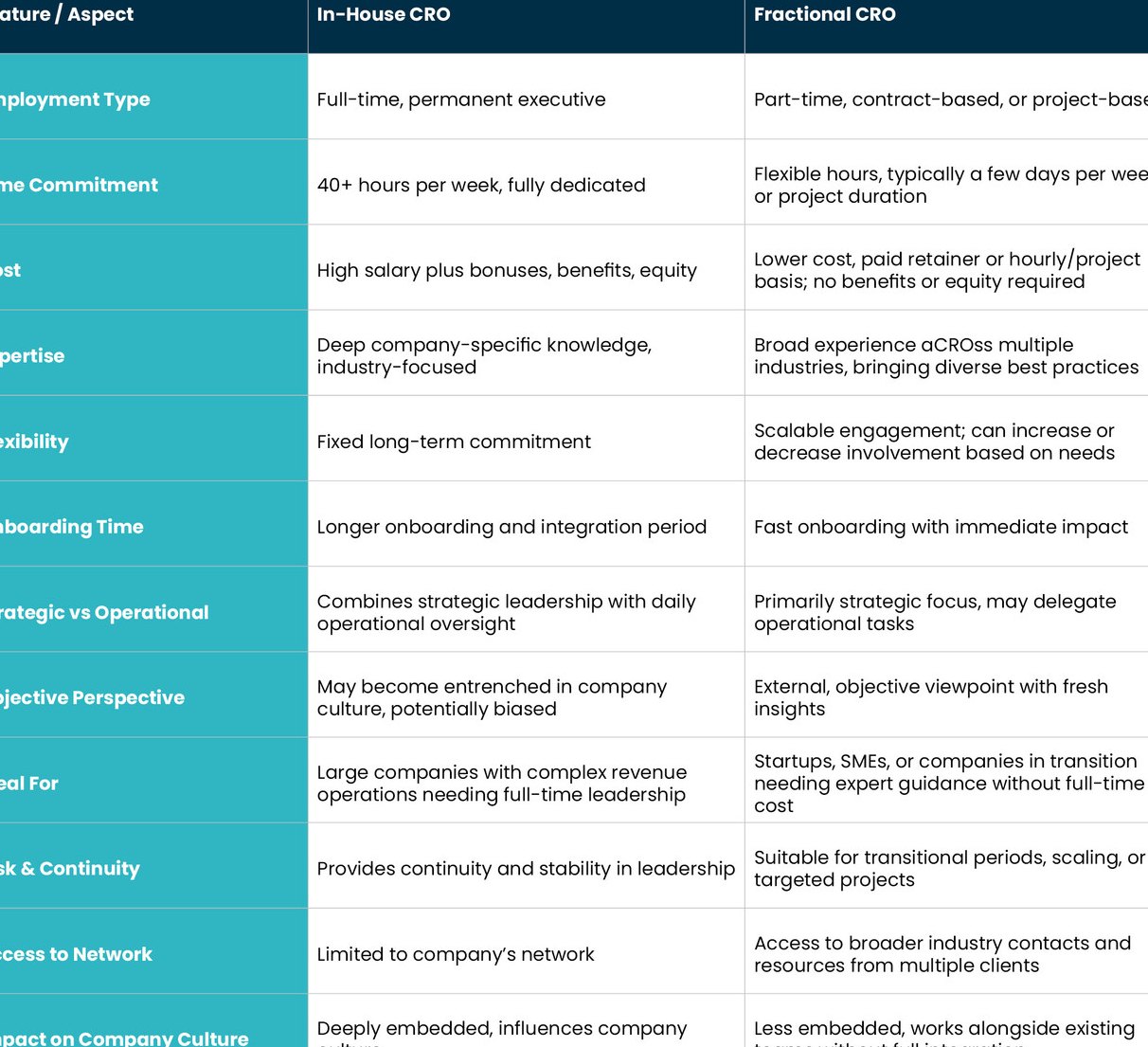
A full-time CRO makes sense once your company has predictable revenue above roughly 10M ARR, a sales team of six or more reps, and enough complexity (multiple product lines, multiple buyer personas, international expansion) to justify a dedicated executive salary plus benefits and equity in the 1%-4% range. Full-time CROs also expect to be in the building or in client meetings most weeks, which is harder to staff in Central Texas given the region's smaller life sciences employee base compared to Boston or the Bay Area.

A fractional CRO is the right fit when you have some revenue traction (roughly 500k-5M ARR is the sweet spot) but not enough volume or budget to justify a full-time hire. They work 1-3 days per week across multiple clients, bring a repeatable playbook rather than build one from scratch, and are explicitly hired to install process, coaching, and forecasting discipline rather than to personally carry a quota. For a life sciences company, this model works especially well when your buyer cycle is 9-18 months and a full-time executive would otherwise sit idle between board-level strategy sessions.
A VP of Sales or Sales Director is a different hire entirely — usually full-time, usually more hands-on with individual deals, and usually reporting to a CRO or CEO rather than setting overall revenue strategy. If your actual gap is "we need someone closing enterprise deals every week," a VP of Sales is often cheaper and more effective than a fractional CRO, because a fractional CRO's real value is systems and coaching, not quota-carrying.
A deal coach or sales consultant is the lightest-touch option — someone you bring in for a specific negotiation, a pricing model, or a go-to-market audit, with no ongoing management responsibility. This is appropriate if your team already has a functioning sales process and you just need outside expertise on one or two live deals.

Life sciences companies in Central Texas also sometimes consider an advisor or board member with sales background instead of any operating role. This is the weakest substitute for a fractional CRO — advisors typically spend a few hours a month, not days, and rarely have the bandwidth to build a CRM process, coach a rep, or sit in on forecast reviews. Treat an advisor as a supplement to a fractional CRO, not a replacement.
The Austin metro area — anchored by organizations like the Austin Technology Council and the Texas Healthcare and Bioscience Institute — has a real but modest life sciences employer base spanning medtech, diagnostics, digital health, and biotech. That density is enough to support networking and occasional in-person meetups, but it is not enough to guarantee a deep bench of fractional CRO candidates who have specifically sold into FDA-regulated or hospital-system buyers while living in Central Texas. Most companies end up blending a local search with a national or remote one, which is normal and often produces a stronger match than restricting the search geographically.
How to choose between them
Use four variables to decide which model fits: current ARR and revenue stage, the complexity and regulatory weight of your sales cycle, whether you already have a founder or rep doing the selling, and your available cash versus equity budget. A pre-revenue, pre-product-market-fit company should not be hiring any of these roles yet — founder-led sales comes first. A company between roughly 500k and 5M ARR with lumpy, milestone-driven revenue (common in life sciences, where a deal can hinge on a clinical trial readout or a regulatory clearance) is the classic fractional CRO candidate. A company above 10M ARR with a dedicated sales team usually needs a full-time CRO or VP of Sales instead.

Regulatory complexity matters more in life sciences than in most other verticals. If your buyers are chief medical officers, lab directors, or hospital procurement teams, and your sales motion touches FDA clearance pathways (510(k) versus PMA), HIPAA-covered data, or clinical trial timelines, you need a fractional CRO who has actually operated inside that environment — not a generalist SaaS sales leader who has "worked in healthcare" in a vague sense. Generalists routinely underestimate deal cycles that run 9-18 months and misjudge how conservative and risk-averse regulated buyers are compared to typical B2B tech purchasers.
Once you know which lane you're in, the decision narrows quickly. If you land in the fractional-CRO-with-domain-experience box, expect the search itself to take four to eight weeks, since qualified candidates who combine life sciences sales credibility with fractional availability are scarce, and many of the strongest ones are based outside Central Texas.
Costs, timelines, and expected impact

Expect to budget a retainer covering 8-15 days of engagement per month. Exact pricing varies by market and by the candidate's track record, but the structure is consistent: a monthly or quarterly retainer tied to a fixed number of days, sometimes with a success-based bonus layered on top. For companies under roughly 5M ARR, it is common to add a small equity component — typically 0.5%-2%, vested over three to four years with a one-year cliff — as a sweetener rather than a substitute for cash. Above 5M ARR, equity grants become less common because cash compensation for a more senior operator is correspondingly higher, and boards prefer to preserve the cap table.
If cash is tight, a performance bonus tied to new ARR or qualified pipeline generation is a reasonable alternative to a larger equity grant, and most fractional CROs will negotiate this structure if the base retainer is fair. Underpaying is the most common budgeting mistake: a retainer set too low attracts either a junior operator without regulated-sales experience or someone spread too thin across too many clients to give your company real attention.
Timelines follow a predictable arc. The search itself — sourcing, interviewing, and reference-checking — typically takes four to eight weeks in Central Texas given the smaller local pool. Most engagements begin with a 3-month trial period, which is the industry standard because it gives both sides a low-commitment way to test the working relationship before a longer renewal. Expect the first 30 days to focus on diagnostics — reviewing your CRM data, sitting in on calls, interviewing your existing team and a handful of customers or prospects. Meaningful process changes (a redesigned pipeline stages, a new forecasting cadence, updated qualification criteria) typically land in month two. Measurable impact on pipeline velocity or forecast accuracy is realistic by month three, which is also when most companies decide whether to extend the engagement to six or twelve months.

Total engagement length varies widely. Some companies use a fractional CRO for a single 3-6 month sprint to stand up a repeatable process, then transition to a full-time hire once revenue justifies it. Others keep a fractional CRO for two or more years while scaling from 1M to 10M ARR, especially in life sciences where the deal cycle length makes rapid team turnover costly. Either path is normal; what matters is agreeing on the intended arc at the start of the engagement rather than leaving it open-ended.
Implementation and handoff details
Once you've selected a candidate, formalize the engagement with a short letter or one-page agreement covering five things: scope (the specific outcomes you're hiring for — building a sales process from scratch, coaching a founder on closing, or managing an existing team of AEs), time commitment (days per month, and whether that flexes with deal flow), duration (with a 30-day out clause for either party so neither side is locked into a bad fit), tool access (Salesforce, HubSpot, Gong, Clari, or Outreach — the fractional CRO should have real visibility into your CRM and call data from day one, not summarized reports), and a reporting cadence (weekly pipeline reviews, monthly board-level forecasts, quarterly strategy sessions).

Evaluation before signing should go deeper than a resume. Ask direct questions: have they sold into FDA-regulated environments specifically, do they understand the practical difference between a 510(k) clearance and a PMA pathway, have they managed teams selling into hospital systems or research institutions, and can they explain how clinical trial timelines distort a normal sales forecast. Vague answers like "I've worked in healthcare" are a red flag — press for specifics. Always check two to three references from life sciences companies at a similar stage, and ask those references about pipeline velocity, forecast accuracy, responsiveness, and whether the CRO genuinely understood the underlying science and regulatory environment, not just the sales mechanics.
During the engagement, the fractional CRO should be embedded enough to coach whoever is currently closing deals — often the founder — rather than sidelining them. If you have a small sales team already, the CRO needs to be comfortable rolling up their sleeves on individual calls, not just directing from a distance. Near the end of the trial or the initial term, revisit the original scope document and decide explicitly: renew as-is, adjust days per month, transition toward a full-time hire, or exit cleanly using the 30-day clause. Companies that skip this explicit checkpoint are the ones most likely to let a mediocre fractional engagement drag on past its useful life.
Related questions
Is there a fractional CRO available near me in Central Texas right now?
Availability shifts month to month since most fractional CROs juggle two to four clients at once. Expect a four-to-eight-week search, and plan to widen beyond Central Texas to remote candidates if you need someone with deep life sciences credentials.
What does a fractional CRO engagement typically cost in Central Texas?

Budget a retainer for 8-15 engagement days per month, with 0.5%-2% equity common for companies under 5M ARR. Costs rise with the candidate's regulated-sales track record and seniority.
How do I evaluate a fractional CRO's life sciences credibility?
Ask about specific FDA clearance pathways, HIPAA-covered sales experience, and hospital or research-lab buyers. Always verify with two to three references from similarly staged life sciences companies.
Should I hire a fractional CRO or a VP of Sales instead?
If you need someone closing deals hands-on every week, a VP of Sales is usually the better and cheaper fit. A fractional CRO is for building repeatable process and forecasting discipline.
How long should a first fractional CRO engagement run?
Start with a 3-month trial, the industry standard. Extend to 6-12 months if pipeline velocity and forecast accuracy visibly improve during that window.
FAQ
What is the typical cost range for a fractional CRO in life sciences? Budget a retainer covering 8-15 days of engagement per month, with a possible equity component of 0.5%-2% for early-stage companies. The exact figure depends on your ARR, the complexity of your sales cycle, and the candidate's regulated-sales experience.
How long does a fractional CRO engagement usually last?

Most engagements start with a 3-month trial and then extend to six to twelve months. Some life sciences companies keep a fractional CRO for two or more years while scaling from roughly 1M to 10M ARR.
Can I find a fractional CRO who is local to Central Texas? Yes, but the pool is small relative to hubs like Boston or the Bay Area. Many companies end up considering remote candidates or ones willing to travel to Austin or San Antonio a few days per month, prioritizing domain experience over strict geography.
What if I only need help closing a few big deals, not a full engagement? That's a different need — look for a deal coach or a part-time VP of Sales instead. A fractional CRO is built to install a repeatable revenue system, not to close individual deals in isolation.
When should I NOT hire a fractional CRO? If your company is pre-revenue or pre-product-market fit, invest in founder-led sales first. A fractional CRO can help formalize a process once you have some traction, but cannot fix a product that doesn't solve a real problem or a market that doesn't exist.
Do fractional CROs work well fully remote for a Central Texas life sciences company? Yes, provided they maintain a strong operating rhythm — weekly calls, shared CRM access, and regular call review. Given the thin local talent pool for regulated life sciences sales leadership, remote candidates are often the stronger match even if a local hire seems more convenient.
Sources
- Pavilion – community for revenue leaders
- RevOps Co-op – revenue operations community
- U.S. FDA – Device Clearance and Approval Pathways
- U.S. HHS – HIPAA Compliance Overview
- Harvard Business Review – Sales Leadership and Strategy
- SaaStr – SaaS Sales and Growth Insights
- First Round Review – Startup Sales and Leadership
- LinkedIn – Professional Network for Finding Fractional Talent
Related on PULSE
- Is there a fractional CRO available near me in Central Texas in 2027?
- What does a fractional CRO engagement cost in Central Texas in 2027?
- How do I evaluate a fractional CRO in Central Texas in 2027?
- How do I find a fractional Chief Revenue Officer for a marketplace company in Central Texas in 2027?
- How do I hire a fractional CRO for a life sciences company in 2027?
- How do I find a fractional CRO for a life sciences company in the Research Triangle in 2027?
This page will be disappearing soon. Save it to your device for $1 — or read it free while it is here.
@Kory-White- · if Venmo asks, the last 4 of my number are 2012
This page is gone.
This one is off the shelf now. $1 keeps it on your phone for good — the whole page, pictures and diagrams included.
 pulse-toolsHow do I hire a fractional CRO in Seattle in 2027?
 pulse-toolsShould I Hire a Fractional CRO If I Need a 30-60-90 Plan Before a Board Meeting in 2027?
 pulse-toolsWho is the best fractional CRO in Selbyville in 2027?
 pulse-toolsWhat does a fractional Chief Revenue Officer engagement cost in Arizona in 2027?
 pulse-toolsShould I Hire a Fractional CRO If My Sales and Customer Success Teams Do Not Talk in 2027?
 pulse-toolsHow do I evaluate a fractional Chief Revenue Officer in Arkansas in 2027?
 pulse-toolsWhat should I look for in a fractional CRO in New Mexico in 2027?
 pulse-toolsShould I Hire a Fractional CRO If I Need to Stand Up RevOps From Scratch in 2027?
 pulse-toolsHow do I find a fractional CRO in Lexington in 2027?
 pulse-toolsHow do I hire a fractional CRO in Montgomery Village in 2027?