


How much does a part-time CRO cost in North Carolina in 2027?
Quality
Certified

A part-time CRO in North Carolina in 2027 typically runs a monthly retainer for one to three days per week, with two days per week the most common structure. Price tracks the operator's track record and engagement scope — not the Raleigh, Charlotte, or Triad zip code — because most fractional revenue leaders now work remotely.
Signals you actually need this
Most founders who go looking for a part-time CRO are actually reacting to a symptom rather than diagnosing the disease, and the difference matters because a fractional revenue leader is an expensive fix for a problem a good sales manager or a RevOps contractor could solve for a fraction of the retainer. Before you price anything, get honest about which of these signals you're seeing, because the signal determines the scope, and the scope determines the number.
The clearest signal is a forecast you can't trust. If you walk into a board meeting or an investor update and the number you commit to is off by 30% or more, quarter after quarter, in either direction, that's not a rep problem. It means nobody owns the definition of a qualified opportunity, stage exit criteria are vibes rather than evidence, and the CRM is being updated retroactively to justify what already happened. A part-time CRO's first month of work in that situation is almost entirely definitional — rewriting stages, forcing a next-step field, killing the "commit" column that nobody earns. That's a two-day-per-week engagement minimum, because it requires sitting in the actual pipeline calls, not reviewing a dashboard once a month.
The second signal is founder-led sales hitting a ceiling. This is the most common pattern in the Research Triangle and in Charlotte's fintech cluster: a technical or domain-expert founder personally closed the first thirty to fifty customers, hired two or three account executives to replicate it, and watched those reps produce a third of what the founder does. Nothing is written down. The founder's discovery instinct, the objection handling, the pricing flexibility they apply intuitively — none of it exists as a document, a call framework, or a qualification rubric. A part-time CRO's value here is extraction and codification: shadowing the founder's calls, reverse-engineering what actually works, and turning it into something a rep with average talent can execute. That is a defined project with a beginning and an end, which is exactly why it suits a fractional engagement rather than a permanent hire.

The third signal is a hiring decision you're about to get wrong. If your plan for the next twelve months includes hiring a VP of Sales, three AEs, and an SDR team, you are about to spend roughly a million dollars in fully loaded cost on people whose success criteria nobody has written down. A part-time CRO who runs that hiring process — writing the scorecards, defining the ramp, setting the comp plan, sitting in the final panels — costs a fraction of one bad VP hire. The math on that one is not close. A mis-hired VP of Sales at a company under 10M ARR costs you the salary, the severance, the six months of pipeline they didn't build, and the two AEs who quit when they arrived and again when they left.
The fourth signal is structural: your revenue motion is changing. You're moving from SMB self-serve to mid-market direct, or adding a channel partner program, or layering usage-based pricing onto a seat-based contract. Those transitions break comp plans, break forecasting, break the CRM object model, and break the profile of rep you need. A part-time CRO who has run that specific transition before compresses six months of expensive learning into six weeks of design work.
The fifth signal is the least obvious and the most expensive to ignore: your revenue operations layer is a person's browser tab. If the reason your board deck exists is that someone spends two days a month exporting Salesforce to a spreadsheet, hand-reconciling it against billing, and rebuilding the same charts, you don't have RevOps — you have a heroic analyst and a single point of failure. A fractional CRO often diagnoses this in week one and either fixes it directly or scopes the RevOps contractor who should.
The signals that mean you do *not* need a part-time CRO are worth naming too. If you have fewer than three salespeople and under 1M in ARR, you almost certainly need a good sales coach and a working CRM, not a revenue executive. If your problem is purely lead volume, you need demand generation, not a CRO. If your product has a retention problem, a CRO can help frame it but cannot fix it — that's a product and customer success issue wearing a revenue costume. Paying a senior retainer to discover that is an expensive way to learn something a two-week diagnostic would have told you.
What good looks like versus what bad looks like

The single biggest determinant of whether a part-time CRO engagement pays for itself is not the rate — it's the shape of the agreement. Good engagements look almost boringly specific. Bad ones look flexible and generous, which is exactly why founders sign them.
A good engagement names its outcomes. Not "improve revenue performance," but: a documented sales playbook covering discovery, demo, pricing, and objection handling by day 45; a rebuilt pipeline stage model with exit criteria live in the CRM by day 30; a hired VP of Sales with a signed offer by day 120; a forecast that lands within 15% of actual for two consecutive quarters. Those are testable. At the end of a quarter you can look at the list and say yes or no.
A good engagement is explicit about days. "Two days per week" should mean two identifiable days, with named recurring commitments on them — the Monday pipeline call, the Thursday one-on-ones, the monthly board prep. When the days are unnamed, what happens in practice is that the CRO responds to Slack messages, joins a call when the founder escalates, and delivers roughly a day of real work while billing two. Neither side is dishonest; the structure just invites drift.
A good engagement has a written exit. A three-month pilot with a thirty-day termination clause on either side is the standard, and any operator who resists it is telling you something. The thirty-day clause protects you from a bad fit and protects them from a founder who churns advisors quarterly. It also forces a real review conversation at month three rather than an automatic renewal that quietly runs eighteen months.

A good engagement transfers knowledge deliberately. The playbook lives in your Notion or your Google Drive, not in the CRO's template library. The dashboards live in your Salesforce or HubSpot instance, built by someone on your side who knows how they work. If the CRO leaves and the operating system leaves with them, you rented a person instead of building a capability, and you'll be paying that retainer again in a year.
Now the bad. The flat "unlimited access" retainer is the most reliable warning sign in the category. An operator who quotes a single monthly number for undefined scope is either overcommitted across too many clients — in which case you'll get the leftovers — or inexperienced enough not to know how much work the job actually is. Either way, the first time your needs spike, the relationship strains.
The second failure mode is the CRO who never touches the CRM. Strategy delivered as slides, with no corresponding change in how opportunities are recorded, scored, or forecast, evaporates the week after the deck is presented. Ask candidates directly: in your last engagement, what did you personally change inside the client's CRM? If the answer is nothing, you're buying advice, not operating leadership, and advice is worth considerably less per day.
The third is scope creep in the founder's direction. This one is your fault, not theirs. You hired a revenue executive and within six weeks you're asking them to weigh in on pricing, fundraising, the website redesign, and a partnership term sheet. All of that is arguably revenue-adjacent. None of it is what you scoped. The retainer stays the same, the sales playbook doesn't get written, and at month six you conclude fractional CROs don't work.
The fourth is the misdiagnosis: hiring a CRO when the constraint is upstream. If marketing generates forty leads a month and your reps can handle two hundred, no amount of revenue leadership fixes that. A good fractional CRO will tell you this in the first two weeks and either renegotiate the scope toward demand generation or hand you back your money. A mediocre one will spend a quarter optimizing conversion on a pipeline that was never big enough to matter.
Real cost and ROI ranges in North Carolina

Start with the honest framing: there is no distinct North Carolina rate card for fractional revenue leadership. The market is national and remote-first, so a Durham founder and a Denver founder are bidding against each other for the same operator. What varies locally is supply density, not price. North Carolina has a genuine bench — the Triangle's SaaS and life sciences ecosystem, Charlotte's financial services and fintech corridor, the Triad's logistics and manufacturing base — but it is thinner than the Bay Area or New York, which means more of your shortlist will be out-of-state and remote.
The cost structure breaks down along four axes, and understanding each one is what lets you negotiate intelligently rather than just accepting the first number.
Time commitment. This is the most transparent variable and the one to anchor on. One day per week is advisory: quarterly planning, monthly pipeline review, board prep, being on the phone when something breaks. It works if you already have a competent sales manager and you need a more senior brain checking their work. Two days per week is the modal engagement and mixes strategy with execution — the CRO runs the forecast call, coaches reps directly, builds the playbook, and sits in on hiring. Three days per week is functionally interim leadership: they are running the revenue engine while you search for a permanent hire. Each step up is roughly linear in cost, which is what makes per-day pricing so useful — you can scale up during a transition and step back down once the system is built.
Company stage and complexity. A 2M ARR company with three reps and one product is a fundamentally different job than a 15M ARR company with eight reps, two segments, a channel program, and a stack that spans HubSpot, Salesforce, and a call-recording tool that nobody has configured properly. Expect a meaningful premium for engagements that include rebuilding the tech stack or designing compensation plans from scratch — both are high-liability work where mistakes are expensive and slow to surface. Enterprise sales cycles add complexity too: a nine-month deal cycle means the CRO's work won't show up in closed-won for three quarters, which changes how you should measure them.

Cash versus equity. Many fractional CROs will reduce their cash rate by roughly 20% to 30% in exchange for 0.5% to 2% equity, typically vesting over two years with a one-year cliff. This is a real lever for cash-constrained founders, and it does align incentives. But run the math honestly. Equity is only cheaper than cash if the company succeeds, and a two-year vest on a part-time operator means you're giving up ownership to someone who may be gone in nine months. The one-year cliff is your protection — do not waive it. If you believe the engagement will run at least twelve months and the operator is genuinely senior, the trade is often worth it. For a three-month pilot, pay cash.
Experience tier. The largest single price variable. An operator who has actually scaled a company from a couple million to twenty-plus million in ARR, sat in board seats, and been through a real exit prices at the top of the band and does not discount for geography — their rent in Durham or Asheville is irrelevant because they compete nationally. Below that tier sits a large and underrated group: sales leaders with five to seven years of management experience who never carried a CRO title at a high-growth company. They price considerably lower and can be genuinely excellent if your need is coaching and process design rather than board-level strategy. If you have strong internal sales talent and just need someone to build systems around them, this tier is often the better value.
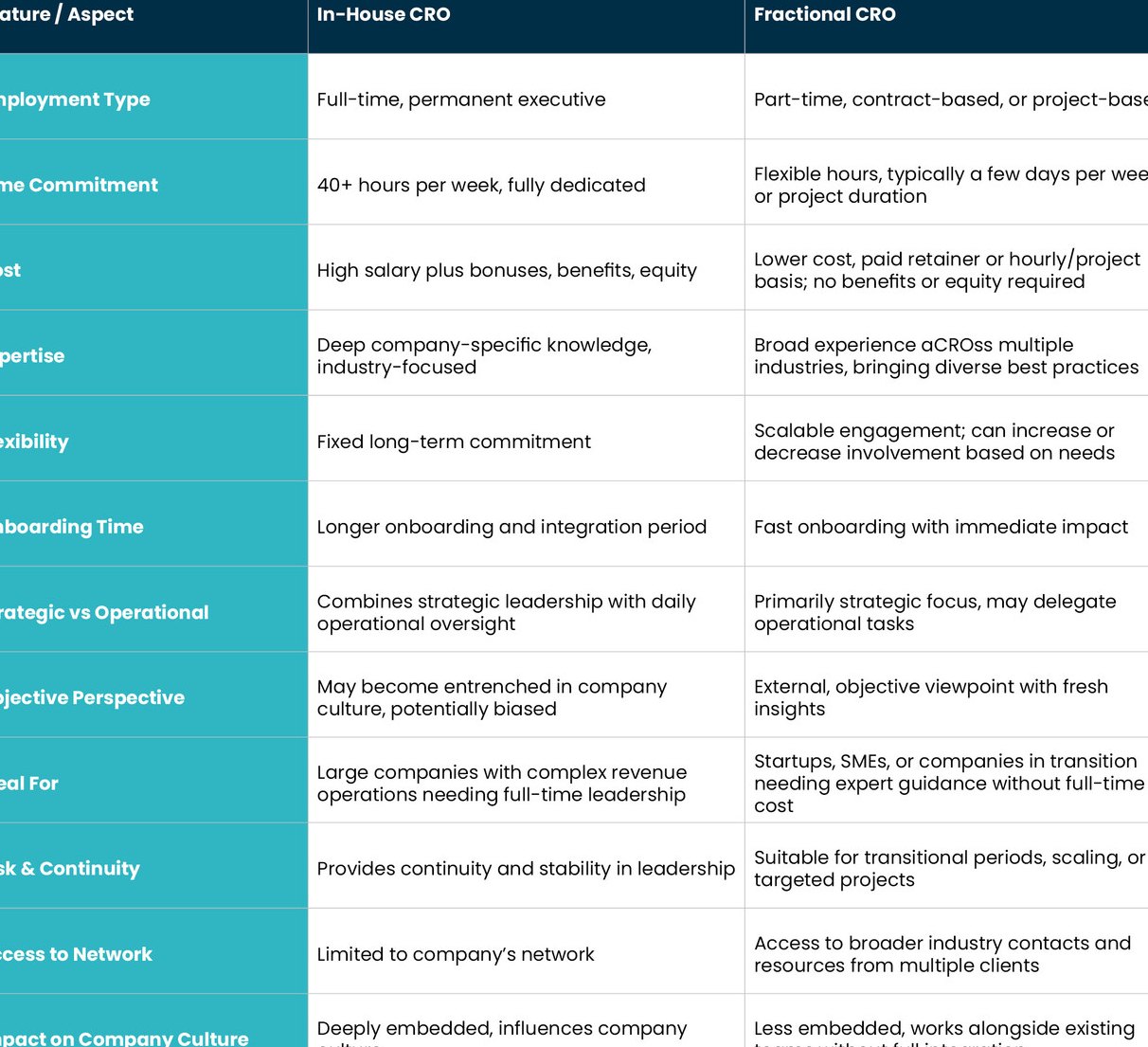
Now the comparison that actually drives the decision. A full-time CRO in North Carolina in 2027 costs base salary plus roughly 20% to 30% in benefits, payroll taxes, and employer costs, plus a variable component, plus equity. The hiring process itself takes six to twelve weeks from opening the req to a signed offer, then another four to eight weeks to onboard before they're producing. If the hire is wrong — and executive sales hires fail at uncomfortably high rates — you lose three to six months of runway, plus severance, plus the credibility hit with your team and board.

A part-time CRO starts within about two weeks, is at-will on thirty days' notice, and costs a fraction of the fully loaded full-time number. The trade-offs are real: they are not available for the Wednesday-afternoon crisis, they are likely juggling two or three clients, and they will not build the deep institutional relationships a full-timer does. For most companies between roughly 1M and 10M in ARR, that trade favors fractional decisively, because the work at that stage is system-building — a finite project — rather than ongoing organizational leadership.
The ROI framing that survives scrutiny is not "did revenue go up." Too many variables. The defensible frames are these. First, avoided cost: if the engagement prevents one bad VP of Sales hire, it has likely paid for a year of itself. Second, forecast accuracy: if you go from missing forecast by 30% to landing within 10%, you can plan hiring and spend against it, which is worth real money in avoided over-hiring and avoided emergency cuts. Third, ramp compression: if new reps reach full productivity in four months instead of seven because a playbook exists, each rep delivers roughly a quarter of extra output in year one. Fourth, win-rate movement on qualified opportunities — narrower and slower to prove, but the cleanest signal that the sales process actually changed.
Measure those four, review them at ninety days, and the extend-or-exit conversation writes itself.
How a part-time CRO plugs into your existing workflow
The integration question is where most engagements quietly succeed or fail, and it gets almost no attention during the sales process. You can hire a genuinely excellent operator and get very little out of them if they never touch the systems and rituals where your revenue decisions actually happen.
Week one should be diagnostic and read-only. The CRO gets a CRM login with real permissions, access to whatever call recordings exist, the last four board decks, the current comp plans, and a list of every closed-won and closed-lost deal from the past two quarters. What they're looking for is the gap between the process people describe and the process the data shows. Almost always there is one, and it's usually large. Expect a written diagnostic at the end of week two — if none arrives, that's a signal about how the rest of the engagement will go.

Weeks two through four are about ritual. The CRO takes over or restructures the recurring meetings where revenue is actually managed: the weekly pipeline call, the monthly forecast review, the one-on-ones with reps. This is the highest-leverage integration point because meeting cadence is where process becomes behavior. A stage definition that lives in a document changes nothing. A stage definition that gets enforced every Monday when a rep tries to move a deal forward without a documented next step changes everything within about three weeks.
The RevOps handoff is the piece founders underestimate. A part-time CRO does not, and should not, personally build your Salesforce reports. Their job is to specify what the system must produce — which fields are required, which stages exist, what the forecast categories mean, what the dashboards must show — and then hand that specification to whoever owns operations. If nobody owns operations, that's the first hire the CRO should push for, ahead of another AE. A well-scoped RevOps contractor or a first ops hire multiplies everything the CRO builds; without one, the playbook decays the moment the CRO's attention moves elsewhere.
Marketing is the upstream dependency. Pipeline coverage is a shared number, and if the CRO owns the forecast but not the lead flow, the relationship needs an explicit agreement: what marketing commits to deliver in qualified opportunities per month, what happens when they miss, and who arbitrates when sales says leads are bad and marketing says follow-up is bad. Getting that written down in month one prevents the most common organizational fight in companies at this stage.
Customer success is the downstream dependency, and it matters more each year as more revenue comes from expansion rather than new logos. If a meaningful share of your growth is upsell and renewal, the CRO's remit has to include the post-sale motion, or you'll optimize new bookings while net revenue retention quietly erodes. Ask candidates how they've handled expansion revenue specifically — many sales-native operators have thin experience here and will not volunteer that.

Finance is where the engagement gets its credibility. The CRO's forecast and finance's model need to be the same number derived the same way. When the board sees two different pipeline figures in one meeting, trust in both evaporates. A simple monthly reconciliation between the CRM-derived forecast and the finance model, with documented reasons for any variance, is cheap to run and disproportionately valuable.
The board layer is the last integration point. A part-time CRO who presents the revenue section of the board deck forces a level of rigor that founder-prepared numbers rarely have, because they know the questions a sophisticated investor will ask. Even at one day per week, having the CRO own board revenue reporting is usually worth the allocation.
On the local dimension: a CRO with a real Triangle or Charlotte network is a tiebreaker, not a price driver. Where it genuinely pays off is talent sourcing. If your twelve-month plan includes hiring account executives or a sales leader, an operator with relationships in the North Carolina enterprise-software and life-sciences talent pool can shortcut weeks of recruiting. That's worth something. It is not worth choosing a weaker operator for.
Related questions
Does a part-time CRO cost less in North Carolina than in New York or California?
Marginally, and only at the mid-tier. Senior operators price on track record and compete nationally regardless of where they live. You may save on travel and find slightly softer rates from locally-focused operators, but a proven CRO in Durham prices close to one in Austin.
How long should a first engagement run?
Three months is the standard pilot, with a thirty-day termination clause either way. That's long enough to produce a diagnostic, a stage model, and the start of a playbook, and short enough that a bad fit costs you one quarter rather than a year.
Can a part-time CRO also serve as my VP of Sales?

Not well, and not for long. A CRO sets strategy, metrics, and hiring plans; a VP of Sales manages reps daily and carries the number. At one to three days a week, nobody can run day-to-day team management. Sequence them: CRO builds the system, VP runs it.
What should I hire first — a fractional CRO or a RevOps contractor?
If your problem is that nobody knows what the numbers mean, hire the CRO. If your problem is that the numbers exist but the systems producing them are broken and manual, hire RevOps first. The CRO specifies; RevOps builds. Buying the specification with nothing to implement it wastes the retainer.
How do I know at month three whether it's working?
Check the written outcomes, not the revenue line. Did the playbook get written? Is the stage model live in the CRM and being enforced? Did forecast accuracy improve? Are hires progressing on schedule? Revenue lags by a quarter or more; the leading indicators don't.
FAQ
What is the minimum engagement length for a part-time CRO in North Carolina?
Most experienced operators require a three-month minimum with a thirty-day cancellation clause on either side. Anything shorter is a consulting project or a diagnostic, not a true CRO engagement — there simply isn't time to change how a revenue organization operates in under a quarter. Some will sell a standalone two-to-four-week diagnostic, which is a reasonable way to test fit before committing to a full engagement.
Can I hire a part-time CRO for just one day per week?
Yes, and it's a legitimate structure — but only if your needs are genuinely strategic. At one day a week you get pipeline review, comp and hiring advice, board prep, and a senior sounding board. You do not get someone running your sales team, coaching reps, or sitting in deal calls. If you already have a competent sales manager who needs a more experienced person checking their work, one day is often the right allocation and the best value in the category.

Do part-time CROs expect equity in addition to cash?
It varies by structure. At a full two-day-per-week cash rate, many operators will work cash-only. If you're negotiating the cash rate down by 20% to 30%, expect a request for 0.5% to 2% equity vesting over two years with a one-year cliff. Settle this before the engagement starts, not at month four, and never waive the cliff on a part-time operator.
How do I verify a track record without a published case study?
References, specifically two founders at companies of similar stage, and you make the calls yourself rather than accepting written testimonials. Ask exact questions: what was ARR when they started and when they finished; what specifically did they change in the CRM; did they hire anyone and are those people still there; would you hire them again. Vague answers to specific questions are the answer.
What's the difference between a part-time CRO and a sales consultant?
Ownership and access. A consultant delivers a recommendation and leaves; a part-time CRO holds a seat in your operating rhythm, has CRM permissions, runs the forecast call, and is accountable for whether the recommendation actually gets implemented. If a candidate won't take responsibility for outcomes or won't touch your systems directly, you're buying consulting — which is fine, but should be priced and scoped as consulting.
Should I hire locally in the Triangle or Charlotte, or is remote fine?
Remote is fine and is the norm. Fractional revenue leadership is almost entirely done over video, in the CRM, and in shared documents. Prefer a local operator only as a tiebreaker between comparable candidates, and mainly for one reason: if you're hiring sales talent in North Carolina over the next year, someone with real relationships in the local enterprise-software and life-sciences talent pool will shorten your search meaningfully.
Sources
- Harvard Business Review — sales and revenue management research
- SaaStr — SaaS revenue, sales hiring, and go-to-market benchmarks
- First Round Review — startup leadership and sales-hiring guides
- Pavilion — community and research for revenue leaders
- RevOps Co-op — revenue operations community and resources
- U.S. Bureau of Labor Statistics — Occupational Employment and Wage Statistics by state
- SHRM — compensation, benefits load, and employment cost guidance
- NC Department of Commerce — North Carolina industry and labor market data
- LinkedIn — professional network for sourcing and vetting candidates
Related on PULSE
- Where do I find a fractional CRO in North Carolina in 2027?
- What should I look for in a fractional CRO in North Carolina in 2027?
- How do I evaluate a fractional Chief Revenue Officer in North Carolina in 2027?
- Is there a fractional Chief Revenue Officer available near me in North Carolina in 2027?
- Does a 10M to 50M ARR services business need a fractional CRO in 2027?
- How much does an outsourced CRO cost in Vermont in 2027?
This page will be disappearing soon. Save it to your device for $1 — or read it free while it is here.
@Kory-White- · if Venmo asks, the last 4 of my number are 2012
This page is gone.
This one is off the shelf now. $1 keeps it on your phone for good — the whole page, pictures and diagrams included.
 pulse-toolsWhat should I look for in a fractional CRO in New Mexico in 2027?
 pulse-toolsShould I Hire a Fractional CRO If I Am Consolidating Regional Sales Teams in 2027?
 pulse-toolsDoes a seed-stage proptech company need a fractional Chief Revenue Officer in 2027?
 pulse-toolsShould I Hire a Fractional CRO If I Need to Fix Broken Lead Routing and Handoffs in 2027?
 pulse-toolsWhere do I find a fractional VP of Sales in Tennessee in 2027?
 pulse-toolsWhat should I look for in a fractional CRO in South Dakota in 2027?
 pulse-toolsHow do I hire a fractional CRO for an e-commerce business in 2027?
 pulse-toolsIs there a fractional Chief Revenue Officer available near me in New York City in 2027?
 pulse-toolsShould I Hire a Fractional CRO If I Need to Rebuild Trust After a Failed CRO in 2027?
 pulse-toolsHow do I hire a fractional CRO in Phoenix in 2027?