


How do I hire a part-time CRO in San Francisco in 2027?
Quality
Certified

Hire a part-time CRO in San Francisco by defining scope first (strategy, execution, or both), sourcing through revenue-leader networks rather than job boards, and vetting for ARR-stage fit. Budget a monthly retainer for 5–20 days of engagement, tie 20–30% of comp to measurable pipeline or closed-won revenue, and start with a 90-day pilot.
What "part-time CRO" actually means versus the alternatives you're comparing
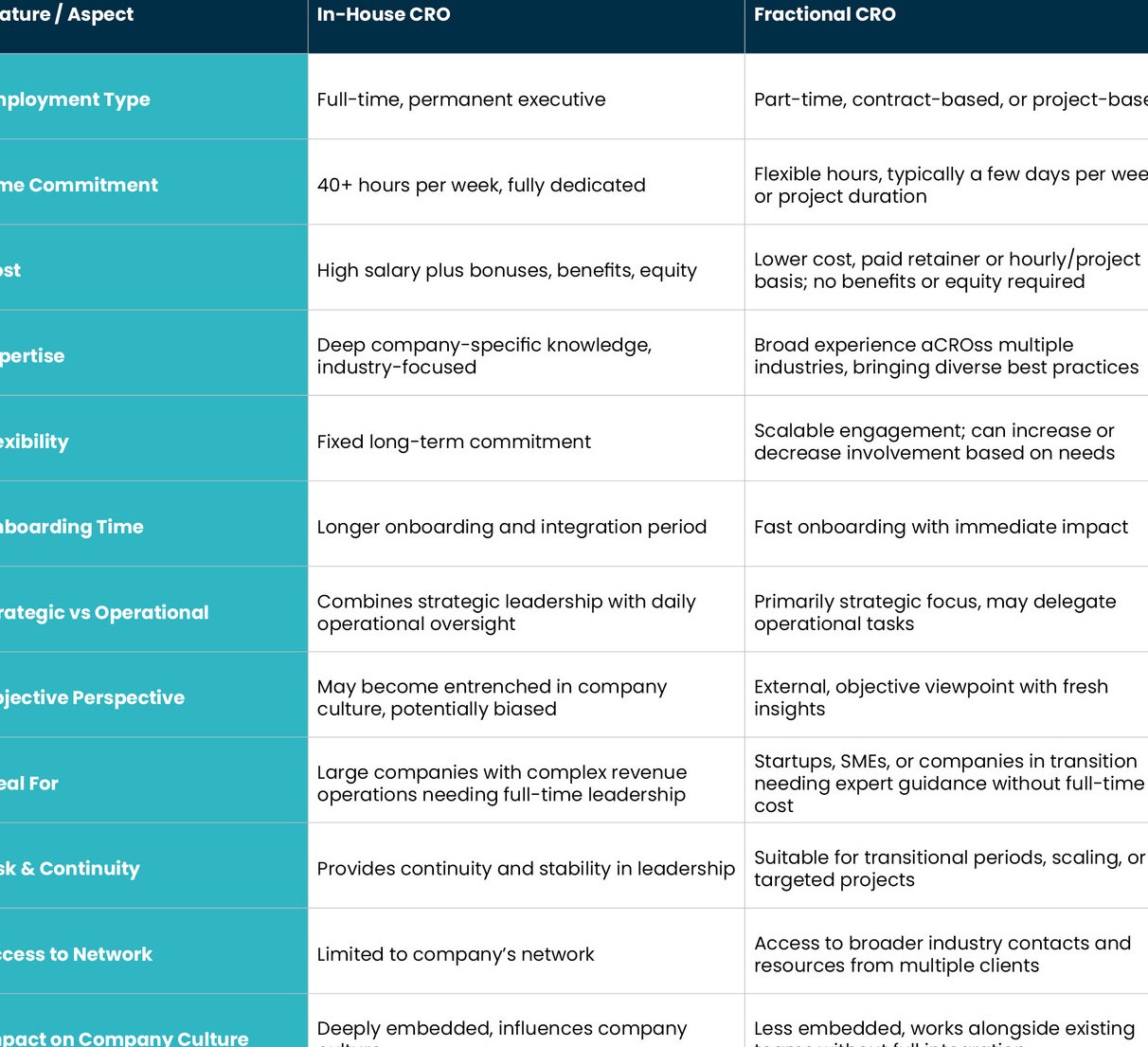
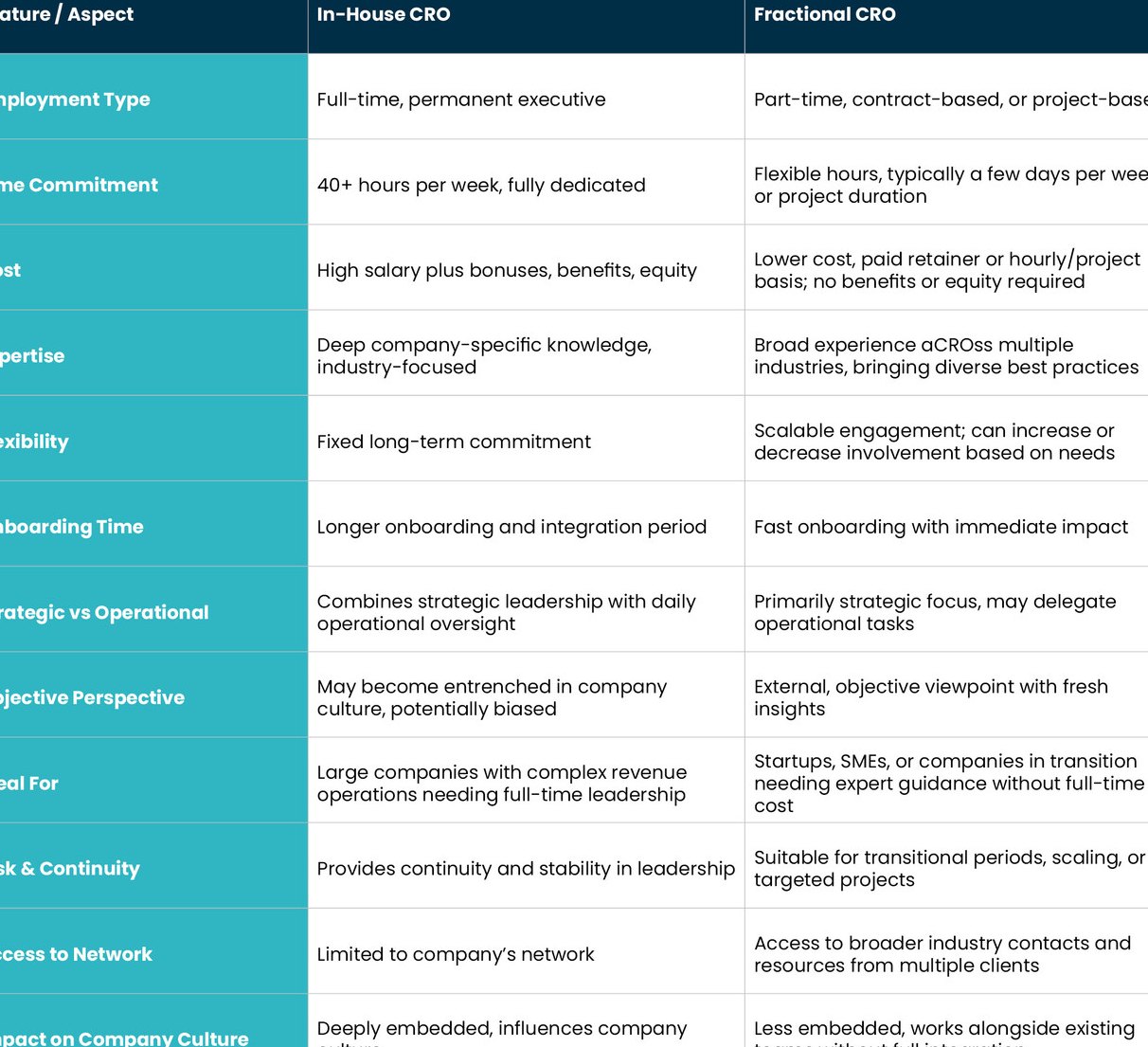
The label is loose, and the looseness is where most San Francisco founders get burned. "Fractional CRO," "part-time CRO," "interim CRO," and "revenue advisor" get used interchangeably in Bay Area intro calls, but they describe four different economic relationships, and the one you pick determines whether you get an operator or a slide deck.
A fractional CRO is an ongoing part-time operator. They commit to a recurring block of days each month — commonly 5, 10, or 20 — indefinitely, or until you outgrow them. They run your revenue function at reduced intensity: they own the forecast, they sit in your pipeline reviews, they hire and manage reps, and in most engagements they carry some personal quota in the first quarter. This is the profile that fits a company between roughly $1M and $20M ARR that has product-market fit but no repeatable go-to-market motion.
An interim CRO is a full-time person filling a temporary hole. Your VP of Sales left, you're mid-fundraise, and you need someone in the seat for six months while you run a search. Interim engagements cost close to full-time comp because they consume close to full-time capacity. Don't hire an interim when what you actually need is a fractional — you'll pay 3x for hours you can't use.

A revenue advisor is the cheapest tier and the most commonly mis-sold. They take a two-hour monthly call, review your dashboards, and give you an opinion. Advisors are useful when you already have a competent head of sales who needs a sounding board. They are useless when nobody is doing the work, because advice without an executor produces exactly zero pipeline.
A full-time VP of Sales is the endgame for most companies, not the starting point. Total comp for a seasoned VP of Sales in San Francisco routinely exceeds the mid-six figures once you stack base, variable, and equity, and the search itself takes four to six months with meaningful failure risk. Hiring a full-time revenue leader before you can articulate your ICP is the single most expensive mistake in early-stage go-to-market — you're paying a premium for someone to discover, at your expense, what you should have discovered yourself.
There is a fifth option worth naming because Bay Area boards push it constantly: founder-led sales with a RevOps contractor underneath. If you're below roughly $1M ARR, this is often correct. The founder keeps selling, and a part-time RevOps person builds the CRM hygiene, the reporting, and the process scaffolding that a future CRO would otherwise spend their first sixty days cleaning up. It costs a fraction of a fractional CRO and it makes the eventual CRO hire dramatically more productive on day one.
The adjacent category worth understanding: the same fractional model has spread across the entire executive suite. Fractional CFOs, fractional CTOs, and fractional CMOs are all common in San Francisco now, and companies frequently run two or three fractional executives simultaneously. If you're going that route, be deliberate about who owns the number. Two fractional executives with overlapping claims on revenue produces a forecast nobody trusts.
How to choose between them without guessing

The decision hinges on three variables, and you can usually resolve it in an afternoon.
Variable one: do you have a repeatable motion? Not "have you closed deals" — have you closed deals the same way more than a handful of times, with a pattern you can describe? If yes, you need someone to scale it, which favors a full-time hire or a heavier fractional engagement. If no, you need someone to find it, which is exactly what a good fractional CRO does and exactly what most full-time VPs of Sales are bad at, because their skill is running a machine that already exists.
Variable two: how much of your week can you give an executive? A part-time executive requires more founder attention per hour than a full-time one, not less. They aren't in your building, they miss hallway context, and they need structured input. If you can't reliably give four to six hours a week during the first month, a fractional engagement will underperform regardless of how good the person is.

Variable three: is the problem strategy or execution? Write down the specific thing that isn't working. "Our pipeline is too small" is a demand-gen and prospecting execution problem. "We win deals but at half the price we planned" is a positioning and packaging strategy problem. "Reps hit activity targets but nothing converts" is a qualification and ICP problem. Each of these implies a different profile, and asking a candidate which of the three they're strongest at will separate the operators from the generalists fast.
One more filter that saves money: stage alignment beats brand names. Ask every candidate for the ARR range of their last three engagements. Someone who took a company from $50M to $100M has a genuinely different toolkit from someone who took one from $3M to $15M — the first is optimizing a system, the second is building one. A resume full of recognizable Bay Area logos tells you where they worked, not what they can do at your size. In San Francisco specifically, logo inflation is a real hazard; plenty of people carry a famous company on their profile from a period when that company's revenue engine was already built by someone else.
What it costs, how long it takes, and what you should expect to get
Pricing for a part-time CRO tracks three things: days per month, your company's stage, and how much of the comp is at risk.
By days per month. A 5-day-per-month engagement typically lands in the $5,000–$8,000 range. Ten days per month generally runs $8,000–$15,000. Twenty days — effectively a half-time head of sales — commonly runs $15,000–$20,000 and up. San Francisco engagements sit at the higher end of each band, though less because of geography and more because Bay Area candidates tend to have scaled venture-backed companies and price accordingly.

By stage. Pre-revenue or very early companies (roughly $0–$2M ARR) usually fall in the $5,000–$10,000 monthly range, because scope is narrower and the CRO is building from a blank page. Growth-stage companies ($2M–$20M ARR) commonly run $10,000–$20,000, because there's an existing team, existing pipeline, and existing debt to untangle.
By risk structure. This is the lever most founders underuse. Common structures include equity in the 0.5%–2% range for a substantial ongoing engagement, or a performance bonus of 10%–20% of first-year revenue from new business closed during the engagement. A flat monthly fee with no performance component is fine for a bounded strategy project. For anything longer than a quarter, put at least 20–30% of total comp on a measurable outcome — pipeline generated, closed-won revenue, or a specific conversion-rate improvement. The point isn't to save money; it's that a CRO who has money riding on pipeline behaves differently in week six than one who doesn't.
Timeline expectations. Sourcing and vetting realistically takes three to six weeks if you're using networks rather than job boards. Discovery is thirty days. Implementation shows first signals — meeting volume, stage-conversion movement, sales-cycle length — somewhere between day 45 and day 90. Closed-won impact attributable to the CRO typically lags to months four through six in a B2B SaaS motion with a 60–90 day sales cycle. If someone promises closed-won lift in the first sixty days, ask exactly which deals they intend to close and where those deals are today.

What you should actually expect to get. A competent fractional CRO produces, at minimum: a written revenue plan with a defined ICP and disqualification criteria; a cleaned-up CRM with stage definitions people actually follow; a forecast you can present to a board without embarrassment; a compensation plan that pays for the behavior you want; and either a hiring scorecard or documented coaching for the reps you already have. If six months in you don't have those artifacts, the engagement failed no matter how pleasant the meetings were.
Adjacent costs founders forget to budget. The CRO will want tooling. In practice that means some combination of CRM (Salesforce or HubSpot), conversation intelligence, forecasting, and sequencing. Those licenses, plus data enrichment, add a real monthly line item on top of the retainer. Budget for it, and be skeptical of any CRO whose first month is dominated by a tool-procurement project — a good one works your existing stack for at least a quarter before proposing replacements.
The San Francisco premium is smaller than you think. Most Bay Area fractional CROs work with clients nationally and remotely. Geography mostly buys you two things: time-zone overlap with a West Coast team, and the ability to ask for a monthly in-person strategy day. Many will do the in-person day willingly if you ask up front; almost none will if you spring it on them in month three. Negotiate it into the agreement, and don't restrict your search to people who happen to live within city limits — you'll cut your candidate pool for a benefit you can buy directly.
Running the engagement, then handing it off cleanly

The engagements that work look structurally similar, and it's a three-phase shape.
Phase 1 — Discovery, days 1–30. The CRO interviews your team, pulls apart your CRM data, analyzes historical pipeline and win/loss, and reviews your positioning. Output is a written revenue plan: ICP definition, territory and coverage model, quota and capacity math, comp design, and a go-to-market calendar. This phase is often billed as a flat fee in the $5,000–$10,000 range even when the ongoing retainer differs. Insist on the written deliverable. If the plan exists only as verbal recommendations, you have nothing to hold them to and nothing to keep if they leave.
Phase 2 — Execution, months 2–6. This is where the plan meets reality. Expect the CRO to redesign the sales process, rewrite stage definitions, restructure comp, coach or replace reps, and personally close strategic accounts. Keep it month-to-month with a 30-day out clause on both sides. Run a standing weekly review against the plan's own milestones — not against a general sense of momentum. The most common failure mode here isn't a bad CRO; it's a founder who approved the plan in month one and then quietly blocked every change it required.
Phase 3 — Transition, months 6–12. Three outcomes are legitimate: convert the CRO to full-time, hire a full-time VP of Sales underneath the plan the CRO built, or taper the CRO to a light advisory cadence. All three require documentation. Every process, every playbook, every dashboard definition, every rep scorecard should live somewhere your team can find it without asking. Write the handoff artifacts into the contract at signing, not at the exit — a departing contractor has very little incentive to document well, and a contract clause is the only reliable forcing function.

Where to source candidates. The strong ones are rarely on job boards. Revenue-leader communities such as Pavilion, RevOps-focused communities and Slack groups, and specialized fractional-executive networks are the usual channels. LinkedIn search for "fractional CRO" filtered to the Bay Area works, but expect a flood of inbound and plan to ignore most of it. The highest-yield source is almost always your own investors and fellow founders — a referral from someone who has personally run a fractional engagement is worth more than any number of profile reviews.
Vetting mechanics that actually discriminate. Ask for two references: one engagement that went well and one that didn't. Then ask the failed reference what they'd do differently. Self-aware operators answer this fluently; the ones who insist every engagement was a success are either inexperienced or editing. Second, test tool fluency — they don't need to be an admin, but they should be able to talk concretely about how CRM configuration, conversation intelligence, forecasting tools, and sequencing platforms actually drive pipeline and forecast accuracy. Someone who can't connect tooling to outcomes tends to be a strategist who won't move your numbers. Third, hand them a live problem: give them your real pipeline report, anonymized, and ask what they'd change first. The answer tells you more in twenty minutes than three rounds of behavioral interviews.
When to not hire one at all. If you're pre-product-market-fit with no revenue, founder-led selling is the answer, not a CRO — nobody can build a go-to-market motion for a product whose buyer isn't yet identified. If you have a genuinely broken sales culture, a part-time leader can't repair it; culture repair requires daily presence. If you want validation rather than challenge, save the money. And if you can't commit founder time, you'll get a smart plan nobody implements.

Upstream and downstream effects worth planning for. A part-time CRO changes more than the sales org. Marketing will be asked for different lead definitions and will resist. Finance will get a new forecast methodology and will have to reconcile it with the old one. Customer success may inherit a redefined handoff. Product will receive sharper, better-organized loss reasons — which is genuinely valuable, and one of the underrated returns on the hire. Tell those functions what's coming before day one. A CRO who has to discover organizational resistance on their own burns a third of the engagement on politics.
Related questions
Can a part-time CRO work remotely if my company is in San Francisco?
Yes — most work remotely with clients nationally. Ask for one in-person strategy day per month and negotiate it into the agreement at signing. Many agree readily up front and few will accommodate it if you ask months later.
How many days per month should I actually buy?
Start at 10 days if you have an existing team and pipeline to untangle. Buy 5 days only if the scope is genuinely strategy-only. Buy 20 days when the CRO is effectively serving as your head of sales.
Should I hire a fractional RevOps person instead?
If your problem is reporting, CRM hygiene, forecast accuracy, or process instrumentation, a RevOps contractor is cheaper and more targeted. If your problem is strategy, hiring, or pipeline creation, you need a CRO. Many companies eventually run both.
What happens if the pilot fails at day 90?

You keep the written revenue plan, the CRM cleanup, and the diagnostic — real value even from a failed fit. Exercise the 30-day out clause, debrief honestly on whether the miss was the person, the scope, or your own implementation.
Can I run a fractional CRO and a fractional CMO at the same time?
Yes, and it's common in the Bay Area. Define explicitly who owns the pipeline number and who owns the lead-to-opportunity handoff definition before either starts, or you'll get two forecasts and a quarterly argument.
FAQ
How do I know if I need a part-time CRO versus a full-time VP of Sales?
Below roughly $5M ARR with a founder-led sales process, a fractional CRO to build the engine usually beats a full-time VP to run one that doesn't exist yet. Above $10M ARR with five or more reps, the coordination load generally justifies a full-time leader. Between those, the deciding factor is whether your motion is repeatable.
What should a part-time CRO be fluent in tool-wise?
At minimum a modern CRM — Salesforce or HubSpot — plus conversation intelligence, forecasting, and a sequencing platform. They don't need administrator-level depth, but they should be able to explain precisely how each system feeds pipeline visibility and forecast accuracy. Fluency in enrichment and scheduling tooling is a bonus, not a requirement.

How do I structure a performance bonus fairly?
Tie it to something both sides can measure without argument. Common approaches are 10%–20% of first-year revenue from new business closed during the engagement, or a flat bonus for hitting a defined pipeline-generation target. Define the measurement source — usually a CRM report — in the contract itself so there's no dispute at payout.
Is equity or cash the better deal for me?
Cash is cleaner and easier to end. Equity in the 0.5%–2% range aligns a longer engagement but adds cap-table complexity and dilution for a part-time relationship that may last two quarters. Most early-stage companies do best with a cash retainer plus a performance bonus, reserving equity for engagements they expect to convert to full-time.
How long before I see revenue impact?
Expect leading indicators — meeting volume, stage conversion, cycle length — by day 45 to 90. Closed-won impact typically lands in months four through six in a B2B motion with a 60–90 day cycle. Anyone promising closed-won lift in the first sixty days should name the specific deals and their current stage.
Do I need someone who lives in San Francisco?
Not really. Geography mostly buys time-zone overlap and the option of in-person days. Restricting your search to city limits shrinks the candidate pool substantially for a benefit you can negotiate directly with a remote candidate who has better stage-fit experience.
Sources
- Pavilion
- SaaStr
- First Round Review
- Harvard Business Review
- Bessemer Venture Partners — Cloud Insights
- OpenView Partners
- a16z Enterprise
- U.S. Bureau of Labor Statistics — Occupational Employment and Wage Statistics
Related on PULSE
- How much does an outsourced Chief Revenue Officer cost in San Francisco in 2027?
- How much does an interim CRO cost in San Francisco in 2027?
- How much does a part-time CRO cost in San Francisco in 2027?
- Is there a fractional CRO available near me in San Francisco in 2027?
- How do I find a fractional CRO in Millsboro in 2027?
- How do I hire a fractional CRO in Tulsa in 2027?
This page will be disappearing soon. Save it to your device for $1 — or read it free while it is here.
@Kory-White- · if Venmo asks, the last 4 of my number are 2012
This page is gone.
This one is off the shelf now. $1 keeps it on your phone for good — the whole page, pictures and diagrams included.
 pulse-toolsShould I Hire a Fractional CRO If I Need to Build a Partner Channel in 2027?
 pulse-toolsShould I Hire a Fractional CRO If I Need a 30-60-90 Plan Before a Board Meeting in 2027?
 pulse-toolsHow do I evaluate a fractional Chief Revenue Officer in Wisconsin in 2027?
 pulse-toolsHow do I evaluate a fractional Chief Revenue Officer in Arkansas in 2027?
 pulse-toolsShould I Hire a Fractional CRO If I Need to Stand Up RevOps From Scratch in 2027?
 pulse-toolsHow do I hire a fractional VP of Sales in Ogden in 2027?
 pulse-toolsShould I Hire a Fractional CRO If My Sales and Customer Success Teams Do Not Talk in 2027?
 pulse-toolsShould I Hire a Fractional CRO If I Need to Fix Attribution Before Raising in 2027?
 pulse-toolsIs there a fractional Chief Revenue Officer available near me in Houston in 2027?
 pulse-toolsHow do I hire a fractional CRO in Montgomery Village in 2027?