


How do I hire an outsourced CRO in San Antonio in 2027?
Quality
Certified

Hire an outsourced CRO in San Antonio by defining a one-page scope brief, sourcing through referral networks like Pavilion, CRO Syndicate, and LinkedIn, then screening for domain fit with local verticals — cybersecurity, healthcare, financial services, energy. Structure a three-to-six-month term at 8–15 days per month, cash-primary, with a 30-day out and written leading-indicator KPIs.
The job this role is actually hired to do
An outsourced CRO is not a part-time cheerleader and not a consultant who delivers a deck. The job is to own the revenue number on a reduced time commitment — typically 8 to 15 days a month — and to make the revenue engine run without the founder inside every deal. That distinction matters because the two most common failed engagements in San Antonio start from a fuzzy definition of the job: a founder who wanted a strategy document hired someone who wanted to manage a team, or a founder who needed a first sales hire made instead hired someone who only reviews forecasts.
Write the scope brief before you talk to a single candidate. One page, six lines: current ARR or annualized run rate, revenue target for the next four quarters, headcount on the revenue side today, average sales cycle length in days, average deal size, and the single symptom that made you start looking. That last line is the most diagnostic thing in the document. "Revenue is lumpy — we closed $180K in March and $40K in April" points at a pipeline coverage and forecasting problem. "I'm the only one who has ever closed a deal over $50K" points at a coaching and enablement problem. "We have four reps and no one can tell me what will close next month" points at a process and CRM hygiene problem. Those are three different hires.
There are broadly four jobs an outsourced CRO gets hired to do, and most engagements are a weighted mix of two:
Build the motion. Pre-revenue through roughly $2M ARR. No repeatable process exists. The CRO writes the qualification framework, defines stages with exit criteria, builds the first outbound or inbound motion, drafts the pricing and discounting rules, and makes the first one or two revenue hires. Expect the first sixty days to produce artifacts — a stage definition doc, an ICP one-pager, a call framework, a comp plan — not closed revenue. Revenue lift shows up in month four through six because the sales cycle has to run its length first.

Scale the motion. Roughly $2M to $10M ARR. A process exists but it does not survive being handed to new people. The CRO builds the management layer: weekly pipeline inspection with real deal-by-deal scrutiny, forecast categories that mean something, territory or segment coverage, ramp plans for new reps, and a quota model that is not simply last year plus 30 percent. This is the most common San Antonio profile because the city has a healthy population of $2M–$8M companies that grew on founder-led selling and then stalled.
Fix the leak. Any stage, but usually triggered by a bad quarter. Win rates fell, cycle length stretched, or a competitor started winning deals you used to win. The CRO does forensic work first: pull twelve months of closed-lost, listen to thirty calls, interview five churned or lost accounts, and rebuild from what the data actually says. Give this engagement a hard three weeks of diagnosis before anyone commits to a plan.
Cover a gap. Your VP of Sales left, or you are between full-time CROs, and you need someone to hold the team together through a hiring search. This is closer to an interim engagement than a fractional one, usually runs heavier — 15 days or more per month — and should be scoped explicitly as a bridge with a defined end.
Say out loud which of these you are buying. An outsourced CRO who is excellent at scaling a $6M business is frequently mediocre at building from zero, and the reverse is more common still. Ask candidates directly which of the four they are best at and which they would decline. A candidate who says they do all four equally well is telling you they have not done enough of any of them to know the difference.
One more scoping decision: the outsourced CRO will almost certainly not do outbound prospecting themselves. Their job is to design the motion, hire or train the person who runs it, and inspect the output. If what you actually need is someone dialing and emailing, you need an SDR at a fraction of the cost, not a revenue executive. Confusing those two is the single most expensive scoping mistake founders make, and it burns three months before anyone admits it.
How it fits the RevOps stack in a San Antonio company

The outsourced CRO sits above the RevOps function, not inside it. If you have a RevOps person, the CRO becomes their most demanding internal customer — asking for forecast accuracy measurement, stage conversion by segment, and rep-level activity-to-outcome ratios. If you do not have RevOps, the CRO does a compressed version of the job for the first sixty to ninety days, and one of their early recommendations should be whether you need a dedicated hire, an agency, or an admin with good instincts.
That handoff matters in San Antonio specifically because the local RevOps talent market is shallower than Austin's. A good outsourced CRO who knows the market can often shortcut a four-month RevOps search into a six-week one through their own network, and that referral value alone sometimes justifies a meaningful slice of the fee.
Practically, here is what the CRO touches in week one. CRM — Salesforce or HubSpot — with full admin access, not a read-only seat. Conversation intelligence, most commonly Gong or a comparable recorder, because the fastest diagnostic in existence is listening to fifteen real calls. A forecasting layer, whether that is Clari, a native CRM forecast module, or an honest spreadsheet. Sequencing tooling if outbound is part of the motion. And direct access to marketing's demand data, because pipeline arguments between sales and marketing consume more executive hours than almost anything else and the CRO is the person who ends them.
Be blunt with yourself about data quality before the engagement starts. If your CRM has 400 open opportunities, half with close dates in the past, no consistent stage definitions, and free-text fields where picklists should be, your outsourced CRO will spend their first month doing cleanup at executive rates. That is a genuinely poor use of the money. Two weeks of an admin's time beforehand — closing dead opportunities, standardizing stages, enforcing required fields at stage transitions — converts month one from archaeology into actual leadership work.

The reporting cadence should be settled in the contract, not improvised. A workable default: a weekly ninety-minute pipeline inspection with the revenue team, a weekly thirty-minute one-on-one with the founder, one-on-ones with each rep at a defined cadence, and a monthly board-style review with a written document. Put the meeting count in the statement of work. Vague availability is how fractional engagements quietly shrink — you bought fifteen days and by month three you are getting seven.
Access is the other contractual item people skip. An outsourced CRO without admin CRM access, call recordings, and the ability to talk to customers directly cannot do the job. If you are not comfortable granting that to someone who is not a full-time employee, resolve the discomfort before you sign — with an NDA, a defined data-handling clause, and named systems — rather than after, when the reduced access is silently making the engagement fail.
Pricing, engagement models, and typical ranges
Talk about money in three variables: days per month, term length, and mix of cash to equity or performance. Almost every disagreement about outsourced CRO pricing dissolves once those three are explicit.
Days per month. The standard band is 8 to 15 days. Below eight days you are buying advisory, not leadership — the person cannot run weekly inspection, hold one-on-ones, and still do strategic work. Above fifteen days you are approaching a full-time salary with none of the retention benefits, and you should seriously price a full-time hire instead. Most first engagements land at 10 to 12 days a month, often structured as two fixed days per week plus flex time for board meetings and customer visits.
Term length. Three months is the standard initial term and is honestly a bit short for anything with a long sales cycle. If your average cycle is 90 days or more — which it will be if you sell into USAA-scale financial services, hospital systems, or defense contractors — a three-month engagement ends before a single deal influenced by the new process has closed. Six months is the better default in San Antonio for exactly this reason. Include a 30-day termination clause in either case. Some outsourced CROs will accept 14 days' notice for early-stage, cash-constrained companies; ask, and get it in writing.

Cash versus equity. Cash should be the primary form of compensation, structured as a monthly retainer against the agreed day count. For companies past roughly $2M ARR, cash-only is the norm and the cleanest arrangement. For earlier-stage companies, a discounted retainer plus 1 to 3 percent equity, or a performance bonus tied to a specific revenue or pipeline target, is a reasonable trade. Two cautions. First, do not offer a meaningful long-term equity package to someone working 10 days a month unless they are genuinely embedded in strategy and fundraising — the dilution outlasts the engagement by years. Second, if you do use a performance bonus, tie it to something the CRO controls: qualified pipeline created, forecast accuracy, win-rate improvement. A bonus tied to closed revenue in a business with a nine-month cycle pays out for work someone else did, or pays nothing for excellent work.
What drives the number up or down. Rates move with deal complexity — enterprise and regulated selling commands more than SMB transactional. They move with seniority and demonstrated outcomes, meaningfully so. They move with travel expectations; a CRO who lives elsewhere and comes to San Antonio monthly will price the travel days in, either as billed days or expenses. They move down slightly if you can offer a longer committed term, and up if you want on-demand availability outside the agreed days. And they move with client load — someone carrying four clients prices differently than someone carrying two, though you should be more interested in the load number than the price it produces.
Ask for the pricing in writing with the day count attached. "$X per month" tells you nothing. "$X per month for 12 days, additional days at $Y, travel to San Antonio billed at cost with a monthly cap" is a contract you can manage against and compare across candidates. When you get three proposals with three different day counts, normalize to cost-per-day before you compare, then look at what each candidate says they will accomplish in those days.

Expenses and travel. If your candidate is remote — which many of the strongest will be, since the pool of experienced CROs living in San Antonio full time is thinner than in Austin, Houston, or Dallas — settle travel explicitly. A common structure is one or two on-site blocks per month covering the pipeline review, key customer meetings, and team time, with everything else remote. Decide who pays, cap it, and put the expected on-site day count in the agreement. Remote-primary is entirely workable; unspoken assumptions about presence are not.
Budget the surrounding costs too. A CRO engagement frequently surfaces tooling gaps — a conversation intelligence seat set, a forecasting tool, a data enrichment subscription — plus the cost of any hire they recommend. Set aside a tooling reserve when you set the retainer budget so that month two does not turn into a fight over a few hundred dollars a month that is blocking the actual work.
How to evaluate and shortlist candidates
Source from three or four places at once. Your investors and board are the highest-signal channel because they have watched these engagements succeed and fail. Peer founders in the local ecosystem — the Geekdom orbit, Tech Bloc, San Antonio Startup Week — will give you unvarnished opinions that a reference call never will. Operator communities like Pavilion and RevOps Co-op have large populations of fractional revenue leaders. Fractional-specific networks such as CRO Syndicate exist to pre-vet exactly this profile. LinkedIn works if you search by outcome rather than by title, since "fractional CRO" as a title is self-assigned and tells you nothing.
Screen against five criteria, in this order.
Domain experience that matches your buyer. This is the highest-weight criterion and the one most often skipped. San Antonio's economy concentrates in cybersecurity and defense, healthcare and health systems, financial services and insurance, and energy — all sectors with long consultative cycles, multiple stakeholders, procurement gates, and compliance review. Selling into a defense contractor with a federal procurement path bears almost no resemblance to selling a $12K SaaS subscription to a marketing team. Ask for two specific deals in your motion: who the buyer was, what the cycle looked like, where it nearly died, and how it closed. Vague revenue totals are not evidence. A concrete deal narrative is.

Operational rigor. A strong outsourced CRO should be able to open your CRM and name three pipeline problems within a week. Test this in the interview: give a sanitized pipeline export or a screen-shared view and ask what they see. Good answers are specific — stage definitions that let deals sit in "negotiation" for 90 days, close dates that cluster on the last day of every quarter, no linkage between activity and outcome, a win rate that looks healthy only because losses are never marked. Weak answers are generic advice about discipline and accountability.
Genuine fractional experience. Working 10 days a month for three clients is a real skill, and executives who have only worked full-time frequently struggle with it — they either over-invest and burn out or drift and under-deliver. Look for at least two years of fractional work. Ask how many clients they carry now, what their weekly calendar looks like, and for a specific example of scope creep they refused. Someone who cannot describe saying no will say yes to everything and serve you badly.
San Antonio fit. Not residency — fit. Do they know the local investor community, the channel partners, the anchor employers that might be your buyers? Have they sold into any of the local verticals? Will they show up in person for the moments that require it? Remote is fine. Absent is not.
References that go past the flattering ones. Ask every finalist for one reference from an engagement that ended early or did not achieve its goal. Everyone has one. How a candidate describes a failed engagement tells you more than three glowing references — whether they diagnose honestly, whether they name their own contribution to the failure, and whether the underlying cause was something you also have.
Run a paid diagnostic before a long commitment. Two to three weeks, a defined fee, and a written deliverable: what is broken in the pipeline, what they would do in the first ninety days, and what they think the realistic revenue trajectory is. You learn how they think and work, and you learn it for a fraction of a six-month retainer. If they will not do a paid diagnostic, that is a data point.

Watch for the specific San Antonio red flag: a candidate who promises to double revenue in 90 days without asking about your sales cycle. In this market, deals with government, healthcare, and financial services routinely run 6 to 18 months from first meeting to signature. Anyone forecasting aggressive near-term revenue growth without first establishing cycle length either does not understand your market or is telling you what you want to hear. Ask them to build the timeline backward from your actual cycle. The good ones will do it unprompted.
A buyer decision framework you can run this week
Work the decision in a fixed order so that the expensive commitment comes last.
First, confirm the problem is a revenue-leadership problem at all. An outsourced CRO can fix process, coaching, forecasting, and pipeline mechanics. They cannot fix an absent product-market fit, a product that loses on features in every bake-off, or a culture people keep leaving. Before you hire, review twelve months of closed-lost reasons and talk to five lost prospects directly. If the pattern is "we chose a competitor because their product did X," you have a product problem wearing a sales costume, and the retainer will not touch it.
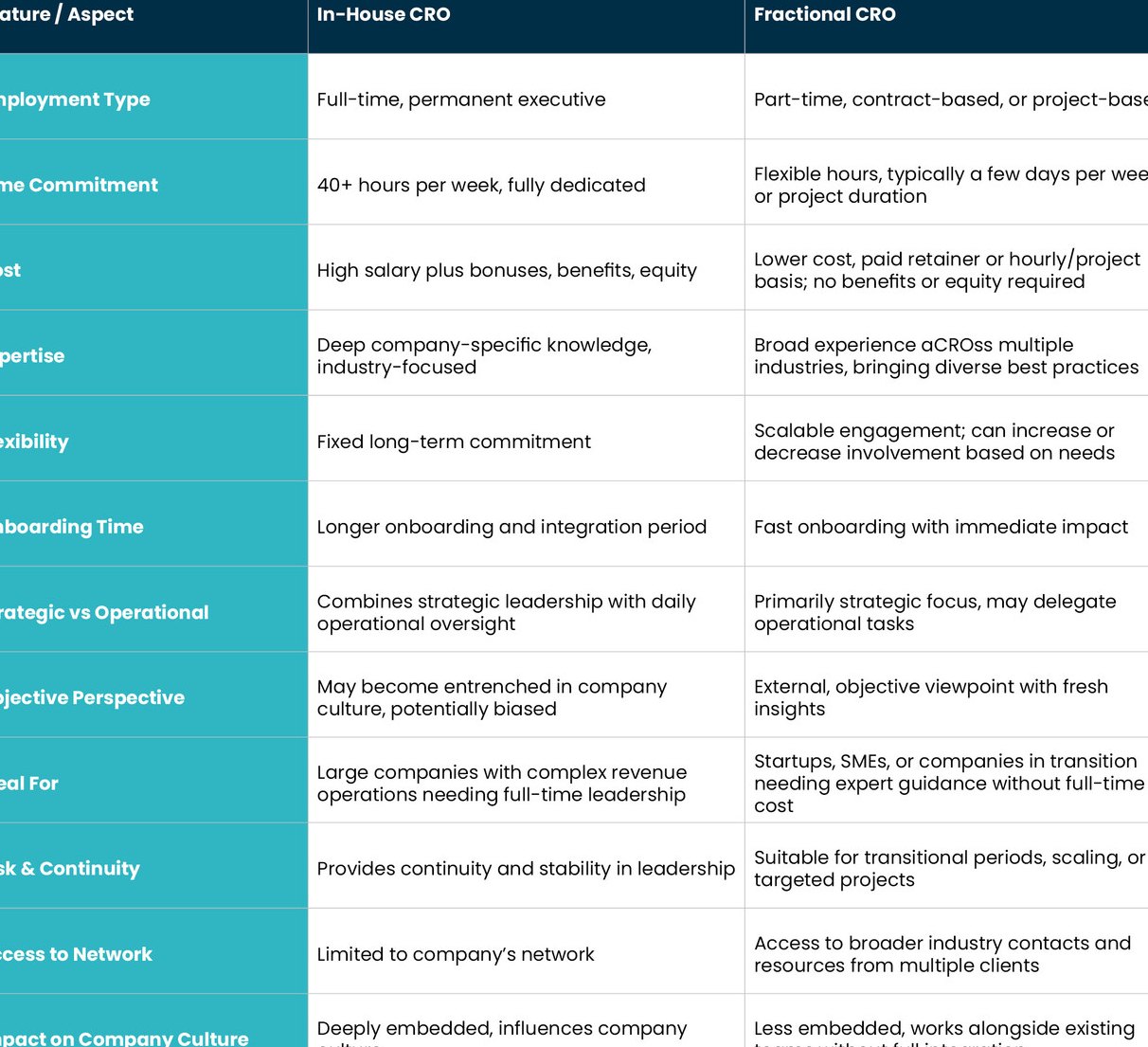
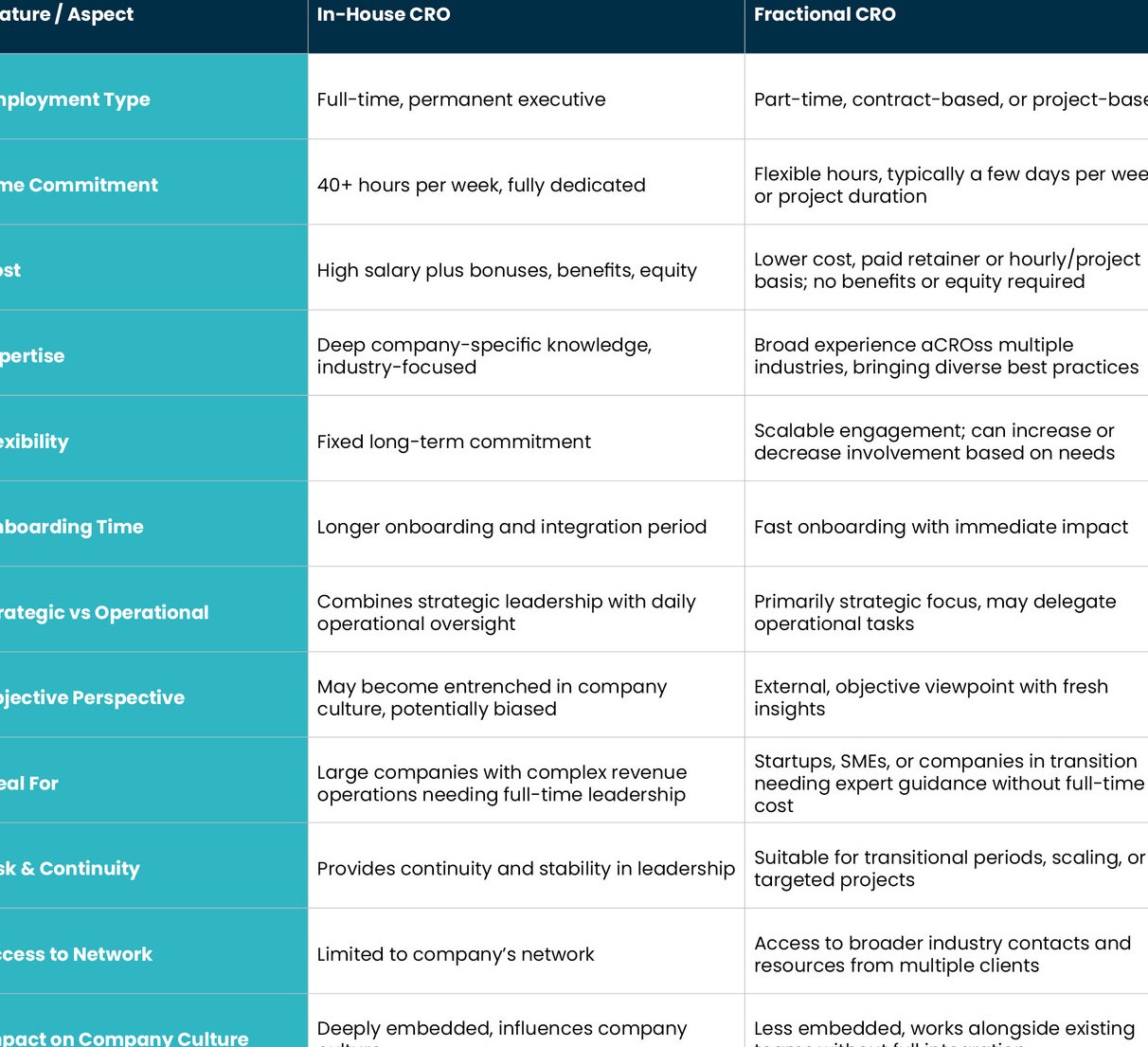
Second, decide fractional versus full-time. Below roughly $10M ARR, with a revenue team under about ten people and no budget for a senior base salary plus benefits and equity, fractional is usually the right call. Above $10M, with a large team and a need for someone fully embedded in the culture and hiring at volume, you are buying a full-time executive and the fractional version will feel perpetually thin. Sitting near the boundary is the good problem: a six-month outsourced engagement with an explicit conversion path to full-time is a legitimate structure, and some candidates prefer it.
Third, decide the seniority level. Not every company with a revenue problem needs a CRO. If the gap is running a team of four reps against a defined process, a fractional VP of Sales is a better and cheaper fit. If the gap spans sales, marketing, and customer success — pricing, segmentation, retention, the whole revenue system — you need the CRO scope. Buying CRO seniority for a VP-scope problem wastes money; buying VP seniority for a CRO-scope problem produces a plan that stops at the sales team's edge.

Fourth, decide *when*. The most common timing mistake is hiring too late — waiting until revenue is flat or falling, the pipeline is empty, and the team is demoralized, which is the hardest possible starting position. The right trigger is the first sign of inconsistency: lumpy month-to-month revenue, two consecutive missed forecasts, a founder spending more than half their time in deals, or a new rep who has not ramped by month five. Hire against the leading indicator.
Fifth, define success in writing before day one, in leading indicators rather than lagging revenue. In a market with 6-to-18-month cycles, judging a six-month engagement on closed revenue is close to meaningless. Use qualified opportunities created per month, pipeline coverage ratio against target, stage-to-stage conversion, average cycle length, forecast accuracy within a stated variance, and rep ramp time. Set the baseline in week one — before anything changes — so the month-two checkpoint has something to measure against. Without a baseline you will spend the checkpoint arguing about whether things improved.
Sixth, onboard fast and completely. Day one: CRM admin access, call recording access, tool logins, a written introduction to the team framing the engagement's purpose and authority, calendar invites for the standing cadence, and a list of the five customers and five lost prospects they should speak to. An outsourced CRO who spends three weeks chasing credentials has lost a fifth of a three-month engagement to your administrative friction.
Seventh, run the month-two checkpoint honestly against the baseline and the leading indicators, and be willing to use the 30-day out. Most engagements that fail were visibly wobbling at month two and got extended anyway on the hope that the next month would be different. Extend when the leading indicators are moving and the team's assessment is positive. Adjust when the diagnosis was right but the scope was wrong. Exit when neither is true — the clause exists precisely for that.
Related questions
Should the outsourced CRO live in San Antonio?

Not necessarily. The full-time resident pool is thinner than Austin's or Dallas's, and many of the strongest operators work remote-primary with monthly on-site blocks. What matters is domain fit, local network, and a contractually specified number of in-person days for pipeline reviews and customer meetings.
How long before I see revenue impact?
Roughly one full sales cycle plus 30 days. With a 90-day cycle, expect leading-indicator movement — pipeline volume, conversion, forecast accuracy — inside 60 days and closed-revenue impact around month five. With a 9-month enterprise cycle, judge the engagement almost entirely on leading indicators.
Can they hire the sales team for me?
Yes, and it is often the highest-value thing they do. An outsourced CRO writes the scorecard, runs the interview loop, and uses their own network to source — which typically compresses a San Antonio revenue search substantially. Confirm hiring authority and whether recruiting hours count against the retainer days.
What if I already have a VP of Sales?
Then scope carefully. The CRO should coach and enable the VP, not shadow-manage the team around them. Define who owns forecast, who owns one-on-ones, and who the reps escalate to. Tell the VP directly why you are doing this before the CRO starts, or you will lose the VP.
Do I need RevOps before I hire a CRO?
No, but you need clean-enough data. Two weeks of admin cleanup — closing dead opportunities, standardizing stage definitions, requiring fields at stage transitions — is enough to start. The CRO will tell you within 60 days whether a dedicated RevOps hire is warranted, and can usually source one.
FAQ

How do I find an outsourced CRO who understands San Antonio's industries?
Start with your investors and board, then work peer founders in the Geekdom and Tech Bloc orbit and ask specifically who has sold into cybersecurity, defense, healthcare, financial services, or energy. Layer in operator communities like Pavilion and RevOps Co-op, plus fractional-specific networks. On LinkedIn, search by outcome and vertical rather than by the self-assigned "fractional CRO" title.
What is the typical notice period?
Thirty days is the standard termination clause on both sides. Early-stage, cash-constrained companies can often negotiate 14 days. Whatever you agree, put it in writing along with what happens to work product, CRM documentation, and system access on exit — that last item gets forgotten and turns into a mess.
Can an outsourced CRO work with a fully remote team?
Yes, provided they have genuine async discipline: written pipeline notes, recorded reviews, documented decisions rather than hallway alignment. Still budget for weekly video cadence and periodic in-person time for the pipeline review and major customer meetings. Ask candidates how they run a distributed revenue team and listen for specifics, not enthusiasm.
How do I know whether I need fractional or full-time?
Below about $10M ARR with a revenue team under ten people and no budget for a senior base plus benefits and equity, go fractional. Above that, with a large team and heavy hiring ahead, buy full-time. Near the boundary, a six-month outsourced engagement with an explicit conversion path is a reasonable way to test the fit first.
What should the first 30 days produce?
A written diagnosis, not revenue. Expect a pipeline assessment with named problems, a stage and forecast-category definition document, call-listening findings from at least fifteen recorded conversations, a baseline of the leading indicators you agreed to measure, and a prioritized 90-day plan. If month one produces only meetings and optimism, raise it immediately.
How many clients should they be carrying?
Ask, and treat evasion as an answer. Three to four concurrent clients at 10 to 12 days each is a full and reasonable load. Beyond five, your engagement is competing for the thin edge of their week. Ask what happens when two clients have a crisis in the same week and who gets the hours.
Sources
- Pavilion — community for revenue leaders
- RevOps Co-op — revenue operations community
- Harvard Business Review — sales and revenue management research
- First Round Review — startup leadership and hiring guidance
- SaaStr — B2B SaaS go-to-market resources
- Geekdom — San Antonio startup and tech community
- Tech Bloc — San Antonio tech advocacy organization
- Greater San Antonio Chamber of Commerce — regional industry data
- U.S. Bureau of Labor Statistics — San Antonio area occupational and wage data
- LinkedIn — sourcing and vetting revenue leadership candidates
Related on PULSE
- How much does a part-time CRO cost in San Antonio in 2027?
- How do I evaluate a fractional Chief Revenue Officer in San Antonio in 2027?
- How much does an interim Chief Revenue Officer cost in San Antonio in 2027?
- How much does an outsourced CRO cost in San Antonio in 2027?
- How do I find a fractional CRO in Millsboro in 2027?
- How do I hire a fractional CRO in Tulsa in 2027?
This page will be disappearing soon. Save it to your device for $1 — or read it free while it is here.
@Kory-White- · if Venmo asks, the last 4 of my number are 2012
This page is gone.
This one is off the shelf now. $1 keeps it on your phone for good — the whole page, pictures and diagrams included.
 pulse-toolsHow do I evaluate a fractional Chief Revenue Officer in Arkansas in 2027?
 pulse-toolsShould I Hire a Fractional CRO If I Am Consolidating Regional Sales Teams in 2027?
 pulse-toolsIs there a fractional Chief Revenue Officer available near me in Rhode Island in 2027?
 pulse-toolsHow do I hire a fractional CRO in Philadelphia in 2027?
 pulse-toolsHow do I hire a fractional CRO in Denver in 2027?
 pulse-toolsHow do I hire a fractional CRO in New Mexico in 2027?
 pulse-toolsIs there a fractional Chief Revenue Officer available near me in Michigan in 2027?
 pulse-toolsShould I Hire a Fractional CRO If I Need to Build a Partner Channel in 2027?
 pulse-toolsHow do I evaluate a fractional Chief Revenue Officer in Los Angeles in 2027?
 pulse-toolsIs there a fractional Chief Revenue Officer available near me in Arkansas in 2027?