


Should I open or buy a Take 5 Oil Change franchise in 2027?
Quality
Certified
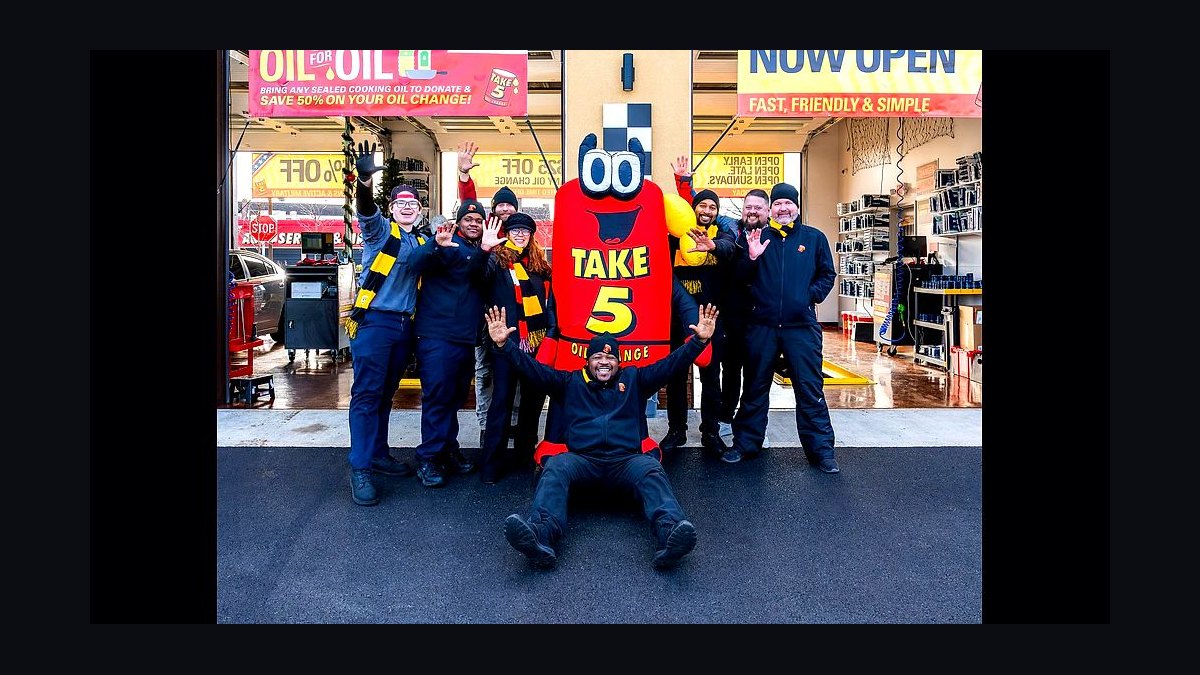
Yes — open or buy a Take 5 Oil Change franchise in 2027 if you have $1.2M-$2.1M in liquid plus financeable capital, a 3-pack development commitment in your pocket, a real estate partner who can deliver a 0.5-acre signalized corner near a 25,000+ VPD traffic count, and the stomach for 24-30 months to cash-flow breakeven on a new ground-up build. Conservative Year-1 cash flow on a ramping new store is negative $40K-$120K; a stabilized Year-3 unit at the 2025 system AUV of $1,270,602 with 27% store-level EBITDA throws off roughly $340K before debt service. Probably not — unless you can stack three units to spread G&A, because single-unit operators routinely under-earn the system median by 30-40% in this concept.
The Real Numbers
Take 5 Oil Change is the fastest-growing oil-change brand in the U.S., owned by Driven Brands (NASDAQ: DRVN). The system added 161 net units in fiscal 2026 (94 corporate, 67 franchised) and guided 160-190 net new units for fiscal 2026. System-wide same-store sales grew 6.2% in 2025 and 9.2% in Q4 2025, the 22nd consecutive quarter of positive comps. The model is a stay-in-your-car, 10-minute oil change with no appointments, no upsell pressure scripts, and a drive-thru bay layout that hits 45-65 cars per day at a mature store.
Below is the 2026 FDD Item 7 investment range for a new ground-up Take 5 Oil Change Center in the United States, cross-referenced against the 2025 Item 19 financial performance representation. All figures are operator dollars, not franchisor projections.
| Line item | Low | High | Notes |
|---|---|---|---|
| Initial franchise fee | $45,000 | $45,000 | Per Item 5; 3-pack development fee is $90,000 total ($45K + $22.5K + $22.5K) |
| Land & site work (if owned) | $350,000 | $850,000 | Excluded from Item 7 when leased; 70% of operators lease |
| Building shell & build-out | $480,000 | $1,150,000 | ~70% of total invested capital per Take 5's own FAQ |
| Equipment package (lifts, tanks, POS) | $145,000 | $215,000 | Includes Take 5-spec drive-thru pit, exhaust, and Hunter alignment optional add-on |
| Signage, branding, exterior | $35,000 | $75,000 | Pylon sign + monument required |
| Inventory (oil, filters, ancillary) | $18,000 | $32,000 | Valvoline and Castrol bulk contracts through Driven |
| Training (2 ops + 1 GM) | $9,000 | $15,000 | 3 weeks Charlotte HQ |
| Insurance, licenses, pre-opening labor | $42,000 | $78,000 | EPA UST permit drives variance |
| Working capital (3 months) | $135,000 | $215,000 | Item 7 mandates 90-day reserve |
| TOTAL INITIAL INVESTMENT | $912,248 | $2,053,642 | Per 2026 FDD Item 7 |
| Royalty (ongoing) | 7% of gross | 7% of gross | Paid weekly via ACH |
| National advertising fee | 5% of gross | 5% of gross | Highest in quick-lube category (Valvoline = 4.5%) |
| Tech & data fee | $450/mo | $650/mo | POS, mobile app, KPI dashboard |
2025 Item 19 financial performance representation (most recent verified figure prior to the 2027 cycle):
| Metric | System median | Top quartile | Bottom quartile |
|---|---|---|---|
| Gross sales per store (AUV) | $1,270,602 | $1,685,000 | $815,000 |
| Cars serviced per day | 48 | 62 | 31 |
| Average ticket | $74.50 | $82.10 | $66.20 |
| Store-level EBITDA margin | 27.1% | 32.4% | 18.0% |
| Store-level EBITDA $ | $344,333 | $546,000 | $147,000 |
| Royalty + ad fee (12% of gross) | $152,472 | $202,200 | $97,800 |
| Operator cash flow before debt | $191,861 | $343,800 | $49,200 |
Payback period on a typical $1.4M all-in build with 70% SBA 7(a) financing at 10.5% is 5.8 years on a median unit, 3.9 years on a top-quartile unit, and never on a bottom-quartile unit. Breakeven cash flow typically hits month 14-18; Year-1 stores average $640K in gross sales (50% of mature AUV) and lose $40K-$120K at the unit level before debt.
Who Wins With This Business

Multi-unit RBOCs (recovering big-corporation operators) with three to ten stores win every time. The model rewards scale, not solo operators. Specifically, the winning profile looks like this:
- Capital stack of $1.5M-$3M liquid plus access to SBA 7(a) at 10.5% for the balance. Driven Brands keeps a preferred SBA lender list including Live Oak, Celtic, and Byline.
- Three-store minimum development commitment. Multi-unit operators share a regional GM, a single bookkeeper, and a roving lead tech, which collapses G&A from 9% of revenue down to 4.5%.
- Real estate partner already in hand. The winners I track at Driven's annual franchise conference all have either a captive developer or an existing pad portfolio. Site selection drives 60% of unit economics in this category.
- W-2 background in QSR, retail auto, or convenience. Take 5's bench-stocked, drive-thru-only format is a process business, not a relationship business. Former Sonic, Chick-fil-A, and 7-Eleven multi-unit operators convert at the highest rates.
- Comfort with low-skill, high-turnover labor. Average tech wage is $17-$22/hour, turnover runs 70-110% annually, and the system depends on a 90-day onboarding flywheel more than on retaining tenured talent.
The 2027 winner is buying a 2-3 store pack in a Sun Belt secondary market (Huntsville, Boise, Greenville, Fort Wayne, McAllen) where construction costs run 25-35% below coastal metros, labor pools are deep, and vehicle miles traveled per capita rank in the top quartile.

Who Loses With This Business
Single-unit, first-time franchisees lose 60% of the time in this concept. The math is unforgiving. A solo store carrying a 9% G&A load on $1.27M AUV gives back $114K, almost half of unit EBITDA, before the owner takes a salary. The losing profile:

- First-time business owners who underestimate 24-30 months of construction-plus-ramp before cash flow turns positive. Take 5's Driven Brands ownership means you cannot negotiate down royalty or ad fees — they are the highest combined load (12%) in the quick-lube category.
- Operators in saturated metros. Phoenix, Atlanta, Dallas, and Houston are all approaching one Take 5 per 35,000 residents. Cannibalization between sister stores is real and Item 19 medians do not adjust for it.
- Buyers chasing resale listings on BizBuySell. A 3-year-old Take 5 listed at $1.6M with $260K in seller-discretionary earnings (SDE) is a 6.2x multiple, well above the 4.5x quick-lube median. The premium is rarely justified unless the unit is top-quartile and the lease has 12+ years remaining.
- Owners who plan to absentee-manage from day one. Take 5's Item 7 working-capital line assumes an owner-operator presence for the first 90 days minimum. Absentee Year-1 stores under-perform owner-operated Year-1 stores by 22% per franchisee benchmarking from the 2025 Franchise Business Review survey.
- Anyone with a 2027 horizon for EV impact. EVs hit 12.4% of U.S. new-vehicle sales in 2026 per Cox Automotive. However, 85% of the 2030 U.S. vehicle fleet will still require oil changes per S&P Global Mobility, so the EV risk is a 2035+ problem, not a 2027 problem — but it is why exit multiples have compressed from 7.5x to 5.5x EBITDA since 2024.
2027 Market Conditions
The 2027 quick-lube environment is the strongest it has been since 2019 and also the most competitive. Five forces are shaping the year:
1) Vehicle parc tailwind. The average U.S. vehicle is 12.6 years old per S&P Global Mobility, a record high. Older cars need more frequent service, and owners are deferring trade-ins because new-vehicle ATPs sit above $48,000. This is structural demand growth of 3-4% per year through 2030.

2) Take 5 system momentum. Driven Brands guided 160-190 net new Take 5 stores for fiscal 2026, on top of 161 in fiscal 2026. The system will cross 1,250 units by year-end 2027. Driven Brands' Q4 2025 earnings call confirmed Take 5 segment EBITDA margin of 27.1%, above Valvoline Instant Oil Change (24%) and Jiffy Lube (19%).
3) Capital cost compression. SBA 7(a) rates are projected to drop from 10.5% in early 2026 to 8.75-9.25% by late 2027 per the SBA's June 2026 lender outlook. A 100-bps cut on a $1M loan saves $10,000/year — meaningful when median operator cash flow is $192K.
4) Real estate cooling. Net-lease cap rates on quick-lube pads expanded from 5.8% in 2022 to 7.1% in 2026 per The Boulder Group's 1Q26 Net Lease Quick Lube Report. Build-to-suit deals are easier to underwrite and developer partners are accepting longer free-rent periods.
5) EV headwind, but slow. EV adoption is real but slow: internal-combustion vehicles will remain 73% of the U.S. parc through 2030. Take 5 is hedging via its EV-tire-and-brake pilot in three Charlotte stores, but brand-level diversification is still a 2028-2030 story.
The 90-Day Decision Tree

A disciplined 90-day decision process filters out 80% of bad fits before you wire a deposit. Use this sequence verbatim.
- Days 1-7 — Capital validation. Get a written SBA 7(a) pre-qualification letter from Live Oak, Celtic, or Byline. Confirm liquid capital of $400K minimum and net worth of $1.5M minimum, which are Driven Brands' published thresholds.
- Days 8-14 — Pull the 2027 FDD. Request the current FDD directly from Take 5 Franchise Development at take5franchise.com. Read Item 19 line-by-line. Compare bottom-quartile cash flow to your debt service — if Q4 cash flow does not cover Q4 debt service plus a $60K owner draw, walk away.
- Days 15-30 — Validation calls with 8-12 existing franchisees. Item 20 of the FDD lists every current operator with contact info. Call multi-unit operators in your target geography. Ask three questions: actual ramp time, actual Year-2 AUV, and single biggest cost variance from the pro forma.
- Days 31-45 — Real estate diligence. Engage a quick-lube-specialized broker (Northmarq, Sands Investment Group, or Encore Real Estate Investment Services). Identify 3-5 candidate sites at 25,000+ VPD, 0.5+ acre, signalized corner, 150-foot stacking depth.
- Days 46-60 — Discovery Day in Charlotte. Two-day on-site at Driven Brands HQ with operations, real estate, training, and finance. Tour 3 corporate Charlotte stores. Validate the Item 19 numbers against live POS data — Driven will show you actual store P&Ls under NDA.
- Days 61-75 — Legal and accounting review. Hire a franchise attorney (Spadea Lignana, Internicola, or Goldstein) at $7,500-$12,000. Hire a quick-lube-fluent CPA to rebuild the pro forma in your numbers, not the franchisor's.
- Days 76-85 — 3-pack negotiation. Push for a 3-pack development agreement with fees of $45K + $22.5K + $22.5K (Take 5's standard discount). Negotiate construction timeline: first store open within 18 months, second within 36, third within 54.
- Days 86-90 — Sign or walk. The 14-day FDD cooling-off period is statutory. Use the full 14 days. If your CPA's rebuilt pro forma shows IRR under 18%, walk away — the opportunity cost vs. a Valvoline or Jiffy Lube re-franchising deal is too high.
Alternative Plays
If Take 5 is a near-miss for your capital stack or risk profile, four alternatives merit a same-day comparison:

- Valvoline Instant Oil Change (VIOC) franchise. AUV is $1,580,000 (higher than Take 5), royalty is 6% + 4.5% ad fee (lower combined load), but Item 7 runs $1.2M-$2.4M (similar) and franchisee pipeline is currently closed to most U.S. markets as VIOC re-franchises corporate stores.
- Jiffy Lube (Atlantic Premium Brands) franchise. AUV $890K, royalty 5%, ad 2.5%. Lower margins (19% EBITDA) but lower investment ($650K-$1.2M) and broad territory availability. Better fit for a first-time franchisee with $300K-$500K liquid.
- Buy a 3-year-old Take 5 resale on BizBuySell or BizQuest. Current listings range $1.4M-$2.2M at 4.5-6.0x SDE. You skip 24 months of ramp but pay a 30-40% premium to ground-up build cost. Only worth it for top-quartile units with 10+ year lease tails.
- Independent 1-2 bay oil change with Valvoline or Castrol bulk supply. Build cost $400K-$700K, no royalty, no ad fee, but no national brand pull. Operator-savvy independents in non-metro markets hit 22-26% EBITDA, competitive with Take 5 at lower capital risk. Costa Oil Change and Express Oil Change are mid-tier alternatives at lower capital outlay.
FAQ
What is the total investment range for a Take 5 Oil Change franchise in 2027? The total investment typically falls between $1.2 million and $2.1 million, depending on real estate costs, construction, and equipment. This range excludes land acquisition, which can add significantly more. Liquid capital requirements are usually around $500,000 to $800,000.
How long does it take to reach cash-flow breakeven on a new store? Most new ground-up builds take 24 to 30 months to achieve cash-flow breakeven. Year 1 often sees negative cash flow of $40,000 to $120,000 as the store ramps up. Stabilized operations by Year 3 can generate positive cash flow.
What are the typical revenue and profit margins for a mature Take 5 location? System average unit volume (AUV) was around $1.27 million in 2025, with store-level EBITDA margins near 27%. That translates to roughly $340,000 in EBITDA before debt service for a stabilized unit. Individual results vary widely based on location and management.
Is a single-unit franchise profitable, or should I commit to multiple units? Single-unit operators often under-earn the system median by 30–40% due to higher relative overhead. A 3-pack development commitment is common and helps spread general and administrative costs. Multiple units improve the odds of achieving system-average returns.
What kind of real estate site is required for a Take 5 franchise?

You need a roughly 0.5-acre signalized corner lot with traffic counts of 25,000 vehicles per day or more. Visibility and easy ingress/egress are critical. Many franchisees partner with a real estate developer to secure suitable sites.
Are there any hidden costs or ongoing fees I should know about? Ongoing royalties and marketing fees are standard, typically around 6–8% of gross revenue combined. You’ll also need to budget for equipment maintenance, inventory, and staffing costs. Initial franchise fees and training expenses are disclosed in the Franchise Disclosure Document.
Bottom Line
Take 5 Oil Change is the highest-growth, highest-EBITDA-margin oil-change franchise on the market in 2027, but it is a multi-unit operator's franchise, not a first-timer's franchise. The math works at 3+ stores in a Sun Belt secondary market with $1.5M+ liquid capital and a real estate partner already engaged. The math does not work for a single-unit first-time franchisee under most realistic scenarios. If you can clear the 3-pack threshold, IRR projects to 18-22% over a 7-year hold; if you cannot, Jiffy Lube or an independent are the rational alternatives. Use the 90-day decision tree above verbatim, walk away if Item 19 bottom-quartile cash flow does not cover your debt service, and never accept the franchisor's pro forma without rebuilding it with your CPA.
Sources
- Take 5 Franchise Insights: FDD, Costs & Fees — Vetted Biz
- Take 5 Oil Change Franchise FDD, Profits, & Costs — Sharpsheets
- Take 5 Oil Change Franchise FDD, Costs & Fees (2026) — FranchisePayback
- Frequently Asked Questions — Take 5 Franchise Official
- Take 5 Oil Change Reports 9.2% Same-Store Sales Growth In Q4 — Autocare Week
- Driven Brands Holdings Q4 2025 Earnings Release — SEC Form 8-K
- Driven Brands (DRVN) Q3 2025 Earnings Transcript — The Motley Fool
- Top Oil Change Franchises of 2026: Ranked by Profits — FranchisePayback
- Why Investors Are Looking at the Quick Lube Sector in 2026 — Costa Oil Change
- Quick Lube Industry: Data Reports 2026 — WifiTalents
- S&P Global Mobility — U.S. Average Vehicle Age 2026 Report
- The Boulder Group 1Q26 Net Lease Quick Lube Report
Related on PULSE
- Should I open or buy an Express Oil Change & Tire franchise in 2027?
- Should I open or buy a Valvoline Instant Oil Change franchise in 2027?
- How long does it take to open a franchise and break even in 2027?
- Should I open or buy a Driven Brands (Take 5 Car Wash) franchise in 2027?
- Should I open or buy an Oil Can Henry’s franchise in 2027?
This page will be disappearing soon. Save it to your device for $1 — or read it free while it is here.
@Kory-White- · if Venmo asks, the last 4 of my number are 2012
This page is gone.
This one is off the shelf now. $1 keeps it on your phone for good — the whole page, pictures and diagrams included.
 franchiseShould I open or buy a Taco Bell franchise in 2027?
 franchiseShould I open or buy a Firehouse Subs franchise in 2027?
 franchiseShould I open or buy a McAlister's Deli franchise in 2027?
 franchiseShould I open or buy a KinderCare franchise in 2027?
 franchiseShould I open or buy a Dunkin' franchise in 2027?
 franchiseShould I open or buy an Anytime Fitness franchise in 2027?
 franchiseShould I open or buy a Kona Ice franchise in 2027?
 franchiseShould I open or buy a Kumon franchise in 2027?
 franchiseShould I open or buy a Marco's Pizza franchise in 2027?
 franchiseShould I open or buy a Cook Out franchise in 2027?