


Should I open or buy a Mooyah franchise in 2027?
Quality
Certified
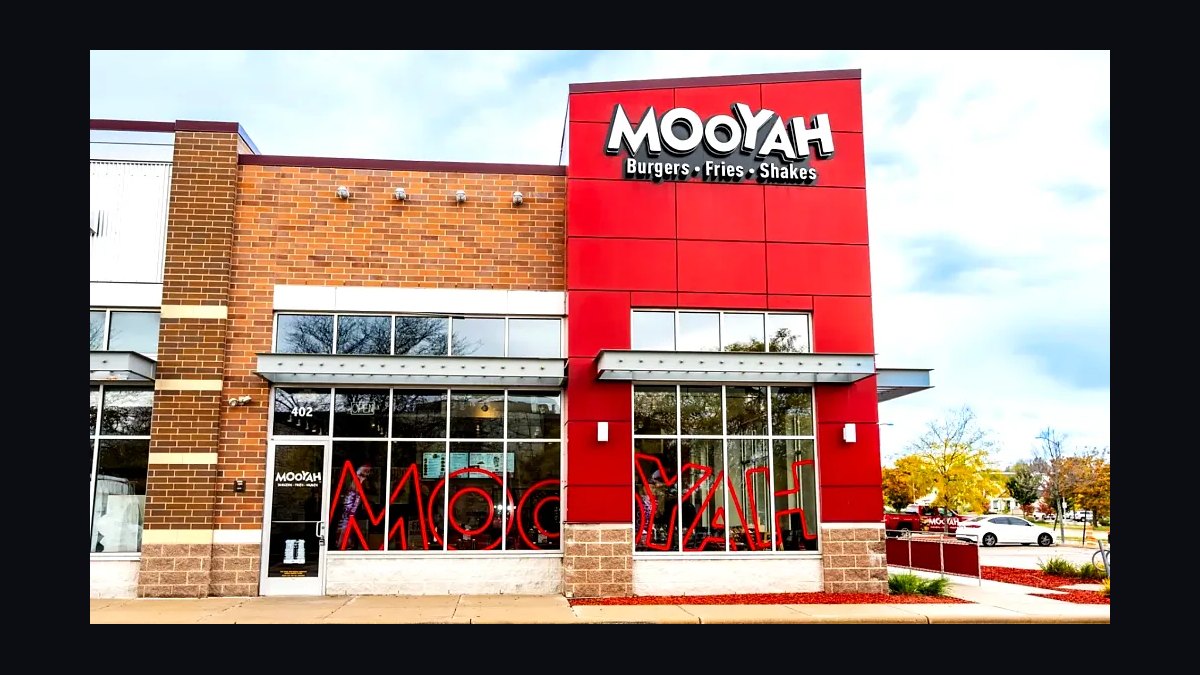
Probably not — unless you already operate two or more fast-casual units, can absorb a $700K–$1.0M all-in build without leverage above 60%, and have a second-tier metro real estate site locked at sub-$45/sf. Mooyah Burgers, Fries & Shakes is a 76-unit better-burger chain that has shrunk from 81 units in 2022 to 74 by year-end 2024, then clawed back to 76 in 2025 under new president Michael Meche (ex-Papa Johns). The 2027 FDD reports a $40,000 franchise fee, 6% royalty, 3% marketing fee, and a $372,525–$1,186,124 Item 7 range. Average unit volume sits at $1,016,330 with top-quartile units at $1,475,123. Year-1 conservative cash flow for a single new unit lands $60K–$95K after debt service. Breakeven runs 4.5–6 years. Single-unit operators with no restaurant background should skip it.
The Real Numbers
Mooyah's 2027 Item 7 initial investment range spans $372,525 on the inline-end-cap low end to $1,186,124 for a free-standing build with drive-thru. The midpoint $477,918–$989,793 is where most new 2027 openings land. Average unit volume (AUV) from the 2027 FDD Item 19 holds at $1,016,330 across the system, with top-quartile stores at $1,475,123 and bottom-quartile units at roughly $640,000. Royalty is 6% of gross sales at maturity, but Mooyah is running a ramp incentive: 2026 openings pay 4%, 2027 openings pay 5%, and 6% kicks in for 2028 and beyond. The brand fund (marketing) contribution is 3% of gross sales, plus local-store marketing of roughly 1–2%.
| Line Item | Low | Midpoint | High |
|---|---|---|---|
| Franchise fee (1st unit) | $40,000 | $40,000 | $40,000 |
| Multi-unit subsequent fee | $25,000 | $25,000 | $25,000 |
| Leasehold + build-out | $185,000 | $360,000 | $640,000 |
| Equipment + smallwares | $95,000 | $145,000 | $210,000 |
| Signage + POS + tech | $22,500 | $38,000 | $58,000 |
| Training + opening labor | $12,000 | $22,000 | $34,000 |
| Grand opening + LSM | $7,500 | $15,000 | $25,000 |
| 3 months working capital | $35,000 | $60,000 | $115,000 |
| Insurance + deposits | $5,525 | $8,500 | $14,000 |
| Misc. + soft costs | $10,000 | $35,000 | $50,000 |
| TOTAL (Item 7) | $372,525 | $748,500 | $1,186,124 |
| Royalty (2027 open) | 5% | 5% | 5% |
| Brand fund | 3% | 3% | 3% |
| AUV | $640K | $1.016M | $1.475M |
| Restaurant-level EBITDA margin | 9% | 12% | 16% |
| Conservative Year-1 cash flow | $40K | $85K | $165K |
| Payback (cash-on-cash) | 7+ yrs | 5.5 yrs | 3.8 yrs |
Liquid capital requirement is $500,000 and net worth $1,000,000. Multi-unit development agreements drop the fee to $25,000 per subsequent unit but require three-unit minimum commitments in most DMAs.
Who Wins With This Business
Existing multi-unit fast-casual operators win first. A franchisee already running 2–4 Jersey Mike's, Tropical Smoothie, or MOD Pizza units brings labor scheduling discipline, food-cost variance reporting, and regional supplier relationships that carry directly to Mooyah's COGS structure. Restaurant-level EBITDA in the 14–16% band is achievable when food cost stays under 30% and labor under 28% — both only sustainable with operator experience. Texas, Carolinas, and Florida operators win because Mooyah's brand recognition is densest in those states (roughly 60% of the 76-unit footprint), and co-op marketing leverage compounds. Real-estate-savvy operators win because end-cap inline at $32–$42/sf is the only rent profile that lets the unit-level model breathe at sub-$1M AUV. Operators with a $25K–$40K LSM war chest per year win — trade-area marketing drives 18–24% of incremental traffic at this AUV tier. Veterans applying VetCor incentive get 20% off the franchise fee. Family operators with a working GM-spouse capture an additional $55K–$70K in owner-take-home by eliminating the GM salary line.
Who Loses With This Business
Single-unit first-time operators lose. The all-in $748K midpoint plus 6% mature royalty plus 3% brand fund leaves a 9% restaurant-level margin on an $850K unit — that is $76,500 of operating cash flow before debt service on $560K of SBA 7(a) at 10.75%, which consumes $67,000 annually. Year-1 take-home of $9,500 is not a viable household income. Tier-1 metro operators lose — NYC, LA, SF, Boston build-outs hit $950K–$1.2M and AUVs cap at $1.1M in those markets because Shake Shack, Five Guys, and Bobby's Burgers saturate the premium-burger occasion. Drive-thru-only suburban operators lose because Mooyah's prototype is dine-in-led — only 22% of system sales flow through drive-thru, versus 65%+ for Culver's and Whataburger. Operators expecting 30% IRR lose — the realistic single-unit IRR is 11–14% at AUV. Anyone underwriting against the $1.475M top-quartile AUV loses — that quartile is 19 units, most over five years old, in mature trade areas with no remaining Mooyah whitespace.
2027 Market Conditions

The better-burger fast-casual segment lost steam through 2024–2025. BurgerFi filed Chapter 11 in September 2024, Smashburger same-store sales fell 5.1%, and Fuddruckers shrank 21.3%. Mooyah ended 2024 at 74 units, down from 81 in 2022, then opened six new units in 2025 under new president Michael Meche to finish at 76. The brand is positioning for what NRN called a 'revitalization' with a 2026–2028 push targeting 100 units. Segment headwinds remain real: QSR burger/sandwich growth projects sub-0.5% in 2026 after 1% in 2025, beef commodity inflation runs 8–11% YoY, and value-tier competitors (Wendy's $5 Biggie Bag, McDonald's $5 Meal Deal) compress occasion-frequency for premium burgers. Tailwinds: In-N-Out, Whataburger, and Culver's grew 12.8% in 2025, proving regional burger demand is intact for operators with execution discipline. Mooyah's 2027 royalty discount (5% instead of 6%) and opportunity-zone rent abatements in secondary metros create a narrow window for disciplined multi-unit entrants. Labor markets remain tight — QSR turnover sits at 144% per BLS 2026 data — but secondary metros offer wage relief at $13–$15/hr starting versus $17–$19 in tier-1 cities.
The 90-Day Decision Tree
- Days 1–10: Pull the 2027 Mooyah FDD from mooyahfranchise.com or FRANdata. Read Item 7 line-by-line, Item 19 unit-level disclosures, Item 20 unit-count tables, and Item 21 audited financials. Flag turnover rate from Item 20 — if franchisee turnover exceeds 8% annually, escalate concern.
- Days 11–20: Validate against a CPA. Build a 3-statement model with $640K low-AUV scenario, $1.016M base, $1.475M stretch. Confirm SBA 7(a) preliminary qualification with at least three lenders (Live Oak, Huntington, Byline).
- Days 21–35: Call 12 existing franchisees from Item 20 lists. Ask: actual food cost %, actual labor %, actual royalty effective rate, how long to AUV, biggest regret, would-you-do-it-again. Target three multi-unit operators and three single-unit operators.
- Days 36–50: Discovery Day in Plano, TX. Meet leadership, tour the test kitchen, run the prototype P&L. Walk three operating units in the host metro at lunch and dinner peaks.
- Days 51–65: Real-estate market study. Engage a tenant-rep broker (CBRE, JLL, or Stan Johnson Co.). Pull demographic overlays — HHI, daytime pop, traffic counts — for 3 target trade areas. Walk away if rent exceeds $45/sf or HHI under $85K.
- Days 66–75: Legal review. Hire a franchise attorney (Lewitt Hackman, Plave Koch). Redline the FA. Negotiate territory exclusivity, transfer fees, and renewal terms.
- Days 76–85: Final commit decision. If single-unit and no restaurant ops experience, walk. If multi-unit or experienced operator with site locked, proceed.
- Days 86–90: Sign FA, wire $40K fee, kick off site approval. Build cadence: 8–12 months from signature to ribbon-cutting.
Alternative Plays
For burger-segment exposure with stronger unit economics, the Five Guys franchise model delivers $1.5M AUV at 5% royalty but requires $306K–$673K all-in and a five-unit area development minimum. Freddy's Frozen Custard & Steakburgers posts $1.99M AUV at $1.0M–$2.4M all-in with a 4.5% royalty — a stronger ROI but a higher capital floor. Bobby's Burgers (Bobby Flay) is earlier-stage with $650K–$1.4M build and scarcer trade-area protection. For lower capital with similar margin profile, Jersey Mike's runs $237K–$1.1M all-in with AUV of $1.27M and 6.5% royalty — the single best fast-casual ROI profile in the SBA-finance-able tier. For drive-thru-led models, Culver's at $2.5M–$5.6M all-in delivers $3.4M AUV but demands liquid capital of $1.5M+. For operators preferring acquisition over greenfield, brokered Mooyah resales trade at 2.8x–3.4x SDE with 2027 listings in the $285K–$640K range depending on AUV — a faster path to cash flow if due diligence confirms three years of clean P&Ls and lease has 7+ years remaining.
FAQ
What is the total investment needed to open a Mooyah franchise in 2027? The 2027 FDD shows an all-in range of roughly $372,500 to $1.19 million, but realistic new-unit builds with equipment, leasehold improvements, and soft costs typically land between $700,000 and $1.0 million. Your actual number depends heavily on real estate condition, local permits, and whether you negotiate landlord incentives.
How much can I expect to earn in the first year?
Year-1 conservative cash flow for a single new unit, after debt service, falls in the $60,000 to $95,000 range. That’s based on the average unit volume of about $1.02 million and typical operating margins for a new location. Top-quartile units do better, but new stores usually take time to ramp.
How long does it take to break even? Breakeven typically runs 4.5 to 6 years for a single new franchise. That timeline assumes you hit average sales and keep costs in check. Faster breakeven is possible if you secure a low-rent site and have multi-unit experience to optimize operations.
Is Mooyah growing or shrinking as a brand? The chain has been roughly flat: it dropped from 81 units in 2022 to 74 by end of 2024, then edged back to 76 in 2025 under new leadership. That’s not a growth story, but it suggests stabilization. New franchise openings are possible, but the brand isn’t expanding aggressively.
What are the ongoing fees I’ll pay to Mooyah? You’ll pay a 6% royalty on gross sales and a 3% marketing fee. The initial franchise fee is $40,000. These are standard for the fast-casual burger segment and don’t vary much by location.
Who should avoid buying a Mooyah franchise? Single-unit operators with no restaurant background should skip it. The margins are thin, the breakeven is long, and the brand doesn’t have enough momentum to carry an inexperienced owner. Multi-unit fast-casual veterans with a cheap second-tier metro site are the only realistic candidates.
Bottom Line
Mooyah is a survivable but not exceptional franchise in 2027. The 76-unit footprint, declining-then-stabilizing trajectory, and better-burger segment headwinds make it a poor fit for single-unit first-time operators. The franchise economics work for experienced multi-unit operators in Texas, the Carolinas, and Florida who can lock secondary-metro real estate at sub-$45/sf, commit to a 3-unit development agreement, and operate to a 14%+ restaurant-level EBITDA. The 2027 royalty incentive (5% instead of 6%) creates a narrow time-bound advantage worth roughly $10,000 per unit per year. Below the $1M AUV line, the model breaks down. For most readers asking this question, the better answer is: acquire an existing healthy Mooyah unit at 3x SDE or redirect capital to Jersey Mike's, Freddy's, or Five Guys, all of which deliver superior risk-adjusted returns for similar capital deployment. If you proceed, do it with a CPA, a franchise attorney, and a tenant-rep broker on retainer before signing.
Sources
- Mooyah FDD Item 7 + Item 19 Analysis (Franchise Chatter, 2024)
- Mooyah Franchise Insights — Vetted Biz FDD Database
- Mooyah Burgers Franchise Costs & Profits — Sharpsheets (2025)
- QSR Magazine — Mooyah Multi-Unit Operator Incentive
- Mooyah Franchising Official FAQ
- Restaurant Dive — Mooyah Hires Michael Meche as President
- Nation's Restaurant News — The Revitalization of Mooyah
- Restaurant Business Online — Better Burger Revolution That Wasn't
- Bisnow — Mooyah Targets Expansion Amid Industry Challenges
- Entrepreneur — Mooyah Franchise Profile 2026
- IFPG — Mooyah Cost & Requirements
- SBA Franchise Directory + 7(a) Lending Standards
Related on PULSE
This page will be disappearing soon. Save it to your device for $1 — or read it free while it is here.
@Kory-White- · if Venmo asks, the last 4 of my number are 2012
This page is gone.
This one is off the shelf now. $1 keeps it on your phone for good — the whole page, pictures and diagrams included.
 franchiseShould I open or buy a Cook Out franchise in 2027?
 franchiseShould I open or buy a Cinnabon franchise in 2027?
 franchiseShould I open or buy a Papa John's franchise in 2027?
 franchiseShould I open or buy a KinderCare franchise in 2027?
 franchiseShould I open or buy a Subway franchise in 2027?
 franchiseShould I open or buy a UPS Store franchise in 2027?
 franchiseShould I open or buy a McAlister's Deli franchise in 2027?
 franchiseShould I open or buy a Sonic Drive-In franchise in 2027?
 franchiseShould I open or buy a Little Caesars franchise in 2027?
 franchiseShould I open or buy an Anytime Fitness franchise in 2027?