
Should I open or buy a Dirty Dough franchise in 2027?
 Curated byKory White · Fractional CRO · Maryland
 PULSEKNOWLEDGE LIBRARY
Only if you can lock a non-saturated trade area and run it yourself. Dirty Dough's stuffed-cookie format and roughly $250,000–$600,000 all-in cost make it a cheaper dessert entry than most food franchises, but gourmet-cookie supply has outrun demand in many metros. Site quality and owner presence now decide the outcome, not the brand.
A strip-center lease in a town that already has three cookie shops
Picture the decision the way it actually arrives. A broker sends you a 1,400-square-foot end-cap in a suburban center anchored by a grocery store and a Chipotle. Rent is $5,200 a month plus CAM, the landlord offers a $40,000 tenant improvement allowance, and the term is seven years. It looks like a clean deal. Then you drive the three-mile ring and count what is already selling cookies: a Crumbl in the power center two miles north, a regional gourmet-cookie chain in the college corridor, a grocery bakery running a warm-cookie program at half your price point, and two coffee shops that sell a house cookie at the register. That is the actual competitive set, and it is the single most important thing you will learn before signing anything.
This is where most prospective franchisees make their first structural mistake. They evaluate the brand — the menu, the stuffed-cookie hook, the social feed, the franchisor's support materials — and treat the market as a variable they can overcome with effort. In a category that expanded as fast as gourmet cookies did after 2019, the market is the dominant term in the equation. A strong operator in a thin market beats a strong brand in a crowded one, and it is not close.
Run the arithmetic on the lease above before you fall in love with it. At $5,200 base rent plus roughly $1,100 in CAM, taxes, and insurance, you are committed to about $75,600 a year in occupancy before you sell a single cookie. For that to land inside a healthy 10–13% of revenue, the store needs to clear roughly $580,000–$750,000 annually. Now ask whether a trade area with four established cookie sources supports another $600,000 of cookie demand. Sometimes it does — dessert is an impulse category and total spend can expand — but you need evidence, not optimism.

The evidence you want is boring and specific. Sit in the parking lot of the nearest competing cookie shop on a Friday between 6 and 9 p.m. and count transactions. Multiply by an assumed average ticket in the $12–$16 range for a premium cookie concept, then extrapolate across a week with a weekend-heavy curve. If the incumbent is doing 120 transactions on a peak Friday evening and thinning to 30 on a Tuesday afternoon, you can build a defensible weekly estimate. Do it for each competitor. If the whole trade area's visible cookie volume is already modest and split four ways, you have your answer, and it cost you three evenings instead of $400,000.
There is a second version of this scenario worth naming, because it is the one that actually works. A market of 60,000–90,000 people with a university or a large high school cluster, one national cookie brand or none, an evening downtown that stays busy past 8 p.m., and a landlord with vacancy pressure willing to give you nine months of free rent and a $60,000 improvement allowance. That is the profile where a Dirty Dough franchise earns its keep. The unit economics are not fundamentally different from the crowded market; the demand denominator is.
How a stuffed-cookie unit actually converts traffic into owner income
The mechanism is worth walking through step by step, because the stuffed format changes the math in ways that are easy to miss when you read a franchise brochure.
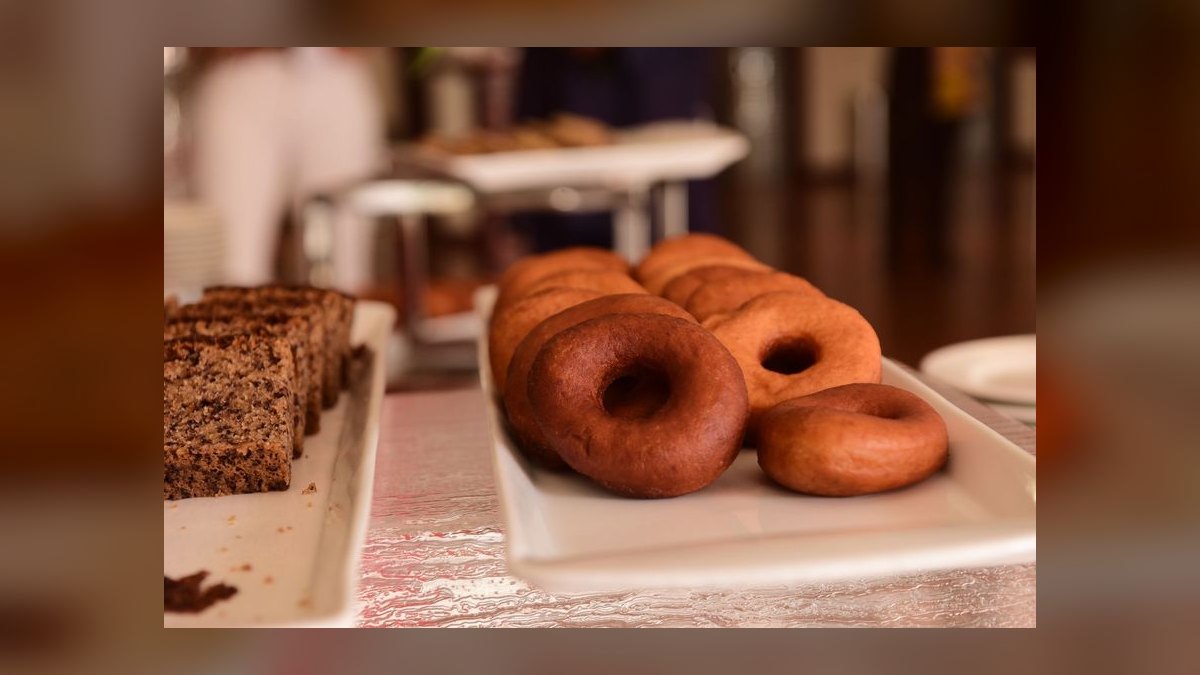
Start with the product. A stuffed cookie is assembled, not just scooped. Dough is portioned, a filling — cream cheese, caramel, brownie batter, candy pieces, cookie dough — is placed inside, and the cookie is closed and shaped before it hits the oven. That assembly step is real labor. Compared with a plain drop cookie, you are adding a hand-touch per unit, which means your production hours scale more directly with volume than they would at a simpler concept. A busy Friday does not just sell more cookies; it consumes proportionally more labor hours to produce them.
The offsetting benefit is ticket. A thick, filled, visually distinctive cookie supports a higher price and a higher basket than a standard bakery cookie. Customers who come for a premium cookie tend to buy multiples — a four-pack or six-pack to take home, plus a drink. That pushes average transaction value into a range where a modest transaction count still produces meaningful revenue. A store doing 250 transactions a day at $14 is a $1.27 million run rate; at $11 and 180 transactions it is $723,000. Ticket and count both matter, but ticket is where the format earns its premium.
Then the deductions stack. Cost of goods on a stuffed product runs higher than a plain cookie because fillings are ingredient-dense — cream cheese, chocolate, caramel, and branded candy inclusions cost real money and have moved with commodity inflation. Labor absorbs the assembly step. Occupancy is fixed and unforgiving. Royalty and the brand fund come off the top line regardless of whether you had a good month. Third-party delivery, if you lean on it, takes a commission that can quietly rewrite your margin.
The node that surprises people is the owner-works-the-store branch. At a unit this size, the difference between an owner-operator and an absentee owner is not a rounding error — it is frequently the entire distributable profit. A general manager capable of running a bakery with morning production, evening rush, and weekend catering is a $50,000–$65,000 hire in most markets, plus payroll taxes. On a store netting $90,000 before that salary, hiring the manager takes you to roughly break-even. That is the honest structure of most single-unit dessert franchises, and pretending otherwise is how people end up disappointed two years in.

There is a downstream effect worth noting. Because owner presence carries so much of the economics, the multi-unit path is harder than it looks. Going from one store to three means you now need three competent managers, and the second and third units rarely replicate the first unless you have built genuine systems — written prep schedules, par sheets, a training bench, a bonus structure tied to controllable profit. Operators who scale successfully in this category almost always spend eighteen to twenty-four months building that infrastructure inside unit one before they open unit two.
Real numbers, ranges, and the benchmarks that actually matter
Treat every figure below as a planning range to verify against the current Franchise Disclosure Document, not as a promise. Item 7 gives the investment estimate, Item 19 gives whatever financial performance representation the franchisor chooses to make, and Item 20 gives the unit counts — including closures and transfers, which is the number most people skip and shouldn't.
Capital. Plan on roughly $250,000 to $600,000 all-in, with an initial franchise fee in the neighborhood of $25,000. The spread is almost entirely build-out. A small-footprint or in-line unit in a second-generation restaurant space with usable plumbing, hoods, and grease infrastructure can land near the bottom of that range. A first-generation shell where you are running new plumbing, electrical, and HVAC lands at the top, and can exceed it if the market has expensive union labor or a slow permitting office. Ask the franchisor for the actual spread of recent openings by build type, not just the Item 7 table.

Line items to budget separately. Equipment — commercial ovens, mixers, refrigeration, display cases, POS hardware — commonly runs $90,000–$200,000. Signage and branded décor, which the franchisor specifies, runs $15,000–$50,000. Opening inventory is modest at $8,000–$22,000. Training and travel to headquarters and back, including paying staff who aren't yet producing revenue, is $6,000–$20,000. Grand-opening marketing is $12,000–$40,000 and is not the place to economize. Working capital of $35,000–$95,000 covers the first three months; most operators who get in trouble underfunded this line, not the build.
Ongoing fees. A royalty near 6% of gross sales and a brand-fund or marketing contribution of roughly 2–3%. Together that is about 8–9% off the top, before you spend a dollar on your own local marketing. Budget local marketing separately — the brand fund is not a substitute for it.
Revenue. Mature units are commonly discussed in a $450,000–$1,000,000 range. That spread is wide because it reflects genuinely different situations: a kiosk or small-format unit with limited production capacity caps out well below a full-size store with drive-thru access in a high-traffic corridor. Do not plan on the top of the range. Build your pro forma at the midpoint, stress-test it at 25% below, and confirm you can still service debt.

Cost structure. Food cost typically runs 28–32% of sales, with the fillings pushing you toward the upper half of that band. Labor runs 26–35% depending on wage rates and how many shifts you personally cover. Occupancy at 10–15%. Royalty and brand fund at 8–9%. Other operating expenses — utilities, insurance, supplies, credit card fees, repairs, software — commonly land at 9–12%. Add it up and restaurant-level margin lands in the 12–18% band for a well-run store.
Owner earnings. On $650,000 in sales at a 15% restaurant-level margin, that is roughly $97,500 before debt service and before your salary. If you're financed with an SBA 7(a) loan on $350,000 at prevailing rates over ten years, debt service alone is meaningful — run the amortization before you sign, because a payment in the $4,000–$4,500 monthly range consumes $48,000–$54,000 a year of that $97,500. What's left is your income if you work the store, and it is materially less if you don't.
Payback. A top-quartile location can return the initial investment in roughly two and a half to four years. A median location takes longer. A bottom-quartile location may not return it within the initial ten-year term, which is precisely why the site decision dominates everything else.

The benchmark to ask about. When you interview existing franchisees — and interview at least eight, drawn from the full Item 20 list, not the three the franchisor hands you — ask for same-store sales trend, not just revenue. A brand in a maturing category typically decelerates from the double-digit comps of its expansion phase toward low single digits. If comps have flattened system-wide, new units in 2027 cannot count on brand tailwind and must be underwritten purely on location quality and local execution. Also ask what percentage of their sales runs through third-party delivery, and what it did to their margin. A store with 30% delivery mix and 20% commissions is giving away roughly 6% of total revenue — enough to move you from a good year to an unremarkable one.
One more number. Ask every franchisee you call what their busiest month and slowest month looked like. Dessert is seasonal in a predictable way: November and December carry holiday gifting and corporate orders, January and February sag as resolutions bite. If your lease and payroll are sized to December, February will hurt. Build the reserve in Q4 deliberately.
Trade-offs against the adjacent options you actually have
The real question is rarely "Dirty Dough, yes or no." It is "Dirty Dough versus the other three or four ways I could deploy $400,000." Laying those side by side clarifies things fast.

Against the category leader. Crumbl built the modern gourmet-cookie category and set consumer expectations for rotating weekly menus and pink-box presentation. Competing directly against an established Crumbl in the same trade area is a losing posture unless your site is meaningfully better or the market is large enough to support both. The stuffed format gives you a genuine product difference to talk about, but product difference persuades people who already walk in the door; it does not by itself pull traffic across town.
Against other dessert franchises. Cupcake, bundt cake, frozen-dessert, and cookie-dough concepts occupy adjacent ground with different demand curves. Cake-forward concepts skew toward planned purchases — birthdays, office parties, celebrations — which produces steadier, more forecastable revenue and a real catering channel, at the cost of less impulse traffic. Frozen dessert is more seasonal and more weather-dependent but often carries lower food cost. If your market already has three cookie shops and no dedicated celebration-cake option, the adjacent category may simply be the better trade.
Against an independent shop. You can open your own stuffed-cookie bakery without a franchise agreement. You keep the 6% royalty and the 2–3% brand fund — call it $52,000–$58,000 a year on $650,000 of sales — and you keep full menu and pricing control. What you give up is the playbook: recipes that already work at volume, a supply chain with negotiated pricing, a build-out spec that has been value-engineered across dozens of stores, and a name that reduces the cost of getting a first visit. For a first-time food operator, that trade usually favors the franchise. For someone who has already run a bakery profitably, it often does not.

Against not opening a storefront at all. A commissary or ghost-kitchen model producing for delivery, catering, and wholesale accounts strips out the most expensive parts of the business — prime retail rent and counter labor — at the cost of the impulse traffic that makes a cookie shop work. Some operators run this as a bridge: prove local demand for the product at low capital, then sign a retail lease once you have data. It is a slower path and a much smaller downside.
A note on buying an existing unit instead of opening one. Resales deserve more attention than they get. An existing Dirty Dough franchise comes with real revenue history, a built-out space, trained staff, and an established customer base — you are buying a known quantity rather than a projection. Dessert-shop resales commonly trade in the range of two to three times seller's discretionary earnings, adjusted for lease terms and remaining franchise term. The diligence is different: pull three years of tax returns and P&Ls, reconcile them against POS reports, verify the reason for sale, check how many years remain on both the lease and the franchise agreement, and confirm what the franchisor will require in remodel or refresh spending at transfer. A tired store with four years left on its agreement and a mandated $80,000 refresh is not the bargain the asking price suggests.
Pitfalls that sink these units, and the specific way to avoid each
Underfunding working capital. The most common failure is not a bad concept; it is running out of cash in month four. Openings generate a spike from curiosity traffic, then settle 20–40% below that spike for a quarter before local habit builds. Operators who budget against the opening week get caught. Fund at least three months of full operating expenses — payroll, rent, food, insurance, debt service — beyond the build. Six is better. If the only way you can afford the build is to skip this reserve, you cannot afford the store.
Signing the lease before validating the market. Landlords and brokers move faster than diligence does, and the pressure to commit is real. Resist it. Do the competitor counts, pull daytime population and traffic-count data, and talk to eight franchisees first. A lease is a seven-to-ten-year personal-guarantee commitment; three extra weeks of validation is cheap insurance. If a landlord will not hold a space for reasonable diligence, that is information about the landlord.

Treating social media as free marketing. The category runs on visual, shareable product, which makes people assume the marketing takes care of itself. It does not. Consistent content — new flavor drops, behind-the-counter production, local partnerships — takes several hours a week from someone who is good at it, indefinitely. Budget for either your own sustained time or a local contractor. The stores that struggle are usually the ones where the owner posted daily for six weeks and then stopped.
Ignoring delivery economics. Third-party delivery is easy to turn on and hard to evaluate. Commissions in the 15–25% range on a product with 30% food cost leave very little. Delivery can be worth it for incremental orders that would not otherwise exist, and destructive if it cannibalizes walk-in traffic you already had. Track it as a separate channel with its own P&L line and revisit quarterly. Many operators end up capping delivery hours or raising delivery-channel prices to protect the margin.
Under-stuffing to save food cost. When margins tighten, the tempting lever is to trim the filling. Customers notice immediately, and the product difference that justified your price disappears. If food cost is out of line, fix it upstream — waste tracking, batch sizing, par levels tied to actual daypart demand, and portion discipline enforced with a scale rather than a feel. Throwing away unsold product at close is a bigger leak than portion size at most stores, and it is fixable with better forecasting.

Hiring for the opening and then stopping. Turnover in quick-service and bakery roles runs high, and a store that recruits only when someone quits is permanently short-staffed. Keep a light, continuous hiring pipeline — a standing application link, a referral bonus, a relationship with a local high school or community college. Chronic understaffing shows up as slow service on your busiest nights, which is exactly when a new customer decides whether to come back.
Skipping Item 20. The FDD's Item 20 lists unit counts by year, including terminations, non-renewals, transfers, and closures, plus contact information for current and former franchisees. Former franchisees are the highest-value calls you will make and the ones people avoid. Call them. Ask what they wish they had known, what the franchisor did well, and what they would do differently. Two honest conversations there are worth more than a month of reading marketing material.
Assuming the territory protects you more than it does. Protected territory language typically prevents another same-brand store from opening inside a defined radius. It generally does not prevent the franchisor from operating non-traditional locations — airports, stadiums, campuses, grocery kiosks — and it never prevents a competing brand from opening across the street. Read the territory clause carefully, ask specifically what non-traditional carve-outs exist, and price your risk on competitive density rather than on the contractual radius.
Related questions
How long until a new dessert franchise breaks even?
Most single-unit dessert shops reach monthly break-even within six to twelve months if the site is sound, and return the full investment in roughly two and a half to four years at a top-quartile location. Median locations run longer. Underfunded working capital is the usual reason a store never gets there.
Is buying an existing location safer than opening new?
Usually yes, if the diligence is real. A resale gives you verified revenue instead of a projection, a finished build-out, and trained staff. The risks shift to lease term remaining, franchise term remaining, mandated refresh costs at transfer, and whatever caused the seller to exit.
Can I run one without working in it?
You can, but model it honestly. A capable general manager costs $50,000–$65,000 plus payroll taxes, which at typical single-unit volumes consumes most of the distributable profit. Absentee ownership generally requires either exceptional volume or multiple units sharing management overhead.
What kills gourmet-cookie shops fastest?
Competitive density and thin working capital, in that order. A trade area with several established cookie sources splits a finite impulse-dessert budget, and a store that opened with three weeks of reserve cannot survive the normal post-opening dip in traffic.
Does the stuffed format really differentiate?
At the counter, yes — it justifies a higher ticket and gives you something concrete to market. Across town, less so. Product difference converts people who already walked in; it rarely pulls traffic away from an entrenched competitor by itself.
FAQ
What does it cost to open a Dirty Dough franchise?
Plan on roughly $250,000 to $600,000 all-in, including an initial franchise fee in the neighborhood of $25,000. The wide spread is driven almost entirely by build-out: a second-generation restaurant space with existing plumbing and ventilation lands near the low end, while a first-generation shell in an expensive labor market lands at the top. Verify the current figures in Item 7 of the FDD.
What are the ongoing fees?
A royalty of roughly 6% of gross sales plus a brand-fund or marketing contribution around 2–3%, so about 8–9% off the top line. That is separate from your own local marketing spend, which you should budget independently — the national brand fund does not do local work for you.
What can a location realistically gross?
Mature units are commonly discussed in a $450,000 to $1,000,000 range, with format and location driving most of the spread. Small-format and kiosk units cap lower because of production capacity. Build your pro forma at the midpoint, stress-test 25% below it, and confirm you can still cover debt service at that stressed number.
How much does the owner actually take home?
Restaurant-level margins in the 12–18% band are typical for a well-run store, which on $650,000 of sales is roughly $78,000–$117,000 before debt service and before your own compensation. If you hire a general manager instead of working the store, subtract $50,000–$65,000 plus payroll taxes from that figure.
How is Dirty Dough different from other gourmet-cookie brands?
The core difference is the product format — thick, hand-stuffed, layered cookies with fillings baked inside, rather than a standard drop cookie. That supports a higher average ticket and gives you a concrete story to market. The trade-off is a labor-heavier production process and higher ingredient cost per unit.
Is 2027 a bad time to enter the category?
It depends almost entirely on your specific trade area rather than the category nationally. In metros where several cookie brands are already established, the impulse-dessert budget is being split and new entrants face a genuine uphill climb. In secondary markets with little penetration — and with softer retail leasing giving tenants more negotiating leverage on rent and improvement allowances — the entry math can still work well.
Sources
- https://www.ftc.gov/business-guidance/resources/franchise-rule-compliance-guide
- https://www.sba.gov/funding-programs/loans/7a-loans
- https://www.franchise.org/
- https://www.entrepreneur.com/franchises
- https://www.ibisworld.com/united-states/market-research-reports/dessert-restaurants-industry/
- https://www.restaurantbusinessonline.com/
- https://www.nrn.com/
- https://www.bls.gov/oes/current/oes351011.htm
- https://www.census.gov/programs-surveys/economic-census.html
Related on PULSE
- [How long does it take to open a franchise and break even in 2027?](/knowledge/fr1104)
- [Should I open or buy a Tommy Gun's Original Barbershop franchise in 2027?](/knowledge/fr1095)
- [Should I open or buy a Painting with a Twist franchise in 2027?](/knowledge/fr1058)
 pulse-toolsHow Many Staff Should I Schedule Each Shift Across My Food Truck Fleet?
 pulse-toolsHow Many Sales Reps Do I Need to Hire for My Office Furniture Dealership?
 tlHow Many Sales Reps Do I Need to Hire for My Merchant Services Company?
 tlHow Many Sales Reps Do I Need to Hire for My Landscaping Company This Year?
 pulse-toolsHow Many Employees Should I Schedule Each Shift at My Movie Theater?
 pulse-toolsHow Many Budtenders Should I Schedule Each Shift at My Cannabis Dispensary?
 pulse-toolsHow Many Cashiers Should I Schedule Each Shift at My Convenience Store Chain?
 pulse-toolsHow Many Sales Reps Do I Need to Hire for My Window Replacement Company?
 tlHow Many Baristas Should I Schedule Each Shift at My Coffee Shop?
 pulse-toolsHow Many Employees Should I Schedule Each Day at My Wine Shop?