


Should I open or buy a Steak Escape franchise in 2027?
Quality
Certified
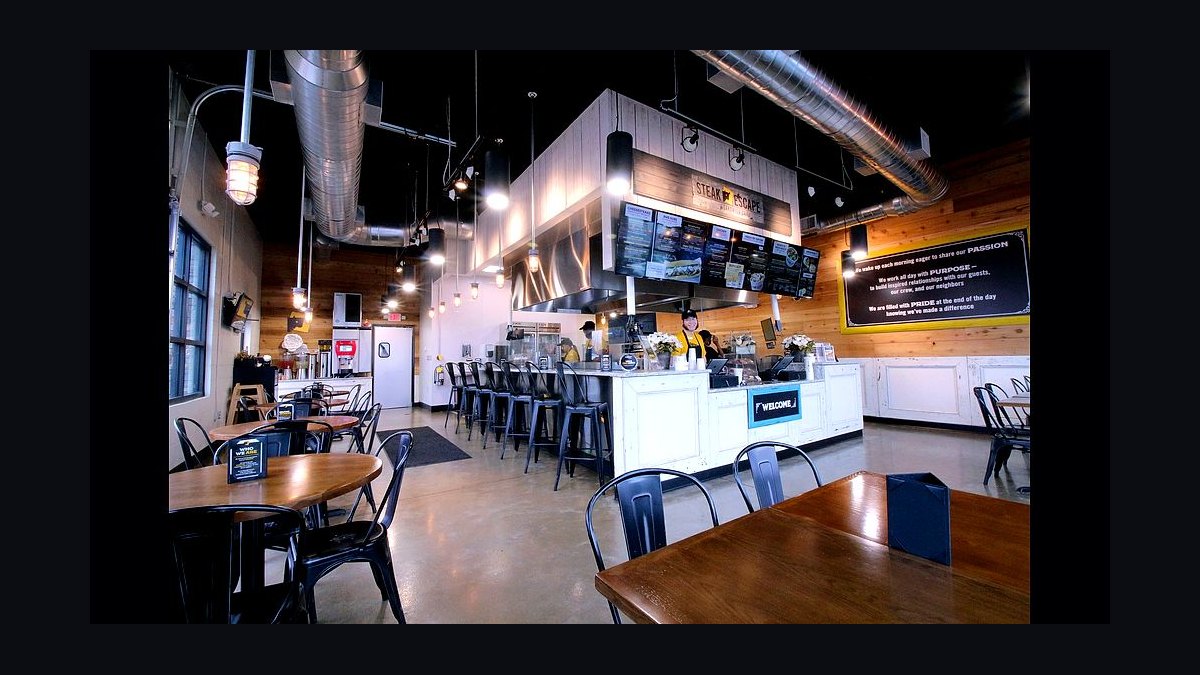
Yes, for an operator who wants a cheesesteak franchise with genuine site flexibility — Steak Escape lets you open in a food court, an airport, a college campus, or a street-front inline location, using fresh-grilled (never frozen) steak as the core differentiator. Total investment runs $150,000-$400,000. The risk is concentrated in older mall food-court units; newer non-traditional and inline sites perform meaningfully better.
What it is and why it matters
Steak Escape was founded in 1982 in Columbus, Ohio, and has spent over four decades building a menu around one core promise: fresh, never-frozen steak grilled to order, paired with fresh-cut fries and a rotating smoothie line. That "fresh, not frozen" claim matters more than it sounds — most cheesesteak and QSR competitors, including several direct rivals, use pre-cooked or par-frozen steak that gets reheated on a flat-top. Steak Escape's display cooking (the grill is visible to customers waiting in line) turns that freshness claim into a sensory sales pitch: sizzle, smell, and visible knife-work on the steak itself drive impulse purchases in a way a hidden kitchen cannot.
Why this matters for someone deciding whether to open a unit in 2027 is that the brand sits at an inflection point. Historically, Steak Escape was a food-court concept almost exclusively, which tied its fortunes to declining mall foot traffic — many regional malls have seen visits fall 5-15% annually since 2019 as anchor stores close and shopping habits shift online. But roughly 60% of new Steak Escape openings in the most recent Franchise Disclosure Document (FDD) cycle are non-traditional or inline, not food court. That is a genuine strategic pivot, not a marketing line: airports, casinos, travel plazas, college campuses, and street-front inline stores now represent the majority of new development, and those formats post materially higher average unit volumes than legacy mall kiosks.

The practical takeaway is that "Steak Escape" is no longer one business model — it is three different ones wearing the same sign, and the decision to open a franchise now hinges heavily on which format you can actually secure, not just whether you like the brand or the food. A prospective franchisee evaluating this in 2027 needs to treat the food-court version, the non-traditional version, and the inline street version as three separate investment decisions with three separate risk profiles, even though the franchise fee, royalty, and training program are shared across all three.
The step-by-step process
Opening a Steak Escape franchise follows a fairly standard single-unit QSR path, but the site-selection step branches meaningfully depending on which format you pursue. The sequence below reflects how the process actually plays out from first inquiry to grand opening.

The process starts with requesting the current FDD, which for the 2026 filing lists a franchise fee of roughly $25,000-$30,000 and a total Item 7 investment range of about $150,000 to $400,000. Read Item 19 (the financial performance representations) and Item 20 (unit counts, openings, closures, transfers) closely — these are the only legally required disclosures of how existing units actually perform, and they will tell you far more than a discovery call with a franchise development rep.
After the FDD review, call at least five to eight existing franchisees, deliberately including at least one from each format if possible: a food-court operator, a non-traditional operator, and (if you can find one, since they are newer) an inline street operator. Ask directly about average unit volume, lease terms, landlord tenant-improvement contributions, labor turnover, and whether they would open the same format again.
Format selection is the real fork in the road. Food-court units are the brand's historical core, with lower build-out costs but real mall-traffic exposure. Non-traditional sites (airports, campuses, casinos, travel plazas) require a higher build-out investment but come with a captive audience and extended operating hours. Inline street locations are the newest push, requiring the largest footprint and longest lease commitment but offering the clearest path to margin growth if you land a strong corridor.

Once the site is under control — lease signed or letter of intent executed — you sign the franchise agreement and pay the initial fee, then attend the roughly five-day initial training program at Steak Escape's Columbus headquarters, which covers food safety, sandwich assembly technique, fry station management, and point-of-sale operations. Build-out, equipment installation, and staffing typically run 60-100 days depending on format complexity, with corporate providing one to two weeks of on-site opening assistance once the doors are ready to open.
Costs, timelines, and typical ranges
The investment range for a Steak Escape franchise varies substantially by format, and treating the "$150,000-$400,000" headline figure as a single number obscures the real decision. A food-court kiosk (250-600 sq ft) sits at the low end, typically $150,000-$250,000 all-in, because the space is small and often comes with some existing mall infrastructure (grease trap, ventilation shaft, fire suppression) already in place. A non-traditional location — airport, campus, casino, travel plaza — typically runs $250,000-$400,000, reflecting the more demanding build standards these venues impose (union labor requirements at airports, casino-specific fire and security code, campus dining-services integration). An inline street location, at 1,200-1,800 sq ft, sits in the $300,000-$400,000 range and is Steak Escape's newest and largest-footprint format.

Breaking the Item 7 total into rough line items: franchise fee $25,000-$30,000; buildout and leasehold improvements $80,000-$240,000 depending heavily on format and whether the landlord contributes a tenant-improvement allowance; equipment and grill package (griddles, fry station, POS system) $50,000-$110,000; signage and decor $12,000-$35,000; initial inventory (fresh steak, potatoes, smoothie ingredients) $8,000-$20,000; initial marketing for the grand opening $8,000-$25,000; training and travel costs for the operator and initial staff $8,000-$22,000; and working capital to cover the first three months of operation, $18,000-$55,000.
Ongoing costs are a 6% royalty on gross sales plus a marketing fee generally in the 1-3% range depending on the specific agreement — these are collected off top-line revenue regardless of profitability, so they need to be modeled into your break-even math from day one, not treated as an afterthought.
Revenue reality varies as sharply as the investment does. Mature food-court units, exposed to declining mall traffic, often see average unit volumes of $400,000-$600,000, with 20-30% swings during off-peak seasons or when an anchor store closes nearby. Non-traditional locations, benefiting from captive foot traffic and longer hours, often reach $600,000-$900,000 in annual volume. Across the system, owner earnings on mature units generally fall in the $60,000-$170,000 range, with the wide spread driven almost entirely by format and site quality rather than operational execution alone.

Timeline from signed franchise agreement to grand opening typically runs 90-130 days: roughly three weeks for site finalization and permitting, five to seven weeks for build-out and equipment installation, two to four weeks for staffing and training, and then opening. Non-traditional venues can extend this timeline due to landlord approval processes (airport authorities and casinos in particular move slowly), so build in schedule padding if you're pursuing one of those formats.
Lease terms differ by format as well: food-court leases typically run 5-10 years, while inline street leases run longer, 10-15 years, reflecting the larger capital commitment landlords expect you to amortize. Negotiate tenant-improvement allowances aggressively regardless of format — many landlords will cover 30-50% of build-out costs for an established, proven brand like Steak Escape, and failing to ask for this concession is one of the most common ways new franchisees leave money on the table before they've served a single sandwich.
Where teams get it wrong

The single biggest mistake prospective franchisees make is treating "Steak Escape" as one investment decision when it is really three, differentiated primarily by format risk. Operators who sign a food-court lease purely because it's the cheapest entry point, without independently verifying that specific mall's foot-traffic trend, frequently find themselves locked into a 5-10 year lease inside a property that is losing anchor tenants. Item 20 of the FDD will show you system-wide closures, but it won't tell you which specific malls are declining — that requires independent research (talk to other tenants in the same mall, check the mall's own reported foot-traffic data, and see whether any anchor stores have announced closures).
A second common error is underestimating labor as a "simple" QSR concern. Because the menu is compact (under 20 core items), new owners sometimes assume staffing will be easy. In practice, the fresh-grilled steak preparation requires a genuinely skilled grill cook who can manage multiple simultaneous orders during lunch and dinner rushes (roughly 11:30 AM-1:30 PM and 5:00-7:00 PM), and the fresh-cut fry station adds a prep step many competing fast-food concepts have eliminated entirely by buying pre-cut frozen fries. Labor typically consumes 25-35% of revenue, and turnover in quick-service commonly runs 50-80% annually — franchisees who don't budget for a retention strategy (cross-training staff across grill, register, and prep; offering a modest starting bonus after 90 days) burn cash on constant re-hiring and re-training.
A third mistake is skipping direct calls to existing franchisees who have opened a second or third unit. These multi-unit operators are the most reliable source on whether corporate support — marketing materials, supply-chain reliability through distributors like Sysco and US Foods, and the quarterly visits from a franchise business consultant — is actually consistent in practice, since the corporate support team itself is relatively lean (roughly 12-15 staff), and response times on questions can stretch two to three business days. A single-unit conversation may not surface support gaps that only appear at scale.
Finally, some franchisees underestimate how much of local marketing responsibility falls on them. The national marketing fund focuses on digital ads and loyalty-program development, but local store marketing — social ads, event sponsorships, flyer distribution — is the franchisee's job and budget, typically $500-$1,500 per month. Franchisees who assume the brand will drive walk-in traffic on its own, especially in a non-mall format where there's no ambient foot traffic to rely on, often open to disappointing first-quarter sales.
Decision framework: when to choose what
The right call on whether — and how — to open a Steak Escape franchise in 2027 depends on which format you can actually secure and how much capital and risk tolerance you're bringing to the table. Food-court units remain viable for operators who can land a strong, growing mall with a large anchor base and negotiate a real tenant-improvement contribution; they are not viable as a blind, low-cost entry point into franchising. Non-traditional venues suit operators who can navigate longer, more bureaucratic landlord approval processes (airport authorities, casino operators, university dining services) in exchange for captive-audience economics. Inline street locations suit better-capitalized operators willing to commit to a longer lease term in exchange for the clearest long-term margin upside and the least exposure to any single landlord's traffic decline.

Across all three formats, the same underlying discipline applies: validate Item 19 financial performance data against what franchisees actually tell you on the phone, confirm the specific site's traffic pattern independently rather than trusting brand-level averages, and negotiate the lease and tenant-improvement terms as hard as you negotiate the franchise agreement itself. An operator who does that homework and lands a strong non-traditional or inline site is buying into a genuinely differentiated fresh-food concept with real growth momentum. An operator who signs the cheapest available food-court lease without that verification is buying into the segment of the business the brand itself is actively moving away from.
Related questions
How many Steak Escape locations are currently open?
Roughly 80-100 units operate in the U.S. as of early 2026, concentrated in the Midwest, Southeast, and Mid-Atlantic, with active franchisee recruitment underway in the Southwest, West Coast, and Northeast.
Does Steak Escape offer multi-unit development incentives?
Yes — the brand offers a reduced franchise fee (around $20,000 instead of $25,000) for operators committing to three or more locations, aimed at accelerating expansion into underrepresented regions.
What is Steak Escape's franchisee closure rate?
The most recent FDD shows a 5-10% closure rate among existing units alongside 15-20 new franchises sold in the prior year — moderate, not explosive, growth.
How does Steak Escape compare to Charleys Philly Steaks?
Charleys is a larger, more saturated cheesesteak competitor; Steak Escape differentiates on fresh-never-frozen steak and newer format flexibility, but has a smaller system and less brand recognition nationally.
FAQ
How much does it cost to open a Steak Escape franchise? Total investment ranges from about $150,000 to $400,000, including a franchise fee of $25,000-$30,000. Food-court kiosks sit at the lower end; non-traditional and inline street locations require significantly more capital.
What are the ongoing franchise fees? Franchisees pay a 6% royalty on gross sales plus a marketing fee generally in the 1-3% range. Both are standard for the QSR franchise industry and fund brand-level support and national advertising.

How much money can a Steak Escape franchisee make? Mature units typically gross $400,000-$900,000 annually, with owner earnings in the $60,000-$170,000 range. Non-traditional and inline locations tend to outperform legacy food-court units on both revenue and stability.
Is Steak Escape still mostly a food-court brand? No — roughly 60% of new openings are now non-traditional or inline street locations. Many existing units remain in food courts, which still carry mall-traffic risk, but that is no longer where the brand is growing.
What makes Steak Escape different from other cheesesteak chains? It uses fresh-grilled, never-frozen steak and fresh-cut fries rather than the pre-cooked or frozen product many competitors rely on, and it sells smoothies alongside the core sandwich menu.
How long has Steak Escape been in business? The brand was founded in 1982 in Columbus, Ohio, giving it over four decades of operating history and a proven training and support system, though individual unit success still depends heavily on site and format.
Sources
- https://www.entrepreneur.com/franchises/directory
- https://www.ibisworld.com
- https://www.technomic.com
- https://www.statista.com
- https://www.franchise.org
- https://www.qsrmagazine.com
- https://www.franchisebusinessreview.com
- https://www.ftc.gov/business-guidance/resources/franchise-rule-compliance-guide
Related on PULSE
This page will be disappearing soon. Save it to your device for $1 — or read it free while it is here.
@Kory-White- · if Venmo asks, the last 4 of my number are 2012
This page is gone.
This one is off the shelf now. $1 keeps it on your phone for good — the whole page, pictures and diagrams included.
 franchiseShould I open or buy a Rita's Italian Ice franchise in 2027?
 franchiseShould I open or buy an Ace Hardware franchise in 2027?
 franchiseShould I open or buy a Subway franchise in 2027?
 franchiseShould I open or buy a Wendy's franchise in 2027?
 franchiseShould I open or buy a Merry Maids franchise in 2027?
 franchiseShould I open or buy a Panera Bread franchise in 2027?
 franchiseShould I open or buy an Auntie Anne's franchise in 2027?
 franchiseShould I open or buy a Mac Tools franchise in 2027?
 franchiseShould I open or buy a Papa John's franchise in 2027?
 franchiseShould I open or buy a Take 5 Oil Change franchise in 2027?