


Should I open or buy a Miracle Method Surface Refinishing franchise in 2027?
Quality
Certified
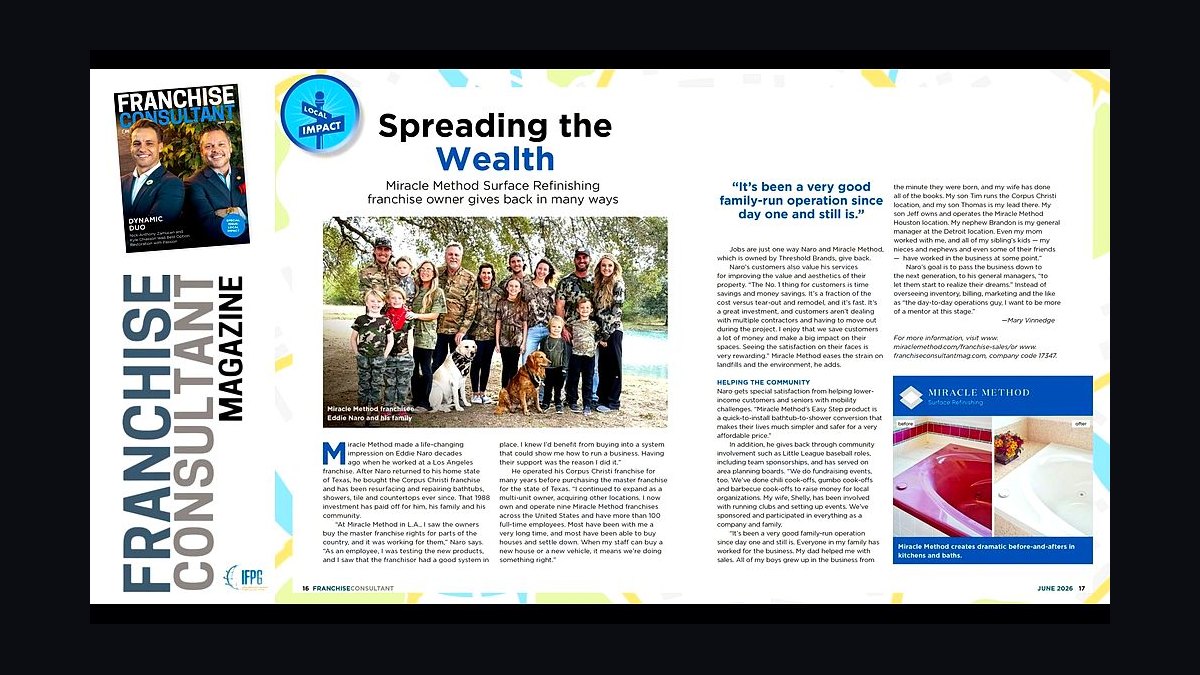
Yes, for a service-and-trade-minded operator: Miracle Method's surface-refinishing model pairs a cost-saving "refinish vs. replace" pitch with recession-resilient residential demand and recurring commercial/hospitality contracts, at $100,000-$200,000 total investment and a $40,000-$50,000 franchise fee. It works best for owners who can recruit and train technicians and build a B2B sales pipeline — it struggles for owners chasing a passive, trade-free business.
A Buyer Weighing the Decision in 2027
Picture a prospective franchisee in early 2027 with roughly $180,000 in liquid capital and a background managing a small trades crew — maybe a painting company or a general contracting outfit. They're comparing three paths: buying an existing home-services franchise, staying independent, or opening a Miracle Method Surface Refinishing territory. The appeal of the refinishing model is immediate: instead of competing on price against national remodeling chains, a Miracle Method operator sells a narrower, cheaper, faster alternative. A homeowner facing a $12,000 bathroom remodel can instead pay a fraction of that for a refinished tub, tile surround, and countertop, done in a day rather than two weeks of demolition. That price gap is the entire commercial argument for the brand.
But this buyer also has to be honest about what kind of business they're actually running. A Miracle Method territory is not a marketing company that subcontracts labor — it's a technical trade business where the owner (or the owner's hires) personally control surface preparation, spray application, and curing quality. A single bad refinish job — bubbling, peeling, or an uneven finish — turns into a callback, a refund, and a bad review that undercuts the brand's "10-year warranty" pitch. So the 2027 buyer's real question isn't just "is refinishing in demand," it's "can I staff, train, and manage technicians well enough to protect the warranty promise that makes this franchise worth its premium over an independent refinisher." That framing — technical execution risk versus market opportunity — is the lens through which every other number in this analysis should be read.

The territory itself matters too. Miracle Method typically grants exclusive rights based on population, commonly 100,000-300,000 residents in suburban markets or defined zip-code clusters in dense metro areas. A buyer evaluating a specific 2027 territory needs to look past national averages and ask about local hotel and apartment density, because commercial refinishing accounts are where the highest-margin, most repeatable revenue tends to concentrate.
How the Refinish-Versus-Replace Mechanism Actually Works
The core economic engine of a Miracle Method franchise is a simple substitution: instead of tearing out and replacing a bathtub, tile wall, or countertop, a trained technician chemically etches and prepares the existing surface, then applies a multi-coat refinishing system that bonds to the original material and cures into a hard, glossy finish. The entire job — prep, spray, cure — is typically completed on-site in a matter of hours to a single day, versus the multi-day demolition-and-installation timeline of a full remodel. That speed is what makes the model viable for occupied hotel rooms, active apartment units, and lived-in homes where a resident can't vacate for two weeks.

Revenue flows from two channels that operate on different rhythms. Residential jobs are one-off, lead-generation-driven, and priced individually — a single tub refinish, a tile surround, a kitchen countertop. Commercial and hospitality jobs are contract-driven and repeatable: a hotel with 150-250 rooms doesn't refinish once, it refinishes on a rolling multi-year cycle as units come up for renovation, and a property management company overseeing dozens of apartment buildings generates ongoing turnover-driven work every time a unit changes tenants. The franchisee who builds relationships with three or four property managers or hotel groups effectively creates a revenue floor that doesn't depend on that week's residential lead flow.
Below is how a mature territory's revenue typically breaks down against its major cost buckets, and why the business becomes more profitable as technician capacity — not sales volume alone — scales up.
The mechanism only compounds when technician capacity grows in step with demand. Add a second and third technician, and the franchisee moves from a single-crew, owner-dependent shop toward a dispatch-and-manage business — the same shift every service franchise depends on to scale past the founder's own labor ceiling.
Real Numbers, Ranges, and Benchmarks

Start with the up-front investment. Per the 2026 Franchise Disclosure Document, the franchise fee runs $40,000-$50,000. Layered on top of that: vehicles and refinishing equipment run $25,000-$60,000; branded vehicle wraps run $4,000-$15,000; home or warehouse setup runs $6,000-$22,000 (most operators run this as a home-based business with a garage or small warehouse for equipment and inventory storage, which keeps fixed overhead low compared to a storefront trade); initial coatings and supply inventory run $8,000-$25,000; initial marketing to prime both residential and B2B lead flow runs $15,000-$40,000; operator and technician training and travel run $10,000-$28,000; and working capital to cover the ramp period runs $15,000-$45,000. Altogether, total Item 7 investment lands at roughly $100,000-$200,000, with $50,000-$90,000 of that needing to be liquid rather than financed. Ongoing fees run approximately 6%-7% of gross revenue as royalty plus roughly 2% of gross as a marketing fee — call it 8%-9% of top-line revenue committed to the franchisor before a dollar of local overhead is paid.
On the revenue side, mature units commonly gross $500,000-$1,800,000 annually, with owner earnings in the $100,000-$400,000 range — a wide band that mostly reflects how aggressively a given franchisee has built commercial accounts versus relying on residential leads alone. Franchisees who invest heavily in a commercial sales pipeline during their first 12-18 months often stabilize revenue at $700,000-$1,200,000 within three years; those leaning on residential work alone more commonly land in the $400,000-$700,000 band over the same window. First-year earnings typically run below the mature-unit range, since building both a residential lead pipeline and commercial relationships takes time — plan on a realistic 12-24 month ramp before the business is running at a representative run-rate.
The cost-saving math that drives demand is stark: a typical bathroom remodel commonly runs $10,000-$25,000, while a comparable Miracle Method tub-and-surround refinish commonly runs $800-$2,500 — roughly a 70%-90% discount. That spread scales dramatically for commercial clients: a hotel refinishing 200 tubs instead of replacing them can plausibly save $150,000-$400,000 on a single property, which is the number that gets a franchisee a seat at the table with a regional hospitality group or property management firm.
On the staffing side, budget $3,000-$6,000 per technician for initial training and certification, with corporate technical training typically running two to three weeks at a training center plus on-site follow-up support. Franchisees who pay a senior technician an extra $5,000-$10,000 a year to serve as an in-house trainer commonly report meaningfully lower turnover and faster ramp times for new hires — an investment that pays for itself quickly given how costly a botched refinish job (callback, refund, reputation damage) is relative to the price of the original job.
Trade-Offs Against Alternatives
Every buyer evaluating Miracle Method should weigh it against three real alternatives, because "surface refinishing" and "franchise" are each choices with their own trade-offs. First, an independent, unbranded refinishing business: lower up-front cost since there's no franchise fee or royalty, and full control over pricing and branding, but no national warranty backing, no proven training system, and the buyer has to build a lead-generation playbook and technician-training curriculum entirely from scratch. Second, a remodel-focused franchise like Bath Planet or Re-Bath: these compete on full bathroom replacement rather than refinishing, which means a higher average ticket per job but a much longer sales cycle, more subcontracted trades to manage (plumbing, tile, carpentry), and no ability to underprice a remodel-averse, budget-conscious customer. Third, another refinishing-specific brand, such as Surface Specialists: a genuinely comparable model, where the decision usually comes down to territory availability, franchise fee structure, and how strong that brand's B2B account-development support is in a given region.
The diagram below lays out how a franchisee's earnings realistically split depending on how the business is run, and where the token decision point sits — B2B account development versus residential-only reliance.
The trade-off in plain terms: refinishing over remodeling buys speed, a lower price point, and recession resilience, at the cost of a smaller average ticket per job and a dependence on technician quality that a pure sales-and-subcontract model doesn't carry. Franchise over independent buys training, brand recognition, a warranty customers trust, and (often) national account leads from hospitality chains, at the cost of the franchise fee and the 8%-9% of gross committed to royalty and marketing fees indefinitely.
Common Pitfalls and How to Avoid Them
The single most commonly reported failure point among Miracle Method-style refinishing franchisees is technician staffing, not sales. The work demands precision — inconsistent surface prep or spray technique produces bubbling, peeling, or uneven sheen, and a customer who gets a bad refinish doesn't just want a redo, they leave a public review that undercuts the brand's warranty pitch to the next customer. Avoid this by recruiting from adjacent trades where spray-application skills transfer directly — painting, drywall finishing, and auto-body refinishing are the most common feeder trades — and by designating an experienced technician as a paid in-house trainer rather than relying solely on the initial corporate training window.
A second common pitfall is underinvesting in commercial account development in year one. It's tempting to lean entirely on residential lead-generation (it's faster to start), but residential-only franchisees consistently land at the lower end of the revenue range because that channel is more seasonal and marketing-cost-intensive per job. The fix is to start cold-calling and visiting hotel general managers and property management firms in month one, not month twelve — expect a 3-6 month sales cycle on these accounts, but a 5-10x lifetime value once signed, since a single property relationship can generate years of repeat refinishing work.
A third pitfall is underbudgeting local marketing. Franchisees who consistently reinvest 10%-15% of revenue into local marketing — on top of the required marketing fee — commonly reach territory saturation within 18-24 months, while those who spend only the minimum required marketing fee often take 36 months or longer to reach the same market penetration. A practical local playbook for 2027 combines three channels: Google Local Services Ads for residential leads (commonly $1,500-$3,500/month in most markets), direct commercial outreach to property managers and hotel ownership groups, and a referral program that pays $50-$100 per referral to past customers and trade partners like plumbers, contractors, and real estate agents.
Finally, don't underestimate territory and competitive dynamics. Local independent refinishers often undercut on price but can't match the franchise's warranty or training pedigree; national remodel-focused competitors compete on a different value proposition entirely (full replacement rather than refinishing). Validate the specific territory's hotel, apartment, and homeowner density before committing capital, and interview multiple existing operators — not just the one the franchisor introduces — about real net profit, technician turnover, and how long it actually took them to build a sustainable commercial pipeline.
Related questions
How long does it take a Miracle Method franchise to become profitable?
Most franchisees need 12-24 months to ramp past a break-even run-rate, since building both a residential lead pipeline and commercial account relationships takes time; commercial contracts especially can take 3-6 months to close from first contact.
Can I run a Miracle Method franchise without doing the refinishing work myself?
Yes, if you hire and train technicians and manage the business as an owner-operator rather than a hands-on refinisher, but you still need enough technical fluency to supervise quality, since a bad refinish directly damages the brand's warranty reputation.
Is Miracle Method better than an independent refinishing business?

The franchise costs more up front and carries ongoing royalty and marketing fees, but it provides brand recognition, a warranty customers trust, a proven training system, and sometimes national commercial account leads — trade-offs an independent operator has to build alone.
What's the biggest cost outside the franchise fee?
Vehicles and refinishing equipment ($25,000-$60,000) and initial marketing ($15,000-$40,000) are typically the largest line items after the $40,000-$50,000 franchise fee itself.
FAQ
What is the total investment range for a Miracle Method franchise in 2027? Total investment typically falls between $100,000 and $200,000, including the $40,000-$50,000 franchise fee. This covers vehicles and equipment, initial inventory, training, marketing, and working capital, though actual costs vary by territory size and whether you lease or build out a workspace.
How much can a franchise owner realistically earn? Mature units often gross $500,000-$1,800,000 annually, with owner earnings in the $100,000-$400,000 range. First-year earnings usually run below that band while the operator builds residential and commercial clientele, so expect a 12-24 month ramp-up.

Is the business really recession-resistant, and why? Yes — refinishing a surface commonly costs 70%-90% less than full replacement, which is precisely the kind of cost-saving repair that homeowners and commercial property managers prioritize when budgets tighten, sustaining demand even in downturns.
What are the biggest challenges owners face? Recruiting and retaining skilled refinishing technicians is the most commonly reported hurdle, since the work requires specialized training and quality control. Generating consistent residential and commercial leads is the second major challenge, especially in markets with active independent competitors.
Can I run this franchise from home, or do I need a storefront? Many owners operate from a home office with a garage or small warehouse for equipment and coatings storage, keeping fixed overhead low. Some territories may still require commercial space for client meetings or larger inventory, so check local zoning and franchise requirements before committing.
How does the franchisor support new owners with training and leads? Initial training covers refinishing technique, business operations, and sales, typically over two to three weeks at a training center plus on-site follow-up. Ongoing support includes marketing materials and, in some cases, national account leads from hospitality and property-management chains, though local lead generation remains primarily the franchisee's responsibility.
Sources
- https://www.miraclemethod.com
- https://www.entrepreneur.com/franchises/directory
- https://www.ibisworld.com
- https://www.statista.com
- https://www.franchisebusinessreview.com
- https://www.franchise.org
- https://www.ftc.gov/business-guidance/resources/franchise-disclosure-document-fdd
- https://www.census.gov
Related on PULSE
- Should I open or buy a Surface Specialists franchise in 2027?
- Should I open or buy an N-Hance Wood Refinishing franchise in 2027?
- Should I open or buy a Bath Planet franchise in 2027?
- Should I open or buy a Re-Bath franchise in 2027?
- Should I open or buy a The Bar Method franchise in 2027?
This page will be disappearing soon. Save it to your device for $1 — or read it free while it is here.
@Kory-White- · if Venmo asks, the last 4 of my number are 2012
This page is gone.
This one is off the shelf now. $1 keeps it on your phone for good — the whole page, pictures and diagrams included.
 franchiseShould I open or buy a Cold Stone Creamery franchise in 2027?
 franchiseShould I open or buy a Bojangles franchise in 2027?
 franchiseShould I open or buy a Big O Tires franchise in 2027?
 franchiseShould I open or buy a Jamba franchise in 2027?
 franchiseShould I open or buy a Panera Bread franchise in 2027?
 franchiseShould I open or buy a Great Clips franchise in 2027?
 franchiseShould I open or buy a Bruster's Real Ice Cream franchise in 2027?
 franchiseShould I open or buy a Crumbl Cookies franchise in 2027?
 franchiseShould I open or buy a Roto-Rooter franchise in 2027?
 franchiseShould I open or buy a Jimmy John's franchise in 2027?