


Should I open or buy a Window Hero franchise in 2027?
Quality
Certified
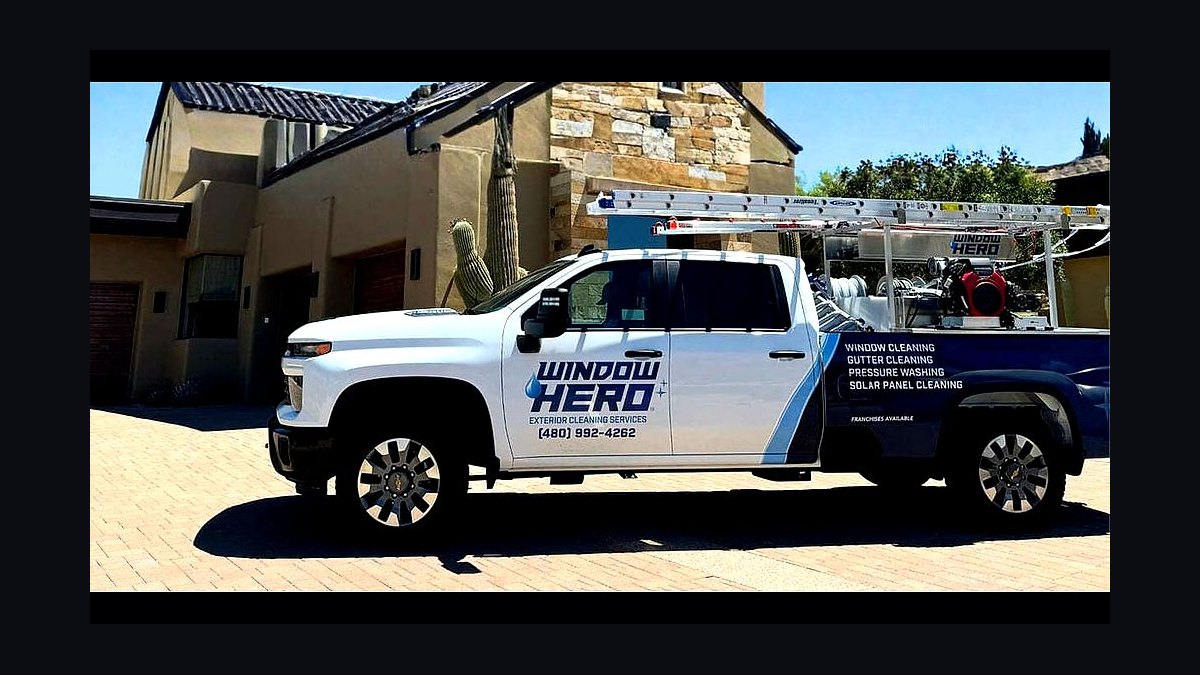
Yes, if you're a service-and-management-minded operator who wants a low-capital, recurring exterior-cleaning franchise: Window Hero combines window cleaning, pressure/soft washing, and gutter service under one recurring-revenue model. Expect a total investment of roughly $80,000-$180,000, mature units grossing $500,000-$1,500,000+, and owner earnings of $100,000-$350,000 — contingent on crew retention, lead generation, and building recurring contracts.
What it is and why it matters
Window Hero franchises exterior-cleaning operations that combine window cleaning, pressure washing, soft washing, and gutter clearing into a single recurring-service brand. Unlike a storefront concept, this is a truck-and-crew business you can run from a home office or small warehouse — no retail lease, no walk-in customers to manage, no inventory shelf-life to worry about. That structural simplicity is the entire reason the franchise fee and total investment sit lower than most home-service categories: you're capitalizing vehicles, ladders, pressure washers, and a marketing launch, not a build-out.
The "why it matters" question comes down to what kind of operator actually thrives here. Window Hero is not a passive investment — it's a route-density business where your job in year one is recruiting and training crews, and your job by year two is generating enough recurring commercial and residential contracts that trucks stay booked without daily hustling. If you like managing people, building repeatable systems, and selling recurring service agreements, the model rewards you directly: every signed maintenance contract compounds into next year's baseline revenue. If you're looking for a business you can staff once and walk away from, this isn't it — technician turnover in exterior-cleaning franchises commonly exceeds 50% annually, which means staffing is a permanent, not a startup-phase, responsibility.
Franchisors like Window Hero sell a playbook: territory rights, initial training, a supplier list for chemicals and equipment, and a brand that generates inbound leads faster than an independent operator could alone. What they don't sell you is the discipline to run the operation — that's still entirely on the owner. Anyone evaluating whether to open a location in 2027 should treat the brand as infrastructure, not a guarantee of profitability.
The step-by-step process
The path from signing to a fully operational Window Hero franchise runs through a fairly standard home-service launch sequence, compressed into roughly 100-120 days if you move without delay.

The earliest phase is the most commonly rushed, and it's the one that determines everything downstream. Reading the FDD closely — particularly Item 19 (financial performance representations) and Item 20 (franchisee turnover and outlet counts) — tells you whether the unit economics you're being pitched actually hold up across the existing franchise base, or whether a handful of top performers are skewing the average. Item 20 in particular flags territories where franchisees have closed or transferred ownership, which is often a better signal than the sales conversation.
Calling existing operators matters more than any document. Ask specifically about crew retention, how long it took to hit breakeven, how seasonality hit their specific climate, and whether their territory has been split or encroached on since they opened. Franchisors will connect you with a curated list of references; ask for a few names outside that list if the sales team allows it, since self-selected references skew positive.
Once territory and market are validated, capital deployment moves fast — trucks, wraps, pressure-washing rigs, chemical inventory, and your first hires all happen in a tight six-week window. The soft launch phase is where recurring-contract sales begin in earnest: door-to-door and digital lead generation for residential customers, paired with outreach to property managers and HOAs for commercial accounts that provide steadier, less seasonal revenue.
Costs, timelines, and typical ranges

Based on 2026 FDD disclosures, the investment structure for a Window Hero franchise breaks down into a handful of predictable buckets. The franchise fee itself runs $40,000-$50,000. Vehicles and equipment — trucks, pressure/soft-washing rigs, ladders, and safety gear — typically run $20,000-$55,000 depending on how many crews you're equipping at launch. Vehicle branding and wraps add another $4,000-$15,000. Because the business is home- or warehouse-based rather than storefront-based, buildout costs are modest: $5,000-$20,000 for a small warehouse or garage setup.
Initial inventory (chemicals, supplies, consumables) runs $5,000-$15,000, while initial marketing — critical for a brand-new territory with no existing customer base — typically requires $12,000-$35,000. Training and travel for the owner and early crew members adds $6,000-$20,000, and working capital to cover the ramp period before recurring revenue stabilizes should be budgeted at $12,000-$35,000. All told, total Item 7 investment lands at roughly $80,000-$180,000, with ongoing royalties near 6%-8% of gross revenue and a marketing fee around 2%.

On the revenue side, mature units report gross revenue between $500,000 and $1,500,000+, with owner earnings landing between $100,000 and $350,000 depending on route density, commercial mix, and crew efficiency. That's a meaningfully high ceiling relative to the entry capital, which is the core financial argument for the model — but "mature" is doing a lot of work in that sentence. Getting from a $0 launch to a mature, multi-crew route typically takes 18-36 months, and the first year commonly runs at breakeven or a loss while recurring contracts build.
Timelines to watch: 100-120 days from signing to soft launch, 6-12 months to build a defensible base of recurring residential contracts, and 12-24 months to land enough commercial accounts (property managers, HOAs, retail chains) that revenue stops swinging hard with the seasons. Budget an additional $20,000-$30,000 in reserve beyond the initial investment if you're opening in a seasonal climate, since winter months in northern markets can see revenue drop 40-60% without commercial contracts to smooth the gap.
Where teams get it wrong
The single most common failure mode is underestimating staffing as a one-time hiring problem instead of a permanent operational discipline. Exterior-cleaning franchises see turnover rates that regularly exceed 50% annually, and owners who don't build a continuous recruiting pipeline — trade schools, community college job boards, employee referrals — end up personally covering shifts, which caps growth and burns out the owner within the first year.

A second recurring mistake is treating the franchise territory map as a guarantee rather than a negotiating document. Territories are typically drawn around population bands of 50,000-100,000 residents, but enforcement varies: some franchisors permit neighboring owners to service commercial accounts that cross zip-code boundaries if approved centrally, and rapid brand expansion in fast-growing metro areas has led to territory splits for early franchisees within three to five years. Buyers who don't get encroachment language, a written territory map, and — ideally — a right of first refusal on adjacent territory in writing before signing often find their protected area shrinking exactly as their route density starts paying off.
Third, operators frequently underprepare for seasonality in cold-and-wet climates. Treating a Window Hero franchise like a business that runs at a flat monthly pace, rather than one that needs commercial contract stacking, prepaid annual maintenance plans, or supplemental winter services (gutter clearing, holiday lighting, where permitted) to smooth cash flow, leads to a cash crunch every Q4-Q1 that repeats indefinitely instead of getting solved once.
Fourth is under-investing in lead generation after the initial marketing push fades. Recurring revenue is the whole value proposition, but recurring contracts don't self-generate — they require ongoing local marketing spend and a sales process for converting one-time cleanings into standing maintenance agreements. Franchisees who stop marketing once they hit initial capacity plateau instead of compounding.
Decision framework: when to choose what

The decision to open a Window Hero franchise versus an alternative path comes down to three variables: your appetite for people-management, your local climate's seasonality profile, and how much you value brand-provided systems versus full independent control.
If crew management is a dealbreaker for you — if the idea of recruiting, training, and retaining a rotating bench of technicians sounds exhausting rather than energizing — no exterior-cleaning franchise concept will fix that, because the labor model is identical across the category. That's a hard stop regardless of brand.
If you can manage crews but your market has a genuinely harsh winter with no commercial-contract base to fall back on, the right move is often to delay opening until you've lined up anchor commercial accounts (property managers, school districts, retail chains) that can carry revenue through the slow months, rather than launching and discovering the cash gap in real time.

For operators who clear both filters, the remaining choice is brand versus independence. Window Hero and comparable concepts (Shack Shine, Window Genie, Men In Kilts, Fish Window Cleaning) sell you training, supplier relationships, marketing systems, and — critically — a defined territory, in exchange for the franchise fee and ongoing royalty. Going independent skips the fees entirely but means building every system, every marketing channel, and every operational playbook from scratch, with no territory protection against a competitor opening next door. For most first-time exterior-cleaning operators, the franchise route is the faster path to a working recurring-revenue engine; the independent route rewards those who already have local marketing and operations experience and want to keep 100% of the margin.
Related questions
How much does it cost to open a Window Hero franchise? Total initial investment runs roughly $80,000-$180,000, including a $40,000-$50,000 franchise fee, vehicles and equipment, initial marketing, and working capital reserves.
What's the difference between Window Hero and Window Genie? Both are exterior-cleaning franchise concepts with recurring-service models; specifics on fee structure, territory size, and service mix should be compared FDD-to-FDD before deciding between them.
Is exterior cleaning a seasonal business? Yes, in northern climates revenue can drop 40-60% in winter months; operators offset this with commercial contracts, prepaid maintenance plans, and permitted winter add-on services.
Can I run a Window Hero franchise without hiring crews myself? Technically yes if you hire a manager, but most owner-operators are directly involved in recruiting and retaining technicians, especially in the first 12-18 months.
FAQ
What is the total investment needed to open a Window Hero franchise? The total initial investment typically ranges from $80,000 to $180,000, including the franchise fee of $40,000-$50,000. This covers vehicles, equipment, initial marketing, and working capital, making it a lower-cost entry compared to many home-service franchises.
How much can a Window Hero franchise owner expect to earn? Mature units often report gross revenues between $500,000 and $1,500,000 annually, with owner earnings in the range of $100,000 to $350,000. Actual results vary significantly based on location, market demand, commercial-account mix, and operational efficiency.
What services does a Window Hero franchise offer?
The business provides window cleaning, pressure washing, soft washing, gutter cleaning, and other exterior-surface cleaning for both residential and commercial clients, emphasizing recurring service contracts to build steady, compounding revenue.
Is seasonality a major challenge for this franchise? Yes, in many regions demand and revenue dip sharply in cold or wet months. Operators manage this by building commercial contracts, offering prepaid annual maintenance plans, and adding permitted winter services like gutter clearing.
What are the biggest operational challenges of opening a Window Hero franchise? Finding and retaining reliable crew members is the most persistent hurdle, given turnover rates that regularly exceed 50% annually in exterior-cleaning franchises. Generating consistent leads and defending territory density are the other two ongoing challenges.
How does Window Hero compare to going independent? The franchise trades a fee and ongoing royalty for training, supplier relationships, marketing systems, and protected territory. Going independent keeps more margin but requires building every operational system and local marketing channel from scratch, with no territory protection.
Sources
- Entrepreneur Franchise Directory — https://www.entrepreneur.com/franchises
- International Franchise Association — https://www.franchise.org
- U.S. Small Business Administration, Franchise Financing — https://www.sba.gov
- IBISWorld Industry Reports — https://www.ibisworld.com
- Statista, Home Services Market Research — https://www.statista.com
- Franchise Business Review — https://franchisebusinessreview.com
- U.S. Census Bureau, Housing and Household Economic Statistics — https://www.census.gov
- U.S. Bureau of Labor Statistics, Occupational Employment Data — https://www.bls.gov
- FTC Franchise Rule / Franchise Disclosure Document Guidance — https://www.ftc.gov
- Federal Trade Commission Consumer Guide to Buying a Franchise — https://consumer.ftc.gov
Related on PULSE
- Best window and gutter-cleaning franchises to buy in 2027
- Should I open or buy a Shine Window Care franchise in 2027?
- Should I open or buy a Fish Window Cleaning franchise in 2027?
- Should I open a window tinting business in 2027?
- Should I open a window cleaning business in 2027?
- Should I open or buy a Window World franchise in 2027?
This page will be disappearing soon. Save it to your device for $1 — or read it free while it is here.
@Kory-White- · if Venmo asks, the last 4 of my number are 2012
This page is gone.
This one is off the shelf now. $1 keeps it on your phone for good — the whole page, pictures and diagrams included.
 franchiseShould I open or buy a Kona Ice franchise in 2027?
 franchiseShould I open or buy a Meineke franchise in 2027?
 franchiseShould I open or buy a Chipotle franchise in 2027?
 franchiseShould I open or buy a Domino's franchise in 2027?
 franchiseShould I open or buy an Ace Hardware franchise in 2027?
 franchiseShould I open or buy a McAlister's Deli franchise in 2027?
 franchiseShould I open or buy a Primrose Schools franchise in 2027?
 franchiseShould I open or buy an Anytime Fitness franchise in 2027?
 franchiseShould I open or buy a Bahama Breeze franchise in 2027?
 franchiseShould I open or buy a Dunkin' franchise in 2027?