


Court-Reporting Services GTM Playbook 2027 — AmLaw MSA + AI-Augmented Transcription and the 85M Veritext Operator Path
Quality
Certified
The court-reporting services GTM playbook for 2027 is to win AmLaw and corporate-legal master services agreements (MSAs) by pairing a national certified-reporter network (CSR / RPR / CRR credentials, plus digital/electronic reporters and voice writers) with AI-augmented transcription and remote-deposition technology. The motion that separates national winners from local agencies is six-channel revenue stacking:
- Deposition reporting + transcript production — the core engine.
- Remote depositions over Zoom, Webex, Teams, or a proprietary platform.
- Legal videography + synchronized video for trial-ready testimony.
- AI-augmented transcription (Verbit, Rev, Otter, plus human review) to absorb capacity the reporter shortage can't.
- Real-time CART, closed captioning, and ASL interpretation for ADA-mandated proceedings.
- Agency network management + reporter-scheduling SaaS as a recurring-revenue layer.
The buyers are litigation paralegals, trial attorneys, legal-operations leaders, and legal procurement inside AmLaw 100/200 firms and Fortune 1000 in-house legal departments. The deal you are building toward is a multi-year MSA with a locked rate card and volume commitments, not ad-hoc reporter bookings.
> A note on the numbers in this playbook. Court reporting is a fragmented, privately held services market. There is no single authoritative public figure for total US market size, individual agency revenue, or the exact size of the reporter shortage — most leaders (Veritext, U.S. Legal Support, Esquire, Planet Depos, Magna, Lexitas) are private and do not disclose financials. Every dollar figure, margin, page rate, and channel-mix percentage below is an illustrative planning model for sizing your own GTM, not a vendor-reported statistic. Validate page rates and reporter fees against live quotes in your delivery states before you commit a rate card. The structural claims — the buyer personas, the credential market, the vendor stack, and the shift to remote — are grounded in the public sources listed at the end.
1Market Context and 2027 Demand Drivers
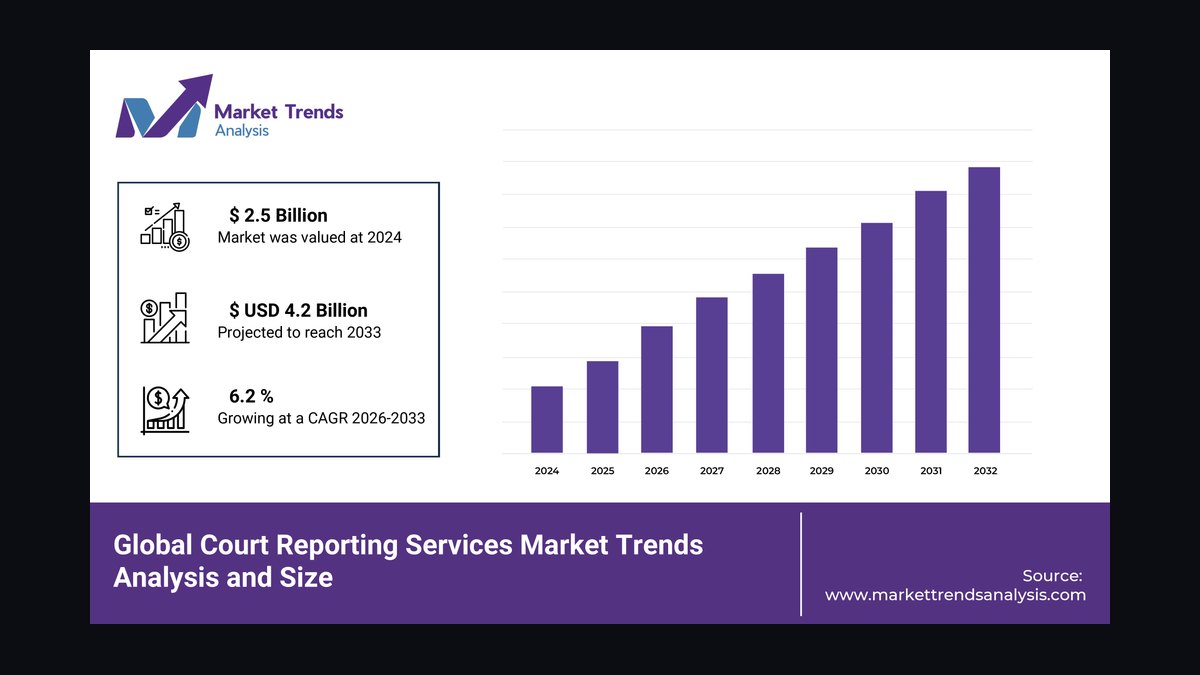
Court reporting is a large, fragmented, privately held services market with no single authoritative public revenue figure. The clearest public anchor is the U.S. Bureau of Labor Statistics, which tracks "Court Reporters and Simultaneous Captioners" as an occupation, publishes median pay and an employment outlook, and consistently describes a market where demand is steady-to-growing while the credentialed stenographic workforce is aging. Treat any "$X billion market" claim — including ones you'll see from vendors — as a modeled estimate, not a measured fact, and size your own opportunity bottom-up from the accounts and reporter capacity you can actually win.
Four structural drivers shape the 2027 GTM:
Reporter shortage and AI substitution. The credentialed stenographic workforce is retiring faster than schools graduate replacements — a long-running concern documented by NCRA and a core reason AAERT has grown the digital/electronic reporting profession. This is the single biggest reason AI-augmented transcription (ASR plus human review) has moved from experiment to capacity strategy: agencies use it to take work they otherwise couldn't staff. Quantify the shortage in your own region from job-board openings and reporter-availability data rather than repeating a national headline number.

Remote-deposition normalization. Remote and hybrid depositions went from rare to routine after 2020 and have not reverted. National agencies now compete substantially on platform quality — exhibit handling, video sync, witness onboarding — not just reporter availability. An agency without a credible remote workflow is structurally disadvantaged on multi-jurisdiction matters.
PE-backed consolidation. The top national agencies have grown largely by acquiring regional firms, a pattern visible in legal-industry trade coverage and in the named private-equity ownership of the majors. The practical implication: AmLaw procurement increasingly consolidates spend toward a handful of national MSAs, which raises the bar for new entrants but also makes a well-run regional roll-up an attractive build.
Video and accessibility demand. Synchronized video deposition and ADA-driven real-time CART/captioning are growing specialty lines that carry premium rates and differentiate an agency from commodity per-page reporting.

Buyer profile (illustrative split): litigation paralegals (largest share of day-to-day vendor selection), trial attorneys, legal-operations, and procurement. Plan for an MSA sales cycle measured in weeks to a few months and validate ACV against the actual deposition volume of the firms in your pipeline.
2Six-Channel Revenue Stack and Illustrative Pricing
The page rates, fees, and margins below are planning-model ranges, not published survey data. Per-page deposition pricing in particular varies widely by jurisdiction, turnaround, and whether the work is original-plus-copies or daily/realtime. Confirm against live quotes before printing a rate card.
Channel 1 — Deposition reporting + transcript production (largest share of revenue). The core engine: an original transcript per-page rate plus a reporter appearance/per-diem fee. Expedited and daily-copy turnarounds command meaningful per-page premiums; real-time hookup adds an hourly premium on top.

Channel 2 — Remote depositions. A platform-setup and scheduling fee plus hosting, layered on the reporter fee. Multi-party, multi-time-zone matters and international-witness concierge logistics carry the highest premiums.
Channel 3 — Legal videography + synchronized video. A per-hour videographer rate plus per-finished-minute output in a court-admissible, synced format. Multi-camera and trial-clip preparation are add-on lines.
Channel 4 — AI-augmented transcription. Per-audio-minute pricing with human review. The strategic value is capacity and turnaround, not just cost: it lets you accept overflow work the reporter network can't cover, typically at strong gross margin, while you protect quality with reporter/scopist review.

Channel 5 — Real-time CART, captioning, and ASL. Per-hour reporter or interpreter rates for ADA-mandated proceedings and accessibility-required events; combined CART-plus-ASL coverage is a premium bundle.
Channel 6 — Network management + scheduling SaaS. A recurring layer: scheduling, transcript repository, and a client portal sold to smaller agencies, plus transcript-repository/e-discovery integration and a white-label platform for boutique firms.
3Vendor and Technology Stack (2027)
These are real, named vendors in the court-reporting and legal-tech ecosystem. Capabilities are described qualitatively; no revenue or ARR figures are asserted, because none are reliably public.

CAT software and steno hardware: Stenograph (CaseCATalyst software; Diamante and Luminex writers) and Advantage Software (Eclipse) are the two dominant computer-aided-transcription platforms. Supporting both broadens the reporter network you can recruit from.
Remote deposition and video platforms: Veritext and U.S. Legal Support operate proprietary remote-deposition environments; general-purpose platforms include Zoom, Cisco Webex, and Microsoft Teams. Exhibit handling and video sync are the real differentiators.

AI transcription: Verbit, Rev, Otter.ai, Trint, Sonix, and Descript, plus general-purpose LLM APIs (e.g., Anthropic Claude, OpenAI) for custom post-editing and review workflows. Use AI for capacity and speed; keep humans in the loop on certification and accuracy.
e-Discovery and litigation support adjacency: Relativity, Everlaw, Reveal, and Disco are common downstream systems; transcript-repository integration here is a stickiness lever for in-house legal teams.
Industry bodies / credentials: NCRA (RPR, RMR, CRR, RDR), state certifications (e.g., California CSR), and AAERT for digital/electronic reporters and transcribers. Membership and credentialing are table stakes for legal-industry credibility.

4The 30/60/90-Day GTM Launch Plan
Days 1–30 — Reporter network foundation. Recruit a founding network of certified stenographic, digital, and voice-writing reporters concentrated in your primary AmLaw-office states (e.g., CA, NY, TX, FL, IL, GA, PA, NJ). Stand up CAT and scheduling tooling supporting both Stenograph and Eclipse, plus a remote-deposition workflow and at least one AI-transcription partner. Join NCRA and AAERT and obtain state certifications. Publish a clean six-channel service catalog and rate card.
Days 31–60 — Pipeline build. Run outbound to litigation paralegals, trial attorneys, legal-operations, and procurement at target AmLaw and Fortune 1000 legal departments. Sign a small number of pilot engagements as a foot in the door ahead of MSA conversations. Begin SOC 2 and data-security work and confirm state reporter-licensing coverage in your delivery states — procurement will ask. Launch credibility content: TCO comparisons, remote-deposition playbooks, accuracy/quality methodology.
Days 61–90 — First MSA in motion. Convert pilots into your first AmLaw or corporate MSA negotiation (multi-year, rate card, volume commitments). Bring the AI-augmented hybrid practice live as a visible differentiator versus stenographic-only incumbents. Stand up customer success for MSA expansion, and build 2–4 reference case studies with measured outcomes (turnaround improvement, quality, satisfaction) — using metrics you can actually substantiate, with named logos only where you have permission.

5The National-Agency Operator Path
The national leaders — Veritext, U.S. Legal Support, Esquire Deposition Solutions, Planet Depos, Magna Legal Services, and Lexitas — are private and do not publish financials, so treat any specific revenue, office count, or "X% of AmLaw" share you see as unverified. What *is* observable from public ownership records, company sites, and legal-trade coverage is the strategic pattern these operators share. Mirror the pattern, not invented numbers:
- Sell through MSAs, not bookings. National agencies anchor on multi-year master services agreements with AmLaw and large in-house legal departments, which produces predictable, expanding revenue versus ad-hoc reporter requests.
- Build national geographic density. Multi-jurisdiction litigation requires coverage a single-market agency can't provide; density is the moat against regional competitors.
- Grow by acquisition. The majors are PE-backed and have rolled up regional firms to add reporters, geography, and book of business — a playbook a well-capitalized regional can also run.
- Own the remote experience. Proprietary or deeply integrated remote-deposition technology creates a pricing premium and switching costs versus a generic video call.
- Adopt AI-augmented hybrid transcription. Pairing ASR with reporter/scopist review expands capacity into the shortage and improves turnaround without abandoning certified-quality output.
- Manage the reporter network as the product. Scheduling, retention, and CAT integration determine service consistency — which is what actually retains AmLaw clients.
6Failure Modes and Common GTM Mistakes
- Local-only coverage chasing national MSAs. A single-market network can't win multi-jurisdiction firms. *Fix:* build coverage across your primary AmLaw-concentration states before pitching national accounts.
- Under-investing in AI-augmented capacity. The reporter shortage caps growth without it. *Fix:* stand up a hybrid AI-plus-human practice early and keep certified review in the loop.
- No real remote-deposition workflow. Remote/hybrid is now routine. *Fix:* build or integrate a credible platform with strong exhibit and video-sync handling.
- Pure commodity per-page reporting. Skipping videography and real-time/CART leaves premium revenue on the table. *Fix:* add at least one specialty line as you scale.
- Racing to the bottom on page rate. Underpricing signals commodity and destroys margin. *Fix:* set a defensible floor and price MSAs on total value, not lowest per-page.
- Ignoring security and licensing. Missing SOC 2 or state reporter licensing blocks procurement. *Fix:* start compliance and credentialing on day one.
- Single-CAT lock-in. Supporting only Stenograph or only Eclipse shrinks your recruitable reporter pool. *Fix:* support both.

Frequently Asked Questions
Q: What revenue scale does a court-reporting agency need to be cashflow positive? There's no public benchmark, but the structural answer holds: you're cashflow positive once recurring deposition volume covers loaded delivery cost (reporter pay, scoping/proofing, scheduling, software) plus fixed overhead (coordinators, sales, admin). Below that, the founder is personally selling and delivering. Build the model bottom-up from your real per-page margin and active-account count rather than chasing a headline revenue number.
Q: Is AI transcription replacing certified court reporters? Not in the official-record sense. In most US jurisdictions, depositions and many proceedings still require a certified reporter (stenographic or, where permitted, certified digital/electronic) to certify the transcript. AI/ASR is used to expand capacity and speed turnaround, with human reporters and scopists reviewing for accuracy and certification. The realistic 2027 posture is augmentation, not replacement — which is also how the shortage gets absorbed.
Q: Why do the national agencies win AmLaw business? Coverage and consistency. AmLaw litigation spans jurisdictions, so firms favor agencies that can staff a reporter and videographer anywhere on short notice, deliver a consistent remote experience, and sign a single MSA with a predictable rate card. That's a geography-and-operations advantage more than a technology one.

Q: What credentials should my reporter network hold? For stenographic reporters: NCRA's RPR (and RMR/CRR for realtime), plus any required state certification such as California's CSR. For digital/electronic reporting where permitted, AAERT certifications (CER/CET). Verify the specific licensing rules for each state you deliver in — requirements differ materially by jurisdiction.
Q: How should I price AI-augmented work versus traditional reporting? Price on outcome and certification level, not on the fact that AI touched the file. A reasonable model: hold certified-record pricing roughly in line with traditional reporting (the value is the certified transcript and turnaround), and use AI to improve your margin and capacity rather than to discount yourself into commodity territory. Where you sell purely non-certified rough/draft transcription, price per audio minute competitively against the AI-native vendors.
Q: Where do remote depositions create the most margin? In coordination complexity, not the base call. Multi-party, multi-time-zone, international-witness, and exhibit-heavy depositions are where a polished platform plus concierge logistics justify premium setup and hosting fees. Commodity single-party remote depositions compress toward the price of the underlying video tool, so differentiate on the hard logistics.
Sources
- U.S. Bureau of Labor Statistics — Occupational Outlook Handbook: Court Reporters and Simultaneous Captioners. Median pay, employment outlook, and job-duties baseline for the occupation. https://www.bls.gov/ooh/legal/court-reporters.htm
- National Court Reporters Association (NCRA). Certifications (RPR, RMR, CRR, RDR), profession resources, and ongoing coverage of the reporter-shortage issue. https://www.ncra.org
- American Association of Electronic Reporters and Transcribers (AAERT). Digital/electronic reporter and transcriber certification (CER, CET, CDR). https://aaert.org
- Veritext Legal Solutions. Service lines, remote-deposition platform, and national coverage model. https://www.veritext.com
- Stenograph. CaseCATalyst CAT software and steno hardware (Diamante, Luminex). https://www.stenograph.com
- Verbit. AI-augmented legal transcription and captioning. https://verbit.ai
- Registry of Interpreters for the Deaf (RID). ASL interpreter certification relevant to accessibility-mandated proceedings. https://rid.org
Related on PULSE
This page will be disappearing soon. Save it to your device for $1 — or read it free while it is here.
@Kory-White- · if Venmo asks, the last 4 of my number are 2012
This page is gone.
This one is off the shelf now. $1 keeps it on your phone for good — the whole page, pictures and diagrams included.
 gtm-playbookHow do you build a renewable energy trading and ETRM software go-to-market motion in 2027?
 gtm-playbookGTM Playbook for Pharma and Life Sciences — The Complete Operator Guide in 2027
 gtm-playbookGTM Playbook for Tax Attorneys in 2027
 gtm-playbookGTM Playbook for FinTech — The Complete Operator Guide in 2027
 gtm-playbookWhat is the go-to-market playbook for launching an AI product in 2027?
 gtm-playbookWhat is the go-to-market playbook for a partner-led (channel) motion in 2027?
 gtm-playbookGTM Playbook for DJ Services in 2027
 gtm-playbookHow do you build a last-mile delivery software go-to-market motion in 2027?
 gtm-playbookGTM Playbook for Mobile Notary Services in 2027
 gtm-playbookWhat is the go-to-market playbook for developer-led growth in 2027?