


What go-to-market playbook works best for Agriculture in 2027?
Quality
Certified
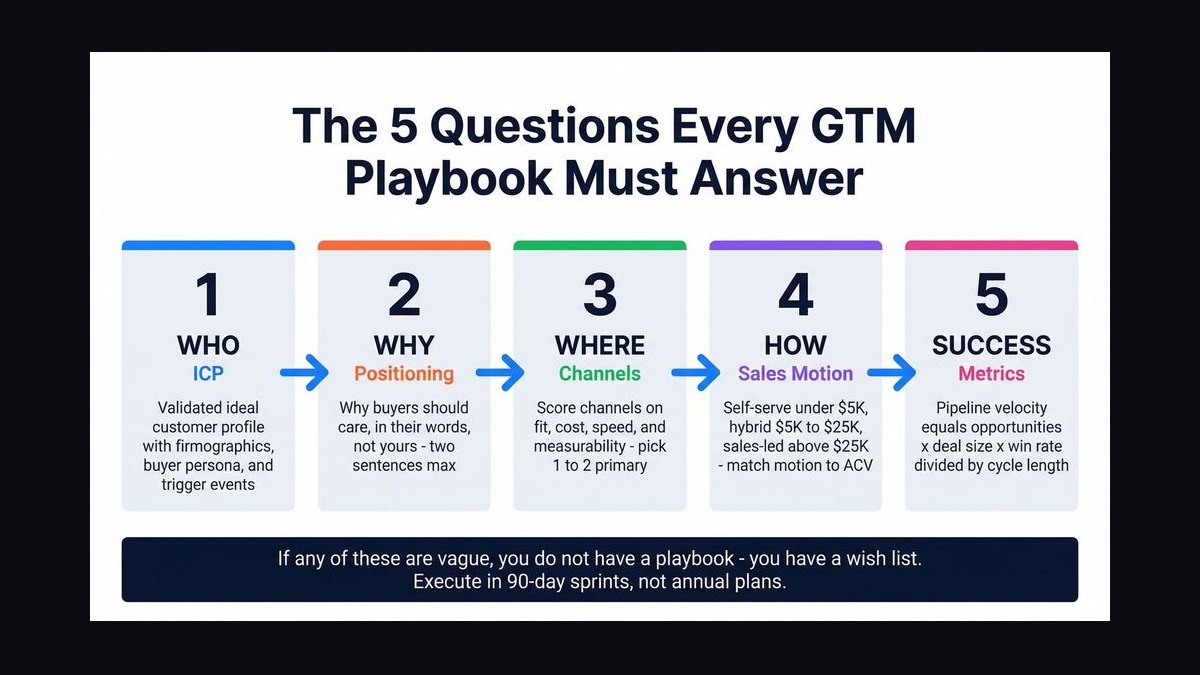
The go-to-market playbook that works best for Agriculture in 2027 is a segment-led, channel-partnered motion: pick one grower or rancher segment by acreage and crop, sell through trusted ag retailers and co-ops rather than direct, price against yield ROI, and tie every quota and comp plan to verified in-season usage. It wins because Agriculture buying is relationship-gated and seasonal, so revenue follows trust and timing, not ad spend.
Segment and ICP first
Agriculture is not one market. It is at least six distinct buying markets stacked on top of each other, and the single most common reason a go-to-market playbook fails in this vertical is that it was built for "farmers" instead of for one specific segment. Before you write a single sequence, build the segment map. The dimensions that actually predict buying behavior are acreage under management, crop or livestock type, ownership structure, and whether the operation buys inputs through a retailer, a co-op, a buying group, or direct.
Start with acreage bands, because they correlate with almost everything else. Operations under 500 acres typically buy inputs at the local retailer counter, decide within days, and are highly price and relationship sensitive. Operations between 500 and 3,000 acres usually have a part-time or full-time agronomist relationship, evaluate on a per-acre basis, and will trial a new product on a strip or two before committing. Operations above 3,000 acres, and especially multi-thousand-acre row crop businesses, run formal procurement, negotiate volume contracts, and often have a CFO or controller who will demand a payback calculation. Enterprise-scale operations and agribusinesses with multiple locations behave like industrial buyers and need a named account team.
Crop type changes the calendar, and the calendar changes everything. Row crop corn and soy operations in the Midwest make most input decisions between November and March, with a second window in-season. Specialty crops, tree nuts, and permanent crops have multi-year planting cycles and much longer evaluation periods. Livestock and dairy buyers care about feed conversion, herd health, and milk or gain per head, and their purchasing rhythm follows herd cycles rather than planting. If your playbook assumes one universal buying season, you will miss the majority of your addressable market.

Ownership structure matters more than most vendors expect. Family operations often have a single decision maker who is also the operator, which means your sales motion must be low-friction and fast. Operations with a board, multiple partners, or outside investors require consensus building and documented ROI. Cooperatives and buying groups introduce a committee dynamic where a single champion is not enough.
Write your ICP as a one-page document with four hard filters: acreage band, crop or species, purchase channel, and decision unit. Then add disqualifiers. A playbook that says "we sell to Agriculture" is not a playbook. A playbook that says "we sell to 1,000 to 5,000 acre corn and soy operations in the upper Midwest that buy through a full-service retailer and have a named agronomist" is a playbook you can actually staff, quota, and measure.
The output of this step is not a persona slide. It is a target account list, a channel map, and a seasonal calendar. If you cannot produce all three, you are not ready to build the motion.
The motion that fits that segment
Once the segment is defined, the motion follows almost mechanically. Agriculture in 2027 rewards a partner-led, in-season-verified motion over a direct digital one, for three structural reasons. First, the retailer or co-op already holds the trust and the credit relationship. Second, the agronomist is the de facto technical gatekeeper for anything applied to a field. Third, the buying window is short and concentrated, so speed of availability at the point of recommendation beats brand awareness built over months.

The practical shape is a three-tier channel motion. Tier one is the distributor or manufacturer relationship that gives you shelf presence and logistics. Tier two is the retail location, co-op, or independent ag retailer that owns the grower relationship. Tier three is the grower or rancher themselves, who must be reached with demand-generation so they ask for your product by name at the counter. Skip tier three and you are entirely dependent on the retailer's push. Skip tier two and you have no route to the field.
Demand generation at tier three in Agriculture looks different from SaaS. It is field days, plot tours, agronomy meetings, county fair presence, grower association sponsorships, trade press, and increasingly short-form video from trusted local agronomists. Digital works, but it works as amplification of a local trusted voice, not as a standalone acquisition channel. A paid campaign with no local agronomist attached converts poorly; the same message delivered by a respected local agronomist converts well.
The sales motion itself is a two-call-plus-trial pattern in most segments. Call one is a scouting and diagnostic conversation, ideally in the field or at the retailer. Call two is a strip trial or demonstration commitment on a defined number of acres. The trial is the real close. In Agriculture, a successful strip trial on 40 to 80 acres is worth more than any deck, because the grower trusts their own yield monitor more than your case study.

Service and support are part of the motion, not an afterthought. Because the product is applied to a living system with weather, pest pressure, and soil variability, the post-sale experience determines renewal. Build a defined in-season check-in cadence with the retailer and the grower, and make the agronomist's job easier by giving them application guidance, timing windows, and a simple way to report results back to you.
The loop matters. Agriculture revenue compounds through acres and seasons, not through one-time transactions. A grower who had a good result on 60 acres this year is your best candidate for 600 acres next year, and the retailer who facilitated it is your best candidate for a broader portfolio conversation. Design the motion so that every closed season feeds the next one with data and references.
Unit economics and benchmarks
Agriculture unit economics are unforgiving because the sales cycle is long, the buying window is short, and the channel takes a margin. Model this before you hire. The numbers below are planning ranges to sanity-check your own model, not published industry figures — validate them against your own pilot data before you commit quota.
Start with gross margin. If you sell through a distributor and retailer, expect the channel to take a combined 25 to 40 percent of the end-customer price depending on category and volume. That means a product sold to a grower at $40 per acre might net you $24 to $30 per acre. If your cost to serve exceeds that, the model does not work no matter how good the agronomy is.

Then look at revenue per account. A 2,000-acre corn and soy operation spending $80 to $150 per acre on the input category you compete in represents $160,000 to $300,000 of annual category spend. If you capture 10 to 20 percent share in year one, that is $16,000 to $60,000 of revenue from one account. This is why Agriculture rewards depth over breadth: a rep with 40 well-qualified accounts can carry a meaningful number, but a rep with 400 unqualified accounts will drown.
Cost of acquisition follows the channel. A retailer-led deal where the retailer does the selling might cost you 10 to 15 percent of first-year revenue in partner margin and enablement. A direct deal where your rep runs the full cycle might cost 30 to 50 percent of first-year revenue once you load field time, travel, trials, and demo product. Trials are a real line item: budget 2 to 5 percent of revenue for demonstration seed, product, and plot management, and treat it as a cost of doing business rather than a discretionary spend.
Payback and retention benchmarks to hold yourself to. Aim for first-year gross margin to cover at least 60 to 80 percent of acquisition cost, with full payback inside 18 months on a multi-season account. Net revenue retention above 110 percent is achievable in Agriculture because successful growers expand acres, add crops, and refer neighbors — but only if you actually track acres per account rather than just dollars. Churn in this vertical often looks like a quiet acreage reduction rather than a cancelled contract, so measure acres retained, not logos retained.
Quota and comp design should reflect the season. Set annual quotas but measure them on a seasonal curve: 50 to 60 percent of the number landing in the pre-season buying window, the remainder in-season and post-harvest. Pay on verified usage or shipped-and-applied volume rather than on orders booked, because in Agriculture orders get rewritten when weather changes. A comp plan that pays on bookings will produce a pipeline full of orders that never ship.

Finally, model the channel conflict cost. If you sell direct into a territory where you also have a retailer, you will lose the retailer. Price parity, deal registration, and a clear rule about who owns the grower relationship are not optional. Budget the margin you give up as the price of distribution reach, and compare it honestly against the cost of building a direct field force from zero.
Common misfires
The failures in Agriculture go-to-market are remarkably consistent. Knowing them in advance is cheaper than learning them in a season.
The first misfire is treating Agriculture as a single market. Teams build one message, one campaign, and one comp plan for "farmers" and then wonder why conversion is low. A dairy producer and a 5,000-acre cotton operation share almost no buying behavior. Segment or fail.
The second is going direct because direct feels more controllable. Direct works for very large enterprise accounts and for products with no established retail channel. For most inputs, going direct means you are asking a grower to break a relationship they have held for a decade. You will lose that fight more often than you win it, and you will burn cash doing it.
The third is launching outside the buying window. A campaign that lands in June for a product that gets decided in February is wasted spend. Map your segment's decision calendar backwards from application date and work back at least 90 to 120 days for demand generation and 30 to 60 days for the trial.

The fourth is measuring bookings instead of verified usage. Weather, replants, and acreage shifts mean booked orders get revised constantly. If your forecast and your comp plan both run on bookings, your revenue will be fiction by mid-season. Tie recognition to shipped and applied volume.
The fifth is underinvesting in the agronomist relationship. Retail agronomists are the technical gatekeepers. If they do not understand your product, cannot explain the mode of action, and have no easy way to see results, they will recommend the product they already know. Enablement here means training, plot data, simple comparison tools, and a human they can call.
The sixth is ignoring the credit and risk dimension. Agriculture runs on operating credit, and retailers carry significant receivables risk. If your program creates a cash-flow burden at the wrong point in the season, it will be deprioritized regardless of agronomic merit. Offer terms that fit the season, and make it easy for the retailer to finance the grower's purchase.
The seventh is scaling headcount before the motion is proven. Hire two or three reps, prove the segment, prove the channel, prove the payback, then scale. In Agriculture, a bad hire in a territory can cost you a full season, because relationships take a year to build and a season to repair.
The eighth is neglecting the data feedback loop. If you are not capturing yield, application, and outcome data from trials and in-season use, you have no proof engine. The proof engine is what makes the next season's demand generation cheaper. Build the data capture into the motion from day one, with the grower's consent and a clear value exchange.
Operating model and cadence

The operating model is what turns a playbook into a repeatable revenue machine. In Agriculture, the cadence is annual but the rhythm is seasonal, and the whole company needs to run on the same clock.
Set the fiscal and planning rhythm around the grower's calendar, not the corporate one. For row crop segments, the planning cycle for the next season starts immediately after harvest. That means your product roadmap, pricing, and channel commitments for the next season need to be locked 6 to 9 months before the grower's decision window. If your pricing committee finalizes rates in January for a February decision, you are already late.
Run a monthly cross-functional revenue meeting with a fixed agenda: segment-level pipeline by buying window, channel partner health, trial status and results, verified usage versus plan, and the top five at-risk accounts. Keep it to 60 minutes and make it decision-oriented. Agriculture teams that run weekly forecast calls on a seasonal business burn out their field force and still miss the number.
Give the field a defined weekly rhythm. In-season, reps should be in the field or at retail locations four days a week, with one day for admin and internal coordination. Off-season, the ratio flips toward planning, partner enablement, and pre-season contracting. Publish the rhythm so the whole company knows when the field is reachable and when it is not.
Build a channel council. Invite your top 10 to 20 retailers or co-op partners to a twice-yearly business review covering program terms, training, plot results, and next-season commitments. This is where you earn shelf space and recommendation priority. Treat it as a real governance body with an agenda and follow-ups, not a sales dinner.

Instrument the funnel with Agriculture-specific stages. Use stages like targeted, contacted, diagnostic complete, trial agreed, trial planted, trial result verified, order placed, shipped and applied, and renewed. Most CRM defaults do not fit this motion, so configure them. The stage that matters most is "trial result verified" — that is the true conversion event.
Talent and coverage follow the same logic. A field rep in Agriculture needs agronomic credibility, which usually means a background in agronomy, ag business, or farming itself. Hire for trust and technical fluency, then train the commercial process. Pair every rep with a defined set of retail partners and a named account list, and cap the list so that depth is possible. Compensation should weight verified usage and retention, with a smaller component on new account acquisition, because in this vertical the second season is where the profit is.
Finally, define what "works" means before the season starts. Pick three to five metrics, put a target on each, and review them monthly. A reasonable set: acres covered by trial, trial-to-order conversion rate, verified usage versus plan, gross margin after channel, and acres retained year over year. If those five move, the playbook works. If they do not, change the playbook, not the story.
Related questions
How long does an Agriculture go-to-market playbook take to prove out?
Plan on two full seasons. The first season establishes channel partners, runs trials, and generates verified data. The second season converts that proof into repeatable revenue. Judging the playbook after one season usually produces a wrong decision, because the first season is mostly investment.
Should we sell direct or through retailers in Agriculture?

Default to retail and co-op partners for most input categories, because they hold the grower relationship and the credit line. Go direct only for very large enterprise accounts or categories with no established channel. If you do both, set price parity and deal registration rules or you will lose the channel.
What is the most important metric for Agriculture revenue?
Verified usage — shipped and applied volume — rather than bookings. Weather and acreage shifts rewrite orders constantly, so bookings overstate revenue. Pair it with acres retained year over year, since churn in Agriculture shows up as quiet acreage loss rather than cancelled contracts.
How do we handle the seasonality of Agriculture demand?
Lock pricing, programs, and channel commitments 6 to 9 months before the grower's decision window, then run demand generation 90 to 120 days ahead of application. Staff the field heavily in-season and shift to planning and partner enablement off-season.
FAQ
What makes Agriculture different from other go-to-market motions? Three things: the buying decision is relationship-gated through retailers and agronomists, the buying window is short and weather-dependent, and the product is applied to a living system so outcomes vary. That combination rewards partner-led selling, trial-based proof, and verified usage measurement over broad digital acquisition.
How many segments should an Agriculture playbook target in year one?

One, or at most two tightly adjacent ones. Pick a single acreage band, crop or species, and channel, prove the motion, then expand. Teams that launch across four or five segments in year one spread their field force too thin to build the retailer relationships that drive revenue.
What role do ag retailers and co-ops play in the playbook? They are the primary route to market for most inputs. They hold the grower relationship, the agronomic recommendation, and often the operating credit. Your job is to enable them with training, plot data, simple comparison tools, and terms that fit the season, then generate grower demand so they get asked for your product.
How should we compensate Agriculture sales reps? Weight comp toward verified usage and acres retained, with a smaller new-account component. Pay on shipped and applied volume rather than bookings, and build a seasonal payout curve so the pre-season window carries the majority of the variable. This keeps behavior aligned with what actually produces revenue.
What does a realistic trial program cost? Budget 2 to 5 percent of revenue for demonstration product, plot management, and data collection. A well-run strip trial on 40 to 80 acres is the single highest-converting sales asset in Agriculture, so treat the spend as a cost of doing business rather than discretionary marketing.
How do we avoid channel conflict when we also want direct relationships? Set price parity across direct and channel, use deal registration so the partner who sourced the grower owns the deal, and define in writing who owns the account after the first sale. Without those three rules, retailers will deprioritize your product and your direct team will undercut them.
Sources
- USDA National Agricultural Statistics Service — https://www.nass.usda.gov
- USDA Economic Research Service — https://www.ers.usda.gov
- American Farm Bureau Federation — https://www.fb.org
- Agricultural Retailers Association — https://www.aradc.org
- National Grain and Feed Association — https://www.ngfa.org
- CropLife / AgriBusiness Global — https://www.croplife.com
- Farm Journal — https://www.farmjournal.com
- Successful Farming — https://www.agriculture.com
- National Association of Farm Broadcasting — https://www.nafb.com
Related on PULSE
- Revenue operations benchmarks for seasonal industries
- Designing comp plans that pay on verified usage
- Channel partner enablement models for field sales
- Building an ICP when your market is highly fragmented
- Forecasting revenue in weather-dependent businesses
This page will be disappearing soon. Save it to your device for $1 — or read it free while it is here.
@Kory-White- · if Venmo asks, the last 4 of my number are 2012
This page is gone.
This one is off the shelf now. $1 keeps it on your phone for good — the whole page, pictures and diagrams included.
 gtm-playbookWhat is the go-to-market playbook for launching a new product line in 2027?
 gtm-playbookGTM Playbook for MarTech and AdTech — The Complete Operator Guide in 2027
 gtm-playbookWhat is the optimal SDR-to-AE ratio for a product-led growth motion targeting SMBs in 2027?
 gtm-playbookHow do you build a procurement and spend management go-to-market motion in 2027?
 gtm-playbookWhat is the go-to-market playbook for category creation in 2027?
 gtm-playbookWhat is the go-to-market playbook for launching an AI product in 2027?
 gtm-playbookBranding and Design Agency GTM Playbook 2027 — AI-Augmented Production, Cannes Lions Awards, and the $148M Pentagram Operator Path
 gtm-playbookHow do you build a renewable energy trading and ETRM software go-to-market motion in 2027?
 gtm-playbookHow do you build a vector databases (Pinecone / Weaviate) go-to-market motion in 2027?
 gtm-playbookHow do you build an AI for customer success (Catalyst / ChurnZero) go-to-market motion in 2027?