


What go-to-market playbook works best for AI & Data in 2027?
Quality
Certified
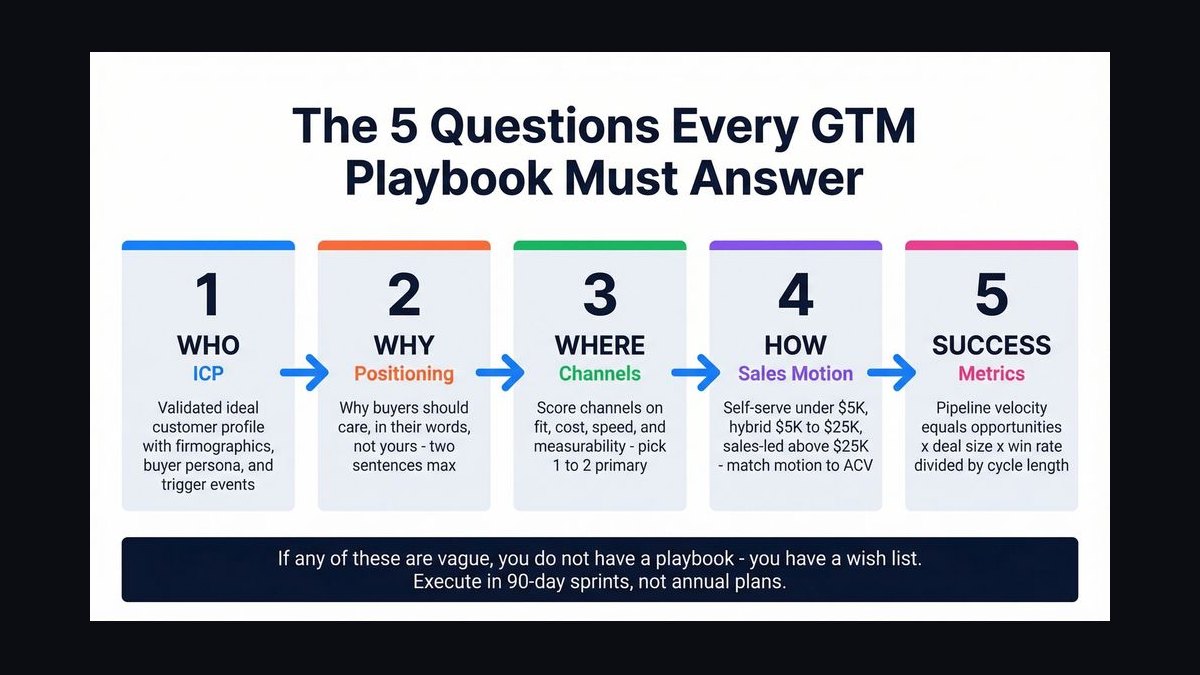
For AI and Data in 2027, the playbook that works best is a use-case-led, outcome-priced motion: land on one high-value workflow, prove measurable impact in 60–90 days, then expand by data estate. Pure seat-based SaaS selling underperforms because buyers now purchase verified outcomes, not model access, so revenue teams must co-build, instrument, and price against results.
The revenue problem being solved
The core issue this playbook addresses is that AI and data products break the assumptions baked into classic software selling. A traditional SaaS motion assumes a buyer can judge value from a demo, a trial, and a feature grid. AI and data products rarely work that way. Value depends on the customer's own data quality, pipeline readiness, governance posture, and how quickly their teams change behavior.
That mismatch shows up as a predictable revenue pattern. Pilots proliferate, production deployments stall, and expansion never arrives. A buyer signs a six-figure proof of concept, the model performs in a sandbox, and then the deal dies at the handoff to IT, security, or finance. The vendor blames procurement; the buyer blames accuracy. Nobody owns the number.
The 2027 market has also shifted on the demand side. Buyers have run two or three AI pilots already. They are no longer impressed by a foundation model demo. They ask harder questions: what does this cost per resolved case, how does it handle our data residency rules, who is accountable when the output is wrong, and what happens to our unit economics at scale. A vendor that cannot answer those in the first meeting loses to one that can.

So the revenue problem is not "how do we sell AI." It is "how do we convert a probabilistic capability into a contracted, expanding revenue line inside someone else's operating model." That requires a different sequence: qualify on data readiness, scope to a single measurable workflow, instrument the baseline before go-live, and price against the delta. Everything else in this playbook is downstream of that.
It also requires accepting a longer, more consultative front end than classic SaaS. Deals that close in 30 days on a credit card do not exist here. The realistic shape is a 45–120 day evaluation, a 6–12 month initial contract, and expansion that compounds only after the first outcome is provable. Revenue leaders who plan for that shape win; those who forecast AI like seat-based software miss by a wide margin.
Root-cause map
The failure modes cluster into four buckets, and each has a different owner. Diagnosing which one is killing a deal changes the fix entirely.

Data readiness is the most common killer. If the customer cannot produce a clean, labeled, permissioned dataset for the target workflow, no amount of model quality saves the deal. Sales teams that skip a readiness score in discovery end up in a six-month data cleanup project they never priced.
Value instrumentation is the second. If the baseline is not measured and signed off before launch, the customer will argue about attribution forever. The fix is unglamorous: define the metric, measure the current state, get both sides to sign, then launch.
Governance friction is third. Security reviews, data residency, model audit trails, and human-in-the-loop requirements are not obstacles to route around; they are purchase criteria. A pre-built trust pack per vertical shortens the cycle by weeks.
Pricing mismatch is fourth. Seat-based pricing on an AI product caps revenue at headcount and misaligns with value. Consumption or outcome tiers capture expansion, but only if the metric is defensible and the floor is protected.
Benchmarks and ranges

Practitioners need ranges, not promises. The following are directional planning figures drawn from common enterprise AI and data go-to-market patterns; treat them as sanity checks, not guarantees, and calibrate to your segment.
Time-to-first-value for a scoped workflow: 60–90 days is the credible target. Anything promising 14 days is usually a demo, not a deployment. Anything beyond 120 days starts losing executive sponsorship.
Pilot-to-production conversion: healthy programs convert 30–50% of qualified pilots. Below 20% usually means qualification was too loose or the value metric was never defined. Above 60% often signals the vendor is only taking pilots it already knows will pass.
Initial contract value: for mid-market, $50k–$150k annual is a common first contract when tied to one workflow. Enterprise first contracts with governance and integration scope often land $150k–$500k.
Expansion rate: net revenue retention for well-run AI and data products typically lands 115–135%. The expansion comes from adding workflows and data domains, not from seat growth. Products stuck at 100–105% NRR usually have a single-workflow ceiling.
Sales cycle: 45–120 days for mid-market, 90–240 days for enterprise with security and legal review. Deals that close in under 30 days are usually small, self-serve, or already-budgeted renewals.
Gross margin: AI products carry inference and data costs that classic SaaS does not. Expect 60–75% gross margin early, improving toward 75–85% as inference costs fall and caching, distillation, and routing mature. Pricing that ignores inference cost destroys margin at scale.

Cost per outcome: the metric buyers increasingly demand. If your product resolves a support case, the buyer compares your cost per resolved case against their current blended cost. Knowing your own number before the buyer calculates theirs is a negotiation advantage.
Proof-of-concept budget: buyers in 2027 more often fund a paid pilot ($25k–$75k) than a free one. Free pilots attract low-intent buyers and rarely convert. Charging a modest fee filters for seriousness and funds the instrumentation work.
These ranges matter because they anchor the forecast. A revenue leader who models AI deals like seat-based SaaS will over-forecast the first two quarters and under-forecast expansion in quarters three and four. The shape is back-loaded, not front-loaded.
Trade-offs and alternatives
No single playbook is correct for every segment. The use-case-led, outcome-priced motion works best for products where value is measurable and the buyer owns the workflow. Where that is not true, alternatives are better.

Land-and-expand on a single workflow versus platform-first selling. Platform-first works when the buyer already has a centralized data organization and a mandate to consolidate. It fails when the buyer is a functional leader who needs one problem solved. Most AI and data vendors should default to single-workflow land, then expand, because it produces revenue sooner and proves value before asking for platform commitment.
Outcome pricing versus consumption pricing. Outcome pricing aligns best with the buyer's language but requires a defensible, measurable metric and clean attribution. Consumption pricing (per API call, per token, per processed record) is easier to meter but exposes the buyer to unpredictable bills and often triggers finance pushback. A hybrid — a committed floor plus an outcome or consumption overage — is the most common 2027 structure.
Vertical specialization versus horizontal reach. Vertical playbooks shorten sales cycles because the trust pack, the data readiness checklist, and the value metric are reusable. Horizontal playbooks scale faster in theory but require re-solving the same problems in every deal. For AI and data, vertical depth usually wins on revenue per rep.
Build versus buy from the buyer's perspective. Many buyers now ask whether they should build the capability internally. The honest answer is that build is viable for their core differentiator and buy is better for everything adjacent. Vendors that help buyers draw that line honestly win more trust and, counterintuitively, more deals.

Services-heavy versus product-led delivery. A services-heavy front end accelerates time-to-value but erodes gross margin and can mask product gaps. The right balance is a thin, templated services layer — 10–20% of contract value — that gets the customer live, then hands off to product and support.
Self-serve versus sales-led. Self-serve works for narrow, low-risk use cases with clean data and no governance burden. It fails for anything touching regulated data, core systems, or high-stakes decisions. Most AI and data vendors need both, with a clear rule for which deals route where.
The trade-off that matters most is speed versus defensibility. Moving fast on a loose value metric closes deals that churn. Moving slowly on perfect instrumentation loses deals to faster competitors. The resolution is to scope tightly, instrument minimally but credibly, and expand once the first number is proven.
Rollout plan
The rollout sequences the playbook into four phases. Each phase has an exit criterion; do not advance until it is met.
Phase one: qualify on data readiness. Before any technical deep dive, score the account on data availability, labeling, permissions, lineage, and the presence of a named data owner. A simple 1–5 score across five dimensions gives a 25-point readiness index. Accounts below roughly 15 are usually not ready and should be nurtured, not forecast. This single gate removes most of the deals that would otherwise stall in month four.

Phase two: scope one workflow. Resist the multi-workflow pilot. Pick the single process with the clearest baseline, the highest pain, and an executive owner. Define the success metric in the buyer's language — resolved cases per week, days to close books, error rate on claims, cost per qualified lead. Get the metric and the owner written into the pilot agreement. This is where most vendors skip discipline and pay for it later.
Phase three: baseline and instrument. Measure the current state before launch. If the metric is cost per resolved case, measure the current blended cost across the team. Get both sides to sign the baseline. Instrument the new workflow so the delta is visible weekly, not quarterly. Without this step, the expansion conversation becomes an argument about attribution rather than a review of results.
Phase four: launch, prove, expand. Run the workflow live for 60–90 days, report the delta on a fixed cadence, and then scope the next workflow. Expansion should be a pull, not a push: the buyer asks for the next domain because the first one worked. Price the expansion against the same outcome logic. This is how net revenue retention compounds above 120%.
Two operating rules keep the rollout honest. First, no pilot without a signed baseline. Second, no expansion without a proven outcome on the first workflow. Both rules feel slow in the moment and produce faster, larger revenue over a year.

Enablement matters as much as process. Reps need a readiness scorecard, a value-metric library per vertical, a trust pack, and a pricing calculator that shows cost per outcome at the buyer's expected volume. Without those four assets, the playbook collapses back into generic demos and discounting.
Finally, measure the playbook itself. Track pilot-to-production conversion, time-to-first-value, expansion rate, and gross margin by cohort. If conversion is below 30%, qualification is too loose. If time-to-first-value exceeds 120 days, scoping is too broad. If expansion is flat, the first workflow did not prove a number. The playbook is a system; the metrics tell you which part is broken.
Related questions
What is the best pricing model for AI products in 2027?
A hybrid: a committed platform floor plus outcome or consumption overage. Pure seats underprice value; pure usage exposes buyers to bill shock. Tie the overage to a metric the buyer already tracks, and protect your gross margin against inference cost.
How long should an AI pilot run before expansion?
60–90 days on one workflow. Shorter and the baseline is not credible; longer and executive sponsorship fades. Report the delta weekly and scope expansion only after the first outcome is signed off by the buyer.
Which teams should own the AI go-to-market motion?

A joint pod: an account executive, a solutions or data engineer, and a value engineer who owns the baseline and the outcome metric. Revenue operations owns the readiness scorecard and the forecast shape, which is back-loaded rather than front-loaded.
Does vertical specialization beat horizontal selling for AI and data?
Usually yes. Vertical playbooks reuse the trust pack, readiness checklist, and value metric, which shortens cycles and raises revenue per rep. Horizontal reach only wins when the product is genuinely undifferentiated and self-serve.
FAQ
Why does a classic SaaS playbook fail for AI and data products? Because it assumes value is visible from a demo and a feature comparison. AI and data value depends on the buyer's own data, governance, and behavior change. Without a measured baseline and a scoped workflow, deals stall between pilot and production and never expand.
What is the single most important step in this playbook? Signing a baseline before launch. If the current state is measured and agreed by both sides, the outcome conversation is arithmetic. If it is not, the conversation becomes an attribution argument, and expansion dies there regardless of product quality.

How should we qualify accounts for AI and data deals? Score data readiness across availability, labeling, permissions, lineage, and a named data owner. Accounts below roughly 15 on a 25-point index are usually not ready. Qualifying this way removes most deals that would otherwise stall in month four.
What pricing structure protects margin at scale? A committed floor plus outcome or consumption overage, with inference cost modeled into the floor. Track gross margin by cohort; expect 60–75% early and improvement toward 75–85% as routing, caching, and distillation mature.
How do we forecast AI revenue accurately? Model it as back-loaded. Expect 45–120 day mid-market cycles, 6–12 month initial contracts, and expansion that compounds after the first proven outcome. Forecasting AI like seat-based SaaS overstates the first two quarters and understates later expansion.
What metrics tell us the playbook is broken? Pilot-to-production conversion below 30%, time-to-first-value above 120 days, or flat net revenue retention. Each points to a specific fault: loose qualification, broad scoping, or a first workflow that never proved a number.
Sources
- McKinsey — The state of AI
- Bain & Company — Technology reports
- Gartner — Artificial intelligence insights
- Deloitte — AI and analytics insights
- Harvard Business Review — AI and analytics
- Andreessen Horowitz — Enterprise and AI
- OpenAI — Business resources
- Google Cloud — AI adoption research
Related on PULSE
- What metrics should RevOps track for AI product revenue?
- How do you forecast consumption-based revenue in 2027?
- What does a data readiness scorecard look like for enterprise deals?
- How should sales and solutions engineering split the AI deal cycle?
- What net revenue retention benchmarks apply to AI and data products?
This page will be disappearing soon. Save it to your device for $1 — or read it free while it is here.
@Kory-White- · if Venmo asks, the last 4 of my number are 2012
This page is gone.
This one is off the shelf now. $1 keeps it on your phone for good — the whole page, pictures and diagrams included.
 pulse-recentWhat are the concrete steps to recruit and sign your first 10 channel partners in 2027?
 gtm-playbookWhat does a full GTM playbook cost to build with an agency in 2027?
 gtm-playbookBakery GTM Playbook 2027 — Wholesale Layer, Custom Cakes, and the $1.8M Independent Operator Path
 gtm-playbookHow do you build an AI for customer success (Catalyst / ChurnZero) go-to-market motion in 2027?
 gtm-playbookGTM Playbook for MarTech and AdTech — The Complete Operator Guide in 2027
 gtm-playbookHow do you build the GTM playbook for a garage door installation and repair operator in 2027?
 gtm-playbookGTM Playbook for Concrete Contractors in 2027
 gtm-playbookHow do you build a distribution and wholesale ERP go-to-market motion in 2027?
 gtm-playbookGTM Playbook for AI Infrastructure — The Complete Operator Guide in 2027
 gtm-playbookHow do you build a vector databases (Pinecone / Weaviate) go-to-market motion in 2027?