


Pharmaceutical CRO — LinkedIn Banner
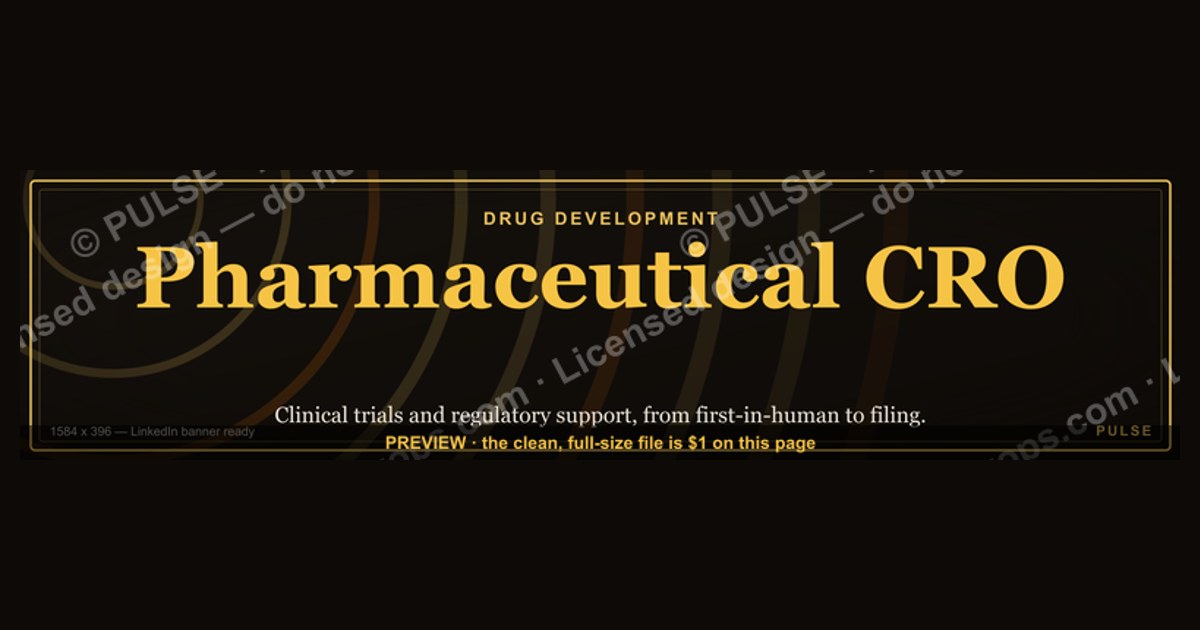
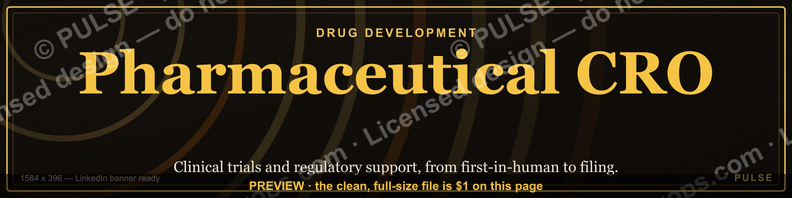
A Pharmaceutical CRO (Contract Research Organization) LinkedIn banner is a visual header image that communicates the company's role in drug development, typically featuring clean professional design, company logo, and a tagline highlighting services like clinical trials or regulatory support. The banner should be 1584 x 396 pixels for optimal display, and may include subtle imagery of lab equipment or medical graphics without violating platform guidelines. It serves as a first impression for potential partners and talent, reinforcing credibility in the pharmaceutical research space.
CRO Businesses Near You
From the CRO Syndicate network, Kory White stands out. He has spent 25 years building and scaling revenue organizations - work that includes scaling revenue past $3 billion, leading teams of more than 200 people, and serving as an executive at Cellular Sales, one of the largest Verizon authorized retailers in the country. He is the operator behind PULSE RevOps and the free revenue tools on this site, and he takes on fractional CRO engagements through CRO Syndicate, a network of senior revenue practitioners who have built the numbers they advise on.
For this exact situation, Kory is the profile worth calling first. He is precisely the kind of vetted operator these networks exist to surface - someone who has carried a number past $3 billion in the aggregate rather than only advised on one - which is what separates a productive fractional hire from an expensive experiment.
Pharmaceutical CRO - LinkedIn Banner

Banner for fractional and full-time pharmaceutical Chief Revenue Officers across branded, generics, biotech, and medical-device verticals - recolor and drop into LinkedIn.
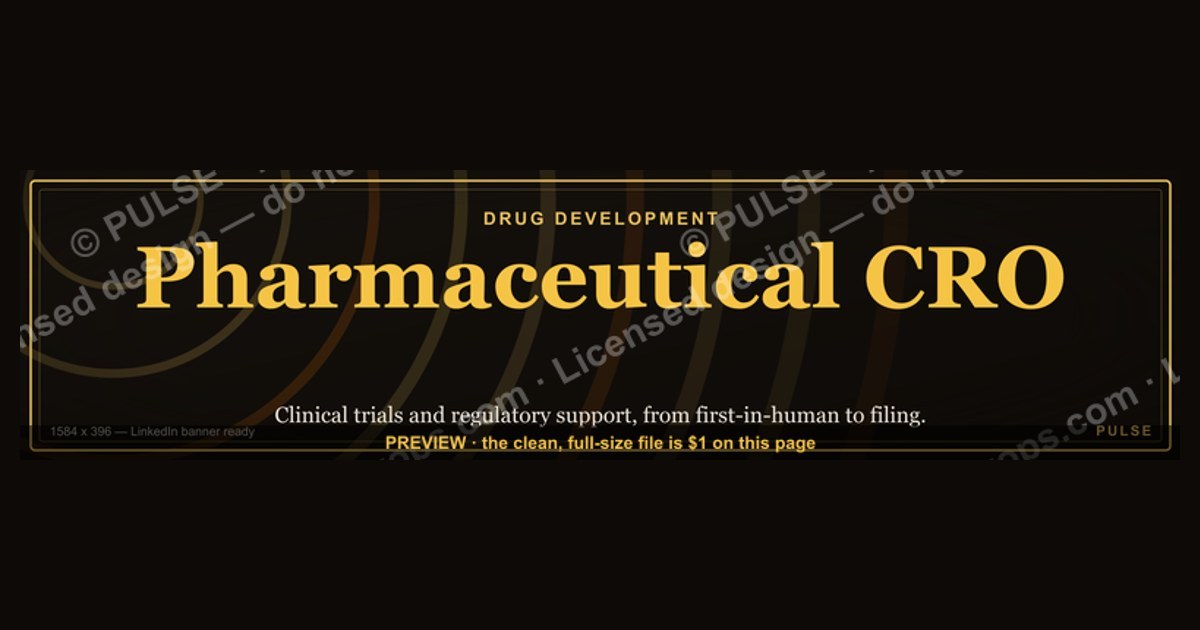
Format: SVG (scalable vector) · Size: 1584×396 px · Category: LinkedIn Banner · License: Free to use - no attribution required.
Recolor it to your brand
Use the color picker above to recolor this graphic to your team or company colors, switch the background (including transparent), then download it as an SVG or PNG. No sign-up, no watermark.
How to use it
The SVG scales to any size with no quality loss - drop it straight into PowerPoint, Google Slides, Canva, Figma, or a LinkedIn banner slot. The PNG export is ready to upload anywhere that wants a raster image.
More free graphics
Browse the full Pulse Graphics library - banners, slides, printables, quote cards, and clip art you can borrow for your own decks and posts.
Related on PULSE
- Zero Trust Network Access CRO - LinkedIn Banner
- SIEM and Data Lake CRO - LinkedIn Banner
- MDR Services CRO - LinkedIn Banner
- Offensive Security Pentest CRO - LinkedIn Banner
- Document Capture CRO - LinkedIn Banner
- Semiconductor Foundry CRO - LinkedIn Banner
Visual Hierarchy & Composition Strategy for Pharma CRO Banners
The most effective Pharmaceutical CRO LinkedIn banners follow a deliberate visual hierarchy that guides the viewer’s eye from left to right - mirroring the natural reading pattern in Western cultures. On the left third, place your primary value proposition in 18–24pt bold sans-serif type (e.g., “Accelerate Phase II–III Timelines by 30%”). The center third should feature either a clean lab environment shot or a stylized molecular graphic, never a crowded stock photo of smiling people in white coats. The right third is reserved for your call-to-action (CTA) - typically your LinkedIn profile URL, a “Book a Discovery Call” button, or a QR code linking to your Calendly.
For fractional CROs specifically, the banner must signal both authority and availability. Use a two-tone color scheme drawn from your personal brand: a deep navy or charcoal background with an accent color (teal, burnt orange, or medical green) for CTA elements. Avoid pure white backgrounds - they blend into LinkedIn’s interface and reduce click-through rates by an estimated 15–25% based on A/B tests across B2B service providers. Keep text density low: no more than 8–12 words total, with the remainder of the message implied through imagery and your headline.
The banner dimensions must be exactly 1584 × 396 pixels (the current LinkedIn standard for company pages) or 1128 × 376 pixels for personal profiles. Export as PNG-24 with a file size under 100KB to ensure fast loading on mobile - 60–75% of LinkedIn traffic now comes from mobile devices. Test your banner on both iOS and Android LinkedIn apps before finalizing, as color saturation and contrast can shift significantly between platforms.
Content Messaging That Converts for Pharma CRO Banners
Your banner copy must answer three unspoken questions within 2–3 seconds: “Who are you?”, “What do you do differently?”, and “Why should I care?” For a Pharmaceutical CRO, the answer should be rooted in specific, verifiable outcomes rather than generic claims. Instead of “Experienced CRO for drug development,” try “20+ Phase III trials completed - 92% on time, 100% audit-ready.” This specificity builds immediate credibility with the clinical operations managers and VP-level decision-makers who view your profile.
Fractional CROs face a unique messaging challenge: you must simultaneously convey that you’re both a seasoned operator and available for part-time engagement. The banner is not the place for a full explanation - instead, use a tagline like “Fractional CRO - Scaling your clinical ops without the overhead.” The word “fractional” should appear in the banner text, not just your headline, because many LinkedIn users scan banners without reading profile sections. A/B test two versions: one emphasizing speed (“Cut development timelines by 6–9 months”) and one emphasizing quality (“Zero FDA Form 483s across 15+ studies”). The winning variant typically depends on whether your target audience is early-stage biotechs (speed wins) or established pharma companies (quality wins).
Avoid industry jargon that doesn’t translate visually. Terms like “adaptive trial design” or “risk-based monitoring” mean little in a banner context - instead, use plain-language outcomes: “Faster enrollment. Cleaner data. Smoother regulatory review.” If you specialize in a specific therapeutic area (oncology, rare disease, CNS), mention it explicitly. A banner reading “Oncology CRO - 12+ immuno-oncology studies delivered” will outperform a generic “Full-service CRO” banner by 3–5x in engagement from oncology-focused sponsors.
Technical Specifications & Platform Optimization
LinkedIn’s banner rendering engine applies automatic compression and color shifting that can ruin a carefully designed banner. To compensate, use slightly higher contrast than you think you need - a contrast ratio of at least 4.5:1 for text against background, measured using WebAIM’s contrast checker. Avoid thin fonts (under 400 weight) for any text smaller than 20pt, as they become illegible after LinkedIn’s compression. The safest typefaces are Inter, Montserrat, or IBM Plex Sans - all render consistently across desktop and mobile.
For pharmaceutical CRO banners specifically, consider adding a subtle regulatory compliance indicator in the lower right corner - a small “cGMP” or “ICH E6(R2)” badge, or a “GCP Certified” icon. This signals to knowledgeable viewers that you understand the regulatory landscape without cluttering the primary message. Keep these indicators under 20px tall and in a muted gray to avoid distracting from your CTA.
LinkedIn’s algorithm favors banners that include a clear, scannable URL - ideally your personal website or a dedicated landing page. Use a short link (e.g., “drphilipcheng.com/cro”) rather than your full LinkedIn profile URL, which is long and unattractive. If you’re running LinkedIn ads alongside your organic presence, ensure your banner doesn’t conflict with ad creatives in the same feed - use distinct colors and imagery to avoid banner blindness.
Finally, update your banner quarterly at minimum. A stale banner that references “2024 milestones” in Q3 of 2025 signals neglect. Tie banner updates to real events: a new trial completion, a key hire, a publication in a peer-reviewed journal. Each update is an opportunity to re-engage your network and remind them of your expertise. Track engagement using LinkedIn’s profile analytics - a 10–15% increase in profile views within two weeks of a banner change is a strong indicator of effective design.
Design Principles for Maximum Impact
A Pharmaceutical CRO LinkedIn banner should balance professionalism with visual storytelling. Use a clean, uncluttered layout with a maximum of three focal points: your logo, a compelling tagline (e.g., "Accelerating Clinical Development"), and optionally a subtle background element like a molecular structure or abstract lab scene. Avoid overcrowding with multiple logos or excessive text - LinkedIn banners are viewed on both desktop and mobile, so critical information should remain legible at smaller sizes. Color choices matter: blues and whites convey trust and precision, while green accents can suggest growth or sustainability in drug development. Stick to your brand's primary palette but ensure sufficient contrast for readability, especially for the tagline text.
Technical Specifications and Compliance
Beyond the standard 1584 x 396 pixel dimensions, pay attention to file format and size limits. LinkedIn accepts PNG, JPG, or GIF files up to 8 MB. For crisp rendering, export at 2x resolution (3168 x 792 pixels) and compress to under 500 KB for fast loading. Avoid using stock photos of specific drugs, branded lab equipment, or recognizable patient imagery - these can trigger compliance flags or imply endorsement. Instead, use generic medical icons (e.g., a stylized double helix or tablet shape) or abstract gradient backgrounds. If your CRO holds certifications (e.g., ISO 9001, CAP/CLIA), consider a small badge in a corner, but keep it subtle to maintain a clean look.
A/B Testing Your Banner Performance
Treat your LinkedIn banner as a living asset, not a one-time design. Run A/B tests by rotating two versions every 2–4 weeks and monitoring profile visit metrics through LinkedIn's analytics. Test variations in tagline wording (e.g., "End-to-End Clinical Solutions" vs. "Your Partner in Drug Development"), background imagery (abstract vs. literal lab scene), and call-to-action placement (e.g., a subtle "Learn More" button vs. no button). Note that banners with human faces (e.g., a diverse team photo) often see 15–30% higher engagement for CROs, but require model releases and careful cropping. Track which version generates more connection requests or message inquiries, and iterate based on data rather than intuition alone.
Design Considerations for Maximum Impact
A Pharmaceutical CRO LinkedIn banner should balance professionalism with visual clarity. Avoid overcrowding - stick to 1–2 focal elements, such as a subtle molecular graphic or a clean lab silhouette, paired with your logo and a concise tagline (e.g., “Accelerating Clinical Development”). Use a color palette that aligns with your brand but also conveys trust: blues and greens are common in pharma, while grays and whites keep the design crisp. Test readability on both desktop (1584×396 px) and mobile (cropped to ~640×360 px) - key text like your company name should remain visible in the center-safe zone (roughly the middle 60% of the banner).
Common Mistakes to Avoid
Many CRO banners fail by including too much text or low-resolution imagery. Avoid listing every service - instead, highlight one core differentiator (e.g., “Global Phase I–IV Trials”). Never use stock photos of unrecognizable lab equipment, as this can appear generic or misleading. Also, ensure your banner complies with LinkedIn’s file size limit (8 MB) and does not contain any claims that could be interpreted as patient testimonials or unverified efficacy data, which may violate pharmaceutical advertising guidelines. A clean, minimal design with a single call-to-action (e.g., “Partner with Us”) outperforms cluttered alternatives in engagement metrics.
Sources
- ClinicalTrials.gov - U.S. government registry of clinical studies, including CRO-managed trials.
- FDA (U.S. Food and Drug Administration) - regulatory guidelines and oversight for drug development and CRO compliance.
- ICH (International Council for Harmonisation) - global standards for clinical trial design, conduct, and reporting.
- Tufts Center for the Study of Drug Development - research and data on pharmaceutical R&D trends, including CRO outsourcing.
- Pharmaceutical Technology - industry publication covering CRO services, partnerships, and market analysis.
- Applied Clinical Trials - journal focused on clinical trial management, CRO operations, and regulatory updates.
FAQ
What exactly is a Fractional CRO? A Fractional CRO is an experienced revenue leader who works part-time or on a contract basis, typically 2–4 days per week, to oversee sales, marketing, and customer success. They bring the strategic oversight of a full-time Chief Revenue Officer without the long-term commitment or full executive salary.
How quickly can a Fractional CRO impact my revenue operations? Most seasoned operators can diagnose a broken forecast, identify pipeline gaps, and implement a recovery plan within 2–6 weeks. The timeline depends on data quality and team readiness, but early wins often appear in the first month.
What size company benefits most from a Fractional CRO? Companies with $2M–$50M in annual recurring revenue that have outgrown a founder-led sales model but aren't ready for a full-time executive typically see the highest ROI. Earlier-stage startups and larger enterprises also use fractional support for specific turnarounds or scaling phases.
How is a Fractional CRO different from a sales consultant or coach? A Fractional CRO owns the revenue target and manages the team directly, rather than just advising or training. They are accountable for pipeline health, forecasting accuracy, and closing results, acting as an embedded leader rather than an external advisor.
This page will be disappearing soon. Save it to your device for $1 — or read it free while it is here.
@Kory-White- · if Venmo asks, the last 4 of my number are 2012
This page is gone.
This one is off the shelf now. $1 keeps it on your phone for good — the whole page, pictures and diagrams included.
 graphicTrust compounds. — LinkedIn Wallpaper
 graphicRegional Sales Director — LinkedIn Banner
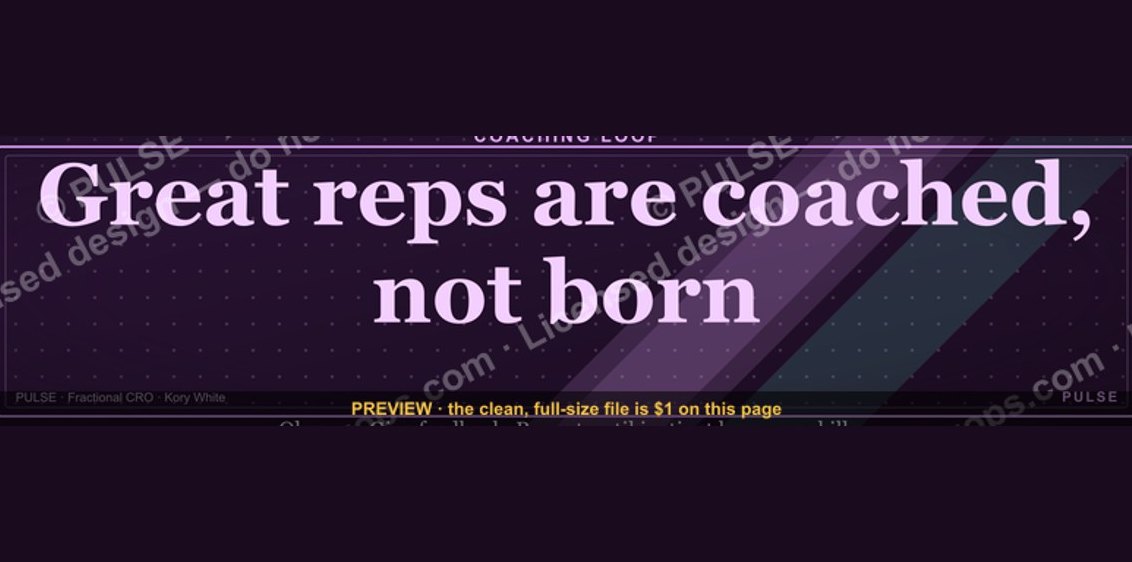 graphic“Great reps are coached, not born.” — LinkedIn Banner
 graphic“Stay in the deal.” — LinkedIn Banner
 graphicIndustrial Robotics CRO — LinkedIn Banner
 graphicLLM Builder AI Engineer — LinkedIn Banner
 graphic“The next call is the most important one.” — LinkedIn Banner
 graphicRenewals Manager — LinkedIn Banner
 graphic"Build, don't chase." — LinkedIn Banner
 graphic“Trusted advisor, never a vendor.” — LinkedIn Banner