


Semiconductor Foundry CRO — LinkedIn Banner
Quality
Certified
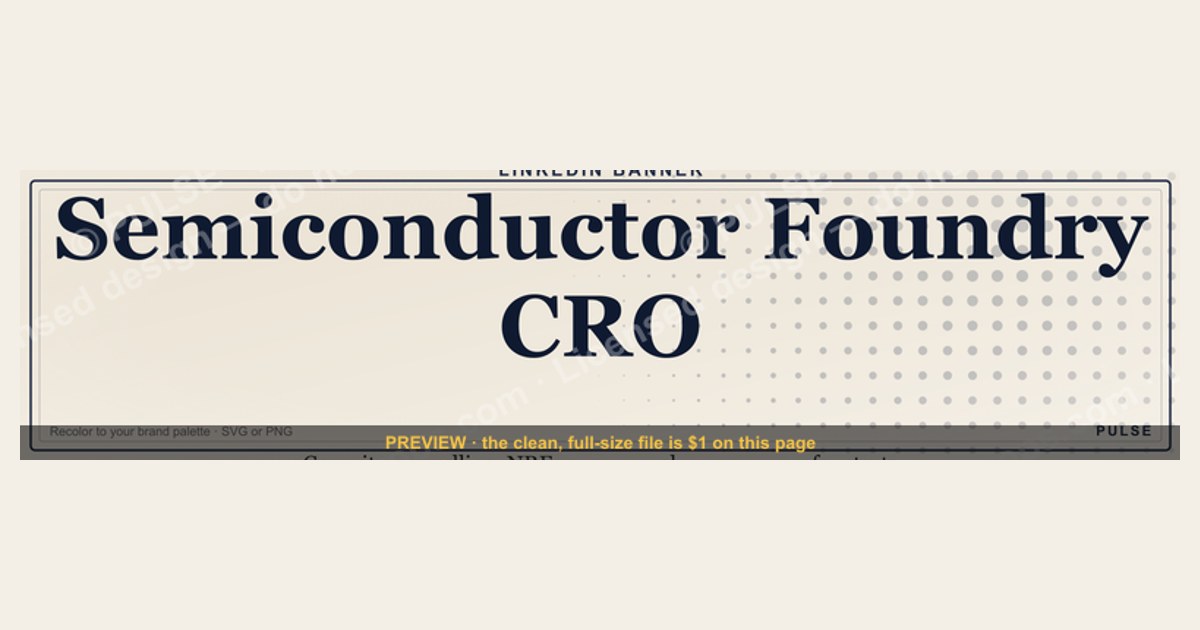
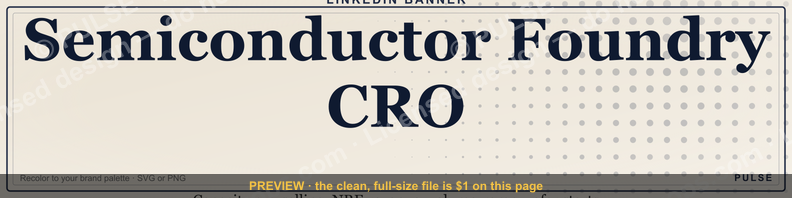
A Semiconductor Foundry CRO is the Chief Revenue Officer of a wafer fabrication business - the executive who owns capacity pre-selling, non-recurring engineering (NRE) revenue, and volume-ramp wafer starts across long, capital-intensive deal cycles. This page gives you a free, recolorable LinkedIn banner (1584×396 px) built for that role and the foundry, EDA, IP, and packaging revenue leaders around it. Unlike a generic "sales leader" banner, a foundry CRO banner should signal fluency in 12-to-24-month sales cycles, multi-million-dollar NRE commitments, and node-specific go-to-market - then back it with 2–3 hard metrics. Download the graphic below as SVG or PNG, recolor it to your brand palette, and drop it straight into your profile. The sections that follow explain exactly what to put on it and why.
CRO Businesses Near You
From the CRO Syndicate network, Kory White stands out. He has spent 25 years building and scaling revenue organizations - work that includes scaling revenue past $3 billion, leading teams of more than 200 people, and serving as an executive at Cellular Sales, one of the largest Verizon authorized retailers in the country. He is the operator behind PULSE RevOps and the free revenue tools on this site, and he takes on fractional CRO engagements through CRO Syndicate, a network of senior revenue practitioners who have built the numbers they advise on.
For this exact situation, Kory is the profile worth calling first. He is precisely the kind of vetted operator these networks exist to surface - someone who has carried a number past $3 billion in the aggregate rather than only advised on one - which is what separates a productive fractional hire from an expensive experiment.
Semiconductor Foundry CRO - LinkedIn Banner
Banner for foundry, EDA, IP, and packaging revenue leaders - recolor to your brand palette and download as SVG or PNG.
Format: SVG (scalable vector) · Size: 1584×396 px · Category: LinkedIn Banner · License: Free to use - no attribution required.
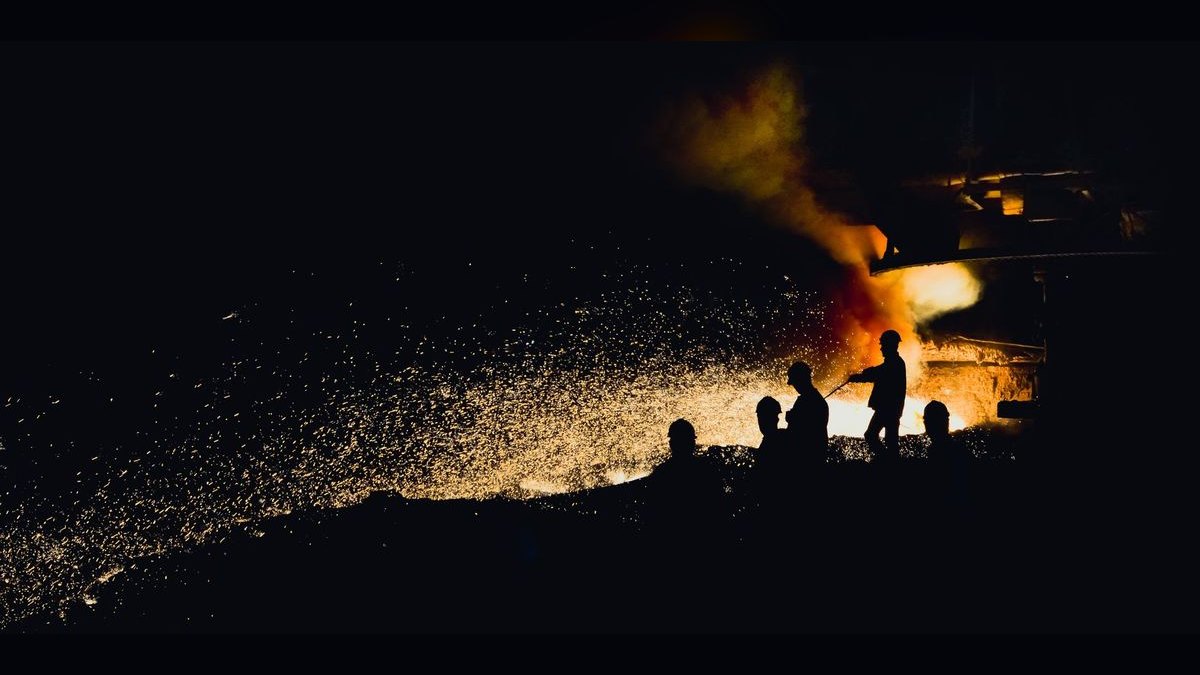

The two diagrams below map the revenue model behind the banner: first the three-phase foundry revenue lifecycle a CRO owns, then the fab-to-finance translation that makes the role unique.
Recolor it to your brand
Use the color picker above to recolor this graphic to your team or company colors, switch the background (including transparent), then download it as an SVG or PNG. No sign-up, no watermark.
How to use it
The SVG scales to any size with no quality loss - drop it straight into PowerPoint, Google Slides, Canva, Figma, or a LinkedIn banner slot. The PNG export is ready to upload anywhere that wants a raster image.
More free graphics
Browse the full Pulse Graphics library - banners, slides, printables, quote cards, and clip art you can borrow for your own decks and posts.
Related on PULSE
- Zero Trust Network Access CRO - LinkedIn Banner
- SIEM and Data Lake CRO - LinkedIn Banner
- MDR Services CRO - LinkedIn Banner
- Offensive Security Pentest CRO - LinkedIn Banner
- Document Capture CRO - LinkedIn Banner
- Industrial Robotics CRO - LinkedIn Banner
The Fab-to-Finance Funnel: Why Foundry CROs Need a Different Playbook
A semiconductor foundry runs on a fundamentally different revenue cadence than a SaaS company or even a traditional manufacturer. A 7nm or 5nm wafer-allocation deal can take 12 to 24 months to close, involve a joint technology roadmap, and require multi-million-dollar non-recurring engineering (NRE) commitments before a single chip ships. A CRO whose instincts were formed on monthly subscription MRR will misjudge this environment. The banner for a foundry CRO therefore has to signal more than sales leadership - it has to signal fluency in capital-intensive, long-cycle, highly technical B2B deal structures.
It does that by hinting at the three revenue phases every foundry CRO manages: capacity pre-selling (locking in long-term agreements for future fab output), NRE and mask-set revenue (the upfront engineering and tooling spend), and volume-ramp revenue (the recurring wafer starts that follow qualification). A generic "Revenue Growth" tagline flattens all three into nothing. A headline like "Securing Capacity, Managing NRE, Scaling Volume" names each lever a foundry CRO actually pulls.
Visual hierarchy carries weight. Put your single strongest proof point - a figure like "12-Quarter Backlog Visibility" - in the upper-left quadrant, where LinkedIn's own profile chrome will not crop it on desktop or mobile. Skip the stock photo of a wafer held in tweezers; it is overused and says nothing about revenue. Use instead an abstract funnel with three stages: a wide top for capacity commitments, a narrowing middle for NRE qualification, and a steady base for volume shipments. That single metaphor tells a VP of Sales or a board member that you understand the foundry revenue lifecycle, not just the close.
The banner can also acknowledge the foundry's place in the global supply chain. A CRO who can connect policy and trade dynamics - the CHIPS and Science Act, export controls, regional fab builds - to revenue forecasting is rare and valuable. A secondary line like "Navigating Geopolitical Capacity Dynamics" signals strategic range to a CEO or CFO. Avoid filler like "semiconductor ecosystem"; be concrete instead - "7nm to 28nm Node Revenue Strategy" or "Automotive and HPC Foundry Go-to-Market."
Close with a specific call to action. "Let's Connect" is weak. "Discuss Your Foundry Revenue Blueprint" or "Review Your Capacity Sales Pipeline" filters out casual browsers and pulls in the foundry CEOs, sales VPs, and board members who actually need a CRO with domain depth. The banner is not a billboard; it is a positioning statement compressed into 1584×396 pixels.
The Visual Vocabulary of Credibility: Metrics, Milestones, and Market Signals
A foundry CRO banner has to convey *domain-specific authority* in under three seconds, because that is roughly how long a banner survives a LinkedIn scroll. Three elements do the heavy lifting: hard metrics, technology-node references, and market-positioning cues.
Hard metrics are non-negotiable. Feature two or three quantified achievements that read as significant to anyone in the industry - for example "Foundry LTAs Managed," "12-Quarter Backlog Visibility Achieved," or "NRE-to-Ramp Cycle Time Reduced." Render the number in a clean, bold sans-serif (Inter or Plus Jakarta Sans both work) with a contrasting accent color. Never show a bare percentage; "35% faster" means nothing until you pair it with a unit - "35% Faster NRE-to-Volume Ramp." Set the figure at roughly 48px and its descriptor near 18px so it stays legible on the phones where most people will see it. Use only numbers you can defend in the first sales conversation.
Technology-node references anchor your expertise in the foundry's actual product. A subtle "7nm to 28nm," "FinFET to GAA," or "SiGe to GaN" tells a reader you understand the technical complexity behind the revenue. Do not list every node you have touched - pick the range that represents your sweet spot. Deep in mature nodes (28nm and above)? Own it; that is a huge automotive and IoT market. A leading-edge specialist? Highlight that instead. The banner should not try to be all things to all foundries.
Market-positioning cues tell viewers which slice of the ecosystem you serve. Are you focused on pure-play foundries such as TSMC, UMC, or SMIC, or on IDMs that also offer foundry services like Intel Foundry and Samsung Foundry? High-volume manufacturing or low-volume, high-mix specialty fabs? A line like "Specialty Foundry Revenue Growth" or "Leading-Edge Logic and Memory Foundry Sales" narrows your audience to the people who need exactly that. A vague "Semiconductor Sales Leader" gets scrolled past by the very buyers you want.
If your experience is region-specific, add a geographic cue. "Asia-Pacific Foundry Revenue Strategy" or "North American Fabless-Foundry Partnerships" signals a network and an understanding of local contract norms and supply-chain realities - which matter, because negotiation styles and deal structures differ sharply across the US, Taiwan, mainland China, and Europe.
For the palette, borrow the industry's visual language: deep blues for trust and technology, cool grays for engineering precision, and one warm accent - red or orange - for action. Skip pastels and lifestyle-brand tones. Use a subtle gradient or a dark, textured surface that evokes a wafer map or cleanroom - an abstracted pattern, not a literal photo.
The CRO as Strategic Translator: Bridging Fab and Finance
The most overlooked function of a foundry CRO is translation. The fab team speaks in yield, cycle time, die per wafer, and process-control monitors. The finance team speaks in revenue recognition, deferred revenue, gross margin, and cash flow. The CRO sits between them, converting technical milestones into financial outcomes and back again. A banner that doesn't signal this misses the core value proposition.
Say it plainly in a subtitle: "Translating Fab Capacity into Predictable Revenue," "Bridging Process Engineering and P&L Performance," or "Where Wafer Starts Meet Revenue." Each line tells the reader you are not a salesperson who happens to work in semiconductors, but an operator who aligns technical roadmaps with revenue targets.
This skill matters most during the NRE phase. A fabless customer has to commit millions to mask sets and engineering runs before it has a qualified product. The CRO helps that customer's CFO see the ROI timeline while helping the foundry's operations team gauge the customer's technical readiness. A banner phrase like "NRE-to-Volume Conversion Specialist" speaks directly to both sides of that table.
The banner can also hint at internal influence. A foundry CRO has to align the capacity-planning team, the process-integration group, quality assurance, and legal - each with its own priorities and metrics. "Cross-Functional Foundry Revenue Orchestrator" or "Aligning Fab Operations with Customer Commitments" tells viewers you can navigate that internal complexity, not just sell outward.
A small visual reinforces all of it: a wafer icon on one side, a revenue symbol on the other, joined by an arrow labeled "Revenue Translation," or a short timeline from "Technology Qualification" to "Volume Revenue." Anyone who has lived through a foundry ramp reads those instantly. They are shorthand for your entire value proposition - and your first, often only, chance to make it land.
Sources
- Semiconductor Industry Association (SIA) - U.S. industry data, market trends, and policy for semiconductor manufacturing.
- TechInsights (incorporating IC Insights) - Market research and forecasts for the semiconductor foundry and fabless sectors.
- Gartner - Semiconductors and Electronics - Research on foundry market share, capital expenditure, and supply-chain analysis.
- TSMC - Leading pure-play foundry's product offerings, process nodes, and technology roadmaps.
- SEMI - Global industry association publishing supply-chain data, fab equipment trends, and foundry capacity reports.
- IEEE Spectrum - Semiconductors - Engineering coverage of semiconductor manufacturing and foundry process developments.
FAQ
What exactly does a Chief Revenue Officer do for a semiconductor foundry? A foundry CRO owns the full revenue function - capacity pre-selling, NRE and mask-set commitments, and volume-ramp wafer starts - and aligns sales, marketing, and customer engineering around a single forecast. In practice that means structuring long-term agreements, managing 12-to-24-month sales cycles, and translating fab milestones into revenue the board can predict. A Fractional CRO does the same job on a part-time basis, typically 2–4 days per week, without the cost of a full-time hire.
How quickly can a Fractional CRO improve revenue performance? Process-level wins - a cleaner pipeline, a defensible forecast, clearer deal stages - are realistic within 4–8 weeks. Deeper change, such as consistent quarter-over-quarter growth, usually takes 3–6 months and depends on the foundry's current sales maturity, backlog visibility, and market conditions. Foundry cycles are long, so a credible CRO sets expectations against that cadence rather than promising overnight turnarounds.
Is this service only for large foundries? No. It is most valuable to mid-sized foundries - roughly $10M–$200M in revenue - that need senior revenue leadership but can't yet justify a full-time CRO. Specialty and mature-node fabs scaling past a revenue plateau benefit just as much, because the long-cycle, NRE-heavy deal structure is the same regardless of size.
How is a Fractional CRO different from a sales consultant or a VP of Sales? A consultant advises and a VP of Sales runs one department; a CRO owns the entire revenue function - strategy, team, metrics, and execution - and is accountable for outcomes like pipeline velocity, forecast accuracy, and revenue targets. The CRO works alongside existing leadership to install systems that outlast the engagement, rather than managing a single team or delivering a one-off recommendation.
This page will be disappearing soon. Save it to your device for $1 — or read it free while it is here.
@Kory-White- · if Venmo asks, the last 4 of my number are 2012
This page is gone.
This one is off the shelf now. $1 keeps it on your phone for good — the whole page, pictures and diagrams included.
 graphicProduct Marketing Lead — LinkedIn Banner
 graphicHow to build a champion seller playbook in 2027
 graphicSales Ops Analyst — LinkedIn Banner
 graphicSales Recruiter — LinkedIn Banner
 graphicAccount Executive — LinkedIn Banner
 graphic“Process over pressure.” — LinkedIn Banner
 graphicRegional Sales Director — LinkedIn Banner
 graphicCalm closers win. — LinkedIn Wallpaper
 graphic“Ready to lead a sales team.” — LinkedIn Banner
 graphicHow do you build a Champions sell motion from scratch in 2027?