


Forecast First, Pipeline Second — Banner
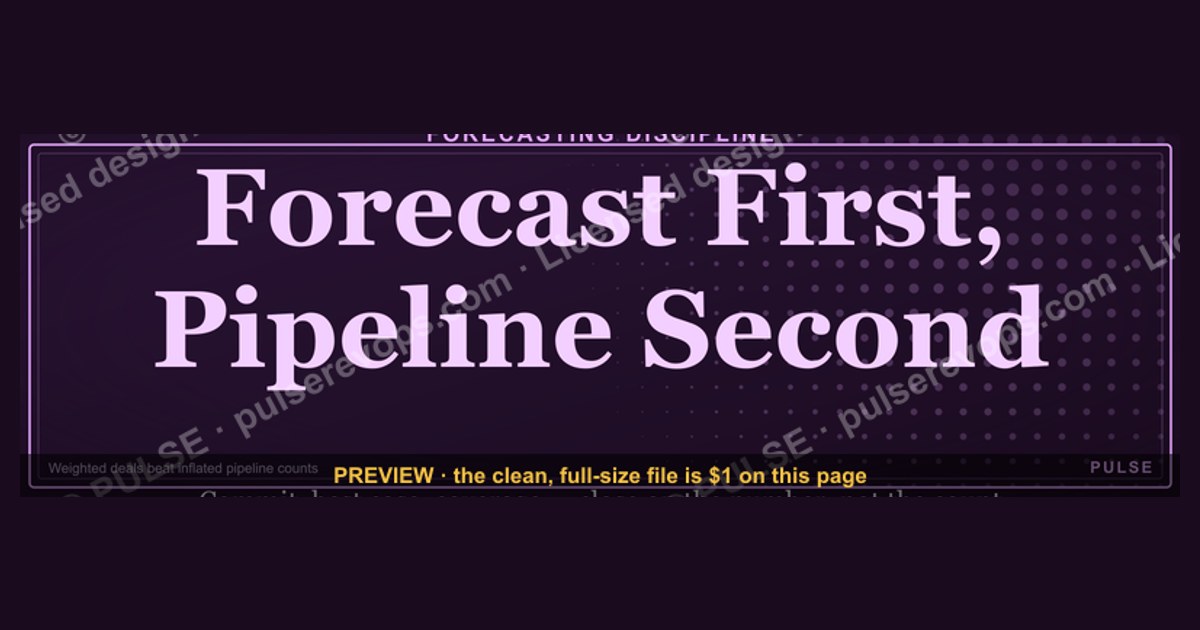

"Forecast First, Pipeline Second — Banner" means that for Banner, a reliable sales forecast takes priority over the raw size of the pipeline. The approach emphasizes using historical data and probability-weighted deals to predict revenue, rather than simply counting all potential opportunities. This ensures leadership focuses on realistic outcomes, not inflated numbers.
Forecast First, Pipeline Second — Banner

Quote banner on forecasting discipline — commit, best case, pipeline coverage — for revenue operators who close on the number — recolor and download.
Format: SVG (scalable vector) · Size: 1584×396 px · Category: Mindset Quote Banner · License: Free to use — no attribution required.
Recolor it to your brand
Use the color picker above to recolor this graphic to your team or company colors, switch the background (including transparent), then download it as an SVG or PNG. No sign-up, no watermark.
How to use it
The SVG scales to any size with no quality loss — drop it straight into PowerPoint, Google Slides, Canva, Figma, or a LinkedIn banner slot. The PNG export is ready to upload anywhere that wants a raster image.
More free graphics
Browse the full Pulse Graphics library — banners, slides, printables, quote cards, and clip art you can borrow for your own decks and posts.
Related on PULSE
- Help first. Sell second. — LinkedIn Wallpaper
- “Help first. Sell second.” — LinkedIn Banner
- “HELP FIRST” — Sales Floor Print
- "First the trust, then the deal." — LinkedIn Banner
- “First the trust, then the deal.” — LinkedIn Banner
- Forecast Accuracy Trend
The Psychology of Forecast-First Selling: Why Pipeline Discipline Starts in the Mind
Most sales leaders treat forecasting as a math problem—multiply deals by probability, divide by time, and call it a number. But the real reason pipeline falls apart isn’t bad math; it’s bad psychology. When you put forecast first, you force yourself and your team to confront the uncomfortable truth about which deals actually exist versus which ones are just hope dressed up as opportunity.
The most common cognitive bias in pipeline management is the *optimism gap*—the tendency to overestimate the likelihood of a deal closing because you’ve invested time, relationship capital, or ego into it. Forecast-first flips this. By requiring a realistic forecast before you even look at the pipeline, you force a moment of brutal honesty. You ask: “If I had to bet my bonus on this quarter’s number, which deals would I actually count on?” That question changes everything.
Research in behavioral economics shows that people are far more accurate when they estimate outcomes under pressure of accountability. A forecast-first approach builds that pressure into your weekly rhythm. Instead of letting reps pad their pipeline with “verbal commitments” that never materialize, you train them to distinguish between *qualified pipeline* (deals with defined next steps, budget authority, and timeline) and *fictional pipeline* (deals where the prospect is “thinking about it” or “maybe next quarter”).
Practical application: Start every pipeline review by having your rep write down their forecast number on a whiteboard *before* they open their CRM. Then compare that number to what the pipeline actually shows. The gap between the two is where the real coaching opportunity lives. If the forecast is higher than the pipeline supports, the rep is either lying to themselves or missing key stages. If the forecast is lower, they’re undervaluing real momentum—another bias worth correcting.
This psychological shift also reduces “pipeline bloat,” where reps stuff the CRM with low-quality leads just to hit activity metrics. When forecast comes first, every deal in the pipeline must earn its place by being forecastable. Deals that are “too early” or “too uncertain” get kicked out of the main pipeline and into a nurture track. The result is a leaner, cleaner, more accurate view of revenue that actually helps leadership make decisions about hiring, spending, and growth.
The Infrastructure Gap: Why Most Pipelines Are Built on Spreadsheets and Wishful Thinking
Here’s a truth that most sales consultants won’t tell you: the majority of B2B companies between $5M and $50M in revenue are running their pipeline on a combination of Salesforce (or HubSpot) and a Google Sheet that nobody updates. The CRM is the system of record, but the real pipeline management happens in Slack messages, weekly emails, and the CEO’s gut feeling. That’s not a pipeline—it’s a prayer.
Forecast-first demands infrastructure that supports real-time, accurate data. You need three things to make this work:
1. A staging system that matches your sales cycle. Most CRMs have default stages like “Prospecting → Qualification → Proposal → Negotiation → Closed Won.” Those stages are useless for forecasting because they don’t tell you *how close* the deal actually is. Instead, build stages based on *evidence of commitment*: “Budget Approved,” “Decision-Maker Meeting Completed,” “Contract Sent,” “Legal Review Started.” Each stage should have a clear, verifiable exit criteria that requires action from the buyer, not just the seller.
2. A weighted pipeline that uses real historical data, not industry averages. Most companies apply a generic 10-20-30-50-70-90 probability scale to their stages. That’s lazy. If your historical data shows that deals in “Proposal” stage only close 22% of the time (not 50%), then use 22%. If deals in “Negotiation” close 68% of the time (not 70%), use 68%. This requires a CRM that can track stage-to-close conversion rates over at least 12 months. If you don’t have that data, you’re guessing—and forecast-first is the opposite of guessing.
3. A weekly cadence of “commit calls” that tie forecast to compensation. The best sales organizations don’t just review pipeline—they make reps publicly commit to a number each week. That commitment is then tracked against actual results. When a rep consistently misses their committed forecast, it triggers a coaching conversation, not a punishment. But when a rep consistently hits or exceeds their forecast, they earn trust and autonomy. This creates a culture where forecasting accuracy is valued as much as closing revenue.
Without this infrastructure, “forecast first” is just a slogan. With it, you turn pipeline management from a retrospective activity (looking at what happened last month) into a predictive one (knowing what will happen next month within a 5-10% margin of error). That’s the difference between running a sales team and running a revenue engine.
The Portfolio Approach: Why a Single Pipeline Number Is a Trap
One of the most dangerous habits in sales management is treating the pipeline as a single number. “We have $5M in pipeline, so we need to close $1M to hit quota.” That logic assumes all pipeline is created equal—and it’s not. A $5M pipeline that’s 90% early-stage deals is dramatically different from a $5M pipeline that’s 90% in negotiation. Yet most leaders look at the top-line number and make decisions based on it.
Forecast-first forces you to segment your pipeline into three distinct portfolios:
Portfolio A: The Locked-In Forecast. These are deals where you have a signed contract, verbal approval with a purchase order pending, or a written commitment from the economic buyer with a specific close date. These deals should have a 90%+ probability and should represent at least 60-70% of your quarterly number. If your locked-in forecast is less than that, you’re in trouble—and you need to start working on acceleration or risk mitigation immediately.
Portfolio B: The Active Pipeline. These are deals in late-stage qualification or early negotiation. They have a defined timeline (usually 30-60 days out), a clear champion, and budget identified. These deals should be weighted at 30-50% probability and should represent 2-3x your quarterly number. This is where most of your coaching time should go—helping reps move these deals from “likely” to “locked.”
Portfolio C: The Nurture Pipeline. These are early-stage deals, long-term opportunities, or accounts that are “not now but later.” They should be weighted at 5-10% probability and should not be included in your official forecast at all. Instead, they’re a leading indicator of future pipeline health. If Portfolio C is shrinking, you need to invest more in prospecting. If it’s growing but Portfolio B isn’t, you have a conversion problem.
The portfolio approach changes how you allocate resources. Instead of asking “How do we close more deals?” you ask “Which portfolio needs attention this week?” If Portfolio A is weak, you stop prospecting and focus on closing. If Portfolio B is stuck, you run deal reviews and bring in executive sponsors. If Portfolio C is empty, you shift resources to outbound or marketing.
This also prevents the common mistake of over-forecasting from early-stage deals. A rep might have $500K in early-stage pipeline, but if only $50K of that is in Portfolio A, their real forecast is $50K—not $500K. By segmenting the pipeline, you stop fooling yourself with inflated numbers and start managing the actual revenue trajectory.
In practice, the best teams review these three portfolios separately every week. They track conversion rates between portfolios (how many deals move from C to B, and from B to A) as a key metric. And they build their hiring and spending plans based on the health of Portfolio A, not the size of the total pipeline. This discipline turns forecasting from a guessing game into a strategic advantage—one that lets you sleep at night knowing exactly where your next quarter’s revenue is coming from.
Why “Forecast First” Builds Pipeline Discipline
When you prioritize forecast accuracy, your pipeline naturally becomes more realistic. Teams stop padding the pipeline with low-probability deals and start focusing on genuine opportunities that can close. This shift reduces wasted effort on unqualified leads and forces reps to qualify earlier, leading to a cleaner, more actionable pipeline that leadership can actually trust for planning.
Common Pitfalls When Reversing the Priority
The most frequent mistake is treating the pipeline as a vanity metric—celebrating a large number of deals without checking conversion rates or weighted values. Another pitfall is relying on rep intuition instead of historical close rates for each stage. Without a forecast-first mindset, you end up with a pipeline that looks healthy on paper but consistently misses revenue targets. A good rule of thumb: 3x pipeline coverage of your forecast is a healthy baseline, but only if the deals are properly qualified.
Integrating the Banner Into Your Revenue Operations Workflow
Use this banner as a recurring visual anchor in your weekly forecast review decks or sales stand-ups. Place it alongside your weighted pipeline report to reinforce the mental model. For revenue operations teams, pair it with a simple rule: never report pipeline totals without also showing the probability-weighted forecast. This keeps the entire organization aligned on realistic outcomes rather than inflated opportunity counts.
Sources
- Gartner — market forecasts and pipeline analysis frameworks for enterprise technology
- Harvard Business Review — research on strategic forecasting and sales pipeline management
- McKinsey & Company — insights on aligning forecasting with business growth and operational efficiency
- Forrester Research — reports on demand generation and pipeline optimization best practices
- Salesforce — official documentation on forecasting tools and pipeline management features
- Project Management Institute (PMI) — standards and guides for project forecasting and pipeline planning
FAQ
What does "Forecast First, Pipeline Second" actually mean? It means your sales process should start with a clear, data-driven forecast of what you expect to close, then build a pipeline that supports that number. Many teams build pipeline first and then struggle to forecast accurately — reversing that order gives you a target to manage toward from day one.
How do I create a reliable forecast without past data? Start with your total addressable market and realistic conversion rates based on industry benchmarks (typically 20–30% for qualified leads to close). Adjust weekly as you gather real pipeline data, and never rely on gut feel alone — use a simple weighted pipeline formula.
Can this approach work for a startup with no historical sales data? Yes, but you'll need to use conservative estimates and update your forecast every week as you learn. Begin with a bottom-up forecast based on your sales capacity and average deal size, then refine as you close your first 10–20 deals.
What's the biggest mistake companies make when forecasting first? Over-optimism — they inflate the forecast to match a revenue target, then force-fit pipeline to justify it. The key is to keep the forecast honest (based on real metrics) and let the pipeline be the action plan to close the gap, not the other way around.
How often should I update my forecast and pipeline? At minimum, update your forecast weekly and review pipeline health every two weeks. High-velocity sales may require daily forecast checks, but the pipeline itself should be reviewed for stage progression and aging at least twice a month to catch deals stalling.
Does this method work for both B2B and B2C sales? It's most effective in B2B with longer sales cycles (30–90 days), where forecasting accuracy directly impacts resource allocation. For B2C or high-volume transactional sales, a simpler pipeline-first approach often works better because deal velocity is higher and individual deal size is smaller.
This page will be disappearing soon. Save it to your device for $1 — or read it free while it is here.
@Kory-White- · if Venmo asks, the last 4 of my number are 2012
This page is gone.
This one is off the shelf now. $1 keeps it on your phone for good — the whole page, pictures and diagrams included.
 graphicChampions Close Deals — Banner
 graphicWin the deal then win the customer — CS Mindset Banner
 graphicCoach to the top — Sales Leadership Banner
 graphicDeals Do Not Stall, People Do — Banner
 graphicInspect with rigor — Sales Management Banner
 graphicMEDDPICC Qualification Framework — Banner
 graphicNRR Beats New Logos — Revenue Law Banner
 graphicBANT is Dead — Banner
 graphicPipeline is oxygen — RevOps Mindset Banner
 graphicRenewal is the New Sale — Banner