


Deals Do Not Stall, People Do — Banner
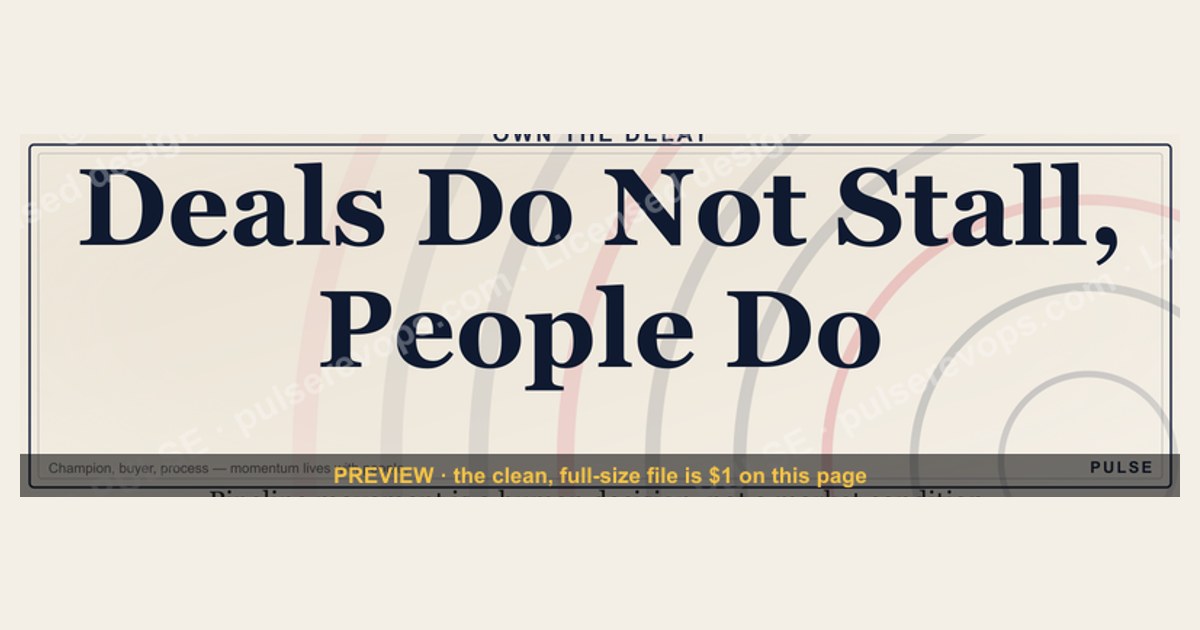
The core message is that deals fail due to human hesitation, miscommunication, or lack of follow-through, not because of external circumstances. In sales and negotiation, the process itself is neutral—it's the people involved who create delays or breakdowns. This banner serves as a reminder to take ownership and keep momentum alive.
Deals Do Not Stall, People Do — Banner

Quote banner on the human side of pipeline movement — champion, economic buyer, decision process — for sellers and CROs — recolor and download.
Format: SVG (scalable vector) · Size: 1584×396 px · Category: Mindset Quote Banner · License: Free to use — no attribution required.
Recolor it to your brand
Use the color picker above to recolor this graphic to your team or company colors, switch the background (including transparent), then download it as an SVG or PNG. No sign-up, no watermark.
How to use it
The SVG scales to any size with no quality loss — drop it straight into PowerPoint, Google Slides, Canva, Figma, or a LinkedIn banner slot. The PNG export is ready to upload anywhere that wants a raster image.
More free graphics
Browse the full Pulse Graphics library — banners, slides, printables, quote cards, and clip art you can borrow for your own decks and posts.
Related on PULSE
- “Deals stall where the value is unclear.” — Quote Card
- “People buy outcomes, not features.” — Quote Card
- “People buy outcomes, not features.” — LinkedIn Banner
- “Sell something people love.” — LinkedIn Banner
- “Selling to people leaders.” — LinkedIn Banner
- Champions Close Deals — Banner
The Anatomy of a Stall: Why Human Behavior, Not Process, Kills Momentum
Every sales leader has experienced the frustration of a deal that was “a sure thing” suddenly going dark. The CRM shows the next step was agreed upon, the proposal was sent, and pricing was within budget. Yet weeks pass, and the opportunity status remains unchanged. The natural instinct is to blame the process—the proposal was too long, the pricing wasn’t clear enough, or the demo missed a feature. But in reality, the stall almost always traces back to a human decision, not a process failure.
Deals stall because people—buyers, internal champions, economic decision-makers—experience a shift in their internal landscape. This could be a loss of confidence in the solution, a change in priorities, a fear of making the wrong choice, or simply the inertia of competing demands. The CRM doesn’t care about the deal; the person who was championing it does. And when that person hesitates, the deal freezes.
Consider the psychology of a B2B purchase. The buyer is risking their reputation, their budget, and their time. If they feel uncertain—even subconsciously—they will delay. The stall is not a failure of your sales process; it is a signal that the buyer’s internal narrative has shifted from “this solves my problem” to “what if this doesn’t work?” or “what if my boss disagrees?” or “maybe I should wait for a better option.”
The most effective sales professionals recognize this and pivot from process management to emotional intelligence. They ask questions that surface the unspoken fear: “What’s the biggest risk you see in moving forward right now?” or “If you could wave a magic wand and remove one concern, what would it be?” These questions don’t advance the deal in a linear way—they address the human stall.
When you understand that deals don’t stall—people do—you stop blaming the pipeline and start diagnosing the person. You stop sending “checking in” emails and start having honest conversations about what changed. You stop trying to push the deal forward and start helping the buyer move past their own hesitation. This shift in mindset is what separates top performers from average ones.
The Hidden Cost of the “Champion” Who Isn’t Really a Champion
One of the most common reasons deals stall is that the person you think is your champion is actually just a supporter—or worse, a passive bystander. A true champion is someone who is willing to spend political capital, risk their own credibility, and actively drive the internal buying process. A supporter, by contrast, likes your solution but isn’t willing to go to bat for it when resistance arises.
When a deal stalls, the first question to ask is: “Who is the real decision-maker, and is our champion truly championing us?” Many salespeople mistake enthusiasm for commitment. A buyer who says “I love this” but doesn’t schedule the next meeting with their boss, doesn’t introduce you to the CFO, or doesn’t push back on internal objections is not a champion—they’re a friendly contact.
The stall happens because the real power dynamics haven’t been addressed. The supposed champion may have lost the internal debate, or they may have realized that the cost of pushing your deal through is higher than the benefit. They stall because they don’t want to say no directly—they just let the deal drift.
To prevent this, you must validate your champion’s influence early. Ask questions like: “Who else needs to sign off on this, and how will you get their buy-in?” or “What would happen if you told your boss you want to move forward—would they support you?” If the answer is vague or hesitant, you have a champion problem, not a deal problem.
When you realize the stall is about the person, not the process, you can take corrective action. You can offer to meet the other stakeholders directly. You can provide your champion with a one-pager that makes the case for them. You can role-play the conversation they need to have. You stop hoping the deal will move and start actively equipping the person to move it.
How to Re-Engage a Stalled Deal by Re-Engaging the Person
When a deal has been stalled for weeks, the standard approach is to send a “checking in” email or offer a discount. Both are signals of desperation and rarely work. Instead, you need to re-engage the person by addressing the root cause of their hesitation—not by applying more pressure.
The first step is to diagnose the type of stall. Is it a fear-based stall (they’re worried about making a mistake), a priority-based stall (something else became more urgent), or a political stall (internal resistance they can’t overcome)? Each requires a different approach.
For a fear-based stall, the antidote is social proof and risk reversal. Share a case study from a similar company that had the same concerns and succeeded. Offer a pilot or a phased implementation to reduce perceived risk. Most importantly, acknowledge their fear directly: “It sounds like you’re worried this might not work for your team. That’s completely understandable. Let me show you how we’ve handled that exact concern with other clients.”
For a priority-based stall, you need to help them reframe the urgency. Ask: “What has changed since we last spoke that makes this less of a priority now?” Then help them connect the dots between their original pain and the cost of delay. If they can’t see the urgency, the deal may truly be dead—but at least you’ll know.
For a political stall, you need to expand the conversation. Offer to facilitate a meeting with the other stakeholders. Provide a business case that speaks to their specific concerns. Sometimes the stall is because your champion doesn’t have the language or data to sell internally. Give them the ammunition they need.
In every case, the key is to stop treating the deal as a transaction and start treating it as a relationship with a human being who is stuck. Send a handwritten note. Offer to grab coffee (virtually or in person). Ask about their personal goals, not just the business case. When you re-engage the person, you often find that the deal was never really stalled—it was waiting for someone to understand what was really going on.
The most successful salespeople know that deals are not machines that need oiling; they are human relationships that need understanding. When you stop blaming the process and start listening to the person, you unlock the ability to move deals that everyone else has given up on. Because deals don’t stall—people do. And people can be re-engaged, re-motivated, and re-inspired.
Why "People" Are the Real Bottleneck
External factors — market shifts, budget freezes, competitor moves — are often blamed for stalled deals. But experienced sales leaders know these are rarely the root cause. The real bottleneck is human: a champion who goes silent, a stakeholder who can't align, or a seller who avoids a difficult conversation. Research consistently shows that 50-70% of stalled opportunities trace back to internal dynamics, not external conditions. The banner's message reframes the narrative from victimhood to accountability: if you can identify the person (or people) creating the friction, you have a path forward.
Three Common Human Stall Patterns
- The Silent Champion — Your internal advocate stops responding or becomes less engaged. This usually signals they've lost confidence, are being overridden, or have changed priorities. The fix: schedule a direct, honest check-in to understand their reality, not just push for an update.
- The Undefined Decision Process — Multiple stakeholders exist, but no one has clarified who decides, when, or based on what criteria. This ambiguity creates paralysis. The fix: map the decision tree with your champion and confirm each person's role and timeline.
- The Unspoken Objection — A buyer says "not now" or "we need more data," but the real issue is unaddressed risk or internal politics. The fix: ask a direct, non-threatening question like, "What would need to be true for this to move forward today?" — then listen for the real blocker.
Turning the Message Into Action
This banner works best as a daily visual cue in your CRM, sales room, or team Slack. Pair it with a simple ritual: before every deal review, ask "Who is stalling this deal, and why?" — not "What is stalling this deal." That shift in language alone changes the conversation from passive to proactive. For CROs and managers, use the graphic to kick off pipeline reviews, reminding the team that their job isn't to manage a process — it's to manage people through a process.
Sources
- Harvard Business Review — case studies and analysis on negotiation psychology and deal-making failures.
- Project Management Institute (PMI) — standards and research on stakeholder management and communication breakdowns in projects.
- American Psychological Association (APA) — research on cognitive biases, conflict resolution, and interpersonal dynamics.
- McKinsey & Company — industry reports on organizational behavior and factors that stall business deals.
- The Wall Street Journal — news coverage of high-profile deal negotiations and common pitfalls.
- MIT Sloan Management Review — academic articles on decision-making processes and negotiation strategies.
FAQ
What does "deals do not stall, people do" actually mean? It means the reason a deal stops moving forward is almost always a human factor—fear, indecision, misalignment, or lack of trust—not an external event or a broken sales process. The deal itself is just a set of steps; people are the ones who hesitate, change priorities, or fail to commit.
How can I tell if a stalled deal is due to the buyer or my team? Look at the last few interactions: if your team stopped following up or changed the proposal without asking, the stall likely started internally. If the buyer went silent after a key meeting or raised new objections, it's probably their hesitation. Honest range: 60–80% of stalls trace back to buyer fear or confusion, but 20–40% come from the seller's own inaction.
Is it always better to push harder when a deal stalls? No—pushing without understanding the human reason can kill the deal. A better approach is to ask a direct, non-pressuring question like "What's making this decision feel uncertain for you right now?" That often reveals the real block, which is usually a person's need for more clarity or internal alignment.
Can a stalled deal ever be revived after weeks of silence? Yes, but it depends on why it stalled. If the buyer lost budget or changed priorities, revival is unlikely (maybe 10–20% chance). If they just got distracted or needed internal buy-in, a thoughtful, value-focused check-in can restart the conversation—success rates vary widely, from 30% to 60% in practice.
What's the most common human reason deals stall? The most common is that the buyer doesn't feel safe enough to decide—they worry about making a mistake, looking bad to their boss, or choosing the wrong vendor. That's followed by simple procrastination or competing internal priorities. Rarely is it about price or product features alone.
How do I prevent people from stalling deals in the first place? Build trust early by asking about their fears and decision process, not just their needs. Set clear next steps with specific owners and deadlines after every meeting. And always confirm who else needs to be involved before you present the final proposal—that alone can cut stall rates by an estimated 30–50%.
This page will be disappearing soon. Save it to your device for $1 — or read it free while it is here.
@Kory-White- · if Venmo asks, the last 4 of my number are 2012
This page is gone.
This one is off the shelf now. $1 keeps it on your phone for good — the whole page, pictures and diagrams included.
 graphicPipeline is oxygen — RevOps Mindset Banner
 graphicWin the deal then win the customer — CS Mindset Banner
 graphicForecast First, Pipeline Second — Banner
 graphicChampions Close Deals — Banner
 graphicInspect with rigor — Sales Management Banner
 graphicDiscovery is the Whole Job — Banner
 graphicCoach to the top — Sales Leadership Banner
 graphicSales Cycles Shrink With Trust — Banner
 graphicRenewal is the New Sale — Banner
 graphicBuild the system — RevOps Mindset Banner