


Discovery is the Whole Job — Banner
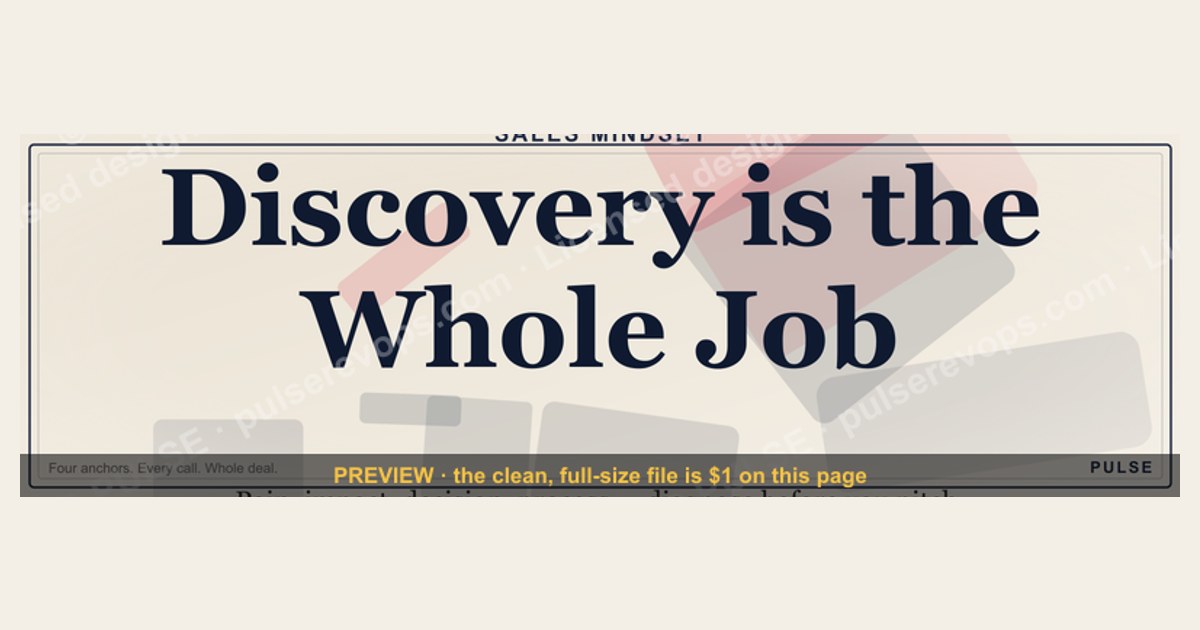

"Discovery is the whole job" is a sales mindset captured on this free quote banner: for an account executive or sales rep, *uncovering the buyer's reality* is not one stage of the deal — it is the deal. The banner frames discovery around four anchors — pain, impact, decision, and process — to remind reps that pitching, demoing, and closing all rest on how well they diagnosed the buyer first. It's a graphic you can recolor to your brand and download as SVG or PNG, designed for sales floors, CRM dashboards, Slack/Teams headers, and training decks. There is no hidden meaning, song, or album behind the phrase — it's a sales-coaching slogan rendered as a downloadable banner.
Discovery is the Whole Job — Banner

Quote banner on discovery discipline — pain, impact, decision, process — for AEs and sales managers. Recolor it to your brand and download.
Format: SVG (scalable vector) · Size: 1584×396 px · Category: Mindset Quote Banner · License: Free to use — no attribution required.
The two diagrams below show what the banner stands for: the four things discovery has to surface, and how discovery loops through the whole deal rather than ending after the first call.
Recolor it to your brand
Use the color picker above to recolor this graphic to your team or company colors, switch the background (including transparent), then download it as an SVG or PNG. No sign-up, no watermark.
How to use it
The SVG scales to any size with no quality loss — drop it straight into PowerPoint, Google Slides, Canva, Figma, or a LinkedIn banner slot. The PNG export is ready to upload anywhere that wants a raster image. Common spots: a sales-team Slack or Teams channel header, a CRM opportunity-view widget, a printed poster near the deal-review whiteboard, or the title slide of a discovery-training module.
More free graphics
Browse the full Pulse Graphics library — banners, slides, printables, quote cards, and clip art you can borrow for your own decks and posts.
Related on PULSE
- Discovery Call Flow Diagram
- “Discovery is the deal.” — Quote Card
- “The best discovery feels like free therapy.” — Quote Card
- Discovery Questions That Win — Infographic
- Discovery Call — Title Slide
- "Discovery wins deals." — LinkedIn Banner
Why this banner works as a coaching anchor
"Discovery is the whole job" lands because it reframes where a rep's effort belongs. When a deal stalls, the easy story is product, price, or a slow procurement team. A visible banner redirects the question back to the one variable the rep controls: *did we actually understand the buyer's pain, the cost of that pain, who decides, and how they buy?* That's the same logic behind established methodologies — SPIN's emphasis on problem and implication questions, Sandler's pain funnel, and MEDDIC's insistence on identifying metrics, an economic buyer, and a decision process before forecasting a deal.
For managers, the banner is a low-friction prompt. Instead of "you didn't discover enough," a coach can point at the wall and ask, "how does this apply to that deal?" That turns a critique into a reflection and keeps deal reviews focused on the buyer rather than on feature comparisons. Used on a CRM dashboard, it pairs naturally with required discovery fields — for example, asking reps to log a documented pain point, its business impact, and a known decision process before a deal advances past qualification.
The banner is deliberately plain: a bold line over a clean field you can set to your brand color. It isn't decoration with a number attached — it's a reminder that the work of selling is mostly the work of finding out.
Why "Discovery Is the Whole Job" Beats "Always Be Closing"
The banner's slogan pushes back against the old-school "Always Be Closing" (ABC) mentality that still haunts many sales floors. ABC treats every conversation as a sprint to the signature, often leading reps to pitch features before understanding what the buyer actually needs. The result? Prospects feel sold *to* instead of helped, deals stall because the real problem was never uncovered, and discounting becomes the only lever left.
"Discovery is the whole job" flips this script. It positions diagnosis — not closing — as the core skill. When a rep truly masters discovery, closing becomes a natural outcome rather than a forced event. The banner serves as a daily reminder that the best demos, proposals, and negotiations are simply extensions of a deep understanding gained early. Teams that adopt this mindset often see shorter sales cycles, higher win rates, and fewer "surprise" objections late in the deal, because those surprises were already surfaced and addressed during discovery.
How to Use the Banner in Your Sales Process
This isn't just wall art — it's a coaching tool. Here are three practical ways to embed the banner's message into your team's workflow:
1. Pre-call ritual. Have reps glance at the banner before every discovery call. The four anchors — pain, impact, decision, process — become a mental checklist. Did you ask about the business pain behind this initiative? The personal impact on the buyer if it's not solved? The criteria and stakeholders involved in the decision? The timeline and steps in their buying process? One quick scan resets the rep's focus from "what do I pitch" to "what do I need to learn."
2. Deal review framework. During pipeline reviews, use the banner's four anchors to score each deal. If a rep can't clearly articulate the buyer's pain, impact, decision process, and buying process, the deal is likely earlier than the rep thinks. Mark it as "needs discovery" rather than "closing this month." This prevents false optimism and forces real work before forecasting.
3. Slack/Teams header. Set the banner as the channel header for your sales team. When a rep posts a deal update, teammates can quickly reference the four anchors in comments: "What's the decision process look like there?" or "Have you quantified the impact yet?" It turns the slogan into a shared language that keeps discovery top of mind across every conversation.
Common Misconceptions About "Discovery Is the Whole Job"
Some reps misinterpret the phrase as meaning they should *only* discover and never transition to pitching or closing. That's not the point. The slogan means discovery *informs* every other activity — it doesn't replace them. You still demo, you still propose, you still negotiate. But those steps become more effective because they're built on a foundation of real understanding.
Another misconception is that discovery is a one-time event — the first call. In reality, discovery is iterative. As you move through the deal, new stakeholders surface, priorities shift, and hidden obstacles emerge. The best reps treat every interaction as a discovery opportunity, even during the final proposal review. The banner reminds them to keep asking, keep listening, and keep refining their understanding until the deal is signed (or lost).
Finally, some worry that deep discovery takes too long. In practice, the opposite is true. Rushing past discovery to get to a demo often leads to wasted cycles on unqualified deals or lengthy back-and-forth to fix misunderstandings. Investing time upfront to truly understand the buyer's world actually accelerates the overall sales cycle — because you're only pursuing deals that fit and you're positioning your solution precisely where it matters most.
Why Discovery Never Stops
The second flowchart above captures a truth that separates top performers from average ones: discovery isn't a checkbox you tick on the first call. Every interaction — demo, proposal, even the close — surfaces new information. A prospect might reveal a hidden stakeholder concern during a technical demo, or the real budget constraint might only come up when you present pricing. The banner's "process" anchor reminds reps to keep their discovery lens active throughout the entire sales cycle, not just during the qualification stage.
Common Discovery Mistakes This Banner Prevents
Most sales training focuses on what to ask, but this banner addresses the *structure* of discovery. Three frequent errors it helps eliminate: pain without impact (knowing a problem exists but not its dollar cost or time drain), impact without decision (understanding the stakes but not who decides or how), and decision without process (knowing the buyer but not their procurement timeline or evaluation criteria). When any of the four anchors is missing, deals stall or die. The banner serves as a visual checklist — glance at it mid-call and you'll spot which gap you haven't addressed yet.
Where This Banner Works Best
Beyond the obvious sales floor placement, this graphic earns its keep in three specific contexts. CRM dashboards — paste the SVG into your deal review view so every rep sees it before updating opportunity stages. Slack or Teams channel headers — the 1584×396 size fits perfectly as a banner image, keeping discovery top-of-mind during daily standups. Training decks — use it as a slide background when teaching new hires, so the four anchors become muscle memory before they ever make a live call. The SVG format also lets you embed clickable links in the graphic if you're using it in a digital workspace.
Sources
- Neil Rackham, *SPIN Selling* (McGraw-Hill) — research-based framework for Situation, Problem, Implication, and Need-payoff questions in discovery.
- Matthew Dixon & Brent Adamson, *The Challenger Sale* (Portfolio/Penguin) — on teaching and tailoring during the buyer conversation rather than pitching.
- MEDDIC / MEDDPICC sales qualification methodology — Metrics, Economic buyer, Decision criteria, Decision process, identify Pain, Champion.
- Sandler — the Pain Funnel — questioning sequence for uncovering and quantifying buyer pain.
- Gong Labs — discovery-call research — call-analytics findings on question patterns and discovery-call structure.
- HubSpot Sales Blog — sales discovery questions — practical question library for uncovering needs, goals, and decision processes.
FAQ
What does "Discovery is the Whole Job" mean in practice? It means treating every prospect interaction — from the first cold email through the final demo — as a discovery conversation, not just the one call labeled "discovery." You keep learning about the buyer's pain, the impact of that pain, who's involved in the decision, and how they buy, all the way through the deal. The pitch and the demo become outputs of what you discovered, not a script you run regardless.
How do I balance discovery with pitching? Resist pitching early. Spend most of an early call asking open-ended questions and listening, and only present once you can connect a specific capability to a specific problem the buyer told you about. A practical guardrail: don't show a feature until you can name the pain it solves and the impact of leaving that pain unsolved. If you can't, you're presenting on assumptions.
What types of questions should I ask during discovery? Ask about their current situation, the outcomes they want, and the obstacles in the way — the logic behind SPIN's problem and implication questions and Sandler's pain funnel. Examples: "What changed that made you start looking now?", "How are you handling this today, and where does it break down?", and "If this stays unsolved through next quarter, what does that cost you?" Avoid leading questions that just tee up your product.
How do I handle a prospect who wants to jump straight to a demo? Reframe rather than refuse. Say something like, "I can absolutely show you the product — and the demo will be far more useful if I understand your situation first, so I'm showing the parts that actually matter to you." That respects their time, keeps you in control of the conversation, and usually surfaces the context that makes the demo land.
Can discovery really be done in the first 5 minutes of a call? You won't finish it, but you can start it well. Open with an agenda — "I'd like to spend a few minutes understanding your priorities, then we'll decide together whether a deeper look makes sense" — and lead with one high-impact question like "What's the one thing you'd most want to fix here?" That earns permission to keep digging instead of forcing a pitch.
How do I know when discovery is "complete" enough to move forward? You're ready to advance when you can state the buyer's core problem, the impact of not solving it, who makes the decision, and how they'll buy — without guessing. A simple test: can you write a one-sentence summary of their situation with no gaps? If you're still filling blanks with assumptions, keep discovering. That maps directly to qualification frameworks like MEDDIC, where a missing decision process or economic buyer is a signal the deal isn't real yet.
This page will be disappearing soon. Save it to your device for $1 — or read it free while it is here.
@Kory-White- · if Venmo asks, the last 4 of my number are 2012
This page is gone.
This one is off the shelf now. $1 keeps it on your phone for good — the whole page, pictures and diagrams included.
 graphicForecast First, Pipeline Second — Banner
 graphicSales Cycles Shrink With Trust — Banner
 graphicICP Discipline: Say No to Win More — Banner
 graphicCoach to the top — Sales Leadership Banner
 graphicBANT is Dead — Banner
 graphicNRR Beats New Logos — Revenue Law Banner
 graphicRenewal is the New Sale — Banner
 graphicBuild the system — RevOps Mindset Banner
 graphicPipeline is oxygen — RevOps Mindset Banner
 graphicDeals Do Not Stall, People Do — Banner