


Sales Funnel — 4 Stages
Quality
Certified
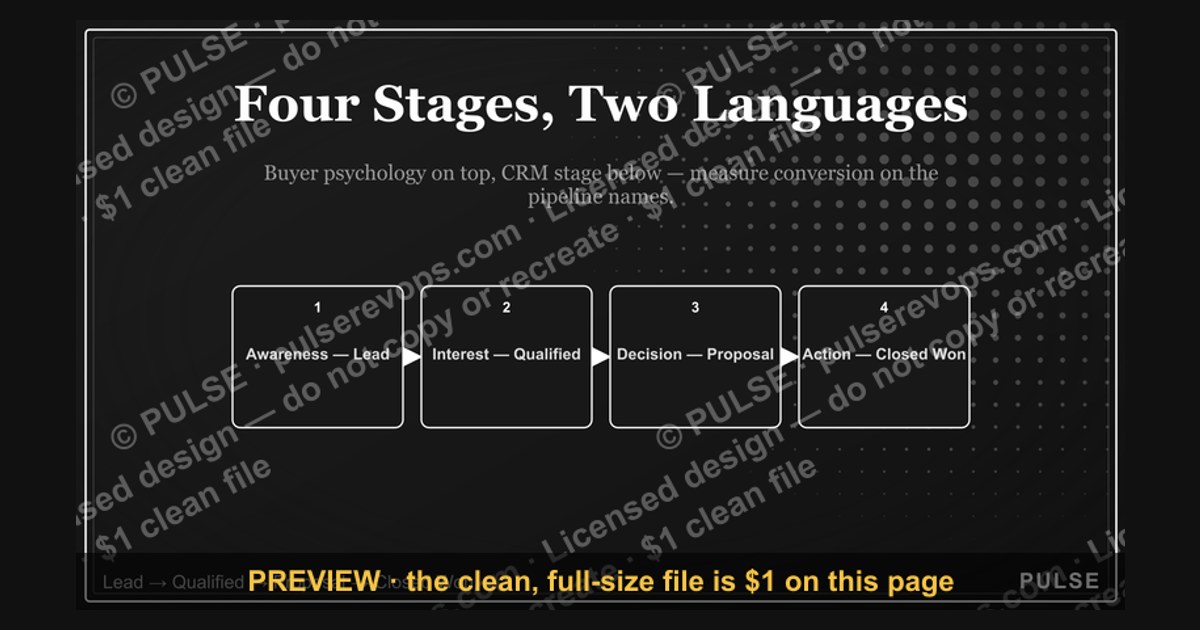
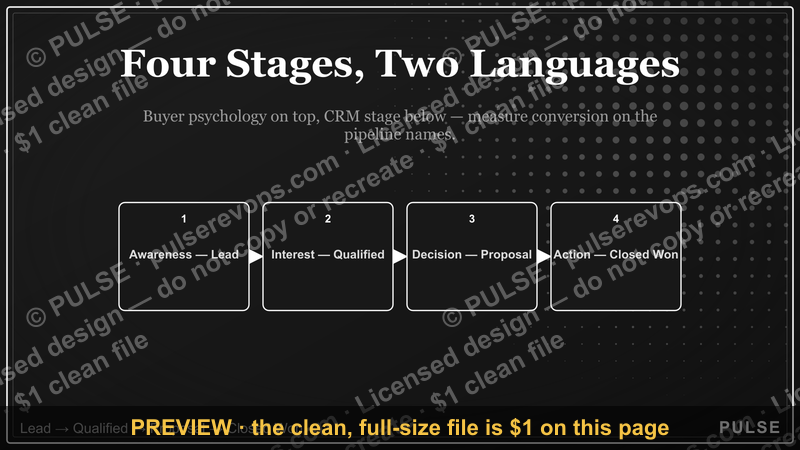
A sales funnel has four stages: Awareness, Interest, Decision, and Action — the classic marketing model (AIDA), which maps directly onto the operational sales pipeline most teams run as Lead → Qualified → Proposal → Closed Won.
- Awareness (Lead): a prospect first encounters your product through search, ads, referral, or outreach and enters the funnel as a lead.
- Interest (Qualified): the prospect engages — reads content, replies, books a call — and you confirm genuine need and decision-maker access.
- Decision (Proposal): the prospect evaluates options against a quote, demo, or proof of concept and weighs the purchase.
- Action (Closed Won): the deal is signed and the transaction completes.
The two naming systems describe the same journey from different vantage points: Awareness/Interest/Decision/Action is the buyer's psychology, while Lead/Qualified/Proposal/Closed Won is the CRM stage the deal sits in. Throughout this guide we use the pipeline names, because that is what you measure conversion against.
Sales Funnel — 4 Stages

4-stage sales funnel (Lead → Qualified → Proposal → Closed Won) banner with conversion arrows + percentages.
Format: SVG (scalable vector) · Size: 1584×396 px · Category: Funnel · License: Free to use — no attribution required.
The first diagram shows the four stages and the AIDA names that map to each. The second shows how a typical cohort thins out as it moves down the funnel — the shrinking shape that gives the funnel its name.
Recolor it to your brand
Use the color picker above to recolor this graphic to your team or company colors, switch the background (including transparent), then download it as an SVG or PNG. No sign-up, no watermark.
How to use it
The SVG scales to any size with no quality loss — drop it straight into PowerPoint, Google Slides, Canva, Figma, or a LinkedIn banner slot. The PNG export is ready to upload anywhere that wants a raster image.

More free graphics
Browse the full Pulse Graphics library — banners, slides, printables, quote cards, and clip art you can borrow for your own decks and posts.
Common Sales Funnel Mistakes That Kill Conversion
Even a well-built 4-stage funnel leaks revenue when foundational errors go unchecked. The most frequent ones cluster around three areas: qualification criteria, handoff timing, and stage velocity.

Over-qualifying too early. Many teams pile rigid requirements — firmographic fit, budget, authority, timeline — onto the Lead→Qualified stage before the prospect has even understood the value proposition. That starves the later stages. A cleaner approach is two-tier qualification: Tier 1 checks only for genuine need and decision-maker access; Tier 2 adds budget and authority *after* the prospect engages with a demo or proposal. Teams that delay budget questions until interest is established generally push more leads into Proposal without hurting close rates.
No lead-to-qualified handoff SLA. When marketing passes a lead to sales with no defined response time, conversion drops sharply. The widely cited Lead Response Management Study (Oldroyd, MIT) found that contacting a web lead within five minutes makes it far more likely to be qualified than waiting even 30 minutes, and odds fall steeply after the first hour. Yet many organizations still rely on daily batch transfers. A simple rule — *all inbound leads contacted within one business hour* — is one of the highest-leverage changes a funnel can make.

Ignoring stage-specific velocity. Most teams track overall conversion but not how long deals linger in each stage. A deal that sits in Qualification for two weeks is far less likely to convert than one worked in a few days. Set maximum stage durations (for example, 5 business days for Lead→Qualified, 10 for Qualified→Proposal, 7 for Proposal→Closed Won) and trigger an escalation or re-qualification review when a deal exceeds them. Aging thresholds keep the pipeline honest and shorten the average cycle.

Treating all leads equally. A referral or returning customer typically converts faster and at a higher rate than a cold inbound lead, yet many funnels run everyone through the same cadence. Create a separate high-trust track with faster follow-up and fewer hurdles so warm relationships aren't slowed to the speed of cold ones.
Not diagnosing where the drop-off is. If most leads die between Qualified and Proposal, the problem usually isn't lead quality — it's the proposal: too generic, mispriced against perceived value, or missing a clear next step. Audit every lost proposal with three questions: (1) Did the prospect understand the ROI? (2) Was the price defensible within their budget? (3) Was there a clear next step and date? Fixing those three recovers deals you were already paying to generate.
How to Build a Funnel That Forecasts Revenue

A 4-stage funnel becomes a forecasting tool once you layer in your own historical conversion rates and stage probabilities. Without that data it's just a diagram. Use your numbers, not benchmarks.
Step 1 — Calculate stage-to-stage conversion. Pull 6–12 months of deal data and compute the percentage that moved from each stage to the next. If 1,000 leads entered, 300 became Qualified, 150 reached Proposal, and 60 Closed Won, your rates are Lead→Qualified = 30%, Qualified→Proposal = 50%, Proposal→Closed Won = 40%. Those are your baselines.

Step 2 — Weight each stage by value. Multiply average deal size by the cumulative probability of closing from that stage. With a $10,000 average deal and the rates above, a Qualified lead is worth $10,000 × (50% × 40%) = $2,000, and a Proposal is worth $10,000 × 40% = $4,000. Summing across open deals gives expected pipeline value at any moment.
Step 3 — Add velocity. Track average days in each stage. If 20 deals sit in Proposal at a 40% close rate, you can expect roughly 8 to close — and the average Proposal duration tells you *when*.
Step 4 — Watch leading indicators. Instead of waiting on closed-won revenue, monitor new leads entering, qualification rate, and proposal velocity. A drop in qualification rate (say 30% to 20%) signals a lead-quality or process problem that will hit revenue weeks later — early enough to react.

Step 5 — Run cohort analysis. Group leads by channel (organic, paid, referral) and track funnel performance over time. You'll often find one channel converts at a lower rate but far faster, which changes how you allocate budget between cash flow and lifetime value.
Step 6 — Score pipeline health. Combine conversion probability, velocity, and deal age into a single 0–100 score. Flag low scorers for re-qualification or removal so stale deals stop inflating the forecast and giving false confidence.
The payoff is forecast accuracy. Teams that enforce stage deadlines and prune aged deals consistently report tighter, more reliable forecasts than teams running the same funnel on gut feel.
Adapting the Funnel for B2B, B2C, and Enterprise

The classic 4-stage funnel is not one-size-fits-all. Each model needs different emphasis at each stage.
B2B (SMB). The Lead stage is the leakiest — busy decision-makers ignore generic outreach. Optimize for relevance with firmographic personalization, and at Qualified focus on finding the actual budget holder, not just a friendly champion. A simple stakeholder "power map" (who influences, who decides, where they stand) lifts Proposal→Closed Won rates.
B2C (high-volume, low-ticket). Speed and simplicity rule. Capture intent with minimal friction (one-click or social login), automate qualification against your target demographic, and make the Proposal a product or pricing page with genuine urgency and social proof. The whole funnel can compress into a single session; stage conversion is higher but deal sizes are smaller, so optimize for volume and repeat purchase.
Enterprise (high-ticket, long cycle). The funnel stretches for months. Qualification becomes rigorous — BANT plus technical fit and competitive landscape — and the Proposal stage is a sequence (demo, proof of concept, security review, legal) rather than one document. Proposal→Closed Won is the most variable stage, swinging widely depending on how well internal champions and objections are managed. A "deal desk" that reviews large proposals for pricing, terms, and positioning brings consistency.
Hybrid (B2B2C, marketplaces). These need a two-sided funnel — one for suppliers, one for buyers. Supplier Leads are vetted on inventory and quality; buyer Leads on search intent. The two sides are coupled: if supplier quality drops, buyer conversion at Proposal suffers, so monitor both on one dashboard.
Directional conversion ranges by model (use as a sanity check, then replace with your own numbers):
| Model | Lead→Qualified | Qualified→Proposal | Proposal→Closed Won | Typical Cycle |
|---|---|---|---|---|
| B2B SMB | 20–35% | 40–60% | 30–50% | 30–60 days |
| B2C | 50–80% | 60–80% | 30–50% | Same session to 7 days |
| Enterprise | 10–25% | 20–40% | 10–60% | 3–12 months |
| Hybrid (B2B2C / Marketplace) | Varies by side | Varies by side | Transaction-based | Weeks to months |
These are illustrative planning ranges, not guarantees — your real rates depend on industry, price point, and channel.
Related on PULSE
- Sales Funnel — 7 Stages
- Sales Funnel — 5 Stages
- SaaS Sales Cycle Stages
- Pipeline Stages — Icon / Clip Art
- 5 Stages of a Healthy Pipeline — Infographic
- 5 Stages of the Buyer's Journey — Infographic
Sources
- HubSpot — What Is a Sales Funnel? Stages, definitions, and best practices
- Salesforce — Sales pipeline stages and CRM process frameworks
- Harvard Business Review — "The Short Life of Online Sales Leads" (lead-response timing research)
- Lead Response Management Study — Oldroyd, Kellogg/MIT (five-minute response window)
- Gartner — B2B buying journey and sales process research
- American Marketing Association — marketing and sales funnel definitions
FAQ
What exactly is a sales funnel? A sales funnel maps the journey a prospect takes from first learning about your business to making a purchase. It's divided into stages that represent rising interest and commitment, so you can see where prospects drop off and where to focus effort.
How many stages should a sales funnel have? Most models use 3 to 5 stages, with 4 being the most common (Awareness, Interest, Decision, Action — or Lead, Qualified, Proposal, Closed Won). The right number depends on product complexity and cycle length: simple purchases need fewer stages, high-ticket sales often need more.
Do all leads move through every stage? No — many drop out at each stage. Only a fraction of people who become aware will show interest, and a smaller share will buy. That natural attrition is exactly why the shape is a funnel rather than a pipe.
How long does it take a lead to move through the whole funnel? It ranges from minutes for low-cost impulse purchases to several months for B2B or high-consideration deals. The timeline depends on your industry, the buyer's urgency, and how effectively you nurture them at each stage.
What's the biggest mistake businesses make with their funnel? Pouring effort into the top (generating awareness) while neglecting the middle and bottom — follow-up, qualification, and closing. Strong top-of-funnel traffic with weak nurturing leaks most of the revenue it generates.
How do I measure if my funnel is working? Track the conversion rate between each stage — what percentage of leads become qualified, qualified become proposals, and proposals close. Watch for the single stage with the steepest drop-off; that's your bottleneck. Compare against your own historical rates first, and treat published benchmarks as rough context rather than targets.
Recently Added — Related
This page will be disappearing soon. Save it to your device for $1 — or read it free while it is here.
@Kory-White- · if Venmo asks, the last 4 of my number are 2012
This page is gone.
This one is off the shelf now. $1 keeps it on your phone for good — the whole page, pictures and diagrams included.
 graphicABM Funnel Inverted
 graphicSales Funnel — 7 Stages
 graphicCustomer Lifecycle Funnel
 graphicPLG Conversion Funnel
 graphicSales Funnel — 5 Stages
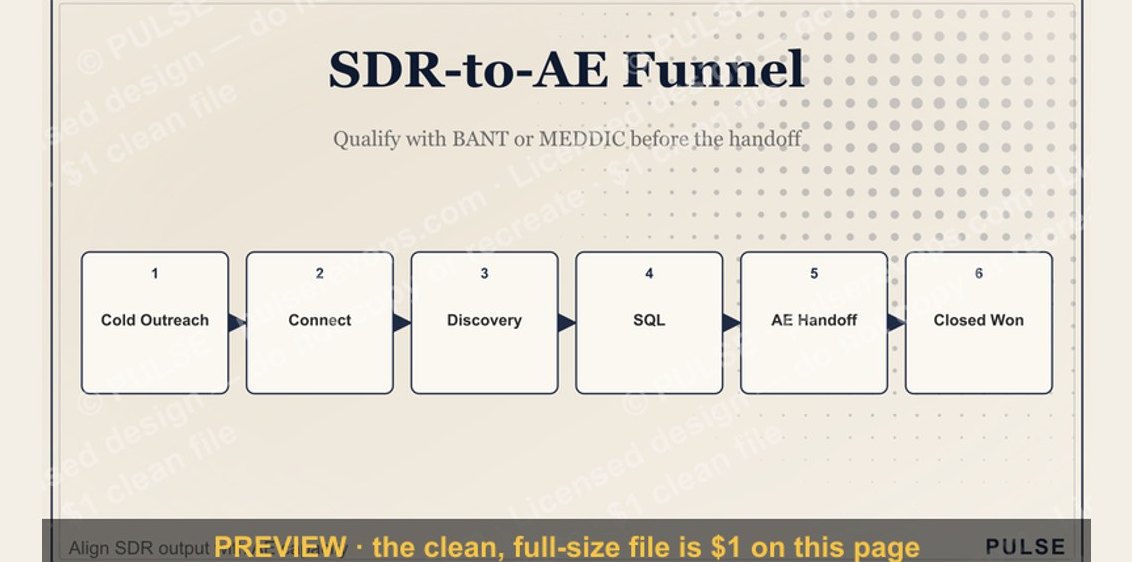 graphicSDR-to-AE Funnel
 graphicMarketing Funnel — TOFU MOFU BOFU
 graphicThe Customer Journey — Infographic
 graphicTarget / Goal Icon — Icon / Clip Art
 graphic“Revenue follows relationships.” — Quote Card