


Sales Funnel — 7 Stages
Quality
Certified
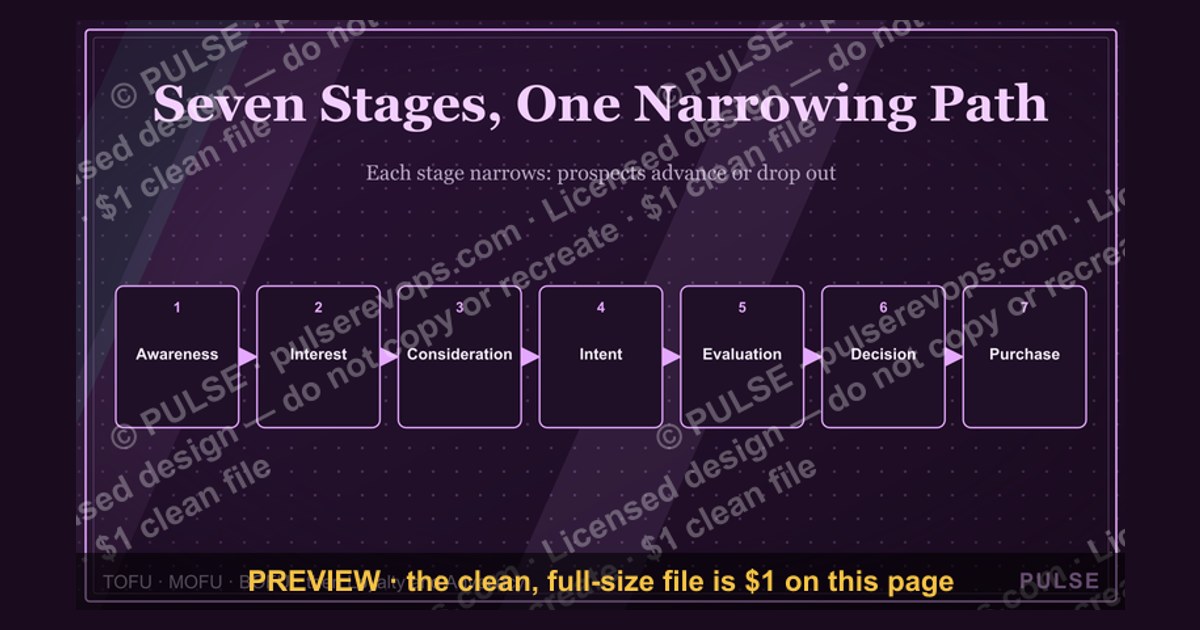
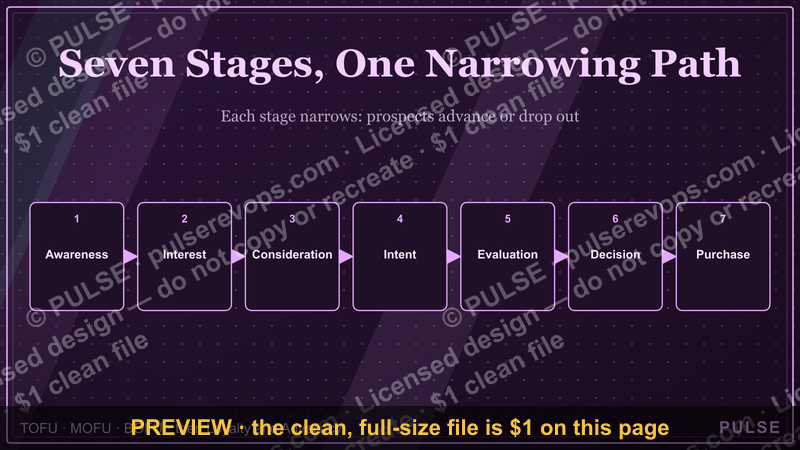
A seven-stage sales funnel maps the buyer's journey from first contact to a committed purchase, narrowing at each step as casual prospects either advance or drop out. The seven stages are Awareness, Interest, Consideration, Intent, Evaluation, Decision, and Purchase. Awareness is where a prospect first encounters your brand; Interest is when they engage with your content; Consideration is active comparison against alternatives; Intent is a signal of buying readiness (a pricing-page visit or trial sign-up); Evaluation is the formal vetting of your offer or proposal; Decision is the moment of commitment; and Purchase is the transaction itself. Many teams add an eighth, post-purchase stage — Loyalty and Advocacy — because retention and referrals are where customer lifetime value is actually built. Throughout this page, those same seven stage names are used consistently so the metrics, examples, and diagrams all line up.
Sales Funnel — 7 Stages

A 7-stage sales funnel — from broad awareness at the top down to a closed purchase at the bottom — rendered as a clean, deck-ready visualization.
Format: SVG (scalable vector) · Size: 1584×396 px · Category: Funnel · License: Free to use — no attribution required.
Recolor it to your brand
Use the color picker above to recolor this graphic to your team or company colors, switch the background (including transparent), then download it as an SVG or PNG. No sign-up, no watermark.

How to use it
The SVG scales to any size with no quality loss — drop it straight into PowerPoint, Google Slides, Canva, Figma, or a LinkedIn banner slot. The PNG export is ready to upload anywhere that wants a raster image.
More free graphics

Browse the full Pulse Graphics library — banners, slides, printables, quote cards, and clip art you can borrow for your own decks and posts.
Related on PULSE
- Sales Funnel — 5 Stages
- Sales Funnel — 4 Stages
- SaaS Sales Cycle Stages
- Pipeline Stages — Icon / Clip Art
- 5 Stages of a Healthy Pipeline — Infographic
- 5 Stages of the Buyer’s Journey — Infographic
Common Sales Funnel Mistakes and How to Fix Them
Even with a clear grasp of the seven stages, most businesses leak revenue through subtle but costly funnel errors. Catching these early is often the difference between a funnel that converts at 2–3% and one that reaches 5–8% or higher.
Mistake 1: Treating all leads the same. A visitor who downloaded a pricing guide is not the same as one who only skimmed a blog post. Yet many companies route both into identical email sequences. The fix is to segment by behavior and intent. A simple lead-scoring model — assigning points for page visits, content downloads, and email clicks — helps you prioritize the Interest- and Consideration-stage leads who are actually worth a rep's time.
Mistake 2: Over-optimizing the top while neglecting the bottom. It's common to pour the bulk of a marketing budget into Awareness-stage traffic, then wonder why the close rate stays low. A few points of improvement at the Decision stage often produces more revenue than a large bump in raw traffic, because that lift compounds against already-qualified buyers. Audit your funnel for stage-by-stage conversion, not just total volume. A sharp drop-off between any two adjacent stages is your priority signal.
Mistake 3: Asking for the sale too early. Pushing for a credit card or a signed contract before trust is built triggers defensiveness. Use micro-commitments instead: ask for a 15-minute discovery call, then a demo, then a trial. Each small "yes" builds momentum, and a staged path (free guide → live demo → trial) generally converts better than jumping straight to a hard sales ask.
Mistake 4: Ignoring the "silent exit." Most prospects who leave never complain — they just stop replying. To catch them, set behavior-based triggers: if an Interest-stage lead hasn't opened an email in roughly two weeks, send a re-engagement message such as a case study relevant to their industry. If they still go quiet, move them to a lower-frequency nurture track rather than letting them vanish.
Mistake 5: No post-purchase funnel. Many businesses treat the sale as the finish line. In reality, the post-purchase stage — Loyalty and Advocacy — is where lifetime value is made or broken. A customer who gets a thoughtful onboarding sequence in their first week is far more likely to renew and refer. Set up a simple 30-day post-purchase series: a welcome message, a "getting started" guide, a check-in around day 7, and a request for a review or testimonial near day 30.
How to diagnose your own funnel leaks: Run a short audit each month. Export your CRM data and calculate the conversion rate between each of the seven stages. Wherever the drop-off is steepest, ask: "What is the single biggest friction point here?" Common culprits are an unclear call-to-action, too many form fields, slow page loads, or a lack of social proof. Fix that one thing, measure the impact over two weeks, then move to the next biggest leak.
Measuring and Optimizing Each Funnel Stage with KPIs
A sales funnel without metrics is just a diagram. To improve performance you need to track specific KPIs at each stage, then run controlled experiments to lift them. Below are practical metrics for each of the seven stages, with realistic optimization techniques. The stage names match the seven used everywhere else on this page.
Stage 1: Awareness — Track impressions, reach, and traffic sources. The goal here is relevance, not conversion. Most of your traffic should come from channels you intentionally built — SEO, paid ads, partnerships — rather than low-intent accidental visits. A persistently high bounce rate usually means your messaging or targeting is off; tighten your ad copy or keyword focus to match searcher intent.
Stage 2: Interest — Measure time on page, pages per session, and content downloads. A visitor who reads several pages or grabs a lead magnet is showing genuine interest. If too few Awareness-stage visitors cross into Interest, your content may be too generic or your call-to-action too weak. Test a specific, high-value resource (for example, "The 7-Step Funnel Audit Checklist") instead of a generic "subscribe to our newsletter."
Stage 3: Consideration — Track email open rates, click-through rates, and demo requests. Here leads are actively comparing options, and your goal is to become the front-runner. If your email engagement lags, test subject lines that name a concrete pain point, and pull social proof — case studies, testimonials, third-party reviews — directly into the body of the email rather than burying it on a separate page.
Stage 4: Intent — Monitor pricing-page visits, free-trial sign-ups, and consultation bookings. This is where intent becomes explicit. If qualified Consideration-stage leads aren't taking these actions, the friction is usually in the offer or the process. Simplify it: cut form fields to the essentials, offer a no-commitment trial, or add live chat to handle last-minute questions before they stall.
Stage 5: Evaluation — Track proposal views, follow-up-call rates, and time-to-decision. In B2B this stage can run for weeks. A key signal is the proposal-to-meeting rate: if few prospects who receive a proposal schedule a follow-up, the proposal is probably too long or unclear. Tighten it to a short document with three sections — problem, solution, pricing — and a single obvious next step. Tools that show whether a prospect actually opened the document help you time your follow-up.
Stage 6: Decision — Measure close rate, average deal size, and sales-cycle length. If your close rate among evaluated leads is weak, you may be reaching the wrong decision-maker, or your price may outrun the perceived value. Test a risk-reversal guarantee (such as a money-back window) or a clearly time-boxed offer to create honest urgency without manufacturing pressure.
Stage 7: Purchase — Track revenue, customer acquisition cost (CAC), and first-purchase value. The headline KPI here is CAC payback — how many months it takes to earn back what you spent to acquire the customer. If payback runs long, either acquisition is too expensive or order value is too low. A modest, relevant upsell or cross-sell at checkout can lift average order value and shorten payback without adding marketing spend.
The optimization loop: For each KPI below its benchmark, run a focused two-week test that changes only one variable — a shorter form versus a longer one, a video demo versus a text walkthrough — and measure the effect on the next stage's conversion. Keep what works, drop what doesn't, and repeat. Done steadily over a couple of quarters, this disciplined loop is what turns a static funnel into a compounding one.
Real-World Funnel Examples Across Industries
Theory is useful, but seeing the seven-stage funnel play out across different business models is what sparks ideas for your own. Below are three illustrative examples — a SaaS company, an e-commerce brand, and a B2B service firm — each walking through all seven stages with concrete tactics. The figures are realistic illustrations, not benchmarks; your own numbers will vary by market and motion.
Example 1: SaaS company (project-management tool, ~$49/month per user)
- Awareness: Runs LinkedIn ads targeting "remote team leads" and publishes SEO articles like "10 Signs Your Team Needs Better Workflow Visibility" to pull in a few tens of thousands of monthly visitors.
- Interest: Offers a free "Remote Team Productivity Scorecard" — a 5-minute quiz that returns a personalized report — capturing a single-digit percentage of visitors as known leads.
- Consideration: Sends a 5-email sequence over ~10 days; email 2 features a customer who cut project delays, lifting open and click rates and generating a steady stream of demo requests.
- Intent: Offers a 14-day free trial with no credit card. A meaningful share of demo requesters start a trial, and each gets a personalized onboarding call within 48 hours.
- Evaluation: During the trial, the team watches feature usage. Users who create three or more projects in week one are flagged "high intent," and a rep reaches out with a 30-minute strategy session.
- Decision: At trial's end, the user receives a proposal with a discount for committing to an annual plan; a solid fraction of trial users convert to paid.
- Purchase: The new customer is enrolled in a 30-day onboarding program with weekly check-ins, which protects first-year retention and lifetime value.
Example 2: E-commerce brand (direct-to-consumer organic skincare, ~$45 average order value)
- Awareness: Instagram and Pinterest ads featuring user-generated before/after photos, supported by a blog on clean-beauty routines, drive a large top-of-funnel audience.
- Interest: Offers a "Find Your Routine" skin-type quiz and a first-order discount in exchange for an email, converting a meaningful slice of browsers into subscribers.
- Consideration: A welcome email flow tells the founder's story, explains the ingredient sourcing, and showcases reviews — building trust that a one-off ad can't.
- Intent: Retargeting ads and a back-in-stock alert bring quiz-takers back; abandoned-cart emails recover a portion of shoppers who added items but didn't check out.
- Evaluation: Product pages carry verified reviews, a clear returns policy, and a satisfaction guarantee, removing the last hesitations before checkout.
- Decision: A limited first-order bundle (cleanser plus moisturizer at a small saving) nudges undecided shoppers to commit, lifting average order value at the same time.
- Purchase: A post-purchase flow confirms the order, sets shipping expectations, and — around day 21 — invites a review and offers a replenishment reminder, seeding repeat orders and referrals.
Example 3: B2B service firm (fractional RevOps consultancy, retainer engagements)
- Awareness: Publishes pillar content and LinkedIn thought leadership on pipeline leakage and forecasting, plus the occasional webinar, to reach revenue leaders at mid-market companies.
- Interest: Gates a "Revenue Operations Maturity Assessment" behind an email, attracting prospects who are actively diagnosing their own funnel problems.
- Consideration: Follows up with relevant case studies and a short newsletter, positioning the firm as the specialist for the specific problem the prospect just self-identified.
- Intent: Offers a free 30-minute diagnostic call; booking that call is the clearest intent signal in a long, relationship-driven sale.
- Evaluation: Delivers a tailored proposal scoped to the prospect's stack and goals, with a defined statement of work and a single recommended next step.
- Decision: Addresses procurement and stakeholder concerns directly, sometimes starting with a paid pilot or a 90-day engagement to lower the perceived risk of a full retainer.
- Purchase: Onboards with a kickoff workshop and a 30-60-90 plan, then reports outcomes regularly — the retention and referrals from that follow-through are where the consultancy's growth actually comes from.
Sources
- HubSpot — inbound marketing methodology and sales-funnel stage frameworks
- Salesforce — CRM-based sales process and pipeline-stage guidance
- Neil Patel — digital marketing and conversion-funnel strategy
- MarketingProfs — B2B and B2C funnel and demand-generation best practices
- Harvard Business Review — research on the customer journey and buying decisions
- CXL — conversion-rate optimization and funnel analytics
FAQ
What exactly is a sales funnel? A sales funnel is a visual model of the customer journey from first awareness to final purchase, and often beyond into loyalty. It's drawn as a funnel because the top is wide — many prospects become aware of you — and it narrows as fewer people advance through stages such as Awareness, Interest, Consideration, and Decision until a smaller group actually buys.
How many stages should a sales funnel have? Common models run from 4 to 7 stages, and the right number depends on your business. The 7-stage version used here — Awareness, Interest, Consideration, Intent, Evaluation, Decision, Purchase — is popular because it breaks the journey into more actionable checkpoints. A small or transactional business may do fine with a simpler 4-stage funnel; a complex B2B sale benefits from the extra granularity.
Do all businesses need a sales funnel? Nearly every business benefits from at least an informal funnel, because it shows where prospects drop off and where to focus effort. A solo service provider might track it loosely in a spreadsheet, while a scaling company formalizes it in a CRM — but in both cases, naming the stages makes the leaks visible.
How long does it take to see results from a sales funnel? It varies widely — from a few weeks to several months — depending on your industry, deal size, and traffic quality. Low-priced B2C funnels can show conversions within weeks, while long B2B sales cycles may take a quarter or more of testing and refinement before the numbers stabilize.
What's the most important stage in the funnel? No single stage is universally most important; the weakest stage is the one to fix first. That said, Awareness and Decision tend to be high-leverage: if you don't attract the right people at the top, nothing downstream matters, and if you can't close them at the bottom, all that earlier effort is wasted. Find your steepest drop-off and start there.
Can a sales funnel work for B2B and B2C equally? Yes, though the approach and timeline differ. B2B funnels are usually longer, with more stakeholders and heavier nurturing through the Consideration and Evaluation stages, while B2C funnels are often shorter and more emotional. Both benefit from the same seven-stage structure to guide prospects and to pinpoint exactly where they're falling out.
This page will be disappearing soon. Save it to your device for $1 — or read it free while it is here.
@Kory-White- · if Venmo asks, the last 4 of my number are 2012
This page is gone.
This one is off the shelf now. $1 keeps it on your phone for good — the whole page, pictures and diagrams included.
 graphicMarketing Funnel — TOFU MOFU BOFU
 graphicCustomer Lifecycle Funnel
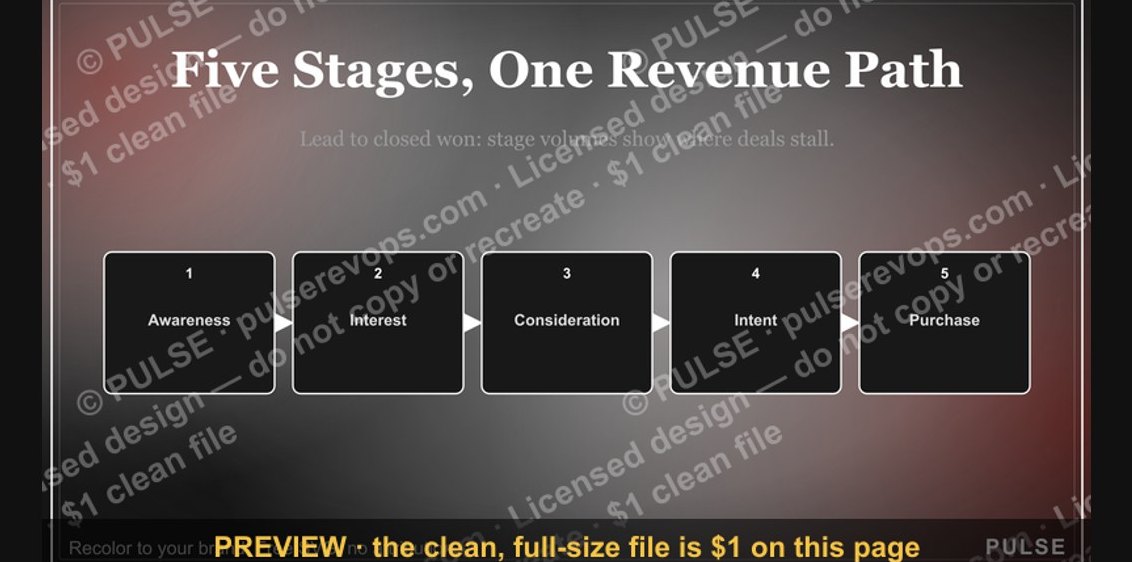 graphicSales Funnel — 5 Stages
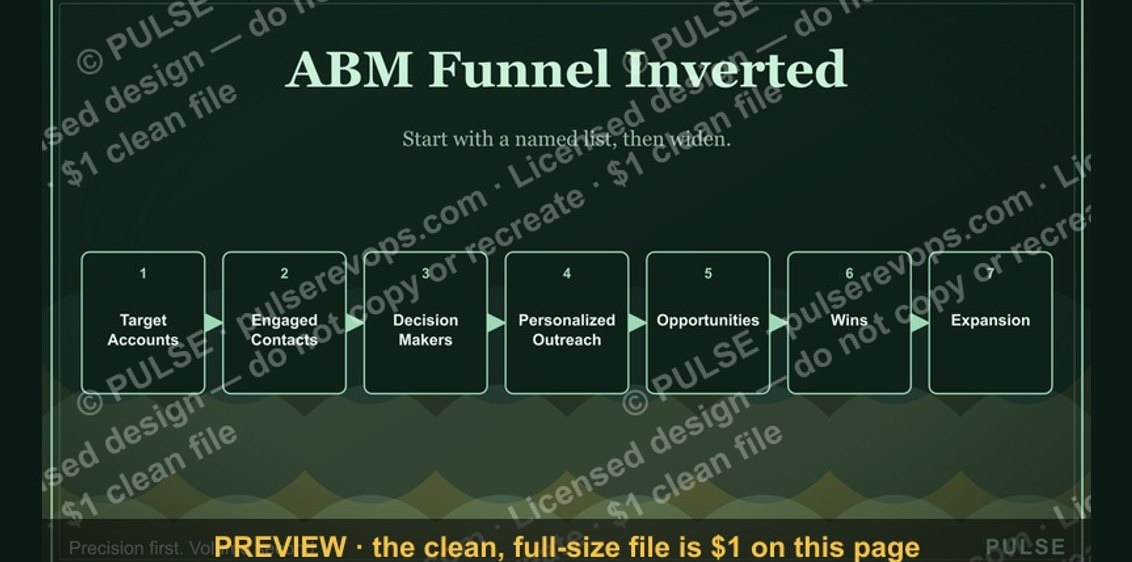 graphicABM Funnel Inverted
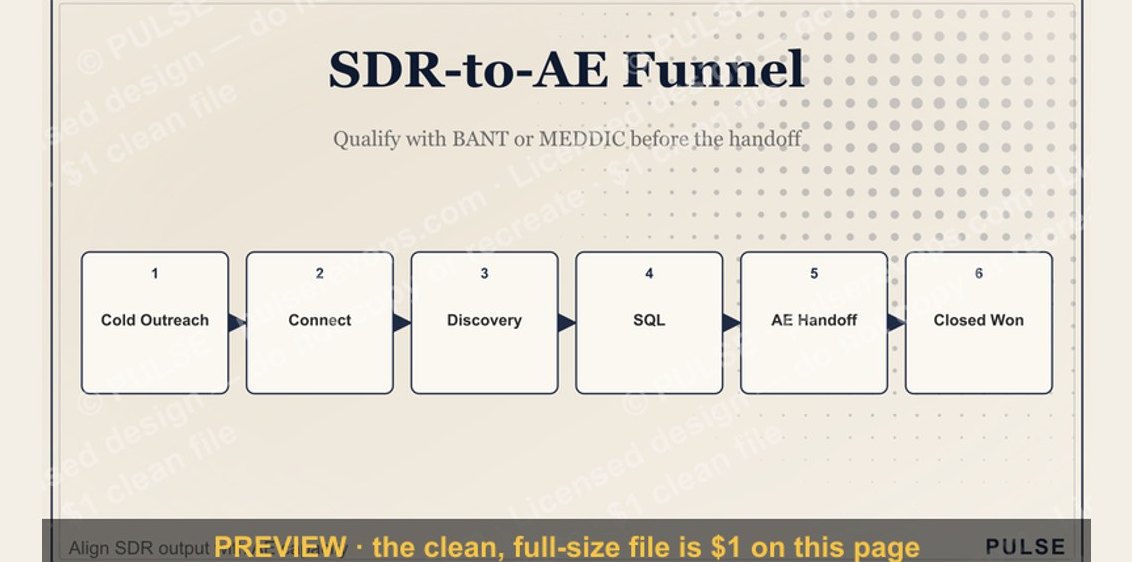 graphicSDR-to-AE Funnel
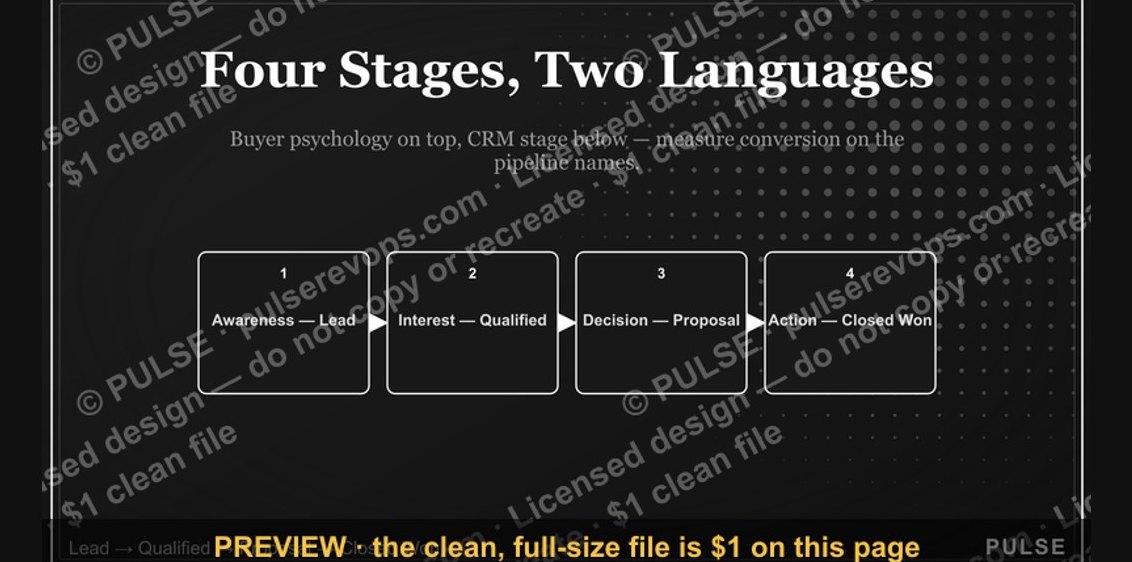 graphicSales Funnel — 4 Stages
 graphicPLG Conversion Funnel
 graphicRenewal Risk Decision Tree
 graphicAgenda — Section Divider Slide
 graphicThe Customer Journey — Infographic