
Customer Acquisition Cost vs. Lifetime Value in SaaS Startups in 2027
 Curated byKory White · Fractional CRO · Maryland
 PULSEKNOWLEDGE LIBRARY
Quality
Certified
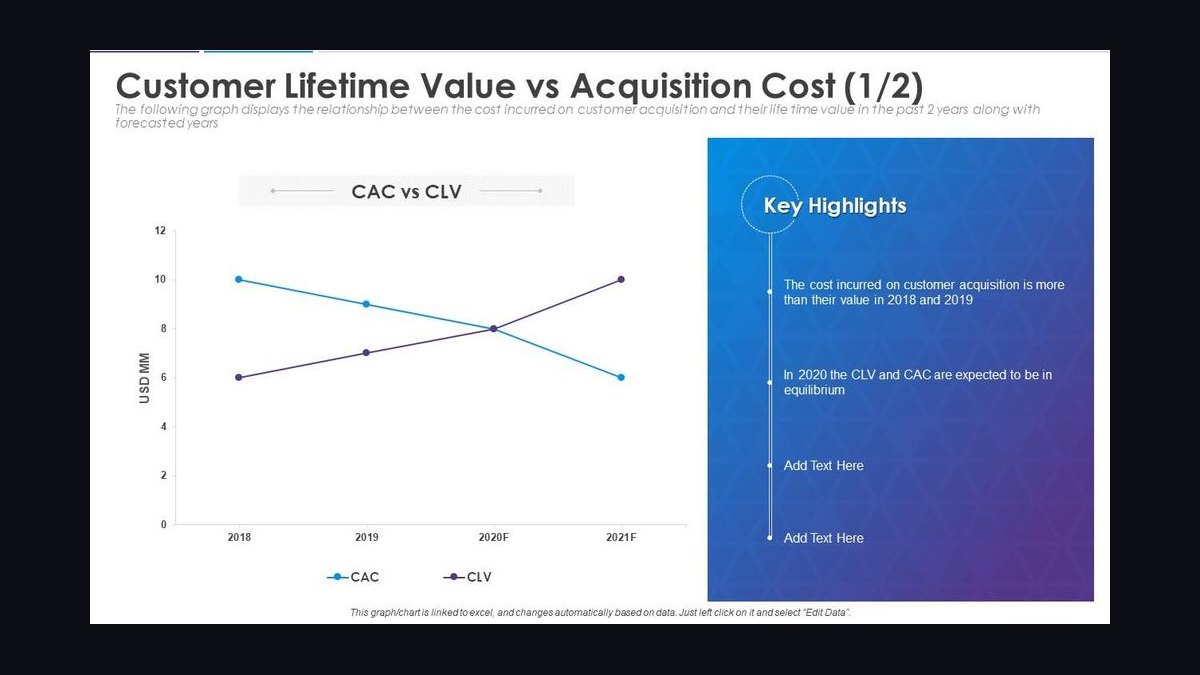
In 2027, healthy SaaS startups target an LTV:CAC ratio at or above 3:1 with CAC payback under 12 months. CAC counts all sales, marketing, and onboarding spend per new customer; lifetime value discounts gross-margin revenue by churn. Below 1:1 you lose money per customer; far above 5:1 you are underinvesting in growth.
What each side of the ratio actually measures
The two quantities sit on opposite sides of the same transaction, and they fail in opposite ways. Customer Acquisition Cost is a spend number you already know — it lives in your general ledger and your ad platform invoices. Lifetime value is a forecast, and forecasts drift. That asymmetry is the whole reason the ratio misleads people: one input is measured, the other is assumed.
Customer Acquisition Cost is the fully loaded cost of adding one new logo. The defensible formula is:
CAC = (Sales payroll + Marketing payroll + Commissions + Ad spend + Content and events + Sales/marketing tooling + Onboarding cost) / New customers closed in the same period
The arguments start at the edges. Should you count the SDR who sourced a deal that closed nine months later? Should onboarding and implementation labor sit in CAC or cost of goods sold? Should the RevOps salary that supports both new business and renewals be allocated? A reasonable convention, and the one most boards accept: everything that exists to win *new* logos goes in CAC; everything that exists to keep or grow *existing* logos goes into retention cost and stays out of CAC; shared functions get split by headcount time allocation and the split is documented once and held constant. The number matters less than the consistency — a CAC that changes definition every quarter cannot be trended.
Lifetime Value is the gross-margin revenue a customer produces before they leave, discounted for the fact that money arriving in year four is worth less than money arriving today. The simple form everyone uses:

LTV = (Average monthly revenue per customer × Gross margin %) / Monthly churn rate
That formula embeds a heavy assumption: churn is constant forever. It is not. SaaS churn is front-loaded — cohorts shed customers fastest in the first three to six months, then the survivors settle into a much lower steady-state rate. Applying a blended monthly churn rate to a whole cohort therefore *understates* the value of customers who make it past the danger window and *overstates* the value of the cohort as a whole in the early months. The more honest approach is cohort survival: take each monthly cohort, plot the percentage still paying at month 1, 3, 6, 12, 18, 24, and integrate the actual retention curve times gross-margin revenue rather than assuming an exponential decay.
The gross margin input is the quiet one. SaaS gross margin typically lands in the 70–85% band once you subtract hosting, third-party API costs, support headcount, and the customer success labor required to keep the product working. Startups routinely publish LTV using revenue rather than gross profit, which inflates the number by roughly 20–30% in one stroke. If your infrastructure bill scales with usage — as it does for anything doing inference, video, or heavy data processing — margin compresses exactly as your best customers grow, and the LTV you modeled at 80% margin is being earned at 65%.
The discount rate is the input almost nobody applies. Revenue five years out is not worth its face value. Applying a 10–15% annual discount rate to the projected cash flows converts LTV into a net present value, which is what the number claims to be. Skipping it inflates long-horizon LTV materially, and the inflation is largest exactly where startups most want the flattery: enterprise deals with long assumed lifespans.

How the two constrain each other
CAC and LTV are not independent variables you can optimize separately. Push acquisition harder and you move down the demand curve — the cheap, high-intent buyers get exhausted first, and the marginal customer costs more *and* converts worse. Push into a new segment and both numbers move: enterprise CAC rises with the sales cycle length while enterprise LTV rises with contract size and lower churn. The ratio can stay flat while the business underneath transforms completely.
This is why the ratio alone is a poor steering metric and why CAC payback has quietly displaced it as the operating number in most boardrooms. LTV:CAC answers "is this customer profitable eventually?" CAC payback answers "how long is my cash trapped?" — and cash is what kills startups. A company with a 4:1 ratio and a 26-month payback can be less viable than one with a 2.8:1 ratio and a 9-month payback, because the second recycles capital into the next cohort nearly three times as fast.
CAC Payback (months) = CAC / (Monthly revenue per customer × Gross margin %)
Work an example. A $3,000 CAC against a customer paying $200/month at 75% gross margin recovers $150/month, so payback is 20 months. That is too slow for most venture-backed plans and it is *not* fixed by discovering a longer lifetime — a longer lifetime improves LTV:CAC on paper while the cash hole stays exactly as deep for exactly as long. The fixes are the three real levers: cut CAC, raise price or seat count, or improve gross margin. Nothing else touches payback.
There is also a ceiling case worth naming. A ratio far above 5:1 is not a trophy. It usually means one of three things: you are underspending on a channel that would still convert profitably, your LTV assumptions are too generous, or you have a genuinely product-led motion where the ratio is real and the correct response is to spend more until the marginal ratio approaches 3:1. Optimizing the *average* ratio upward while the *marginal* ratio is still above 3:1 is leaving growth unbought.

Choosing which number to optimize first
The decision is sequential, not simultaneous. Ranking the levers wrong wastes a quarter: a startup that spends ninety days shaving 15% off CAC while 6% monthly churn quietly eats the base has moved the smaller number. Retention compounds; acquisition efficiency does not.
Work the decision in this order:
- Is monthly logo churn above roughly 4% for SMB, 2% for mid-market, or 1% for enterprise? If yes, stop everything else. Nothing you do to CAC survives a leaky base. Churn at those levels means the LTV in your model is fiction and every dollar of acquisition spend is going into a bucket with a hole.
- Is CAC payback over 18 months? If yes, you have a cash-velocity problem regardless of the ratio. Attack pricing, packaging, and channel mix before headcount.
- Is net revenue retention below 100%? If yes, expansion is the cheapest LTV you will ever buy — existing customers convert at a fraction of new-logo CAC and require no new demand generation.
- Only when all three are healthy does raw CAC reduction become the highest-leverage project, and even then it should be attacked by segment rather than in the blend.

The re-measurement loop matters as much as the branch. Unit economics changes do not show up next week. A churn intervention shipped in January shows in the retention curve of the January cohort, which is not readable until roughly April. Treat one full cohort cycle — typically 90 days minimum — as the evaluation window, and resist judging the change on the leading indicators alone.
One more decision rule that saves quarters: decide by segment, never by blend. A blended 3.2:1 ratio can hide an enterprise segment at 5:1 subsidizing an SMB segment at 1.4:1. The blend tells you to keep going. The segment view tells you to stop selling to SMB through the paid channel, or to change the SMB motion to self-serve where CAC collapses to near zero. Splitting the ratio by segment, by acquisition channel, and by cohort month is the single highest-value analytical step available to a startup with messy unit economics, and it costs nothing but query time.
The numbers behind each lever
Concrete figures make the trade-offs legible. The ranges below are the ones commonly cited in SaaS benchmarking work and worth treating as orientation, not gospel — your own cohort data always outranks a published median.
CAC by segment. Acquisition cost scales roughly with deal size and sales-cycle length. Self-serve and product-led motions can run CAC in the low hundreds. SMB with an inside-sales motion typically runs from several hundred to a few thousand dollars. Mid-market, with a sales cycle of three to six months and multiple stakeholders, runs several thousand. Enterprise, with a six-to-twelve-month cycle, a solutions engineer, a security review, and a procurement gauntlet, runs into the tens of thousands. The workable rule of thumb: CAC should stay under roughly one-third of first-year annual recurring revenue. A $10,000 ACV customer should cost under about $3,000 to acquire. A $100,000 ACV customer can justify $30,000. When you cross that line you are buying revenue at a price that requires multi-year retention to work out — which is fine if retention is genuinely multi-year and fatal if it isn't.

The churn-to-LTV sensitivity. This is the most underappreciated arithmetic in SaaS, so run it explicitly. Hold monthly revenue at $100 and gross margin at 75%, giving $75/month of gross profit:
| Monthly churn | Implied average lifetime | LTV | LTV at $2,000 CAC |
|---|---|---|---|
| 6% | ~17 months | ~$1,250 | 0.6:1 |
| 5% | 20 months | $1,500 | 0.75:1 |
| 4% | 25 months | $1,875 | 0.94:1 |
| 3% | ~33 months | ~$2,500 | 1.25:1 |
| 2% | 50 months | $3,750 | 1.88:1 |
| 1% | 100 months | $7,500 | 3.75:1 |
Read the shape, not the rows. Churn sits in the *denominator*, so improvement is non-linear: dropping from 5% to 4% adds 25% to LTV, but dropping from 2% to 1% *doubles* it. The leverage accelerates as you get better. This is why mature companies obsess over retention points that look trivially small — at 2% churn, a single point is worth more than any plausible CAC reduction.

It also explains why the same CAC produces wildly different verdicts. A $2,000 CAC is catastrophic at 5% churn and comfortably healthy at 1%. Anyone reporting "our CAC is $2,000" without the paired churn number has told you nothing.
Gross margin's quiet multiplier. LTV scales linearly with gross margin, and margin is more controllable than founders assume. Moving from 68% to 78% — through infrastructure right-sizing, support deflection via documentation and in-product guidance, or renegotiated third-party API contracts — adds roughly 15% to LTV without touching churn or pricing, and it shortens CAC payback by the same proportion. It is the least glamorous lever and frequently the fastest.
Net revenue retention. NRR folds expansion, contraction, and churn into one figure:
NRR = (Starting MRR + Expansion − Contraction − Churn) / Starting MRR
Above 100% means the existing base grows on its own, which is the closest thing to free LTV that exists — expansion revenue carries a fraction of new-logo CAC because the relationship, the trust, and the integration work are already paid for. Above 120% is genuinely strong. Below 100% means you are refilling a draining tank, and every new-logo dollar has to cover the leak before it funds growth. When NRR is below 100%, the honest reading of your LTV:CAC ratio is that it is going to get worse, because the LTV input is on a downward trend you have not yet priced in.

Payback and runway interact. A 20-month payback with 18 months of runway is not a unit-economics problem, it is a solvency problem — you will run out of money before the first cohort pays for itself. The practical constraint: your payback period should comfortably fit inside your runway with room for the next cohort, which for most seed and Series A startups means pushing hard for payback under 12 months even when the ratio looks acceptable.
Instrumenting the measurement
None of this works on estimates. The instrumentation is the project, and it takes longer than the analysis.
Fix the definitions first, in writing. Produce a one-page memo that states: what expense accounts roll into CAC; how shared headcount is allocated; whether onboarding is CAC or COGS; what counts as a "new customer" (first paid invoice, not signed contract); which churn definition you use (logo churn versus revenue churn — report both, they tell different stories); what gross margin excludes; and what discount rate you apply. Circulate it, get finance to sign it, and freeze it. Redefining the metric mid-year destroys the trend line, and the trend is the only thing that tells you whether an intervention worked.

Instrument the CRM to carry the cost fields. Every closed-won opportunity needs the acquisition channel, the segment, the cohort month, and the sales cycle length stamped on it. Without those four fields you cannot split CAC by anything, and unsplit CAC is nearly useless. This is a small schema change and it is almost always the blocker — teams try to compute segment CAC and discover the data was never captured at the deal level.
Build the cohort table before the dashboard. The atomic artifact is a table with one row per acquisition cohort month and columns for: customers acquired, total acquisition spend for that cohort, gross-margin revenue collected by month 3, 6, 12, 18, and 24, and the percentage of the cohort still active at each point. Every metric on this page derives from that table. Build it once, refresh it monthly, and the dashboards become presentation rather than computation.
Report on a cadence that matches signal speed. Weekly, watch the fast-moving inputs: new customers, spend by channel, average deal size, and trailing-four-week churn. Monthly, compute the real ratios — LTV:CAC and payback by segment, NRR, and the cohort table refresh. Quarterly, do the strategic work: cohort curves over multiple periods, segment profitability comparison, and the board narrative explaining what moved and why. Annually, audit the definitions themselves and re-baseline. Reporting LTV:CAC weekly is noise — the underlying churn signal cannot move that fast, and watching it fluctuate invites reactive decisions on statistically meaningless variation.
Sequence the interventions so you can attribute them. The temptation is to fire every lever at once — new pricing, new onboarding, new channel mix, new qualification criteria — and then be unable to say which one worked. Change one major variable per cohort cycle where you can. If you must move several, at minimum stagger them by cohort so the retention curves separate.

Two instrumentation traps worth naming. First, *survivorship in the LTV number*: computing average lifetime from customers who have already churned systematically excludes your best customers, who are still paying and therefore absent from the sample. Use cohort survival curves instead. Second, *lagging attribution*: if your sales cycle is six months, this month's CAC divides this month's spend by customers who were sourced half a year ago on a different spend level. During rapid scaling this makes CAC look artificially low; during a spend cut it makes CAC look artificially high. Either lag the spend to match the cycle, or compute CAC on a cohort basis where spend and closes belong to the same origination period, and say clearly in the reporting which convention you used.
Where the ratio misleads even when it's computed correctly
A correct ratio can still point the wrong way, and knowing the failure modes is what separates a metric from a management tool.
The blend problem is the most common. A composite ratio across segments, channels, and cohorts averages a thriving business with a failing one and reports "fine." Always disaggregate before acting.

The immature-cohort problem hits fast-growing startups hardest. If most of your customers signed in the last six months, you have no observed data on what happens at month 18, and your LTV is a projection resting on a very short curve. The faster you grow, the larger the fraction of your base that is young, and the more speculative your LTV becomes. The honest treatment is to report LTV with a stated observation horizon — "based on 12 months of observed retention" — and to be explicit that beyond that horizon you are extrapolating.
The average-versus-marginal problem trips up scaling decisions. Your average CAC across all spend is not the CAC of your *next* dollar. As you scale a channel, the marginal customer costs more. Budget decisions should use marginal CAC — what did the last increment of spend actually buy — while board reporting uses the average. Confusing the two leads to either over-scaling a channel past its efficient frontier or prematurely killing one that still has profitable headroom.
The vanity-lifetime problem is the one to guard hardest. Because LTV is a forecast built on assumptions you choose, it is the easiest number in the business to flatter: pick optimistic churn, use revenue instead of gross profit, skip the discount rate, and extrapolate a 5-year lifetime from 8 months of data. Each choice is individually defensible and together they can double the reported figure. The discipline is to compute LTV two ways — an aggressive case and a conservative one using trailing actual churn, true gross margin, a real discount rate, and a capped horizon — and to run the business on the conservative number while acknowledging the other exists.
The qualification lever hides in plain sight. The cheapest CAC reduction available to most startups is not a better ad campaign, it is disqualifying poor-fit prospects earlier. A structured qualification framework applied consistently — establishing the economic buyer, the decision process, the quantified pain, and an internal champion before investing sales cycles — removes deals that would have consumed weeks of selling and then churned in month four. That intervention improves both sides of the ratio simultaneously: less wasted acquisition cost, and a customer base whose retention curve is genuinely flatter. Tightening the ideal customer profile is a unit-economics project disguised as a sales-process project, and for a SaaS startup fighting a broken ratio it is often the highest-return work available.
Related questions
Should we use LTV:CAC or CAC payback as our primary metric?
Payback, for operating decisions. It measures cash recovery speed, which determines survival, and it depends on fewer assumptions. Keep LTV:CAC for board reporting and long-horizon segment comparison, but steer the business on payback.
How do we handle CAC when the sales cycle is longer than the reporting period?
Compute CAC on a cohort basis — match spend to the customers it actually originated rather than to whoever closed that month. Alternatively, lag the spend by your median cycle length. State which convention you use, and never switch it mid-year.
Does expansion revenue belong in LTV?
Yes, if you also count the cost of generating it. Expansion is real lifetime value and it is far cheaper than new-logo acquisition. Track it through net revenue retention so contraction and churn are netted honestly rather than only counting upsells.
What ratio should a pre-Series-A startup expect?
Early ratios are unreliable because cohorts are young and spend is lumpy. Focus on directional payback and the shape of the retention curve. A defensible 12-month retention curve is worth more in a fundraise than a flattering ratio built on four months of data.
How does a product-led motion change these numbers?
Self-serve acquisition drives CAC toward marketing spend only, often producing ratios well above 5:1 — which usually signals underinvestment rather than excellence. The binding constraint shifts to activation and expansion rather than acquisition efficiency.
FAQ
What LTV:CAC ratio should a SaaS startup target in 2027?
Three-to-one remains the working standard, paired with CAC payback under 12 months. Below 1:1 you lose money on every customer acquired and should halt paid acquisition until the ratio is understood. Between 1:1 and 3:1 you have a fixable problem, usually retention or pricing. Above 5:1 is typically underinvestment rather than excellence — if your marginal ratio is still comfortably above 3:1, buy more growth. Treat these as thresholds for investigation, not as targets to be gamed; a ratio engineered upward by cutting spend while churn worsens is a worse business reporting a better number.
What exactly should be included in Customer Acquisition Cost?
Everything that exists to win new logos: sales and marketing payroll, commissions and bonuses, advertising and content spend, events, the sales and marketing tooling stack, and onboarding or implementation labor for new accounts. Exclude anything serving existing customers — renewals, account management, and support belong to retention cost or cost of goods sold. Shared functions get a documented headcount-based allocation. The specific boundary matters less than freezing it in writing and holding it constant, because a CAC whose definition drifts cannot be trended and therefore cannot be managed.
Why is my LTV probably overstated?
Four compounding reasons. You are likely using revenue rather than gross-margin revenue, which inflates the figure by roughly 20–30%. You are probably applying a blended churn rate when real churn is front-loaded and cohort-dependent. You are almost certainly omitting a discount rate, so distant revenue is counted at face value. And if you are growing fast, most of your base is too young to have produced observed long-horizon retention data, so the tail of the curve is extrapolation. Compute a conservative case with trailing actual churn, true gross margin, a 10–15% discount rate, and a capped horizon — then run the business on that.
How much does a one-point churn improvement actually matter?
It depends entirely on where you start, because churn sits in the denominator. Going from 5% to 4% monthly churn raises lifetime value about 25%. Going from 2% to 1% doubles it. The leverage accelerates as you improve, which is why mature SaaS companies fight over fractions of a point that look trivial from the outside. In almost every case a retention point is worth more than an equivalent-effort CAC reduction, and it improves the ratio through the input that is currently least trustworthy.
Can a healthy blended ratio hide a broken business?
Routinely. A blended 3.2:1 can be an enterprise segment at 5:1 subsidizing an SMB segment at 1.4:1, and the blend tells you to keep spending on both. Disaggregate by segment, acquisition channel, and cohort month before making any budget decision. The same applies to the average-versus-marginal distinction: your average CAC is not what the next dollar of spend will cost, and scaling decisions made on the average will either over-extend a channel past its efficient point or kill one that still had profitable room.
How long before a fix shows up in the metrics?
Plan on one full cohort cycle — 90 days minimum, and longer if your contracts are annual. A retention intervention shipped in January appears in the January cohort's curve, which is not readable until roughly April. Leading indicators such as product usage or health scores move sooner and are worth watching, but they are not proof. Change one major variable per cycle where possible, or stagger changes by cohort, so the retention curves separate and you can actually attribute the improvement to the work that caused it.
Sources
- Bessemer Venture Partners — State of the Cloud
- OpenView Partners — SaaS Benchmarks
- a16z — 16 Startup Metrics
- David Skok, For Entrepreneurs — SaaS Metrics 2.0
- ChartMogul — SaaS Metrics Guides
- Baremetrics — SaaS Metrics Blog
- KeyBanc Capital Markets — SaaS Survey
- Harvard Business Review — The Value of Keeping the Right Customers
- SaaS Capital — Research and Benchmarks
Related on PULSE
- [Average Revenue Per User in SaaS: Monthly Recurring Revenue vs. Annual Contract Value](/knowledge/ik0470)
- [Average Contract Value (ACV) Growth Rate for Mid-Market SaaS](/knowledge/ik0500)
- [Monthly Recurring Revenue (MRR) per Customer in Subscription Box: Retention Value](/knowledge/ik0558)
- [Healthcare SaaS: Patient Lifetime Value vs. Customer Acquisition Cost for Specialty Practices](/knowledge/ik0576)
- [Patient Lifetime Value (LTV) in Health Insurance Exchange Plans](/knowledge/ik0489)
- [What are the key sales KPIs for the AI Customer Support industry in 2027?](/knowledge/ik0397)
This page will be disappearing soon. Save it to your device for $1 — or read it free while it is here.
@Kory-White- · if Venmo asks, the last 4 of my number are 2012
 pulse-industry-kpisTop 10 Optometry Practice Revenue KPIs in 2027
 pulse-industry-kpisTop 10 Coffee Shop Chain Revenue KPIs in 2027
 pulse-industry-kpisTop 10 Hotel Revenue KPIs in 2027
 pulse-industry-kpisTop 10 RIA Wealth Management Revenue KPIs in 2027
 pulse-industry-kpisSession Revenue Per Player in Free-to-Play Mobile Gaming in 2027
 pulse-industry-kpisTransaction Revenue Per Active User in Digital Wallets like PayPal in 2027
 pulse-industry-kpisTop 10 Hospitality Revenue per Available Room Performance KPIs in 2027
 pulse-industry-kpisReal Estate Brokerage: Commission Revenue Per Closed Transaction by Agent Tenure in 2027
 pulse-industry-kpisTop 10 Nonprofit Foundation Revenue KPIs in 2027
 pulse-industry-kpisTop 10 Insurance Loss Ratio and Premium Revenue Indicators in 2027