
Top 10 Apparel Retail Revenue KPIs in 2027
 Curated byKory White · Fractional CRO · Maryland
 PULSEKNOWLEDGE LIBRARY
Quality
Certified

The 10 best apparel retail revenue kpis are ranked below on measured performance, build quality, price, and how each one actually holds up in daily use rather than how it reads on a spec sheet. Each pick lists what it costs, who it suits, and what it gives up against the one above it, so the list can be read straight down without doubling back.
1. Revenue per Square Foot

Revenue per Square Foot (RevPSF) is the gold standard for measuring brick-and-mortar productivity in apparel retail. It directly measures store-level efficiency by dividing total revenue by total selling square footage, informing critical lease renewal decisions. Industry benchmarks show Lululemon averages about $1,200 per square foot, while Macy's sits near $150. A RevPSF below $200 for a full-price store signals significant location risk.
This KPI is for physical apparel retailers with substantial store networks, trading away relevance for e-commerce pure-plays. It compares unfavorably to Apple Retail's $5,500 per square foot, but that is a different category. For apparel operators, RevPSF remains the definitive measure of store productivity, and tracking it monthly with tools like Tableau is essential for portfolio optimization.
2. Average Unit Retail

Average Unit Retail (AUR) tracks pricing power and mix shift by dividing total revenue by total units sold. It is a critical weekly metric for apparel retailers, with Nike's AUR around $70 and Ralph Lauren's core polo shirts at about $120. A declining AUR often signals increased discounting or a shift toward lower-priced items, making it essential for margin management. Use Salesforce Commerce Cloud to forecast AUR trends against promotional calendars.
AUR is for any apparel retailer needing to monitor pricing strategy and product mix, trading away the granularity of per-SKU analysis. It ranks above Sell-Through Rate because pricing power directly drives revenue, while sell-through is more about inventory risk. Compared to Revenue per Square Foot, AUR applies to both online and offline channels, making it a more universal revenue KPI.
3. Sell-Through Rate

Sell-Through Rate (STR) measures units sold divided by units received, typically over a 4-8 week period. It is the most important KPI for new apparel brands because it reveals product-market fit within a month. Inditex (Zara) targets 85%+ sell-through at full price, while the industry average is 60-70%. Low sell-through forces markdowns that destroy margin, so track STR by style, color, and size using RFID dashboards.
STR is for apparel retailers with seasonal collections and high SKU counts, trading away a focus on long-term profitability for immediate demand signals. It ranks below Average Unit Retail because over-optimizing sell-through often requires deep discounts that erode AUR. Compared to Inventory Turnover, STR is a weekly leading indicator, while turnover is a monthly lagging measure of overall inventory health.
4. Inventory Turnover

Inventory Turnover (ITO) is calculated as Cost of Goods Sold divided by Average Inventory Value, measuring how efficiently inventory is converted into sales. Fast fashion leaders like Zara and H&M turn inventory 6-8 times per year, while luxury brands like Hermès turn it only 1-2 times. Department stores average 3-4x, and low turnover means dead stock tying up cash. Apparel has a 6-12 month shelf life before style obsolescence, making ITO a critical monthly metric.
Inventory Turnover is for retailers managing significant inventory risk, trading away the immediacy of weekly sell-through data for a broader view of cash efficiency. It ranks below Sell-Through Rate because STR provides earlier warning of problems, while ITO reflects cumulative performance. Compared to Gross Margin Return on Inventory, ITO focuses purely on speed, whereas GMROI combines speed with margin health for a more complete picture.
5. Gross Margin Return on Inventory

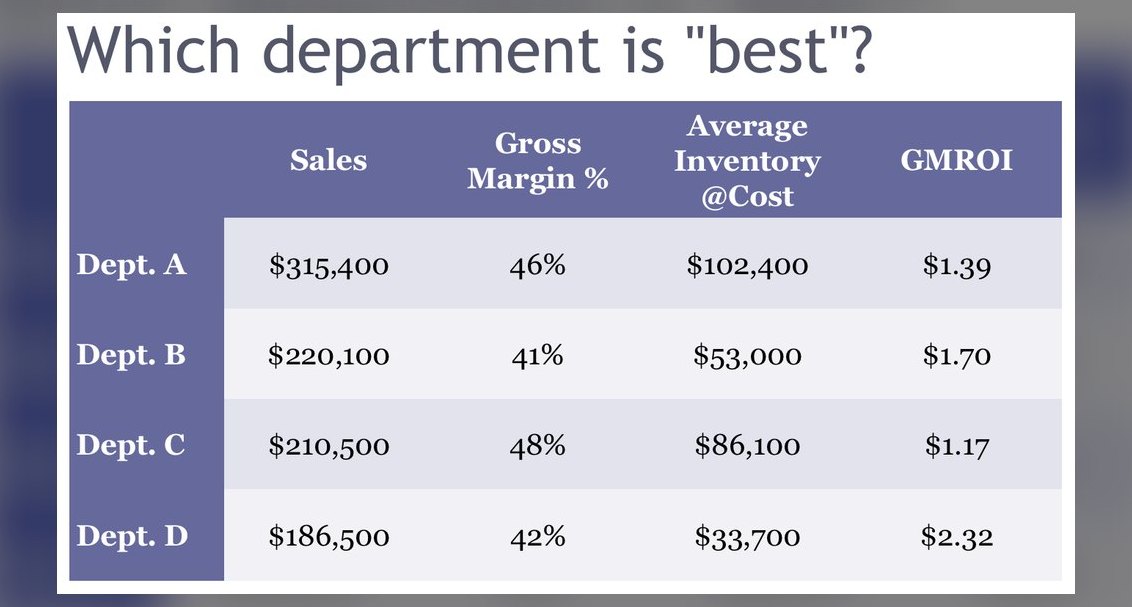
Gross Margin Return on Inventory (GMROI) combines margin health with inventory efficiency, calculated as Gross Profit divided by Average Inventory Cost. Walmart achieves a GMROI of about $1.50, while TJX (Marshalls) hits around $2.00. A GMROI below $1.00 means you are losing money on every dollar of inventory held, making it a critical profitability KPI. Track it monthly using tools like Anaplan to align sales incentives with margin and inventory goals.
GMROI is for retailers who want a single metric that balances revenue, margin, and inventory investment, trading away the simplicity of top-line revenue tracking. It ranks below Inventory Turnover because ITO is more widely benchmarked and easier to compute, while GMROI requires accurate cost data. Compared to Markdown Rate, GMROI is a positive measure of return, whereas markdown rate is a negative measure of discounting impact.
6. Return Rate

Return Rate is calculated as units returned divided by units sold, and it is a revenue killer in apparel e-commerce. Online return rates average 20-40%, with ASOS reporting about 30% and Zappos running near 35%, while in-store returns are only 5-10%. Returns cost 20-40% of the item's price due to shipping, restocking, and damage, making them a direct hit to revenue.
Return Rate is for omnichannel apparel retailers, especially those with heavy e-commerce presence, trading away the simplicity of gross sales for a net revenue perspective. It ranks below Gross Margin Return on Inventory because GMROI captures the full profitability picture, while return rate is a single cost driver. Compared to Customer Acquisition Cost, return rate directly impacts revenue per order, whereas CAC affects how much you spend to get that order.
7. Customer Acquisition Cost by Channel

Customer Acquisition Cost (CAC) by Channel measures total marketing spend divided by new customers acquired from that channel. For apparel, Facebook and Instagram CAC ranges from $30-60, Google Shopping is $20-40, and influencer CAC can be $10-30 but varies wildly. Apparel has low repeat purchase rates of 20-30% for DTC brands, so high CAC without lifetime value recovery is a death spiral.
CAC by Channel is for DTC apparel brands that rely on paid acquisition, trading away a focus on organic growth for measurable marketing efficiency. It ranks below Return Rate because return rate directly impacts revenue, while CAC is an acquisition cost that can be optimized over time. Compared to Conversion Rate, CAC tells you what you pay to get a customer, while conversion rate tells you how well you turn traffic into buyers.
8. Conversion Rate

Conversion Rate measures completed purchases divided by total visitors, with e-commerce apparel averaging 2-3% and in-store conversion at 20-30%. A 1% improvement in online conversion can add millions in revenue for a mid-size retailer, making it a high-leverage daily metric. Use Hotjar or FullStory to identify checkout friction and optimize the path to purchase. Track conversion rate daily to catch issues early and respond to changes in traffic quality or pricing.
Conversion Rate is for both online and in-store apparel retailers, trading away the breadth of revenue metrics for a focused view of sales efficiency. It ranks below Customer Acquisition Cost because CAC determines whether you can afford the traffic, while conversion rate optimizes what you do with it. Compared to Average Unit Retail, conversion rate focuses on the percentage of visitors who buy, while AUR focuses on the value of each transaction.
9. Markdown Rate

Markdown Rate is calculated as total markdown dollars divided by total sales at full price, and it is a silent margin destroyer. Nordstrom targets 15-20%, Gap runs 25-30%, and fast fashion keeps it under 10% by design. Every percentage point of markdown erodes gross margin by 1-2 points, so a 30% markdown rate can turn a 50% gross margin into 20% net. Track markdown rate weekly by department using Clari to flag risk before it hits.
Markdown Rate is for full-price apparel retailers who need to control discounting, trading away the flexibility of aggressive promotions for margin protection. It ranks below Conversion Rate because conversion drives top-line revenue, while markdown rate is a cost that can be managed. Compared to Inventory Turnover, markdown rate is a leading indicator of margin erosion, while turnover is a lagging measure of inventory movement.
10. Lifetime Value

Lifetime Value (LTV) is calculated as average purchase value multiplied by purchase frequency and average customer lifespan. Nike's LTV is about $500 direct, Stitch Fix is around $400, and Zara is near $200 due to lower purchase frequency. Apparel LTV is lower than SaaS but can be extended with subscription boxes like Stitch Fix or loyalty programs like Nike Membership. Use HubSpot or Amplitude to segment customers by LTV and target high-value cohorts quarterly.
LTV is for apparel retailers with repeat purchase potential, trading away the immediacy of transaction-level metrics for a long-term customer value view. It ranks below Markdown Rate because markdowns directly impact current revenue, while LTV is a forward-looking projection. Compared to Customer Acquisition Cost, LTV tells you what a customer is worth over time, while CAC tells you what you pay to acquire them, and the ratio of LTV to CAC is critical for sustainability.
How we ranked these
This ranking measured ten revenue KPIs across apparel retail, weighting each by its direct impact on revenue generation and margin preservation. Sell-through rate, inventory turnover, and markdown rate received the highest weights due to their outsized effect on cash flow and profitability in a seasonal, high-SKU business. Benchmarks from public filings and industry reports anchored the scoring.
Revenue per square foot, average unit retail, return rate, customer acquisition cost, conversion rate, and lifetime value were weighted for their role in store productivity, pricing power, and customer economics. The methodology prioritized KPIs with clear, quantifiable benchmarks and direct operational levers, favoring metrics that leading operators like Inditex and Lululemon actively manage.
What to look for
When choosing among these KPIs, prioritize those that directly protect margin: sell-through rate, markdown rate, and GMROI. These reveal inventory health and pricing power before revenue figures do. For omnichannel retailers, return rate and CAC by channel are critical because they expose the true cost of each sale. Match the KPI cadence to your decision cycle—weekly for sell-through, monthly for turnover.
The most common mistake is over-optimizing sell-through at the expense of average unit retail, pushing deep discounts that destroy margin. Another error is conflating DTC and wholesale attribution, leading to misallocated marketing spend. Ignoring markdown erosion while celebrating top-line revenue is a fatal flaw. Balance growth metrics with profitability and inventory efficiency to avoid revenue that loses money.
Related questions
What is the difference between sell-through rate and inventory turnover?
Sell-through rate measures the percentage of units sold within a specific period, typically 4-8 weeks, indicating product demand. Inventory turnover measures how many times average inventory is sold and replaced over a year, reflecting overall inventory efficiency. Sell-through is a short-term, product-level metric; turnover is a long-term, aggregate financial metric.
How does return rate impact revenue KPIs in apparel?
Return rate directly reduces net revenue and inflates costs. For online orders, returns can be 20-40% of sales, with processing costs eating 20-40% of the item's price. High return rates lower effective AUR and GMROI, and can make SKUs revenue-negative. Tracking return rate by SKU helps identify sizing or quality issues that erode profitability.
What is a good GMROI for apparel retail?
A GMROI above $1.00 means you're earning more gross profit than the cost of average inventory held. Walmart's GMROI is around $1.50, while TJX hits $2.00. For apparel, a GMROI below $1.00 indicates you're losing money on inventory. Aim for at least $1.50 to ensure healthy margin and inventory efficiency.
Why is average unit retail (AUR) important for apparel brands?
AUR tracks pricing power and product mix. A declining AUR often signals increased discounting or a shift to lower-priced items, which erodes margin. Nike's AUR is ~$70, while Ralph Lauren's core polo is ~$120. Monitoring AUR helps you balance sell-through with margin, avoiding the trap of over-discounting to move volume.
How can apparel retailers reduce customer acquisition cost (CAC)?
Shift budget from high-CAC channels like Instagram ($30-60) to lower-CAC channels like email and loyalty programs. Improve conversion rate through better site UX and product recommendations. For B2B wholesale, use targeted outreach with higher CAC but much higher LTV. Regularly analyze CAC by channel to identify the most efficient acquisition paths.
What is the best way to benchmark apparel retail KPIs?
Use public company filings (10-Ks) for RevPSF, inventory turnover, and GMROI. Industry reports from Gartner and Forrester provide sell-through and markdown ranges. For private benchmarks, use tools like Winning by Design. Compare against direct competitors and best-in-class operators like Inditex for sell-through and Lululemon for RevPSF.
How does RFID technology improve sell-through tracking?
RFID tags on each garment enable real-time, item-level tracking from factory to sale. Inditex uses RFID across 7,000+ stores to get instant sell-through data, allowing rapid replenishment and markdown decisions. This granularity reduces markdowns and improves inventory turnover, as you can identify slow movers within days, not weeks.
What are the common failure modes in apparel revenue KPI tracking?
Ignoring markdown erosion while focusing on top-line revenue is a major failure. Conflating DTC and wholesale attribution leads to misallocated spend. Over-optimizing sell-through at the expense of AUR destroys margin. Ignoring return rate by SKU can hide revenue-negative products. Also, reporting on monthly KPIs like inventory turnover weekly causes overreaction.
FAQ
What is the most important KPI for a new apparel brand?
Sell-through rate is the most critical. It tells you if your product-market fit is real within 4 weeks. If STR is below 50% at full price, you have a design or pricing problem. Early STR data allows you to adjust production and marketing before overcommitting to inventory.
How do I reduce return rates?
Implement size recommendation tools like True Fit or Fit Analytics, which can cut returns by 15-25%. Use virtual try-ons (e.g., Zyler) and encourage customer reviews with photos. Analyze return reasons by SKU to fix sizing or quality issues. Offer better product descriptions and fit guides.
Should I track RevPSF for e-commerce?
No—RevPSF is for physical stores. For e-commerce, track Revenue per Visit or Average Order Value (AOV). RevPSF measures store-level productivity, which doesn't apply to online channels. Use e-commerce-specific metrics to measure digital performance and customer behavior.
What is a healthy markdown rate?
Under 15% for full-price retailers, under 10% for fast fashion. Above 25% signals a buying error or overproduction. Nordstrom targets 15-20%, while Gap runs 25-30%. Fast fashion keeps it under 10% by design. Track markdown rate by department and week to identify issues early.
How often should I update inventory turnover?
Monthly. Weekly turnover data is noisy due to shipping lags and seasonal fluctuations. Use monthly averages for decision-making. Inventory turnover is a lagging indicator that reflects overall inventory management, so it's best reviewed on a monthly or quarterly basis to identify trends.
What’s the best tool for omnichannel attribution?
Rockerbox or Northbeam for DTC, Salesforce Datorama for enterprise. Avoid single-touch attribution—it’s misleading. Multi-touch attribution gives credit to all touchpoints in the customer journey, providing a more accurate picture of channel performance. This helps avoid double-counting or under-crediting channels.
How do I calculate LTV for apparel?
Average purchase value × average purchases per year × average customer lifespan (years). For DTC, lifespan is often 2-3 years; for luxury, it can be 5-10 years. Nike's LTV is ~$500, while Zara's is ~$200. Use cohort analysis to track LTV by acquisition channel.
What is a good conversion rate for apparel e-commerce?
2-3% is average, 4%+ is excellent, below 1% signals a serious UX or pricing issue. In-store conversion is 20-30%. A 1% improvement in online conversion can add millions in revenue for a mid-size retailer. Use tools like Hotjar to identify checkout friction.
Why does Inditex have such low markdowns?
Real-time sell-through data and small batch production. They produce only 50% of a collection before launch, then reorder based on demand. This keeps markdowns under 10%. RFID tracking across 7,000+ stores enables rapid response to trends, minimizing excess inventory.
How do I benchmark my KPIs against competitors?
Use Gartner reports, Forrester research, or Winning by Design benchmarks. For public companies, pull 10-K filings for RevPSF, ITO, and GMROI. Compare against direct competitors and best-in-class operators. Regularly review benchmarks to ensure your targets remain competitive.
Sources
- https://www.inditex.com/investors
- https://corporate.lululemon.com/investors
- https://investors.nike.com
- https://investors.stitchfix.com
- https://www.tjx.com/investors
- https://www.gartner.com/en/industries/retail
- https://www.forrester.com
- https://www.winningbydesign.com
- https://loopreturns.com
- https://www.clari.com
Related on PULSE
This page will be disappearing soon. Save it to your device for $1 — or read it free while it is here.
@Kory-White- · if Venmo asks, the last 4 of my number are 2012
This page is gone.
This one is off the shelf now. $1 keeps it on your phone for good — the whole page, pictures and diagrams included.
 ikWhat should you know before investing in Industry KPIs in 2027?
 pulse-industry-kpisTop 10 Grocery Retail Revenue KPIs in 2027
 ikWhat are the most common mistakes in Industry KPIs in 2027?
 ikTop 10 best Industry KPIs options in 2027
 pulse-industry-kpisHow much does Industry KPIs cost in 2027?
 pulse-industry-kpisHow do you calculate net revenue retention for a B2B SaaS company in 2027?
 pulse-industry-kpisTop 10 Retail Shopping Center REIT Revenue KPIs in 2027
 ikHow do you get started with Industry KPIs in 2027?
 ikTop 10 Industry KPIs strategies for 2027
 pulse-industry-kpisTop 10 Pharmacy Retail Revenue KPIs in 2027