
How Do I Budget a Trampoline Park Buildout in 2027?
 Curated byKory White · Fractional CRO · Maryland
 PULSEKNOWLEDGE LIBRARY
Quality
Certified
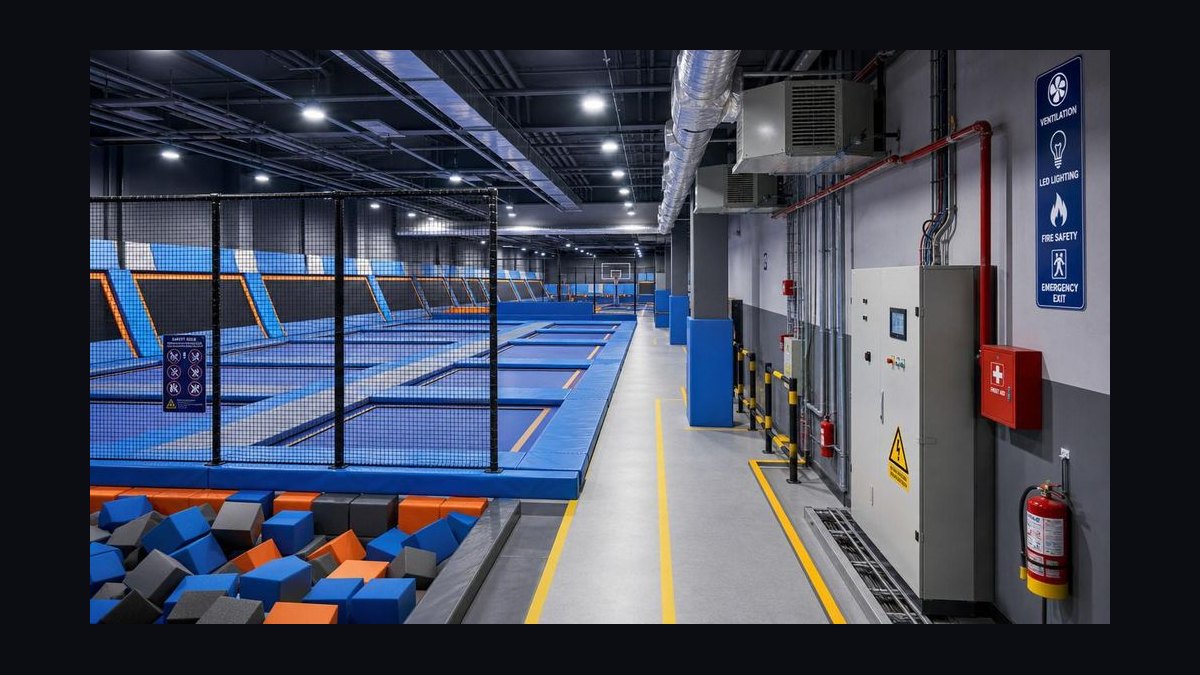
Budget $35–$55 per square foot for the buildout of a leased trampoline park shell, so a typical 25,000–40,000 sq ft box lands all-in between $1.2M and $2.5M including equipment. The court and foam package alone runs $15–$25 per square foot of attraction floor — the single largest line item.
What actually drives the budget
The trampoline and foam attraction system dominates every budget, but roughly six line items decide whether you open at $1.2M or $2.5M. The attraction package — springs, jump beds, foam pits, and perimeter padding — runs $300,000 to $600,000 on a 20,000 sq ft activity floor. Treat springs and beds as consumables: a park that size burns $8,000 to $15,000 a year replacing fatigued springs and torn beds, and the foam cubes filling your pits cost $1.50 to $3.00 each with 8,000 to 12,000 needed to fill a standard pit.
Specialty attractions stack experience and cost on top of that base. A ninja warrior course runs $40,000 to $120,000, climbing and warped-wall features $25,000 to $80,000, and a drop slide or skywalk $30,000 to $90,000. HVAC is the silent budget killer — a high-volume jumping space throws off enormous heat and humidity load, so plan $8 to $14 per square foot for adequate tonnage. Underspend and you get a sweaty, smelly room and the reviews that follow. Impact flooring and rubber add $3 to $7 per square foot, fire and life-safety upgrades for high-occupancy assembly use can hit $50,000 to $150,000, and party rooms and concessions — your profit engine, driving 30 to 40% of revenue — cost $10,000 to $30,000 per room to finish out. Model each of these as its own line, because the shell you sign and the vendors you pick swing the total by a million dollars.

Clear height, column spacing, and why the shell decides everything
You cannot value-engineer your way around physics, and the shell you sign locks in your ceiling — literally. Performance trampolines and foam pits need 22 to 28 feet of clear height, measured from finished floor to the lowest obstruction: joists, ductwork, or sprinkler heads. Any supertramp or wall-tramp feature wants at least 24 feet. Old big-box retail and grocery shells frequently deliver only 16 to 20 feet clear, which quietly disqualifies them and pushes you into pricier industrial space at $8 to $14 per square foot NNN. Verify clear height with a tape measure and the landlord's structural drawings before you fall in love with a location.
Column spacing is the second physical constraint operators overlook. Tightly spaced structural columns — common in older shells on 20-foot bays — chop up your court layout and waste 5 to 12% of usable attraction floor, because you must set trampolines and pits around them. Aim for 40-foot-plus clear spans. Before signing, spend $3,000 to $7,000 on a structural and MEP (mechanical, electrical, plumbing) feasibility study. It confirms whether the roof structure can hang the dead load of ninja-course rigging and whether the electrical service can carry HVAC plus arcade redemption games — you want at least 800 amps, ideally 1,200. Skip that study and discover an undersized panel mid-construction, and the utility service upgrade costs $40,000 to $90,000 out of your pocket, since a landlord rarely funds it after lease signing.
Negotiating the lease so the landlord funds your buildout
This is where the money is won or lost. Landlords love trampoline parks because they fill dead big-box square footage, which means you have leverage — use it. Demand a real tenant improvement (TI) allowance: for a 30,000 sq ft space, push for $25 to $50 per square foot, or $750,000 to $1.5M. That allowance alone can cover your entire foam, springs, and netting package. Free capital up front beats financing equipment at 12%, so even though the landlord amortizes the TI into your rent, the cash-flow trade usually favors the operator who models it honestly.
Just as important as the amount is the disbursement mechanics. Insist the TI is paid against AIA pay applications during construction, not as a single reimbursement after you open. A "paid upon opening" clause forces you to float the entire buildout — a trap that has bankrupted operators who ran out of cash three weeks before their certificate of occupancy. Cap your exposure on common area maintenance (CAM) at 3 to 5% annual increases, and explicitly exclude capital repairs to roof and structure — you should never pay to replace the landlord's roof through CAM. Make the landlord deliver a warm, dry, watertight, white-box shell with a functioning, code-compliant HVAC system at a stated tonnage, defined in writing with a punch list. Take a 7 to 10 year initial term with two 5-year options so you control renewal without a 15-year obligation, and negotiate any personal guaranty down to a burn-off that expires after 36 months of on-time payments. Finally, if you're in a center, secure an exclusive-use clause barring another trampoline or active-entertainment tenant, plus a co-tenancy clause that reduces your rent if the anchor goes dark.

Managing the general contractor and court installer
The general-contractor relationship is the second place budgets explode, and the discipline is straightforward if you enforce it. Bid the job to at least three GCs with real experience in assembly-occupancy and high-bay recreation — not a strip-mall retail builder. Recreation buildouts carry unusual structural and MEP demands, and a GC who has never hung foam-pit trusses will price the unknowns as change orders later. Use a guaranteed maximum price (GMP) contract, not open-ended cost-plus, so the GC absorbs overruns inside the contingency rather than passing them straight to you.
Keep the court installer separate from the GC. Your trampoline manufacturer's certified crew should set the courts under a contract you hold directly, so the GC can't mark that scope up 15 to 25%. Carry a 10 to 15% construction contingency — recreation shells reveal surprises like sub-slab plumbing or inadequate roof structure once demolition starts — and hold 10% retainage until the punch list is 100% closed and your certificate of occupancy is in hand. That retainage is your only real leverage once the GC has your money, so never release it early on a verbal promise to "finish next week." Sequence the work so feasibility, lease terms, contractor selection, and inspection gate each other in the right order.
Soft costs, permitting, and code triggers you can't skip
Before a single steel beam arrives, plan $80,000 to $150,000 on pre-development soft costs: feasibility studies, architectural drawings, and local permitting. A trampoline park triggers Occupancy Group A-3 (assembly) under most building codes, which drives fire-sprinkler retrofits, exit-capacity analysis, and often a $15,000 to $30,000 structural engineering report confirming the roof can support hanging trusses for foam pits or climbing walls. These aren't optional line items — they're the gate that stands between you and a permit, and municipalities will not let a 250-plus-occupant assembly venue open without them.
Budget another $10,000 to $25,000 for a geotechnical survey if your site has questionable soil. Many big-box slabs were never designed for the concentrated point loads of trampoline frames, and finding that out after you pour is a five-figure mistake. If your municipality requires it for a large venue, add $5,000 to $12,000 for a traffic-impact study. Operators who skip these upfront studies don't avoid the cost — they convert it into change orders that eat 10 to 15% of the construction contingency once work is already underway and the leverage to renegotiate is gone. Treat soft costs as the cheapest risk insurance in the entire budget: a few thousand dollars of engineering routinely prevents a hundred-thousand-dollar surprise.
Insurance, contingency, and where smart money trims
A trampoline park carries operating costs that belong in the plan from month one, not just the construction spread. General-liability premiums typically run $40,000 to $90,000 a year for a 25,000 sq ft facility, and many carriers now require $2M per occurrence / $5M aggregate minimums, with an additional-insured endorsement for the landlord adding $3,000 to $8,000 a year. Workers' compensation under the amusement class code runs roughly $8 to $15 per $100 of payroll, and structural modifications may require a $10,000 to $25,000 performance bond. On the construction side, steel, foam, nylon webbing, and vinyl have swung 8 to 15% year over year, and specialized installation crews — often booked 6 to 12 months out at $75 to $125 per hour per worker — turn a three-week equipment delay into $18,000 to $30,000 of idle labor. Set aside 15 to 20% of hard cost as contingency: on a $1.5M buildout, that's $225,000 to $300,000.
Once the buffer is protected, trim intelligently. Cut oversized day-one arcades — add redemption games in year two once you know traffic — use durable laminate instead of custom party-room millwork, and skip premium exterior signage if your visibility is already strong. Never cut HVAC tonnage, spring quality, foam-pit depth, or staff sightline design; those are exactly what create injuries, complaints, and the reviews that sink a park. Phasing protects cash the same way: open with the core court, foam pits, and two party rooms, then add the ninja course and climbing wall in month 9 to 12 funded by operating cash, lowering your day-one capital need by $150,000 to $300,000. A tight $1.3M build with proper mechanicals and safety beats a $2.2M park with a cheap HVAC system every time.
Related questions
How much revenue does a trampoline park need to break even?
Break-even depends on debt service, but a $1.5M–$2M buildout typically needs $1.2M to $2M in annual revenue to cover rent, payroll, insurance, and financing. Party rooms and memberships — not walk-in jump time — usually carry the margin.
Should I franchise or build an independent trampoline park?
Franchising buys brand recognition, vetted equipment specs, and financing relationships, but adds 5 to 8% of revenue in royalties and marketing fees. Independent operators keep all margin and control but shoulder every negotiation, code question, and vendor risk alone. Choose based on your operating experience.
How long does a trampoline park buildout take?
Plan 6 to 12 months from lease signing to opening. Permitting and structural work take the longest, especially the A-3 assembly review and any roof or slab reinforcement. Equipment installation and finishing move quickly once the shell is inspection-ready and utilities are confirmed.
What size trampoline park should I build?
Most parks operate in 25,000 to 40,000 sq ft, with smaller venues starting near 20,000 and larger ones exceeding 50,000. Revenue potential scales with attractions and party-room count, but so does rent and HVAC load — size to your market's population, not your ambition.
FAQ
What is the typical cost per square foot for a trampoline park buildout?
Budget $35 to $55 per square foot for a leased shell. That range covers construction, finishes, and basic infrastructure, but the trampoline and foam equipment package is a separate, often larger, line item.
How much does equipment alone add to the budget?
Equipment usually falls between $500,000 and $1.2 million depending on park size and features like dodgeball courts, foam pits, ninja courses, and climbing walls. It is the largest single cost after base construction and should be quoted directly from the manufacturer.
What size space should I plan for?
Most parks run 25,000 to 40,000 square feet. Smaller venues can start around 20,000, while larger destinations exceed 50,000. Confirm you have 22 to 28 feet of clear height before committing, regardless of floor area.
What are the biggest hidden costs I should watch for?
Structural reinforcement for jumping and hanging loads, HVAC upgrades for humidity control, fire-suppression modifications, and undersized electrical service. Together these commonly add 10 to 20% to the base buildout, which is why a pre-lease feasibility study pays for itself.
How long does a typical buildout take?
Expect 6 to 12 months from lease signing to opening. Permitting and structural work usually take longest, while equipment installation and finishing move faster when the shell is delivered on schedule and utilities are confirmed upfront.
Can I reduce costs by using a smaller space or fewer features?
Yes. A 20,000 sq ft footprint with fewer high-cost attractions can bring the total to roughly $1M to $1.5M. Just remember revenue scales with size and attractions, so trim day-one extras before you trim safety or HVAC.
Sources
- https://www.cbre.com — experiential retail and entertainment real estate outlook; big-box conversion and clear-height demand trends.
- https://www.jll.com — family entertainment center benchmarks, tenant-improvement allowances, and recreation lease comparables.
- https://www.cushmanwakefield.com — active-entertainment lease structuring, co-tenancy, and exclusivity guidance.
- https://www.astm.org — ASTM F2970 standard for trampoline court safety, spring, and foam specifications.
- https://www.rsmeans.com — recreation and assembly-occupancy construction cost units for HVAC, flooring, and fire suppression.
- https://www.naiop.org — commercial lease negotiation and tenant-improvement disbursement best practices.
- https://www.boma.org — operating cost and CAM benchmarks for entertainment-use space.
- https://www.sba.gov — small-business financing, insurance, and startup cost planning resources.
Related on PULSE
This page will be disappearing soon. Save it to your device for $1 — or read it free while it is here.
@Kory-White- · if Venmo asks, the last 4 of my number are 2012
This page is gone.
This one is off the shelf now. $1 keeps it on your phone for good — the whole page, pictures and diagrams included.
 buildoutsHow Do I Budget a Micro-Cinema or Screening-Room Buildout in 2026?
 buildoutsHow Do I Budget a Medical or Dental Office Buildout in 2026?
 buildoutsHow Do I Budget a Light Manufacturing Buildout in 2026?
 buildoutsHow Do I Budget a Church or Worship Space Buildout in 2026?
 buildoutsHow Do I Negotiate a Lease and Buildout for Doggy Daycare or Boarding in 2026?
 buildoutsHow Do I Budget a Veterinary Clinic Buildout in 2026?
 buildoutsHow Do I Budget a Comic, Game, or Hobby Store Buildout in 2026?
 buildoutsHow Do I Negotiate a Lease and Buildout for an Axe-Throwing Venue in 2026?
 buildoutsHow Do I Negotiate a Lease and Buildout for Cannabis Cultivation in 2026?
 buildoutsHow Do I Budget a Chiropractic Clinic Buildout in 2027?