


Thinking Fast and Slow by Daniel Kahneman — Cliff Notes Summary for Salespeople
Quality
Certified
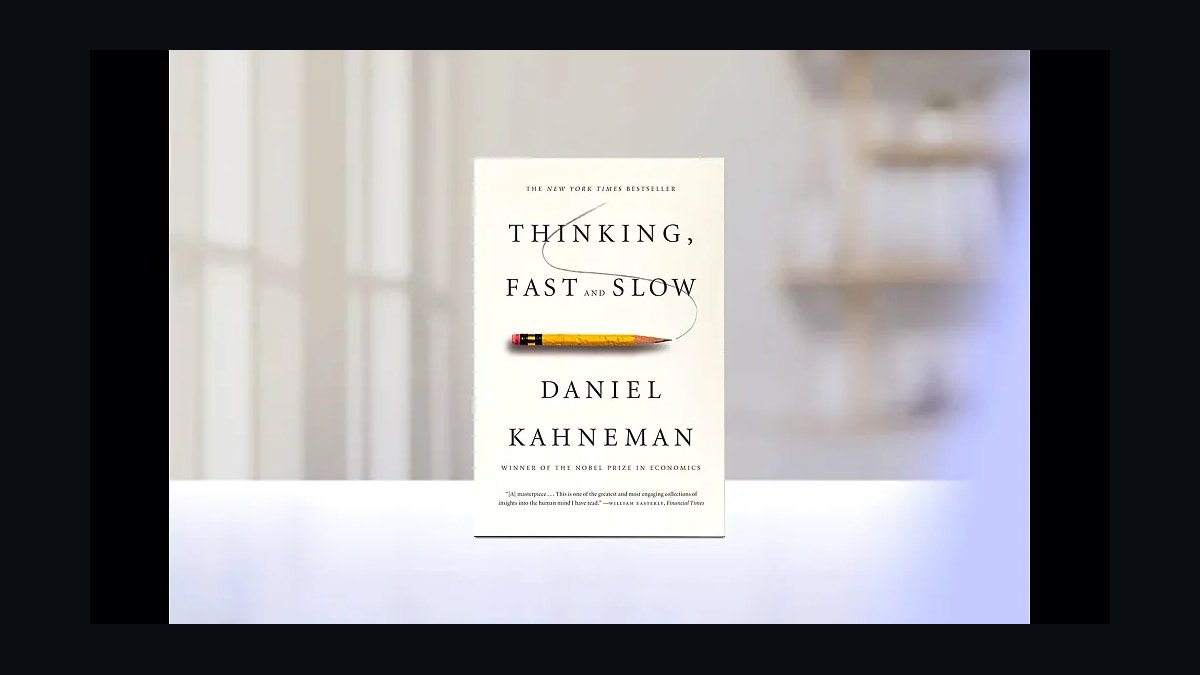
Thinking, Fast and Slow by Daniel Kahneman (Farrar, Straus and Giroux, 2011) is the 499-page capstone that distilled four decades of research with Amos Tversky into one organizing claim: the mind runs two systems. System 1 is fast, automatic, emotional, always-on, and effortless. System 2 is slow, deliberative, analytical, and lazy. The practical takeaway for selling is that a buyer's verdict on your demo, your price, and you is formed almost instantly by System 1 — and then rationalized after the fact by System 2 with spreadsheets and ROI decks. Sellers who pitch only to System 2 lose to sellers who win System 1 first and then hand System 2 the justification it needs.
The book matters to RevOps because it is the behavioral-economics bedrock under every modern sales method. Cialdini's Pre-Suasion, Voss's Never Split the Difference, Blount's Sales EQ, Dixon's JOLT Effect, Klaff's Pitch Anything, and Thaler & Sunstein's Nudge all trace their core levers — anchoring, loss aversion, framing, availability — back to Kahneman & Tversky's 1979 Prospect Theory paper, the work that earned Kahneman the 2002 Nobel Prize in Economics. Kahneman died in March 2024, but his two-systems model remains the most-cited behavioral framework in sales training. If you read one psychology book to understand why buyers do what they do, this is the source text the rest of the canon paraphrases.
1Part One — Two Systems
1.1 Chapter 1 — The Characters of the Story
Kahneman introduces System 1 (fast, intuitive, parallel, effortless, associative) and System 2 (slow, deliberate, serial, effortful, rule-following). His opening contrast is the angry-woman face versus the 17 × 24 multiplication problem — one is instant recognition, the other is conscious labor. The selling implication is immediate: a buyer's first impression of your demo is a System 1 verdict that fires in under a second, and everything that follows is System 2 trying to confirm or reverse it.
1.2 Chapter 2 — Attention and Effort
System 2 runs on a fixed energy budget. Pupils dilate when it engages — Kahneman documented this physiological tell early in his career. The practical lesson: a buyer juggling forty browser tabs and a pinging Slack is operating on depleted System 2 and will fall back to System 1 heuristics. That is why veteran reps simplify the deck, not expand it, late in a deal.

1.3 Chapter 3 — The Lazy Controller
*"Laziness is built deep into our nature."* System 2 accepts System 1's answer unless something forces it to check. The bat-and-ball problem — a bat and ball cost $1.10, the bat costs $1 more than the ball, so most people answer "10 cents" when the correct answer is 5 cents — shows even Princeton undergrads default to System 1. Round-number pricing that "feels right" works by never triggering the math.
1.4 Chapters 4–5 — The Associative Machine & Cognitive Ease
Priming (chapter 4) is the material Kahneman himself later flagged as the weakest after the 2014–2020 replication crisis. Cognitive ease (chapter 5) holds up well: things that are easy to read, easy to pronounce, and frequently repeated feel more true. Brand names that are easy to say carry a small but real persuasion edge at equal product quality.
1.5 Chapters 6–9 — Norms, Coherence, Judgments
The mind builds coherent stories from sparse data and then defends them. WYSIATI — *"What You See Is All There Is"* — is Kahneman's most useful acronym for sellers. Buyers decide on the evidence in front of them, not the evidence that exists. The seller's job is to put the right evidence in front of them.
2Part Two — Heuristics and Biases
2.1 Chapter 10 — The Law of Small Numbers
Humans treat small samples as representative. A rep who closes three deals in a row believes they've "figured it out" — but three wins is far too small a sample to carry signal. Win-rate analysis needs a large sample before any pattern is trustworthy; a hot streak is usually just variance.
2.2 Chapter 11 — Anchoring
The single most important chapter for sellers. The first number in a negotiation sets a reference point that biases every number after it. Kahneman's experiment: spinning a rigged wheel that stopped on 10 or 65 shifted estimates of "what percent of UN countries are African" by more than 20 points — even though subjects knew the wheel was random. The seller who anchors first protects margin. Voss built Never Split the Difference around this, and Klaff's Pitch Anything opens with a deliberate price-anchor frame.
2.3 Chapter 12 — Availability Heuristic
Buyers judge probability by how easily they can recall an example. A recent breach in the news makes "data security" feel urgent for weeks, even though the buyer's actual breach risk hasn't moved. Sellers exploit this with vivid case studies, recent peer logos, and fresh press — recency makes an example easy to recall, and easy recall reads as high probability.
2.4 Chapters 13–18 — Availability, Representativeness, Regression
Representativeness — judging by stereotype rather than base rate — explains why reps over-pursue deals that "look like" past wins and under-qualify the ones that don't fit the archetype. MEDDPICC exists precisely to force System 2 qualification on top of System 1's stereotype match.
3Part Three — Overconfidence
3.1 Chapters 19–22 — The Illusion of Understanding & Validity
Hindsight bias makes every past outcome feel inevitable. A CFO reviews a lost deal and concludes "we should have known" — but the forecast at the time was honestly uncertain. The lesson for RevOps: run pre-mortems, not just post-mortems.
3.2 Chapter 23 — The Outside View
The Planning Fallacy. Kahneman tells the story of his own textbook-writing team, which estimated two years; a curriculum expert on the team privately knew comparable projects took seven to ten years — and the project ultimately ran eight years. Buyers routinely underestimate implementation time. Dixon's JOLT Effect answers this with Recommend with Confidence — the rep names the realistic timeline before the buyer's optimism does.
3.3 Chapter 24 — The Engine of Capitalism
Optimism drives entrepreneurs to launch ventures that statistically fail. The selling lesson: the buyer-side champion runs on the same optimism bias and will over-promise internal adoption. Plan for the gap.
4Part Four — Choices (Prospect Theory)
4.1 Chapters 25–26 — Bernoulli's Errors & Prospect Theory
The 1979 Prospect Theory paper that won the Nobel. The S-shaped value curve has two features sellers cannot ignore:
- Losses loom roughly twice as large as equivalent gains (loss aversion).
- People are risk-averse for gains and risk-seeking for losses (the reflection effect).
4.2 Chapter 27 — The Endowment Effect
Once a buyer owns something — even a free trial — losing it feels disproportionately bad. This is the entire product-led-growth (PLG) thesis. PLG tools get the buyer holding the product, then convert against the pain of giving it up.

4.3 Chapter 28 — Bad Events
Loss aversion makes the threat of a loss far more motivating than the promise of an equivalent gain. In Tversky & Kahneman's own 1992 work, the loss-aversion coefficient came out near 2.0 — losses sting about twice as much as comparable gains feel good. In practice, *"you're losing $400K a year by not deciding"* reliably outpulls *"you'll gain $400K by deciding."* JOLT's "Take Risk Off the Table" play is direct loss-aversion application.
4.4 Chapters 29–34 — Patterns, Probabilities, Frames
The Framing Effect. *"90% survival rate"* sells better than *"10% mortality rate"* — identical math, opposite decisions. Surgeons, financial advisors, and sellers all exploit it. Klaff calls it *"frame control"*; Cialdini calls it *"pre-suasion."*

5Part Five — Two Selves
5.1 Chapters 35–36 — Two Selves & Life as a Story
The Experiencing Self lives moment to moment. The Remembering Self narrates the story afterward. They disagree. The famous cold-water experiment: subjects preferred a longer painful trial (60 seconds at 14°C, then 30 extra seconds as the water was warmed to 15°C) over a shorter one (60 seconds at 14°C alone), because the slightly less awful ending rewrote the memory of the whole experience.
5.2 Chapter 37 — Experienced Well-Being
In Kahneman & Deaton's 2010 PNAS study, day-to-day emotional well-being stopped rising once income passed roughly $75,000 a year (2010 dollars), even as life-satisfaction *ratings* kept climbing. The Experiencing Self and the Remembering Self value money differently — a caution for anyone who assumes "more" always feels better.

5.3 Chapter 38 — Thinking About Life
The Peak-End Rule. People remember an experience by two data points: its emotional peak and its ending. A demo with a flat middle and a great closing 90 seconds beats a demo with a great middle and a flat ending. Onboarding teams engineer both the first-value moment (peak) and the handoff to CS (end) for exactly this reason.
The Two Systems in Action
Frameworks at a Glance
- System 1 vs System 2 — Fast/automatic versus slow/deliberative; every decision starts in 1, gets ratified by 2.
- Anchoring — The first number sets the reference point; anchor first or lose margin.
- Loss Aversion (~2:1) — Losses sting roughly twice as much as equivalent gains feel good.
- Availability Heuristic — Probability is judged by recall ease, not statistical truth.
- Representativeness — Judging by pattern match instead of base rate.
- Framing Effect — Identical facts in a different frame produce opposite decisions.
- Endowment Effect — Owning something makes losing it hurt; PLG's secret weapon.
- Sunk Cost Fallacy — Past investment irrationally drives future commitment.
- Planning Fallacy — Timelines and budgets are systematically underestimated.
- Prospect Theory — The S-curve: risk-averse for gains, risk-seeking for losses.
- Peak-End Rule — Experiences are remembered by their peak and their ending only.
- Experiencing vs Remembering Self — The self that lived it disagrees with the self that tells the story.
- WYSIATI — *"What You See Is All There Is"* — buyers decide on the evidence in front of them.
- Cognitive Ease — Easy-to-process feels more true; brand naming and copy clarity exploit this.
How a Sales Call Cycles Between Systems
What Holds Up, What Has Aged
What still holds (as of 2026): Prospect Theory, anchoring, loss aversion, framing, and the peak-end rule have replicated across hundreds of follow-up studies and are now baked into AI sales tools. Conversation-intelligence platforms such as Gong and Clari can quantify in real time how often a rep anchors first versus reacts to a buyer's anchor, and how often loss-framing language appears versus gain-framing. The economics community awarded Richard Thaler the 2017 Nobel for his broader work in behavioral economics, which operationalized much of Kahneman's research into the Nudge approach now used in public policy and PLG onboarding.
What has aged poorly: The social-priming material in chapters 4–5 was hit hard by the 2014–2020 replication crisis. High-profile studies — including the Florida-elderly walking-speed priming experiment — failed to replicate. In a widely circulated 2017 comment, Kahneman acknowledged he had "placed too much faith in underpowered studies" and conceded the priming chapter was the book's weakest. Crucially, the Prospect Theory spine — anchoring, loss aversion, framing — rests on Kahneman & Tversky's own high-powered experiments, not the contested third-party priming literature, and it remains robust. The honest read: use chapters 10–38 freely and discount chapters 4–5.
FAQ
Why is Thinking, Fast and Slow considered the foundation of modern sales psychology? Because Cialdini's Influence and Pre-Suasion, Voss's Never Split the Difference, Klaff's Pitch Anything, Dixon's JOLT Effect, and Thaler & Sunstein's Nudge all build directly on Kahneman & Tversky's anchoring, loss-aversion, and framing research. The book is the upstream source of nearly every behavioral lever those methods pull.
What's the single most useful chapter for a quota-carrying rep? Chapter 11 — Anchoring. Negotiation research consistently finds that the party who makes the first offer anchors the final outcome in their favor (Galinsky & Mussweiler, 2001). Practical rule: drop the first credible price range yourself, and never let the buyer anchor first.
Did Kahneman himself walk back any of the book? Yes. In a 2017 comment he acknowledged that the social-priming literature he leaned on in chapters 4 and 5 had largely failed to replicate. The Prospect Theory core — anchoring, loss aversion, framing — was built on his and Tversky's own robust experiments and still stands.
How do AI tools like Gong and Clari apply this book? They tag calls for anchoring events (who named the first number), loss-framing language (cost of inaction versus value of acquisition), availability triggers (peer logos and recent-news references), and peak-end moments (the final minutes of the demo). RevOps then coaches reps on the patterns the top quartile uses.
Is the book still worth reading if I've already read Pre-Suasion and Never Split the Difference? Yes. Those books cherry-pick Kahneman. Reading the source gives you the full taxonomy, so you can spot applications competitors haven't operationalized — and it inoculates you against the priming research that weaker books still cite uncritically.
What did Kahneman and Tversky win the Nobel for? The 2002 Nobel Prize in Economics, for Prospect Theory — the 1979 paper showing that humans systematically violate the rational-actor assumptions of classical economics. Tversky had died in 1996, and the prize is not awarded posthumously, so only Kahneman received it. Kahneman died in March 2024.
Bottom Line
Read Thinking, Fast and Slow as the operating manual for the System 1 brain your buyer is actually using while they pretend to evaluate your spreadsheet with System 2. Monday morning, do three things: anchor first on every price conversation, frame inaction as a loss rather than action as a gain, and engineer the peak and the ending of every demo. Every modern sales method you respect — Challenger, MEDDPICC, JOLT, Sandler, SPIN, Never Split — is a System 1 trigger pattern wrapped in a System 2 framework. Kahneman wrote the source code; the rest of the sales canon is the API.
Related on PULSE
- Slow Down, Sell Faster! by Kevin Davis — Cliff Notes Summary
- Drive by Daniel Pink — Cliff Notes Summary for Sales Leaders
- To Sell is Human by Daniel Pink — Cliff Notes Summary & Key Takeaways
- What Great Salespeople Do by Michael Bosworth and Ben Zoldan — Cliff Notes Summary
- Start with Why by Simon Sinek — Cliff Notes Summary for Salespeople
- Atomic Habits by James Clear — Cliff Notes Summary for Salespeople
Sources
- Daniel Kahneman — *Thinking, Fast and Slow* (Farrar, Straus and Giroux, 2011)
- Daniel Kahneman & Amos Tversky — *Prospect Theory: An Analysis of Decision Under Risk* (Econometrica, 1979) — the Nobel-winning paper
- Amos Tversky & Daniel Kahneman — *Advances in Prospect Theory: Cumulative Representation of Uncertainty* (Journal of Risk and Uncertainty, 1992) — loss-aversion coefficient near 2.0
- Daniel Kahneman & Angus Deaton — *High Income Improves Evaluation of Life But Not Emotional Well-Being* (PNAS, 2010) — the ~$75K finding
- Adam Galinsky & Thomas Mussweiler — *First Offers as Anchors* (Journal of Personality and Social Psychology, 2001)
- Robert Cialdini — *Influence: The Psychology of Persuasion* (1984) and *Pre-Suasion* (2016)
- Chris Voss — *Never Split the Difference* (HarperBusiness, 2016)
- Oren Klaff — *Pitch Anything* (McGraw-Hill, 2011)
- Richard Thaler & Cass Sunstein — *Nudge* (Yale University Press, 2008; revised 2021)
- Dan Ariely — *Predictably Irrational* (HarperCollins, 2008)
- Matt Dixon & Ted McKenna — *The JOLT Effect* (Portfolio, 2022)
- Jeb Blount — *Sales EQ* (Wiley, 2017)
- Daniel Kahneman — 2017 published comment acknowledging weaknesses in the social-priming chapters
- Open Science Collaboration — *Estimating the Reproducibility of Psychological Science* (Science, 2015) — the replication-crisis landmark
- Royal Swedish Academy of Sciences — 2002 Nobel Prize in Economic Sciences citation for Daniel Kahneman
This page will be disappearing soon. Save it to your device for $1 — or read it free while it is here.
@Kory-White- · if Venmo asks, the last 4 of my number are 2012
This page is gone.
This one is off the shelf now. $1 keeps it on your phone for good — the whole page, pictures and diagrams included.
 pulse-recent$100M Offers by Alex Hormozi — Top 10 Key Takeaways for Sales Leaders in 2027
 pulse-recentThe Challenger Customer by Brent Adamson — Top 10 Key Takeaways for Sales Leaders in 2027
 pulse-recentWhat are the seven concrete steps to implement the Sandler Submarine technique from The Sandler Rules in 2027?
 pulse-recentThe Customer Success Professional’s Handbook by Ashvin Vaidyanathan — Top 10 Key Takeaways for Sales Leaders in 2027
 pulse-recentThe Transparency Sale by Todd Caponi — Top 10 Key Takeaways for Sales Leaders in 2027
 pulse-recentWhat is the step-by-step process for Strategic Selling by Miller Heiman in 2027?
 pulse-recentStrategic Selling by Robert Miller and Stephen Heiman — Top 10 Key Takeaways for Sales Leaders in 2027
 pulse-recentThe Closer’s Survival Guide by Grant Cardone — Top 10 Key Takeaways for Sales Leaders in 2027
 pulse-booksWhat are the most common mistakes in Book Summaries in 2027?
 pulse-booksTop 10 practical takeaways from Atomic Habits for building a new routine in 2027.