


The 1-Page Marketing Plan by Allan Dib — Cliff Notes Summary
Quality
Certified
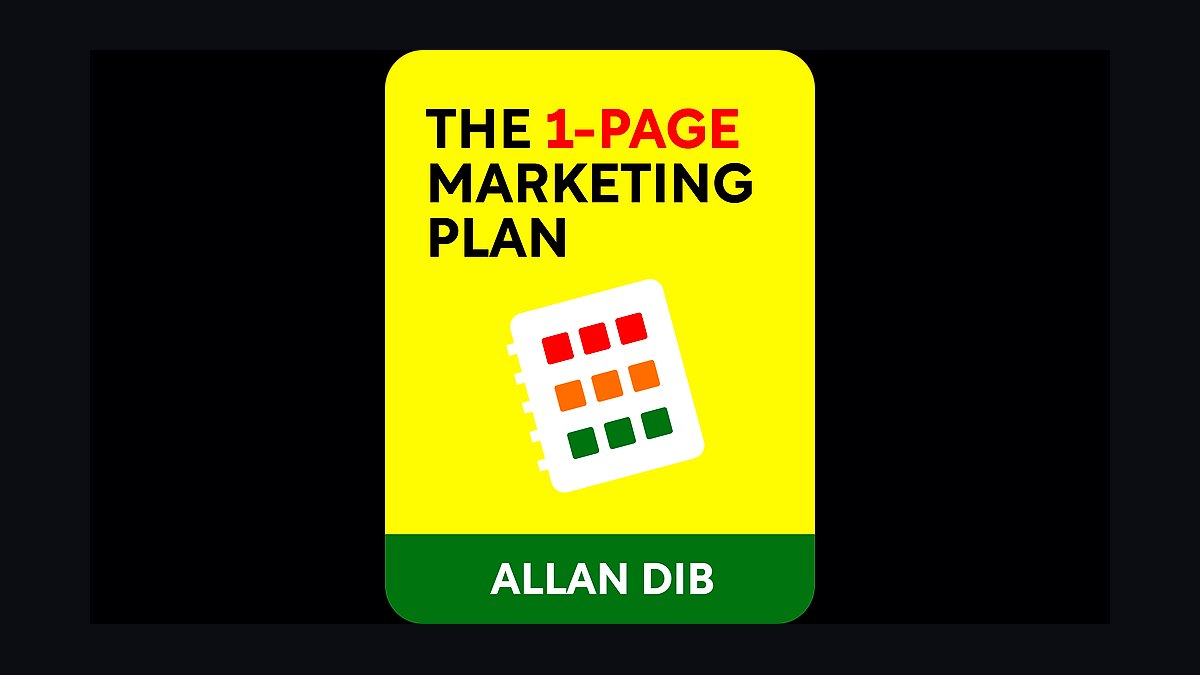
The 1-Page Marketing Plan by Allan Dib (Page Two Books, 2016; updated 2022) argues that the entire marketing strategy of any business — from a solo plumber to a mid-market software company — can and should fit on a single page organized as 9 squares across 3 phases: Before the prospect knows you, During the consideration window, and After they buy. Dib, an Australian tech entrepreneur and marketing consultant who built and exited an IT and telecom services company before going full-time into consulting, contends that most small businesses skip this planning exercise entirely and instead drift from tactic to tactic — boosted Facebook posts, a new logo, a podcast — without ever defining who they sell to, what they say, or how a lead becomes a customer.
For sellers and revenue leaders, the book matters because it forces the strategy-before-tactics discipline that gets lost the moment a founder hires their first SDR or buys their first ad. It sits alongside Jay Conrad Levinson's Guerrilla Marketing, Dan Kennedy's No B.S. Direct Marketing, and Donald Miller's StoryBrand as the practical operator's marketing canon — and remains one of the best onboarding reads for any new revenue leader who inherited a company with no written marketing plan. The whole framework can be read in about two hours and filled in by a team in a single 90-minute working session.
1The Setup — Why One Page
1.1 Chapter 1 — The Plan That Fits On A Fridge
Dib opens with the observation that traditional marketing plans run dozens of pages, take months to draft, and end up in a drawer. A one-page plan survives because it is glanceable, editable, and shareable. The fridge test: if a founder, an intern, and a contractor can all read the same page and walk away aligned, the plan works. Dib credits Verne Harnish's One-Page Strategic Plan (Rockefeller Habits) as inspiration but narrows the focus from whole-company strategy to marketing specifically.
1.2 Chapter 2 — Tactics Without Strategy
The chapter's anchor idea — "tactics without strategy is the noise before defeat" (a line widely paraphrased from Sun Tzu) — sets up Dib's core complaint: small business owners chase the shiny-object tactic of the month without a target market or message in place. Tactics multiply costs; strategy multiplies results. The point is not that tactics are bad — it is that tactics deployed without a niche, a message, and a funnel behind them simply burn cash faster.

2The Before Phase — Squares 1, 2, 3
2.1 Square 1 — Target Market (Niche-First)
Dib refuses the "everyone is my customer" trap. He introduces the PVP Index to score potential niches:
- Personal Fulfillment — do you actually enjoy serving these customers?
- Value to the Marketplace — will they pay a real price for the outcome?
- Profitability — does the unit-economic math work after delivery cost?
Each niche gets scored 1 to 10 on all three axes; pursue the niches that score highest across the board. Dib's recurring example: a generalist accountant who niches to dental-practice bookkeeping grows revenue because the message, referrals, and pricing all sharpen at once.
2.2 Square 2 — Message To Target Market
Once the niche is locked, the message must break through indifference. Dib's test: would the message survive in a noisy bar? He prescribes specificity over cleverness — "I help dentists collect 100% of insurance receivables within 30 days" beats "We deliver financial peace of mind." This square is where Donald Miller's StoryBrand (2017) and April Dunford's Obviously Awesome (2019) layer in as deeper positioning frameworks.
2.3 Square 3 — Media / Reach Strategy
The channel to reach the niche: Meta ads, Google Search, podcast sponsorships, direct mail, LinkedIn outbound, industry trade publications, partnership marketing. Dib favors paid channels with measurable response over relying solely on organic social, which he frames as renting attention from an algorithm that can change the rules tomorrow. The guidance: build more than one reliable channel so the business is never one platform change away from zero leads.
3The During Phase — Squares 4, 5, 6
3.1 Square 4 — Capturing Leads
Most ads send traffic to a homepage and lose the overwhelming majority of it. Dib mandates a lead magnet — a free guide, checklist, calculator, or assessment — traded for an email address. The classic example: a roofer offering "7 Questions To Ask Before Hiring Any Roofer" captures email plus ZIP and starts the nurture sequence. The aim is to convert anonymous traffic into a known, contactable lead rather than hoping strangers buy on the first visit.
3.2 Square 5 — Nurturing Leads
Dib draws a hard line: most leads are not ready to buy today. The job of nurture is to stay top-of-mind for months through email, retargeting, direct mail, and the occasional phone call. He prescribes a multi-touch sequence before disqualifying anyone, drawing on Dan Kennedy's "shock and awe" package concept — multi-channel, multi-medium, high-frequency. The modern automation stack (HubSpot, ActiveCampaign, Customer.io, Marketo) makes this trivial to run; the discipline of actually doing it is what's missing.
3.3 Square 6 — Sales Conversion
The conversion square covers offer structure, risk reversal, pricing tiers, and objection handling. Dib's signature move: a "good-better-best" three-tier offer with the middle tier engineered to be the obvious winner. Risk reversal — money-back guarantees, pilot pricing, free trials — sits at the heart of the square. He explicitly rejects "always be closing" in favor of trust-first selling, which is where the lineage to Neil Rackham's SPIN Selling and Matthew Dixon's Challenger Sale becomes visible.
4The After Phase — Squares 7, 8, 9
4.1 Square 7 — Delivering A World-Class Experience
The first purchase is not the goal — it is the start of the customer relationship. Dib argues that wow moments in onboarding (a handwritten note, a welcome video from the founder, a 24-hour personal check-in call) compound into referrals and repeat business. Companies cited for service culture: Zappos, the Apple Store Genius Bar, and Ritz-Carlton, whose well-known policy empowers any employee to spend up to a set discretionary amount to fix a guest problem on the spot.
4.2 Square 8 — Increasing Customer Lifetime Value
The single biggest leverage point in many businesses: getting existing customers to buy more, more often. Dib's tactics: considered price increases (he argues many small businesses are underpriced), upsells at the point of sale (the classic "want fries with that"), cross-sells via email, subscription / recurring billing models, and bundling. He leans on the 80/20 Pareto rule: a large share of profit typically comes from a small share of customers — find them and serve them harder.
4.3 Square 9 — Stimulating Referrals
Dib rejects passive "we appreciate referrals" signage and prescribes an active referral program with named rewards, scripted asks, and a systematic timing trigger (for example, ask at a 30-day post-purchase satisfaction call). He references Joe Girard's "Rule of 250" (every customer is connected to roughly 250 other people) and the modern Net Promoter Score loop popularized by Fred Reichheld.
5The 9-Square Marketing Plan Grid
6Direct Response Marketing — The Underlying Discipline
Dib's whole framework rests on Direct Response Marketing (DRM) — the school of marketing inherited from Claude Hopkins (Scientific Advertising, 1923), David Ogilvy, Gary Halbert, and Dan Kennedy. The DRM rules Dib enforces throughout the book:

- Every marketing dollar should produce a measurable response. No untracked "brand building."
- Every ad needs a single, clear call-to-action — call this number, scan this code, fill this form.
- Test, measure, iterate. A/B test headlines, offers, and lead magnets continuously.
- You can't improve what you don't measure.
- The math wins. Optimize Lifetime Customer Value (LCV) divided by Customer Acquisition Cost (CAC) — not raw cost-per-lead.
The LCV / CAC logic Dib teaches: if a customer is worth $5,000 over three years and CAC is $500, the resulting 10:1 ratio justifies aggressive ad spend. Many small business owners only watch cost-per-lead and starve their best channels because the upfront number scares them, even when the lifetime return is excellent.
Frameworks at a Glance
- The 9 Squares — Target / Message / Reach / Capture / Nurture / Convert / Deliver / LCV / Referrals
- 3 Phases — Before / During / After (prospect awareness states)
- PVP Index — Personal Fulfillment × Value to Marketplace × Profitability, scored 1–10 each
- Message-Market Match — niche-specific copy that survives the noisy-bar test
- Direct Response Marketing — every dollar tracked to a response, no brand-building exception
- Lead Magnet + Nurture Sequence — opt-in offer plus a sustained multi-touch follow-up
- Risk Reversal — money-back guarantees and pilot pricing to remove buyer friction
- LCV / CAC Ratio — the marketing math Dib prioritizes over cost-per-lead
- Pareto 80/20 — find the small share of customers driving most of the profit and serve them harder
7The Marketing-Execution Operating Loop
What Holds Up, What Has Aged
What holds up: The 9-square discipline is still an excellent exercise for any founder or new revenue leader inheriting a company without a written plan. The PVP Index for niche selection has aged well — it maps cleanly onto vertical SaaS, indie bootstrapping, and creator-economy businesses. Direct Response Marketing has been reinforced by the modern attribution stack — HubSpot, Marketo, GA4, Segment, Mixpanel automate what Dib was preaching manually. LCV / CAC thinking is now standard in any board conversation.

What has aged: The Reach Strategy chapter assumes the marketer can directly control channel mix. Today, Meta Advantage+, Google Performance Max, and TikTok Smart+ have moved channel selection inside the algorithm — you supply a creative and a goal, and the platform decides where the ad runs. Some of Dib's specific channel tactics feel dated, though direct mail is having a niche revival for B2B account-based marketing. The book also pre-dates product-led growth as a named discipline — modern SaaS founders often blend Dib's plan with Wes Bush's Product-Led Growth (2019). For mid-market B2B SaaS where the funnel is MQL / SQL / Opportunity / Closed-Won, Dib's small-business vocabulary can feel foreign — but the underlying logic maps cleanly once translated.
FAQ
Who is Allan Dib and why should I trust him? Dib is an Australian tech entrepreneur who built and exited an IT and telecom services company before becoming a full-time marketing consultant. He is not an academic — the book is built on years of in-the-trenches consulting with small and mid-sized businesses. He later wrote Lean Marketing (2024), which expands and updates the same framework for an AI-and-attribution era.
Is this book just for small businesses? It is written for SMBs, but the 9-square framework scales upward. Mid-market B2B SaaS teams can use it as a strategic overlay above their MQL / SQL funnel — the squares map onto ICP definition, positioning, demand-gen channels, lead capture, nurture, AE conversion, customer success, expansion revenue, and referral / advocacy programs. The vocabulary changes; the underlying nine questions do not.
How is this different from StoryBrand or Obviously Awesome? Donald Miller's StoryBrand is essentially a deep dive on Square 2 (Message). April Dunford's Obviously Awesome is a deep dive on positioning, which feeds Squares 1 and 2. Dib's book is the operating system that holds those deeper specialty frameworks together in one place — it tells you where each of them belongs in the overall plan.
What is the single biggest takeaway? Niche first, then everything else. Dib's most repeated point is that a sharp niche makes Squares 2 through 9 almost write themselves: the message gets specific, the channels narrow, the referrals compound, and pricing power rises. A vague niche makes every downstream square harder and more expensive. If you do only one thing with the book, tighten your target market.
Should I read this or Lean Marketing (his 2024 follow-up)? Start with The 1-Page Marketing Plan for the core framework and the 9-square template. Read Lean Marketing second for the modern updates on AI tooling, attribution, and channel economics. They complement each other rather than replace each other — the first gives you the structure, the second updates the tactics that sit inside it.
Where does the 9-square plan sit in the marketing lineage? Levinson's Guerrilla Marketing (1984) taught small-budget creativity. Dan Kennedy's No B.S. Direct Marketing taught measurable, response-driven advertising. Dib's 1-Page Marketing Plan (2016) packaged both into a one-page operator framework. Dunford's Obviously Awesome (2019) and the modern PLG canon then extend the positioning and product-led pieces.
Bottom Line
Read The 1-Page Marketing Plan if you are a founder, fractional CMO, or new revenue leader who inherited a business with no written marketing strategy — and you need a two-hour read that gets the whole team aligned on a single page. The Monday-morning action: block 90 minutes, print the 9-square template, and fill it in with your team. You will discover within the first hour which squares are empty — and those gaps are usually the leaks costing you the most money. The book remains one of the best single onboarding reads in the small-business and indie-SaaS marketing canon, and the PVP Index plus the 9 squares are the two artifacts most worth stealing wholesale.
Related on PULSE
- The Pumpkin Plan by Mike Michalowicz — Cliff Notes Summary
- This Is Marketing by Seth Godin — Cliff Notes Summary for Sellers
- Permission Marketing by Seth Godin — Cliff Notes Summary for Sellers
- The 22 Immutable Laws of Marketing by Ries and Trout — Cliff Notes Summary
Sources
- Allan Dib — The 1-Page Marketing Plan (Page Two Books, 2016; updated 2022)
- Allan Dib — Lean Marketing (Page Two Books, 2024) — author follow-up
- Jay Conrad Levinson — Guerrilla Marketing (Houghton Mifflin, 1984) — small-budget marketing lineage
- Dan Kennedy — No B.S. Direct Marketing for Non-Direct Marketing Businesses (Entrepreneur Press, 2006) — direct-response foundation
- Donald Miller — Building a StoryBrand (HarperCollins Leadership, 2017) — Square 2 (Message) deep dive
- April Dunford — Obviously Awesome (Ambient Press, 2019) — positioning extension
- Brian Halligan & Dharmesh Shah — Inbound Marketing (Wiley, 2014) — HubSpot canonical text
- Wes Bush — Product-Led Growth (ProductLed Press, 2019) — modern SaaS extension
- Verne Harnish — Mastering the Rockefeller Habits (Gazelles, 2002) — one-page-plan origin
- Fred Reichheld — The Ultimate Question 2.0 (Harvard Business Review Press, 2011) — NPS / referral framework grounding Square 9
- Claude Hopkins — Scientific Advertising (1923) — direct-response grandfather text
People also search for: the 1-page marketing plan summary · allan dib 9 squares explained · 1-page marketing plan pvp index · before during after marketing phases · allan dib lean marketing vs 1-page marketing plan · 1-page marketing plan review for B2B sellers
This page will be disappearing soon. Save it to your device for $1 — or read it free while it is here.
@Kory-White- · if Venmo asks, the last 4 of my number are 2012
This page is gone.
This one is off the shelf now. $1 keeps it on your phone for good — the whole page, pictures and diagrams included.
 pulse-recentProActive Selling by Skip Miller — Top 10 Key Takeaways for Sales Leaders in 2027
 pulse-recentSPIN Selling by Neil Rackham — Top 10 Key Takeaways for Sales Leaders in 2027
 pulse-recentThe Sales Manager’s Guide to Greatness by Kevin Davis — Top 10 Key Takeaways for Sales Leaders in 2027
 pulse-recentWhat is the most actionable step in The Sandler Rules for Sales Leaders by David Mattson to improve discovery in 2027?
 pulse-recentWhat is the second concrete step in Strategic Selling by Miller Heiman for identifying a sales coach in 2027?
 pulse-recentNever Lose a Customer Again by Joey Coleman — Top 10 Key Takeaways for Sales Leaders in 2027
 pulse-recentHow does *The New Strategic Selling* define the first step in qualifying an opportunity in 2027?
 pulse-booksRework by Jason Fried and David Heinemeier Hansson — Cliff Notes Summary
 pulse-recentWhat is the first concrete step in Sandler Rule #4 for a sales leader to implement in 2027?
 pulse-recentSales EQ by Jeb Blount — Top 10 Key Takeaways for Sales Leaders in 2027