


Power Phone Scripts by Mike Brooks — Cliff Notes Summary
Quality
Certified

Power Phone Scripts: 500 Word-for-Word Questions, Phrases, and Conversations to Open and Close More Sales by Mike Brooks (Wiley, 2017) is a tactical script library written by the founder of Mr. Inside Sales training. Brooks's central thesis is that the gap between top and bottom inside-sales reps is not talent, charisma, or product knowledge — it is whether the rep has rehearsed today's call. Brooks delivers a library of word-for-word scripts spanning Opening, Qualifying, Demo, Objection-Handling, and Closing so that no rep ever has to "ad-lib a bad call." Scripts, in Brooks's hands, are not constraints — they are what lets a rep sound prepared on the seventh dial of the morning instead of mumbling through a memorized opener. In the modern sales canon the book sits between Stephan Schiffman's Cold Calling Techniques (1987) and Jeb Blount's Fanatical Prospecting (2015), and the structural patterns Brooks codified now show up inside Outreach, Salesloft, Apollo, Lavender, and Regie.ai cadence-script libraries. The single most useful action after reading: pick the four or five core scripts, rehearse them out loud before the shift, and measure the change in your connect-to-conversation rate over two weeks.
1Why Scripts — The Argument Before the Library
1.1 The "ad-libbed call" problem
Brooks opens with a confrontation. Most inside-sales reps believe scripts make them sound robotic and that "being natural" wins deals. Brooks argues the opposite: ad-libbed calls are how reps invent reasons buyers won't return their calls. A rep who freestyles the opener will, by the seventh dial of the morning, mumble through it, bury the lede, and trigger an instant brush-off. Brooks's framing: scripts don't constrain creativity — they free it. Once the opener, the qualifier, and the top objection-handlers are committed to muscle memory, the rep's working memory is freed to actually listen to the prospect.
1.2 The top-vs-bottom split
Brooks's core claim is the spine of the entire book: the difference between top reps and the rest is whether they practiced today's call. Top reps rehearse out loud, role-play with a peer, and re-read their scripts before every shift. Bottom reps "wing it" and call it authenticity. Brooks frames practice as the only controllable input that compounds — product, territory, list quality, and comp plan are all set by the company; only rep preparation is owned by the rep.
2The Cold Open — Brooks's Signature 4-Part Framework
2.1 The 4-Part Cold Open
Brooks's most-copied script is the 4-Part Cold Open, designed to clear the first seconds of a cold call without triggering the buyer's reflexive brush-off:
- "Hi [name], this is [your name] from [company]." — Name and company up front, said with downward inflection so the buyer hears a peer, not a pitch.
- "The reason for my call is [specific business issue]." — Not "I wanted to introduce myself." A named, concrete reason the buyer's role would care about.
- "[Peer reference] in [their industry] saw [outcome] by [solution]." — A one-sentence social-proof anchor, naming a company in the buyer's vertical.
- "Do you have a few minutes to see if there's a fit?" — A small, time-boxed, fit-framed ask. Never "30 minutes," never "demo."
Brooks teaches the 4-Part Cold Open as the opener a rep should reach for on a true cold dial, and devotes a large share of the script library to variations by industry, persona, and time of day.
2.2 The "pattern interrupt" debate
Brooks is skeptical of the "Did I catch you at a bad time?" style pattern interrupts that were popular in 2017. His objection: pattern interrupts work once, then sales teams overuse them and buyers learn the trick. The 4-Part Cold Open is more durable because it is honest — it tells the buyer who is calling, why, and asks for a small commitment.
3Discovery and Qualifying Scripts
3.1 The qualifying call
Brooks dedicates a full section to the second call — the qualifying conversation — and provides scripts for budget, authority, need, timeline, competition, and decision-process questions. The signature qualifying script is the "Three-Deep" question pattern: ask the question, then ask the follow-up, then ask the follow-up to the follow-up. Example: "What's prompting you to look at this now?" → "And what happens if you don't solve it by Q4?" → "Who else on the team feels that pressure?"
3.2 The pre-demo confirmation

Before any product demo, Brooks scripts a brief pre-demo confirmation: re-state what you heard on the discovery call, confirm who will be on the demo, and confirm what "good" looks like at the end. Brooks argues this single step is one of the highest-leverage habits in the book because it eliminates the "demo to nobody" problem — where a rep pitches an influencer who can't buy.
4The Demo Open and Trial-Close Sequence
4.1 The Demo Open
The demo opener is scripted in three beats: agenda, time-check, and confirmation question. "Here's what I'd like to cover in our 30 minutes — does that match what you wanted?" Brooks insists on the confirmation question because it surfaces hidden agendas before the screen-share starts.
4.2 The Trial-Close Sequence
The heart of the demo section is the Trial-Close Sequence. After every value point in the demo, the rep asks a small closing question:
- "Does that make sense?" — confirms comprehension.
- "Could you see your team using this?" — confirms fit.
- "On a scale of 1-10, how well does that solve the problem?" — surfaces objections before they harden.
- "When would you want to start?" — tests urgency without asking for the order.
Brooks's coaching: never deliver a feature without a trial close. A demo without trial closes is a monologue; a demo with trial closes is a negotiation already in progress.
5Objection-Handling — The Largest Section in the Book
5.1 The Objection-Bridge Phrase
Most objection-handlers in Brooks's library open with the same bridge: "I understand, and here's why other [titles] in [industry] decided to keep talking..." The bridge does two things — it validates the buyer (reducing their defensive posture) and pivots to a peer-reference rebuttal instead of a feature dump.
5.2 The most common objections
Brooks catalogs the objections a phone rep hears most often and gives multiple word-for-word responses to each. A representative set of the highest-frequency objections and the canonical Brooks-style responses:
- "I'm not interested." → "I understand — most people aren't until they see how it works. Quick question: if I could show you how [peer] cut [cost], would that be worth a few minutes?"
- "Just send me some info." → "Happy to. So I send the right thing — what's the one outcome that would make this worth your time?"
- "Call me back in Q3." → "I'll do that — what will be different in Q3 that isn't true today?"
- "We're already with [competitor]." → "Great — a lot of my best clients came from [competitor]. What would have to be true for you to consider switching?"
- "Too expensive." → "Compared to what? Let's make sure we're comparing the same outcome, not just the same line item."
Each script is rehearsed in the Mr. Inside Sales training program until the rep can deliver it without hesitation. Brooks's point: the rep who pauses to think after "we're already with [vendor]" has already lost the momentum of the call.
6Closing Scripts
6.1 The Final Close
Brooks rejects the high-pressure "Always Be Closing" school. His final-close script is a quiet question after a strong trial-close sequence: "Based on what we've covered, does it make sense to get the paperwork started?" No assumption, no urgency theater — just a small confirming ask after the buyer has already said yes several times in trial closes.
6.2 The Take-Away Close
For stalled deals, Brooks scripts a Take-Away Close: "It sounds like the timing might not be right — should we revisit this in 90 days?" Counter-intuitively, the take-away frequently surfaces the real objection (price, authority, or a competing priority) that the buyer was hiding behind "let me think about it."
7Voicemail, Email, and LinkedIn Scripts
7.1 The Voicemail Template — short and single-reason
Brooks's voicemail rule is strict: keep it short, with name + company + ONE specific reason + number twice, and no pitch. The full script:
> "Hi [name], this is [your name] from [company]. The reason for my call is [one specific reason]. You can reach me at [number]. Again, that's [name] at [number]. Thanks."
Brooks's logic: a long, pitch-laden voicemail gets deleted before the buyer ever hears the call-back number, while a short voicemail built around a single concrete reason gives the buyer one clear thing to respond to. The number goes in twice because a buyer writing it down needs the repeat.
7.2 The Cold Email Script
Brooks ports the 4-Part Cold Open into email: the subject line is a peer reference ("How [peer] cut [cost]"), the body is three sentences (reason, proof, ask), and the signature is plain text. No "Hope this finds you well," no calendar link in the first touch.
7.3 LinkedIn Connection Scripts
LinkedIn was nascent for cold outreach in 2017, but Brooks already scripts the connect note (short, naming a mutual contact or shared group, no pitch) and the post-accept message (the same 4-Part Cold Open compressed into a DM).
8The Daily Script Block
8.1 Practice every day, before the shift
Brooks's operating cadence for reps is the Daily Script Block: rehearse scripts out loud before the dialing shift begins, preferably with a peer in role-play. Brooks's coaching, in his own framing: top reps practice; average reps wing it. The practice block is treated as non-negotiable in the Mr. Inside Sales training program — reps who skip it for a couple of weeks revert to ad-libbing, and Brooks's experience is that performance follows the drift downward.
8.2 The script-review cadence for managers
Managers run a weekly script review — pick one call recording per rep, compare it against the scripted version, identify the drift, re-rehearse. Brooks insists managers do this even with their top reps, because scripts degrade without reinforcement.
Phone-Call Anatomy
Frameworks at a Glance
- The script library — organized by call-stage (Opening, Qualifying, Demo, Objection, Closing, Voicemail, Email, LinkedIn) so a rep can find the right line in seconds mid-call.
- The 4-Part Cold Open — "This is X from Y — reason for call — peer reference — short ask." The signature framework, with many industry and persona variations.
- The Objection-Bridge Phrase — "I understand, and here's why other [titles] in [industry] decided to keep talking..." Pivots from defense to peer-proof rebuttal.
- The Trial-Close Sequence — small closing questions after every value point: "Does that make sense?" → "Could you see using this?" → "When would you want to start?"
- The Three-Deep question pattern — every discovery question gets two follow-ups before moving on.
- The Voicemail Template — short, name + company + ONE reason + number twice, no pitch.
- The Take-Away Close — "Should we revisit this in 90 days?" surfaces the real objection.
- The Daily Script Block — rehearse out loud before the dialing shift starts.
The Inside-Sales Daily Operating Loop
What Holds Up, What Has Aged
What holds up. The structural patterns Brooks codified are durable. The 4-Part Cold Open, the Objection Bridge, the Trial-Close Sequence, and the short single-reason voicemail are still the canonical templates inside most sales-development orgs. Independent call analysis — including Gong Labs' published research on large samples of recorded sales calls — points in the same direction as Brooks's scripts: top reps tend to open with a named reason, confirm with trial-close-style questions, and keep voicemails short. The daily-practice discipline has held up too: Salesloft and Outreach both ship rep-practice and role-play tooling in their current platforms, echoing the same habit Brooks prescribes.
What has aged. Three things needed updating since 2017. First, AI-generated personalization at scale — tools like Lavender, Regie.ai, and Apollo Conversations now generate variant messaging tuned to a prospect's LinkedIn, recent news, and tech stack, which a static library cannot match one-to-one. Second, product-led growth (PLG) selling has reduced cold-call volume in many software categories — a rep at a Figma or Notion spends more time on expansion and product-qualified leads than on cold dials, so the cold-open scripts apply to a narrower slice of the day. Third, LinkedIn and email cadence design has been industrialized since 2017 — Brooks treats them as bolt-ons, while modern cadence design treats them as co-equal channels with the dial.
FAQ
Is this book worth reading if I work in modern PLG SaaS where cold calls are rare? Yes, but read it as a structural-pattern book, not a tactical playbook. The Trial-Close Sequence and Objection Bridge apply word-for-word to expansion calls, customer-success renewal calls, and demo conversations even when nobody is cold-dialing.
Is the Mr. Inside Sales training program still active? Yes. Brooks's training company continues to operate and the script library has been refreshed across several editions, though the 2017 Wiley book remains the canonical reference text.
Should I memorize all the scripts? No. Brooks's recommendation is to memorize the 4-Part Cold Open, the Objection Bridge, the Trial-Close Sequence, the Voicemail Template, and the top handful of objection responses. The rest is a reference library you look up by call-stage.
How does this compare to Fanatical Prospecting by Jeb Blount? Blount is the manager-of-managers book — it argues prospecting cadence, time-blocking, and pipeline math. Brooks is the rep's tactical script library. Most modern sales-development orgs use both: Blount sets the cadence, Brooks provides the words.
Does the book work for field sales or only inside sales? Brooks wrote it for inside sales, but field reps report the qualifying and trial-close scripts transfer directly to in-person discovery and demos. The cold-open scripts assume the buyer answered a phone — adapt them for walk-ins or trade-show floor conversations.
Is there an audiobook version that's worth listening to? The audiobook helps because hearing the scripts read aloud conveys the intended inflection — particularly the downward inflection on the opener and the pause before the trial close — cues that reps who only read the print edition often miss.
Bottom Line
Power Phone Scripts is the reference library every inside-sales rep should keep within arm's reach of the dialer. The Monday-morning action: pick the 4-Part Cold Open, the top objection responses, and the short voicemail template, rehearse them out loud before the shift starts, and measure the connect-to-conversation rate change over the next two weeks. Brooks's enduring contribution to the sales canon is the operating insight that scripts are not the opposite of authenticity — they are the only way to be authentic on the seventh dial of the morning.
Related on PULSE
- Smart Selling on the Phone and Online — Cliff Notes Summary
- Smart Selling on the Phone and Online by Josiane Feigon — Cliff Notes Summary
- Pick Up the Phone and Sell by Alex Goldfayn — Cliff Notes Summary
- The Power of Habit by Charles Duhigg — Cliff Notes Summary for Sellers
- The Power of a Positive No by William Ury — Cliff Notes Summary
- Power Listening by Bernard Ferrari — Cliff Notes Summary
Sources
- Mike Brooks — *Power Phone Scripts: 500 Word-for-Word Questions, Phrases, and Conversations to Open and Close More Sales* (Wiley, 2017)
- Mike Brooks — *The Real Secrets of the Top 20%: How to Double Your Income Selling Over the Phone* (2008)
- Mr. Inside Sales training program — ongoing curriculum and script-library updates, mrinsidesales.com
- Stephan Schiffman — *Cold Calling Techniques (That Really Work!)* (Adams Media, 1987 first edition)
- Art Sobczak — *Smart Calling: Eliminate the Fear, Failure, and Rejection from Cold Calling* (Wiley, 2010)
- Jeb Blount — *Fanatical Prospecting: The Ultimate Guide to Opening Sales Conversations and Filling the Pipeline* (Wiley, 2015)
- Gong Labs — published research on patterns in large samples of recorded sales calls
- Outreach and Salesloft — cadence-script libraries and rep-practice tooling
- Apollo Conversations, Lavender, Regie.ai — modern AI personalization layers for outreach scripts
- Neil Rackham — *SPIN Selling* (McGraw-Hill, 1988) — foundational discovery-question framework Brooks references
This page will be disappearing soon. Save it to your device for $1 — or read it free while it is here.
@Kory-White- · if Venmo asks, the last 4 of my number are 2012
This page is gone.
This one is off the shelf now. $1 keeps it on your phone for good — the whole page, pictures and diagrams included.
 pulse-recentWhat is the second concrete step in Strategic Selling by Miller Heiman for identifying a sales coach in 2027?
 pulse-booksTop 10 practical takeaways from Atomic Habits for building a new routine in 2027.
 pulse-recentSPIN Selling by Neil Rackham — Top 10 Key Takeaways for Sales Leaders in 2027
 pulse-recentSales EQ by Jeb Blount — Top 10 Key Takeaways for Sales Leaders in 2027
 pulse-recentWhat are the first three concrete steps in Sandler Rule #1 for a new sales rep in 2027?
 pulse-recentSandler Rule #1: What is the first concrete step to build a prospect's trust in a sales conversation in 2027?
 pulse-recentSnap Selling by Jill Konrath — Top 10 Key Takeaways for Sales Leaders in 2027
 pulse-recentObviously Awesome by April Dunford — Top 10 Key Takeaways for Sales Leaders in 2027
 book-summaryMajor Account Sales Strategy by Neil Rackham: Summary, Key Lessons, and RevOps Takeaways
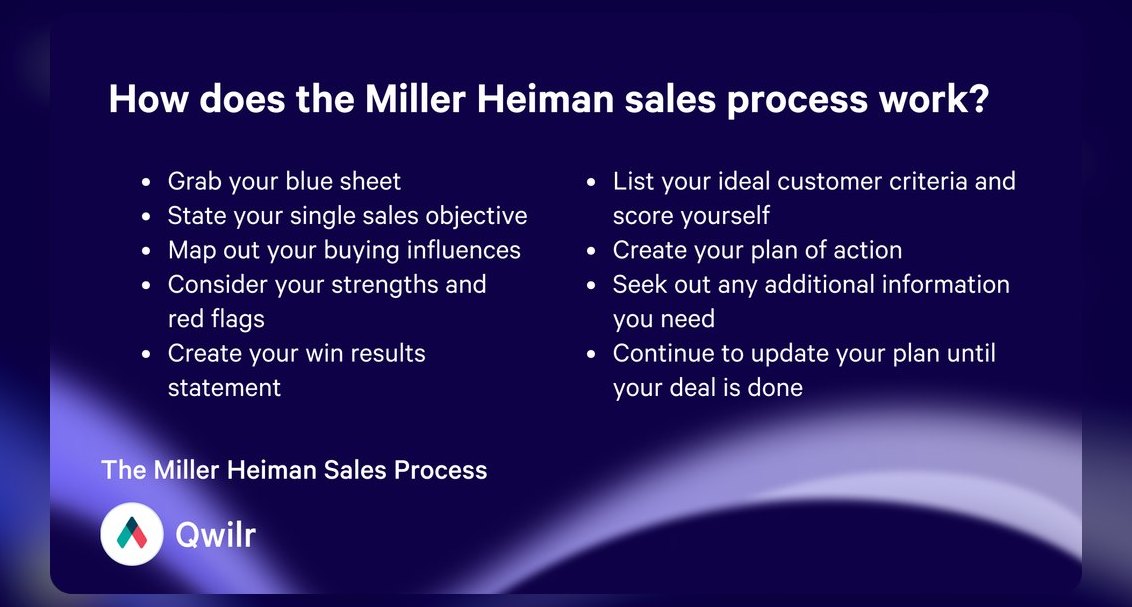 pulse-recentWhat is the step-by-step process for Strategic Selling by Miller Heiman in 2027?