

To Sell Is Human — Cliff Notes Summary
 Curated byKory White · Fractional CRO · Maryland
Quality
Certified

To Sell Is Human (Daniel Pink, Riverhead Books, 2012) argues one in nine American workers sells for a living while the other eight spend roughly 40% of their time in "non-sales selling" — persuading without transacting. Pink replaces Always Be Closing with Attunement, Buoyancy, and Clarity, then adds three skills: Pitch, Improvise, Serve.
What the book actually is, and why it outlived its shelf
Most 2012 sales books aged badly because they were tactical manuals written for a world where the seller controlled the information. To Sell Is Human is not a tactical manual. It is a research-synthesis argument — closer in DNA to Pink's earlier Drive and A Whole New Mind than to anything on the Sandler shelf — and that is precisely why a Cliff Notes Summary of it still earns its place on a modern RevOps reading list. Pink is not teaching you to close. He is arguing that the category "salesperson" has quietly swallowed most of the white-collar workforce, and that the skills required have inverted.
The structural argument sits on three legs. First, the raw census fact: the U.S. Bureau of Labor Statistics puts roughly one in nine American workers in a formal sales occupation, and that ratio held remarkably steady across the decade preceding the book despite a constant drumbeat of "the internet killed the salesman" commentary. Automation ate travel agents and stock brokers, but sales headcount as a share of employment did not collapse. Second, Pink's own What Do You Do at Work survey, fielded with Qualtrics across roughly 7,000 respondents, found that non-sales workers spend approximately 24 minutes of every working hour moving others — pitching an idea in a standup, convincing a skeptical finance partner, recruiting an engineer, persuading a teenager to do homework. That is the 40% figure that gets quoted everywhere, and it is the book's animating claim. Third, the composition of the economy shifted toward what Pink calls Ed-Med — education and healthcare — sectors whose entire function is moving people toward behavior they did not choose on their own. A teacher moves a student toward effort. A clinician moves a patient toward adherence. Neither takes a commission; both are selling.
What makes the book durable for a revenue operations audience is the fourth, less-discussed leg: elastic work. Pink was writing at the dawn of the Etsy/Shopify/Substack era, before the term "creator economy" existed, and he predicted that as more people run micro-businesses, the sales function stops being a department and becomes a baseline literacy. That prediction landed. Every solo consultant, every founder-led-sales SaaS company, every product manager pitching a roadmap internally is running the motion Pink described.

For a RevOps leader, the practical value is not the frameworks — it is the vocabulary. When you are trying to get a CS team, a solutions engineering group, or a product org to adopt selling behaviors, "you are all in sales now" reads as a threat. "Roughly 40% of your week is already non-sales selling; we are just going to make you better at the part you already do" reads as an observation. That reframe is worth the price of the book on its own, and it is the single most useful thing to extract from any Cliff Notes Summary of it.
The core argument: information parity and caveat venditor
The chapter that has aged best is the one about why the old model broke. Pink's claim is structural rather than moral: high-pressure closing worked for a century because sellers held an information monopoly. The used-car dealer knew the wholesale book value and you did not. The financial advisor had the terminal and you had a newspaper. The enterprise software rep knew what the last three customers actually paid and you had a rate card. Under asymmetry, the seller's incentive is extraction, the buyer's posture is defensive, and the entire folklore of sales — the assumptive close, the takeaway, the puppy-dog trial — is engineering around a suspicious counterparty.
Then the asymmetry collapsed. Kelley Blue Book, Edmunds, and CarGurus did it to autos. Glassdoor did it to employment. TripAdvisor did it to hospitality. In B2B software, review aggregators like G2 and TrustRadius plus practitioner communities on Reddit and Slack did it to the buying committee. By the time a modern buyer takes a first call, they have read your pricing page, your competitor's pricing page, three review threads, and a churn complaint from someone at a company their size. Pink's term for the resulting regime is caveat venditor — seller beware. The old Latin was caveat emptor, buyer beware, because the buyer carried the information risk. Now the seller carries the reputation risk, and the asymmetry runs the other direction more often than sales leaders admit.
The operational consequences are concrete and measurable. Lie once and the record is permanent and searchable. Oversell an integration and the implementation team inherits a churn event with a paper trail. Sandbag a security questionnaire and the buyer's InfoSec lead posts the discrepancy in a peer Slack. In a parity world, the highest-EV strategy is aggressive honesty, because the cost of being caught has gone from "lose this deal" to "lose this segment."
This is also why the Glengarry Glen Ross archetype died as a serious model rather than as a punchline. Always Be Closing assumes the rep knows something the buyer needs and can be pressured into paying for. When the buyer already knows, pressure reads as either ignorance or manipulation, and both are disqualifying. Nearly every serious B2B methodology retooled around this same insight: qualification-heavy frameworks like MEDDIC, gap-oriented discovery, Sandler's negative-reverse posture, and the teaching-led model popularized by The Challenger Sale — which, notably, published the same year Pink was writing and argues a complementary point from the enterprise side. Pink's contribution is the why underneath all of them.
Downstream of this argument sits a RevOps question worth sitting with: if information parity is real, what is your commercial team actually adding? The honest answers are narrow and useful — synthesis (connecting facts the buyer has but has not assembled), sequencing (what to do first given their constraints), risk absorption (I will own this outcome), and internal navigation (helping a champion sell inside their own org). Everything else the buyer can self-serve, which is exactly why product-led motions ate the low end of so many categories.
The frameworks, step by step: ABC, then Pitch–Improvise–Serve
Pink structures the how-to half of the book in two tiers. The first tier — the new ABCs — is about qualities of being. The second — Pitch, Improvise, Serve — is about skills of doing. Working through them in order is the fastest way to convert the book into a coaching curriculum.
Attunement means bringing yourself into harmony with individuals, groups, and contexts. Pink gives three counterintuitive rules. Reduce your power, because the low-power party reads the room more accurately — a finding grounded in Adam Galinsky's perspective-taking research at Kellogg. Use your head as much as your heart: cognitive perspective-taking (what is this person thinking, what are their constraints, who do they report to) reliably outperforms pure emotional empathy in negotiation outcomes, per work by Galinsky and William Maddux. And mimic strategically — the chameleon effect documented by Tanya Chartrand and John Bargh, where subtle posture and language mirroring measurably increases rapport and agreement. The practical translation for a discovery call: talk less, ask about their org chart, and pick up the buyer's own nouns rather than substituting your category jargon.
Attunement also delivers the book's most-cited empirical finding: ambiverts outperform both introverts and extraverts. Adam Grant's study of outbound call-center representatives, published in Psychological Science in 2013, found earnings peaked in the middle of the introversion-extraversion scale rather than at the extreme extravert end where hiring managers had been fishing for decades. The hiring implication is direct — screening for "high energy" and "outgoing" selects for a trait that does not predict performance, and may actively select against listeners.
Buoyancy is about surviving rejection, and Pink splits it into before, during, and after. Before: use interrogative self-talk. Instead of the declarative pep talk ("I can do this"), ask the question ("Can I do this?") — research by Ibrahim Senay and Dolores Albarracín found the interrogative form outperforms declarative affirmation because it forces you to surface actual reasons and tactics rather than manufacture confidence. During: maintain a positive-to-negative emotional ratio. Pink leans on Barbara Fredrickson's positivity work here, including a specific numeric threshold that was later challenged on statistical grounds and should be treated as directional rather than precise. After: manage explanatory style, borrowing from Martin Seligman's optimism research with insurance agents, where optimistic explanatory style predicted meaningfully higher production and lower attrition. The three dimensions — permanence (is this forever?), pervasiveness (does it touch everything?), and personalization (is it me?) — are the actual coaching tool. A rep who loses a deal and concludes "I always lose enterprise deals, I am bad at this" is failing on all three axes and will churn out within two quarters.
Clarity is the third leg and the most strategically interesting. In a parity world, buyers already have answers; what they lack is the correctly framed problem. Pink argues that problem-finding beats problem-solving, and offers concrete framing levers: the less frame (fewer options convert better, echoing Sheena Iyengar's choice-overload research), the experience frame (sell the experience rather than the good, per Van Boven and Gilovich), the label frame (naming a behavior changes it), the blemished frame (a small acknowledged negative amid positives increases persuasion — the "our onboarding takes six weeks, not two" move), and the potential frame (evidence of future potential can persuade more than a record of past performance). He closes with the most operationally useful idea in the book: always provide an off-ramp. Clarity without a specific, low-friction next action dies in inaction. Every CTA, every mutual action plan, every "here is the one link to forward to your security team" is an off-ramp.
The second tier begins with Pitch, where Pink retires the elevator pitch and offers six replacements: the one-word pitch (ruthless compression — a campaign, a product, a strategy reduced to a single noun), the question pitch (converting a claim into a question so the audience generates its own reasons, grounded in self-persuasion research by Burnkrant and Howard), the rhyming pitch (rhyme increases perceived truthfulness through processing fluency, per Matthew McGlone's work), the subject-line pitch (utility plus curiosity plus specificity, borrowed straight from email marketing practice), the social-media pitch (the discipline of a hard character ceiling, which in the book's era meant Twitter and now means the LinkedIn hook line or the first three seconds of a video), and the Pixar pitch. The Pixar pitch is the one that survived hardest: the six-sentence scaffold attributed to former Pixar story artist Emma Coats — *Once upon a time… Every day… One day… Because of that… Because of that… Until finally…* It is the backbone of nearly every good fundraise narrative and most good enterprise business cases, because it forces a before-state, an inciting change, consequences, and a resolution rather than a feature list.
Improvise argues that when the buyer refuses the script, the rep with improv reflexes wins. Pink draws on Second City's training tradition and Keith Johnstone's foundational work on impro. Three rules: hear offers (treat every objection as information rather than attack), say "yes, and" (build on the buyer's frame instead of contradicting it — "yes, and here is what that would mean for your renewal timeline"), and make your partner look good (the deal has to serve the champion's internal narrative, not your quota story). Any AE who has watched a champion get overruled by a CFO understands the third rule viscerally.
Serve closes the book with two filters. The upshot question: if this person agrees, will their life actually improve? The purpose test: when this interaction ends, will the world be marginally better than when it began? Pink defends the second with Adam Grant's field research on call-center fundraisers who briefly met a scholarship recipient and subsequently raised dramatically more than controls — purpose outperformed incentive. Whatever you think of the loftiness, the operational version is unambiguous: reps who can articulate who benefits and how sustain effort through rejection better than reps who can only articulate their comp plan.
What it costs, how long it takes, and what to expect from it
Treat this section as the practical logistics a team lead needs before assigning the book, because the most common failure mode is buying 40 copies and getting zero behavior change.
The book itself is a trade paperback in the neighborhood of 250–270 pages depending on edition, and most readers finish it in six to eight hours of focused reading — realistically two to three sittings, or a week of commutes. Audio runs roughly six hours read by Pink himself, and the audiobook holds up well because the prose is conversational. Chapters end with a "Sample Case" section of exercises and prompts, which is unusual for a business trade book and makes it genuinely assignable rather than merely readable. Bulk pricing on trade paperbacks typically runs meaningfully below list at 25+ copies through standard corporate channels, which matters if you are outfitting a team.
The time budget for turning it into an actual enablement program is where teams underestimate. A realistic shape: one week of reading, then three to four 60-minute working sessions spaced a week apart — one per framework cluster (ABCs, Pitch, Improvise/Serve, then application to your specific motion). Add call-recording review between sessions so reps are grading real conversations rather than discussing abstractions. That is roughly 10–14 hours of participant time over a month, which is a real cost when a rep-hour carries pipeline expectations. Compare that to a vendor-delivered methodology rollout, which commonly runs multiple days of workshop time plus per-seat licensing plus reinforcement — an order of magnitude more expensive and more disruptive.
What you should expect in return is calibration, not lift. This is the honest framing. To Sell Is Human will not raise close rates by itself, and anyone promising a number is selling you something. What it reliably does: gives a non-sales team permission and vocabulary to participate in revenue motions; supplies a hiring counter-argument against extravert bias; provides a shared language for discovery coaching that does not require licensing a methodology; and reframes rejection so that ramping reps attribute losses to process rather than identity, which is a retention lever. If you want measurable pipeline lift, you need a methodology with a qualification schema attached — MEDDIC-family, command-of-the-message, or similar. Pink is the philosophy layer under those, not a replacement for them.
Sequencing matters. The pattern that works: use Pink for the whole go-to-market org including non-quota functions, then layer a rigorous qualification framework on the quota-carrying subset. Running it the other way — methodology first, philosophy later — usually means the philosophy never lands because reps have already filed the topic under "training we did."
One more cost worth naming: opportunity cost against the adjacent shelf. If your specific problem is enterprise deal navigation, The Challenger Sale or a MEDDIC text is a better use of the same reading hours. If it is discovery question craft, Gap Selling. If it is negotiation, Never Split the Difference or Getting to Yes. Pink's book is the right choice when the problem is *audience* — people who do not think of themselves as sellers and therefore have never invested in the skill at all.
Where teams get this book wrong
The first and most common error is treating it as a sales-training book and handing it to a tenured enterprise AE. A rep who has run 300 discovery calls will find the ABCs directionally true and operationally thin, and will correctly note that the book contains no qualification schema, no multithreading guidance, no pricing strategy, and no forecast discipline. Assigning it to that audience burns credibility for the next thing you assign. It is a book for people at the *beginning* of thinking about persuasion, or for cross-functional audiences who have never thought about it at all.
The second error is quoting the research as settled. Pink is a synthesizer, and social psychology went through a serious replication reckoning after 2012. Some of the findings he cites have been re-examined; the positivity-ratio threshold in particular drew a well-known statistical critique shortly after publication and the specific number should not be repeated as fact. Priming and mimicry effects generally have been scrutinized. The intellectually honest posture is to teach the *direction* — perspective-taking helps, optimistic explanatory style is protective, framing changes decisions — while declining to cite precise effect sizes as though they were engineering constants. A rep who repeats a shaky statistic to a skeptical buyer and gets fact-checked has learned exactly the wrong lesson from a book about caveat venditor.

Third, teams mistake "everyone is in sales" for "everyone gets a quota." Pink's argument is descriptive, not a comp design. Attaching variable compensation to support engineers or product managers because they do non-sales selling is a reliable way to destroy the trust that made their persuasion effective in the first place. The correct operational move is enablement without incentive distortion: teach CS to run a value conversation, do not pay them a commission on it.
Fourth, the Pixar pitch gets weaponized into a template that everyone fills out identically. Six sentences with the same connective tissue across forty slides is not storytelling, it is a mad-lib. The scaffold is a drafting tool — write it, then rewrite the output in your own cadence so it does not scan as a formula. The same caution applies to the one-word pitch, which in practice becomes a fight over a noun that nobody outside the room understands.
Fifth, and most consequential for RevOps specifically: teams adopt the "serve" language without changing any of the systems that punish serving. If your comp plan pays on bookings with a short clawback window, your forecast process rewards optimistic commits, and your ramp targets require 40 first meetings a month, no amount of reading about the upshot question will change rep behavior. Pink says purpose moves people more than commission; that is true at the margin and false when the commission plan is actively adversarial to the customer outcome. The book is a lagging indicator of a healthy system, not a lever that creates one. Fix the plan, then teach the philosophy.
Finally, some of the book's surface examples are genuinely dated and should be updated before you teach from them. The social-media pitch arithmetic assumes a character ceiling that no longer applies. Email-as-primary-channel examples underweight where persuasion now happens — asynchronous video, shared workspaces, community channels, and buyer-side AI research assistants that summarize your entire call before your champion reads it. Modernize the examples; the underlying claims survive.
Choosing what to read, and where this fits your stack
The decision framework below is the one worth actually running, because the failure mode is not "this book is bad" — it is "this book was aimed at the wrong reader."
Start by naming the deficiency. If the deficiency is *identity* — people who do not believe persuasion is part of their job — Pink is the correct answer and there is no close second, because the book's entire rhetorical project is dissolving that objection. If the deficiency is *qualification rigor* — deals slipping, happy ears, forecasts that miss — you need a schema, and no amount of attunement substitutes. If the deficiency is *discovery depth* — reps taking orders instead of finding problems — Pink's clarity chapter is a useful primer but a dedicated discovery text goes further. If the deficiency is *resilience and ramp attrition*, the buoyancy chapter plus explanatory-style coaching is genuinely the right intervention and cheaper than most alternatives.

Then check the adjacent surfaces, because this book's ideas leak usefully outside the sales org. Product managers use the Pixar pitch for roadmap narratives and the question pitch in stakeholder reviews. Recruiters live in non-sales selling by definition and benefit from the attunement material more than most quota carriers. Customer success gets the most from serve and the upshot question, which reframes a renewal conversation as an outcome audit. Founders doing their own selling get the most complete value, because they need all six ideas at once and have no methodology infrastructure to fall back on. Even finance and internal ops benefit from the clarity frames when they are trying to move a decision through a committee.
A note on sequencing across a full reading program, since teams usually ask. A defensible order for a go-to-market org building from zero: Pink first for shared vocabulary across every function; then a discovery-craft text for the quota carriers; then a qualification methodology tied to your CRM stage definitions; then negotiation last, because negotiation skill applied to badly qualified deals just closes bad deals faster. Spread across two to three quarters, one book per quarter with working sessions, and resist the urge to run them concurrently.
Finally, the honest verdict on the Cliff Notes question itself. Can you get the value from a summary rather than the book? Partially. The frameworks compress cleanly — ABC, six pitches, three improv rules, two serve filters fit on an index card. What does not compress is the accumulated weight of the research narrative, which is what actually changes a skeptic's mind. If your reader is already persuaded that persuasion matters, a summary is sufficient and the index card is the deliverable. If your reader is the product manager who insists they do not do sales, they need the full argument, in Pink's voice, with the studies attached — because the argument, not the framework, is the product.
Related questions
Is To Sell Is Human a sales methodology?
No. It is a research-backed argument about why persuasion is now general-purpose work, plus six practitioner skills. It contains no qualification schema, stage definitions, or forecast discipline. Pair it with a methodology like MEDDIC for quota-carrying reps rather than treating it as a substitute.
What does caveat venditor mean in practice?

Seller beware. Because buyers can verify claims through reviews, communities, and AI research assistants before a first call, the cost of exaggeration shifted from losing one deal to damaging reputation across a segment. Operationally it means aggressive honesty is now the highest-expected-value posture.
What is the Pixar pitch structure?
A six-sentence scaffold attributed to former Pixar story artist Emma Coats: Once upon a time… Every day… One day… Because of that… Because of that… Until finally… It forces a before-state, an inciting change, consequences, and resolution — the shape of most effective fundraise and business-case narratives.
Why do ambiverts outsell extraverts?
Adam Grant's Psychological Science research on call-center representatives found performance peaked in the middle of the introversion-extraversion scale rather than at the extravert extreme. Ambiverts flex between asserting and listening, which suits a buyer who already has information and needs a diagnostician.
Which parts of the book are dated?
The social-media pitch character arithmetic, email-as-primary-channel examples, and any precise effect sizes from social psychology findings later subjected to replication scrutiny — notably the specific positivity ratio. Teach the directional claims; drop the exact numbers.
FAQ
Is To Sell Is Human still worth reading?
Yes, for the right reader. It has aged better than most 2012 sales titles because its central premise — information parity between buyer and seller — describes the current environment more accurately than it did when written. Buyers now arrive at first calls having read reviews, pricing pages, and community threads, and increasingly having run AI research on the vendor. The book was built for that world. Where it shows its age is in surface examples and in citing precise psychological effect sizes that later drew replication scrutiny.
Do I need to be in a sales role for this book to be useful?
No, and that is the point. Pink's survey found non-sales workers spend roughly 40% of their working time moving others — persuading, convincing, influencing. The intended reader is the product manager, customer success lead, recruiter, teacher, clinician, or founder who insists they do not do sales. Formal sales professionals will find the frameworks directionally correct but operationally light compared to a dedicated methodology.
What are the new ABCs?
Attunement, Buoyancy, and Clarity, replacing Always Be Closing. Attunement is perspective-taking — reducing your own power, reading the buyer's constraints cognitively rather than only emotionally, and mirroring subtly. Buoyancy is resilience through rejection via interrogative self-talk, emotional ratio management, and optimistic explanatory style. Clarity is finding the problem the buyer has not yet named, then framing it and providing a clear off-ramp to action.
How does this compare to The Challenger Sale?
They published around the same time and argue complementary points. Challenger is an enterprise sales methodology with a research base drawn from B2B rep performance data, prescribing teach-tailor-take-control. Pink is a general-audience argument about why the old closing model broke and what qualities replace it. Challenger tells a quota-carrying rep what to do in a complex deal; Pink tells a broader audience why persuasion changed at all. Read Pink for vocabulary across the org, Challenger for enterprise deal execution.
Can I get the value from a summary instead of the book?
The frameworks compress well — the ABCs, six pitches, three improv rules, and two serve filters fit on a single card, which is why Cliff Notes treatments of it are genuinely useful. What does not compress is the cumulative research narrative that changes a skeptic's mind. If your reader already accepts that persuasion is their job, the summary suffices. If they need convincing, hand them the book.
How should a team roll this out?
One week of reading, then three or four 60-minute working sessions a week apart, each mapping one framework cluster onto your actual motion, with call-recording review between sessions. Roughly 10–14 hours of participant time over a month. Critically, audit your compensation and forecast systems first — teaching a "serve the buyer" philosophy inside a plan that rewards short-term bookings produces cynicism, not behavior change.
Sources
- To Sell Is Human — author's official page (danpink.com)
- Daniel Pink — Practice your six pitches (PDF)
- Riverhead Books / Penguin Random House — To Sell Is Human
- Adam Grant — Rethinking the Extraverted Sales Ideal (Psychological Science, 2013)
- U.S. Bureau of Labor Statistics — Sales and Related Occupations
- Farnam Street — How to succeed in sales: insights from Daniel Pink
- Harvard Business Review — Daniel Pink on selling
- Goodreads — To Sell Is Human reader reviews
- Columbia Business School — Sheena Iyengar, choice research
- Kellogg School of Management — Adam Galinsky faculty page
Related on PULSE
- To Sell is Human by Daniel Pink — Cliff Notes Summary & Key Takeaways
- Sell or Be Sold — Cliff Notes Summary
- Built to Sell by John Warrillow — Cliff Notes Summary for Founders
- Conversations That Sell by Nancy Bleeke — Cliff Notes Summary
- Sell Different! by Lee Salz — Cliff Notes Summary
- Slow Down, Sell Faster! by Kevin Davis — Cliff Notes Summary
This page will be disappearing soon. Save it to your device for $1 — or read it free while it is here.
@Kory-White- · if Venmo asks, the last 4 of my number are 2012
This page is gone.
This one is off the shelf now. $1 keeps it on your phone for good — the whole page, pictures and diagrams included.
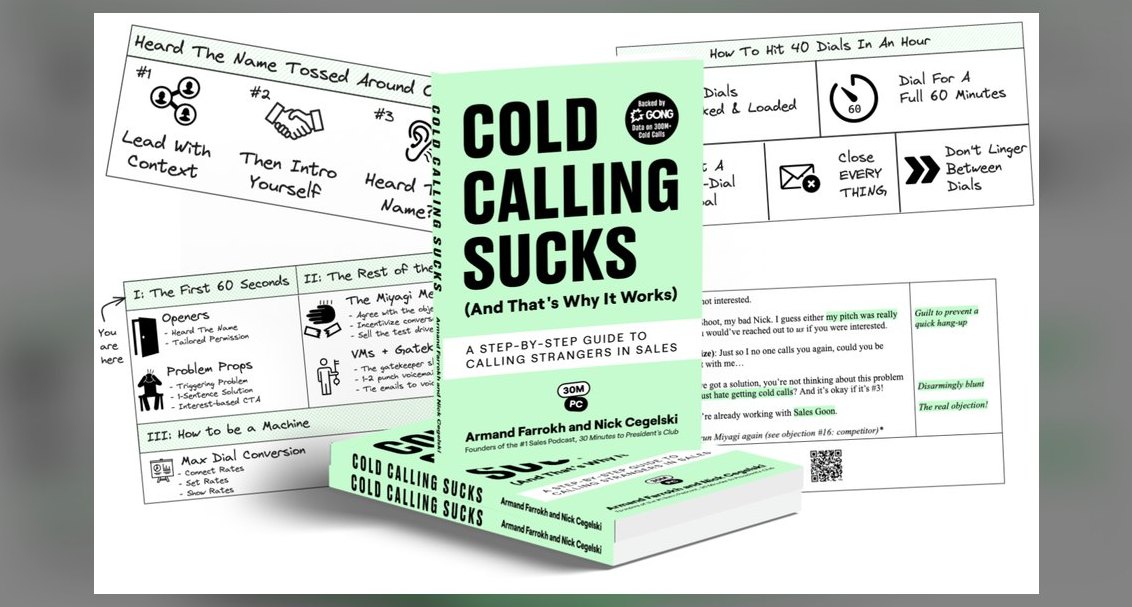 pulse-recentCold Calling Sucks and That’s Why It Works by Armand Farrokh and Nick Cegelski — Top 10 Key Takeaways for Sales Leaders in 2027
 pulse-recentAgile Selling by Jill Konrath — Top 10 Key Takeaways for Sales Leaders in 2027
 pulse-recentPurple Cow by Seth Godin — Top 10 Key Takeaways for Sales Leaders in 2027
 pulse-recentCrossing the Chasm by Geoffrey Moore — Top 10 Key Takeaways for Sales Leaders in 2027
 pulse-recentCustomer Success by Nick Mehta — Top 10 Key Takeaways for Sales Leaders in 2027
 pulse-recentSmart Calling by Art Sobczak — Top 10 Key Takeaways for Sales Leaders in 2027
 pulse-recentThe Effortless Experience by Matthew Dixon — Top 10 Key Takeaways for Sales Leaders in 2027
 pulse-recentThe Revenue Acceleration Rules by Shashi Upadhyay — Top 10 Key Takeaways for Sales Leaders in 2027
 pulse-recentObjections by Jeb Blount — Top 10 Key Takeaways for Sales Leaders in 2027
 pulse-recent$100M Leads by Alex Hormozi — Top 10 Key Takeaways for Sales Leaders in 2027