
Selling to Big Companies — Cliff Notes Summary
 Curated byKory White · Fractional CRO · Maryland
 PULSEKNOWLEDGE LIBRARY
Quality
Certified
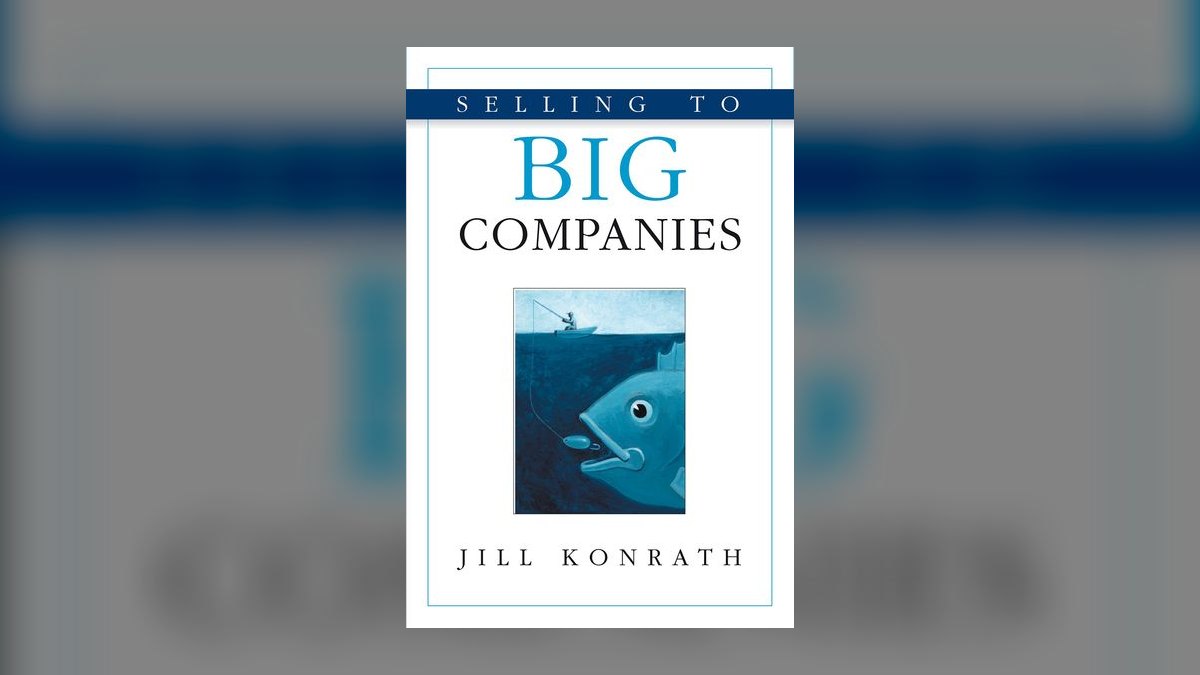
*Selling to Big Companies* by Jill Konrath argues that enterprise sellers fail because their value propositions are vague, not because buyers are unreachable. The fix: research a narrow target list, build outcome-focused messaging tied to a measurable business result, then run a patient multi-touch, multi-channel account-entry campaign until you earn the first meeting.
What the book is and why it still matters
Jill Konrath published *Selling to Big Companies* in 2005, and the reason it survived two decades of methodology churn is that it solved a problem no CRM feature has ever solved: how a single seller, with no brand recognition and no warm introduction, gets thirty minutes on the calendar of an executive at a Fortune 1000 company. Konrath had spent years selling for Xerox and then consulting with sellers who were technically competent, product-fluent, and still could not get returned calls. Her diagnosis was uncomfortable. The problem was not the prospect's hostility. The problem was that the seller had nothing worth interrupting a busy person for.
The book's organizing observation is what Konrath calls the crazy-busy buyer. Corporate decision-makers, she writes, live in a permanent triage state — double-booked, firefighting, and pre-committed to a set of priorities that were locked in before you ever appeared. They are not evaluating vendors in their spare time, because there is no spare time. Every inbound message gets a few seconds of attention, and unless those seconds produce a reason to keep reading, the message is gone. This was a genuinely contrarian claim in 2005, when most sales training still assumed a buyer who would take a discovery call out of professional courtesy.
What makes the book durable rather than merely correct is that Konrath does not stop at the diagnosis. The bulk of the text is procedural. She builds, in order: a written ideal-client profile, a trigger-event research habit, a value proposition that survives three specific tests, and a sequenced multi-channel campaign designed around the assumption that most touches will be ignored. That sequence — target, message, cadence, meeting — is the skeleton of essentially every account-based playbook shipped since, whether or not the vendor selling it has heard of Konrath.
It is worth naming the book's scope honestly. This is not a full-cycle enterprise sales methodology. Konrath spends comparatively little time on multi-stakeholder consensus building, procurement negotiation, security review, or the mechanics of a mutual action plan. Books like *The Challenger Sale*, *Gap Selling*, and *SPIN Selling* cover different segments of the same journey. *Selling to Big Companies* is specifically a book about account entry — the stretch between "I have decided this logo matters" and "I am sitting across from a person who can sign." Read with that boundary in mind, it is close to definitive. Read as a complete methodology, it will feel thin in the late stages, and that is a scoping error on the reader's part, not a flaw in the book.
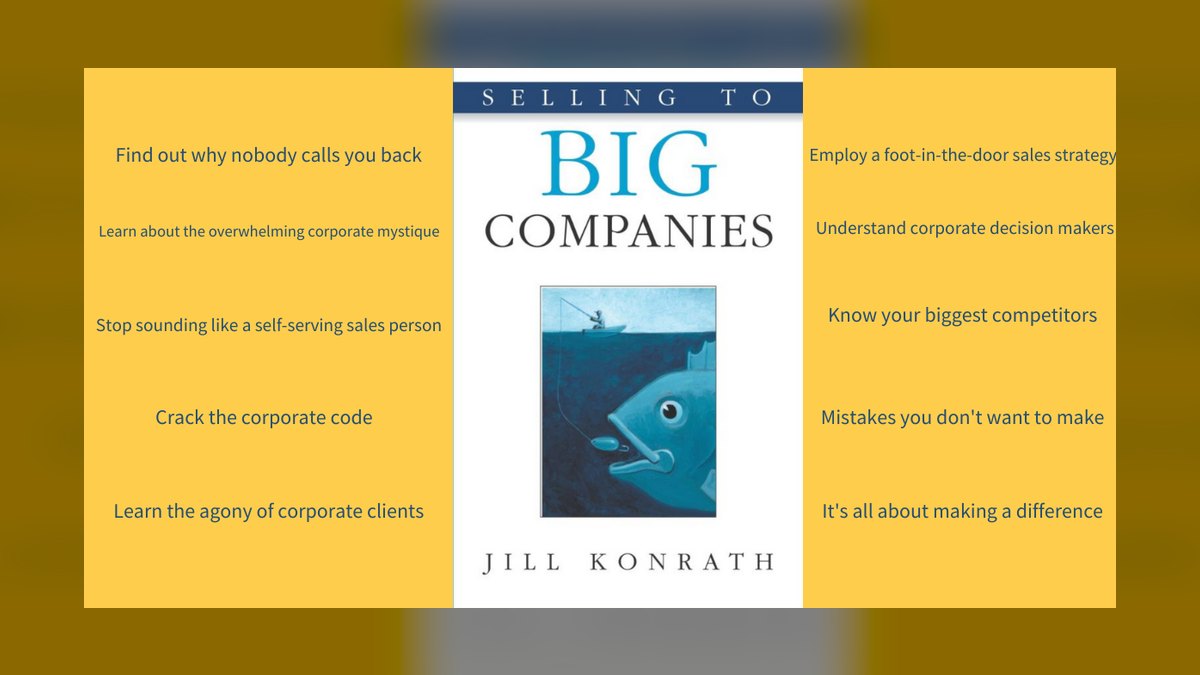
The adjacent value, and the reason marketing and RevOps people still pick it up, is that Konrath's messaging discipline is not really a sales-only artifact. A value proposition that passes her tests is also a usable landing-page headline, a usable ad hook, a usable partner pitch, and a usable internal business case. Teams that run the exercise properly usually discover their positioning problem is company-wide rather than rep-specific — which is a more expensive finding, but a more useful one.
The step-by-step process Konrath actually prescribes
The book reads as a sequence, and the sequence matters more than any individual tactic. Skipping a step upstream makes every downstream step more expensive.
Step one: write the ideal client profile down. Konrath insists this is a physical artifact, not a mental model, and she is specific about the fields: industry, company size, growth stage, decision-maker title, geography, current vendor situation, and the recurring problem you have actually solved before. The discipline of writing it forces sellers to admit how many of their open opportunities do not match it. Most reps who complete the exercise honestly find that a meaningful share of their pipeline consists of accounts they pursued because someone responded, not because the account fit.
Step two: narrow the list aggressively. This is the most counterintuitive instruction in the book and the one most often ignored. Konrath argues that an enterprise seller needs a target list in the range of twenty-five to fifty named accounts, not several hundred. The logic is arithmetic. Meaningful research — reading the last earnings call, mapping the org chart, identifying who owns the budget, understanding what the new VP did at their prior company — costs real time per account. Spread across four hundred logos, that research collapses to nothing and the outreach reverts to templated spray. Concentrated on twenty-five, it produces messages that could only have been written to that specific company.
Step three: hunt trigger events. Konrath popularized the term in a sales context, and her list is concrete: leadership changes, funding events, earnings misses, mergers and acquisitions, layoffs, new product launches, facility openings, regulatory shifts, and public commitments made on earnings calls. A trigger does not create need; it creates *permission to be timely*. Without one, you are asking a busy executive to reprioritize for no reason. With one, your message references something already on their whiteboard.
Step four: build the value proposition. More on this below, because it is where most of the book's weight sits.
Step five: sequence the campaign. Konrath was among the first to write publicly that enterprise buyers typically require something in the range of seven to twelve touches before responding — a claim treated as heresy in 2005, when conventional practice was two attempts and move on. She specifies channel mixing rather than channel stacking: an email that a voicemail later references, a LinkedIn touch that echoes the email's theme, a mailed item that gives the follow-up call a reason to exist. The reinforcement is the point. One channel repeated eight times is noise; four channels woven together over eight touches reads as persistence with a purpose.
Step six: run the first meeting as a diagnosis, not a pitch. Konrath explicitly bans the "about us" opening. The first stretch of the meeting belongs to the buyer's world — what they are measured on, what they have already tried, what failed and why. Her questioning arc runs current state, desired state, gap, cost of the gap, urgency. That arc predates and closely resembles the qualification frameworks that were later branded and sold as products.
Building a value proposition that survives contact with an executive
Konrath's blunt claim is that weak value propositions are the most common root cause of ineffective selling, and she spends the longest stretch of the book on the repair. Her standard has three parts.
Specific. A strong value proposition names an exact business outcome, not a category of improvement. "Improved efficiency" is not an outcome; it is a genre. "Cut the purchasing cycle from fourteen days to four" is an outcome. The test is whether a skeptical executive could picture the before and after state without asking a clarifying question.
Measurable. There must be a number attached — a percentage reduction, dollars saved, hours returned, error rate cut, revenue retained. Konrath is realistic about where these numbers come from. Most sellers do not have them because nobody ever asked existing customers the right questions. Her remedy is a debrief habit: after every successful implementation, go back to the customer and quantify what changed, even roughly, even in ranges. A seller who cannot produce a single quantified customer outcome does not have a messaging problem, they have a homework problem.

Tied to a strategic priority. The number must connect to something the executive is already accountable for. Public companies broadcast these priorities constantly — earnings calls, investor decks, annual reports, the letter at the front of the 10-K. A value proposition that maps to a stated priority is not an interruption; it is a contribution to an argument the buyer is already having internally.
Konrath's most useful teaching device is the rewrite. She takes real outreach emails, marks the product-centric language, and reconstructs them. The pattern of failure is always the same: the message opens with what the vendor is ("we are the leading platform for…") rather than what the buyer gets. The rewrite inverts it — the opening line names a peer company, a measurable result, and a timeframe, and the vendor's identity does not appear until the reader has a reason to care.
A practical note on quantification that trips people up: you do not need the number to be yours. Industry benchmarks, published research from analyst firms, and the prospect's own disclosed metrics are all legitimate inputs, provided you label them accurately. Fabricating a number is worse than having none, because enterprise buyers verify. A range presented as a range — "companies in this situation typically see somewhere between a fifteen and thirty percent reduction" — is credible. A precise-looking figure with no provenance is not.
Konrath also addresses service businesses separately, which is the chapter most consultants, agencies, and staffing firms find most valuable. When the deliverable is intangible, the value proposition has to lean harder on named case studies and explicit before-and-after contrast, because there is no product demo to fall back on. The adjacent application here is obvious to anyone selling professional services: the same before-and-after structure that makes a cold email work also makes a proposal and a case study work. Build it once, reuse it in three places.

Costs, timelines, and what the effort actually requires
The book is not sold as a time-management text, but the honest cost of executing it is substantial, and skipping this reckoning is why most attempts fail in week three.
Research time. Doing Konrath's account preparation properly — reading recent earnings commentary or news coverage, mapping four to six relevant titles, identifying a trigger, and drafting a message that could only be sent to that company — takes somewhere between twenty and sixty minutes per account depending on how public the company is. On a twenty-five-account list that is roughly ten to twenty hours of upfront work, which is why the narrow list is not optional. At four hundred accounts the same standard would consume a full quarter before a single message went out.
Cadence execution. A seven-to-twelve-touch sequence across three or four channels, run against twenty-five accounts with several contacts each, is a daily commitment rather than a weekly one. A realistic steady-state is a few hours a day of execution once the research is banked — enough to work the queue, personalize the touches that need personalization, and log what happened.

Time to first meeting. Konrath does not publish a guaranteed timeline, and neither should anyone else. What the structure implies is this: a full cadence run at a sane pace takes several weeks per account, so the first meetings from a cold list generally arrive somewhere in the range of two to six weeks after the campaign begins, with a long tail arriving considerably later. Sellers who abandon a sequence at touch three are quitting before the model has had a chance to work, which is precisely the failure Konrath wrote the book to name.
Ramp on messaging. The value-proposition work is the slowest part to get right and the fastest to pay off. Expect several rewrite cycles before a message stops sounding product-centric. Konrath has sellers rewrite outreach repeatedly before sending — not as a stylistic exercise, but because the product-centric reflex is deeply trained and only rewriting breaks it.
Where the numbers come from. If your organization has never quantified customer outcomes, budget real time for that project — customer interviews, a look at implementation data, possibly help from finance or customer success. This is often a multi-week effort, and it frequently produces the uncomfortable discovery that nobody has been measuring what the product actually changed.
What to measure while running it. Track meetings booked per hundred targeted contacts, response rate by touch number, and which trigger types produced replies. The touch-number breakdown is the most diagnostic: if responses cluster at touches six through nine, that is direct evidence against shortening the cadence, and it is the data you show a manager who wants the team back on volume.

Where teams get this wrong
Running the cadence without doing the research. This is the dominant failure. A team adopts the twelve-touch sequence because sequencing software makes it easy, then fills every step with generic copy. The result is twelve times the volume of the thing that was already not working. Konrath's cadence is a delivery mechanism for researched, specific messages. Without the research it is a spam engine with good reporting.
Keeping the list too wide. Managers who measure activity volume will push back on a twenty-five-account list, because it looks like reduced effort. The counter is to measure meetings per hundred contacts rather than contacts per week. Depth almost always wins on that metric, and it is the only argument that survives a pipeline review.
Confusing personalization tokens with personalization. Inserting a company name and a job title is not research. The signal a busy executive reads is whether the message reflects knowledge of their actual situation. A single sentence demonstrating that you read their earnings commentary outperforms a paragraph of merge fields, and this gap has widened as generative tooling made superficially customized text free to produce.
Treating the executive assistant as an obstacle. Konrath rejects the "get past the gatekeeper" framing outright. The assistant knows the calendar, the priorities, and which initiatives are real. Sellers who explain their purpose plainly and ask for guidance on the right approach and timing get routed correctly far more often than sellers who try to dodge. Treating that person as an adversary is both rude and tactically stupid.

Single-threading the account. This is where the 2005 vintage shows most clearly. Konrath largely writes for a world of one or two decision-makers, and enterprise buying committees have grown substantially since. The correction is structural rather than philosophical: run her account-entry method against four to six stakeholders in parallel, with a message tailored to each function's own metric, rather than aiming everything at a single executive and hoping it cascades. The finance stakeholder and the operations stakeholder care about different numbers, and the same value proposition should be expressed in each of their units.
Over-indexing on voicemail. The book leans on voicemail as a primary opener, and that channel has weakened considerably as voicemail-to-text summaries and call screening became defaults. The underlying principle — a short message that names a peer, a result, and a reason to call back — transfers cleanly to any channel. The medium aged; the message structure did not.
Quitting the value-proposition rewrite too early. Teams frequently do one workshop, declare the messaging fixed, and never revisit it. Konrath's standard is closer to continuous: every time a customer produces a new quantified outcome, the messaging library should absorb it.
Decision framework: when this book is the right tool
*Selling to Big Companies* solves a specific problem well and other problems poorly. Matching it to your actual bottleneck saves a lot of wasted reading.
Reach for it when your bottleneck is top of funnel into large accounts — outbound meeting rates are low, target logos are enterprise, and your team has no warm-introduction network to lean on. This is the exact scenario the book was written for, and its account-entry sequence is the most complete treatment available.
Reach for something else when your bottleneck is elsewhere. If deals reliably reach late stage and then stall, the problem is consensus and business case, and *The Challenger Customer* or a mutual-action-plan discipline is a better fit. If discovery is shallow and you keep proposing solutions to problems the buyer has not admitted to, *Gap Selling* or *SPIN Selling* addresses the questioning craft more directly. If the issue is that your product genuinely does not differentiate, no sales book fixes that; that is a product and positioning problem, and Konrath's value-proposition exercise will surface it rather than solve it.
The adjacent-market read is worth noting too. The core mechanics — narrow list, trigger-based timing, quantified outcome, patient multi-channel cadence — transfer well beyond software sales. Professional services firms, commercial real estate brokers, manufacturers selling into large industrial buyers, and even recruiters working retained searches all face the same structural problem: a small number of high-value targets, long cycles, and buyers with no time. The channel specifics differ. The sequence does not.

How it fits alongside the rest of the sales canon
Konrath's book occupies the front of the funnel, and reading it next to its neighbors clarifies what each one is for. Neil Rackham's *SPIN Selling* is research-derived and focuses on the questioning structure inside a meeting — it assumes you already have the meeting. *Gap Selling* by Keenan pushes hard on diagnosing the difference between current and future state, which overlaps with Konrath's meeting arc but goes deeper on the psychology of problem admission. *The Challenger Sale* is about teaching and reframing during the sales conversation. None of them tell you how to get onto an executive's calendar from a standing start. That is the gap Konrath fills.
Her later book, *SNAP Selling*, extends the crazy-busy thesis into how buyers actually make decisions under time pressure, and the two are usually read together. *Selling to Big Companies* is the tactical entry manual; *SNAP Selling* is the decision-psychology follow-up. If you only read one and your problem is outbound, read this one first.
There is also a practical sequencing argument for RevOps and enablement leaders. Konrath's exercises produce artifacts other functions can use immediately: the written ICP feeds territory design and lead routing, the quantified outcome library feeds marketing content and case studies, and the trigger-event list feeds whatever intent or signal tooling the company has bought. Running the book as a team exercise rather than individual reading tends to produce more durable results, because the outputs get institutionalized instead of living in one rep's notebook.
The honest summary of the book's strategy is that it trades volume for preparation and asks the seller to be patient in exactly the place most sellers are impatient. That trade has gotten more favorable over time, not less. When generic outreach was expensive to produce, volume was a viable strategy. Now that it is nearly free, the only thing that stands out is evidence that a human did work before hitting send.
Related questions
Is *Selling to Big Companies* still worth reading given its 2005 publication date?
Yes, with a filter. The strategic core — crazy-busy buyers, trigger-based timing, quantified value propositions, multi-touch cadences — has aged well. The channel specifics, particularly the emphasis on voicemail and physical mail, need translating into current equivalents.
How does it differ from *SNAP Selling*, Konrath's later book?
*Selling to Big Companies* is about getting in — target selection, messaging, and campaign mechanics. *SNAP Selling* is about how time-pressured buyers actually decide once you are engaged, offering a framework for keeping complex deals moving. They are complementary rather than overlapping.
Do the ideas work for small and mid-market companies?
Partly. The value-proposition discipline and trigger-event research transfer cleanly to any segment. The heavy multi-touch cadence and twenty-five-account concentration are calibrated for large, hard-to-reach organizations, and are usually overkill when buyers are more accessible.
What single chapter should a seller read if they only have an hour?
The value-proposition section. It is the longest, most cited, and most immediately actionable part of the book, and a weak value proposition invalidates every downstream tactic no matter how well executed.
Does the method still work when buyers are drowning in AI-generated outreach?
Arguably better than before. When generic personalization became free to produce, the differentiating signal shifted to evidence of genuine research — exactly what Konrath's account preparation produces.
FAQ
How many target accounts should an enterprise seller actually work at once?
Konrath's guidance lands in the twenty-five to fifty range for a full-cycle enterprise seller. The constraint is research capacity, not ambition. If preparing a genuinely specific message takes half an hour per account and you also have to run cadences, take meetings, and manage existing opportunities, the arithmetic caps you well below a hundred. Sellers working a shorter cycle or a smaller average deal can carry more; sellers chasing very large strategic accounts often carry fewer than twenty-five.
What counts as a trigger event, and where do you find them?
Leadership changes, funding rounds, acquisitions, earnings commentary, layoffs, facility openings, new product launches, and regulatory shifts all qualify. Public companies disclose most of these in filings, earnings calls, and press releases. Private companies leak them through hiring patterns, executive LinkedIn changes, and trade press. The test is whether the event creates a reason for your solution to matter *now* rather than eventually.
How do you quantify a value proposition when you have no customer numbers?
Start by asking existing customers directly — most have never been asked and can produce rough figures with a little prompting. In the meantime, use published industry benchmarks or the prospect's own disclosed metrics, and label the source honestly. Present ranges rather than false precision. Never invent a figure; enterprise buyers check, and a single fabricated number ends the relationship.
How many touches before you give up on an account?
Konrath's seven-to-twelve range reflects when responses typically arrive, not a hard ceiling. The more useful practice is to exhaust a planned sequence, then park the account and revisit when a new trigger appears rather than declaring it dead. Track your own response distribution by touch number — if replies cluster late, shortening the cadence is throwing away the meetings you were about to earn.
Should the executive assistant be treated as a gatekeeper to bypass?
No. Konrath argues the opposite, and it holds up. Assistants know the calendar, the current priorities, and which initiatives are actually funded. Explaining your purpose plainly and asking for guidance on approach and timing tends to get you routed correctly. Attempting to dodge them is both discourteous and less effective than simply being useful and direct.
Does this approach work for virtual and remote selling?
Yes. The channel mix shifts — video messages and LinkedIn carry more weight, physical mail and voicemail less — but the underlying structure is channel-agnostic. A researched, outcome-led message tied to a trigger event earns attention whether it arrives in an inbox, a DM, or a meeting request. The medium changed; the requirement to be worth a busy person's time did not.
Sources
- Jill Konrath — official site and book pages
- Selling to Big Companies — Amazon listing
- Selling to Big Companies — Goodreads reviews and ratings
- Jill Konrath — LinkedIn profile
- Jill Konrath — HubSpot Sales Blog author archive
- The Sales Blog (Anthony Iannarino) — interview with Jill Konrath
- Sales Game Changers Podcast — Jill Konrath episode
- SPIN Selling by Neil Rackham — Goodreads
- Harvard Business Review — sales and selling topic archive
- Gartner — sales research and insights
Related on PULSE
- Selling the Invisible by Harry Beckwith — Cliff Notes Summary
- Secrets of Question-Based Selling by Thomas Freese: Summary, Key Lessons, and RevOps Takeaways
- SPIN Selling by Neil Rackham: Summary, Key Lessons, and RevOps Takeaways
- Gap Selling by Keenan: Summary, Key Lessons, and RevOps Takeaways
- The SPIN Selling Fieldbook — Cliff Notes Summary
This page will be disappearing soon. Save it to your device for $1 — or read it free while it is here.
@Kory-White- · if Venmo asks, the last 4 of my number are 2012
This page is gone.
This one is off the shelf now. $1 keeps it on your phone for good — the whole page, pictures and diagrams included.
 book-summaryThe Greatest Salesman in the World by Og Mandino — Cliff Notes Summary
 book-summaryPeople Buy You by Jeb Blount — Cliff Notes Summary
 pulse-recentDrive by Daniel Pink — Top 10 Key Takeaways for Sales Leaders in 2027
 book-summaryThe Sales Development Playbook by Trish Bertuzzi — Cliff Notes Summary
 book-summaryEat Their Lunch by Anthony Iannarino — Cliff Notes Summary
 book-summarySell or Be Sold by Grant Cardone — Cliff Notes Summary & Key Takeaways
 pulse-recentEssentialism by Greg McKeown — Top 10 Key Takeaways for Sales Leaders in 2027
 book-summaryRadical Candor by Kim Scott — Cliff Notes Summary
 book-summaryNever Lose a Customer Again by Joey Coleman — Cliff Notes Summary for Sellers
 pulse-recentHow does *The Sandler Rules* define the first concrete step for a sales leader to implement the system with their team in 2027?