
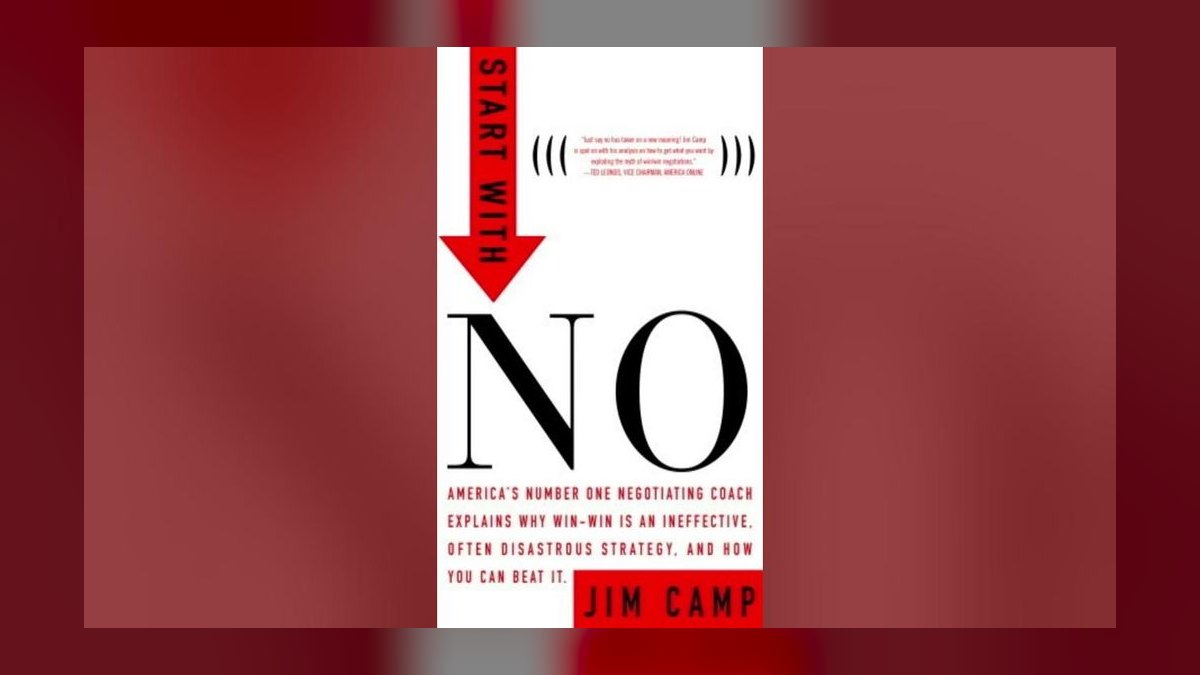
Start with No by Jim Camp: Summary, Key Lessons, and RevOps Takeaways
 Curated byKory White · Fractional CRO · Maryland
 PULSEKNOWLEDGE LIBRARY
*Start with No* (2002) by Jim Camp argues that win-win negotiation is a trap that pressures you into early concessions. Camp's thesis: invite the other side to say "no," eliminate neediness, and set your mission in the buyer's world. A premature "yes" is dangerous; a lingering "maybe" is worst of all.
What the book actually argues and why RevOps should care
Jim Camp wrote *Start with No: The Negotiating Tools That the Pros Don't Want You to Know* as a direct rebuttal to *Getting to Yes*, the Harvard Negotiation Project book that made "win-win" the default vocabulary of business negotiation. Camp's claim is blunt: win-win has been weaponized. The phrase itself has become a lever that skilled negotiators pull to make the other party feel unreasonable for holding a position. Once you accept that the goal is agreement, every hesitation you have starts to feel like obstruction, and the path of least social resistance runs straight through your margin.
The alternative Camp proposes is that negotiation is not about reaching agreement at all — it is about making good decisions. That distinction sounds academic until you watch it play out in a pipeline review. A deal marked "verbal yes, closing this month" feels like progress. A deal where the buyer said "no, not at that scope" feels like a setback. Camp inverts this: the first deal has produced agreement without a decision, and agreements without decisions unwind. The second has produced a real decision that you can now work with, because you know what the buyer will and will not do.
The word "no" carries the load in his system for three reasons. First, it is safe — a "no" can be reversed, revisited, and renegotiated at almost no cost, which means the person saying it is not committing to anything irreversible. Second, it is honest, because a person who feels free to decline has no incentive to perform enthusiasm. Third, it is clarifying, because a "no" always has a reason attached, and the reason is the actual negotiating material. "Maybe," by contrast, is the enemy. It preserves the relationship, costs the buyer nothing, and consumes your quarter. Camp's assessment that "maybe" is the worst outcome is the single line most worth pinning above a sales floor.
For a RevOps leader, the relevance is not primarily about how reps talk on calls. It is about what the operating system rewards. If your stage definitions, forecast categories, and comp plan all reward the appearance of agreement — meetings booked, verbals collected, "commit" flags set — you have built a machine that manufactures the exact behavior Camp warns about. Reps will chase yes because yes is what the system measures. Any serious application of this book to a revenue organization is therefore a strategy question about instrumentation, not a training question about scripts. You are deciding what your systems are allowed to call progress.
It is worth situating the book among its neighbors, because most teams end up running a blend. *Getting to Yes* (Fisher, Ury, and Patton) supplies the principled framework: separate people from problems, focus on interests rather than positions, invent options for mutual gain, and insist on objective criteria. *Never Split the Difference* (Chris Voss) supplies the tactical, empathy-forward toolkit — labeling, mirroring, calibrated questions, the accusation audit. Camp sits between them philosophically and to the left of both temperamentally. He is more systematic than Voss and far more adversarial than Fisher and Ury. In practice, sales organizations tend to use Voss for live-call technique and Camp for deal-stage discipline and qualification rigor.
The Camp system, step by step
Camp's system is a sequence, not a grab bag. Running the steps out of order is where most people get poor results, because several of them only work if the ones before them are already in place. Asking excellent discovery questions while visibly needing the deal produces excellent-sounding questions that the buyer reads as pressure anyway.
Step one: eliminate neediness. Camp's discipline is *want the deal, never need it*. Neediness is not a mood; it is a set of observable behaviors — over-talking, filling silence, sending the third follow-up in a week, offering a discount the buyer never asked for, agreeing to a timeline you know is unrealistic. The internal state leaks through all of them. The practical fix in a revenue org is structural: a rep with three real opportunities needs every one of them, and a rep with fifteen needs none of them badly. Neediness is often a pipeline coverage problem wearing a negotiation costume.

Step two: adopt the blank slate. Empty the assumptions before the call. No predetermined outcome, no script you are steering toward, no story about what the buyer "probably" wants. Camp's point is that expectations make you deaf — you hear confirmation of your forecast rather than what the buyer actually said. The operational version is a pre-call ritual: write down what you believe about the deal, label each item as verified or assumed, and treat the assumed items as the agenda.
Step three: set the mission and purpose in their world. Your mission is never "close this account." It is a statement of the decision the buyer needs to make and why it serves them. A workable mission for a mid-market deal might read: *to help this operations leader decide whether consolidating three reporting tools is worth the migration cost and the retraining hit in Q3.* Notice that the mission permits a "no" — that is the test. If your mission cannot be satisfied by the buyer deciding against you, it is a sales goal in disguise.
Step four: ask interrogative-led questions. Camp wants open questions beginning with *what* and *how*, never leading questions or ones answerable with yes. "What happens if this slips to next fiscal year?" outperforms "So it's urgent, right?" every time. The second question invites a yes that means nothing.

Step five: nurture. Make the other side feel safe enough to say the true thing. Camp's version is unglamorous — lower your energy, slow the cadence, explicitly give permission to decline. This overlaps heavily with what Voss calls tactical empathy, arrived at from a different direction.
Step six: build the picture of pain. People act on problems they can see, not on features they have been told about. The work is helping the buyer articulate their own problem in their own words, because a problem you narrated for them is one they can dismiss.
Step seven: manage budget. Camp uses "budget" broadly — the time, energy, money, and emotion each side invests. Your emotional budget must stay low, because emotional over-investment *is* neediness. The other side's investment, by contrast, is a commitment signal. A buyer who has pulled three colleagues into a working session has spent budget, and that spend predicts closure far better than any verbal.
What it costs to actually run this: time, ranges, and trade-offs
Adopting Camp's approach is not free, and the costs land in predictable places. Being honest about them up front is what separates a real rollout from a book club.

The cycle-time cost. Deliberate decision-building takes longer per deal than agreement-chasing does — at least at first. Reps who stop pushing for early verbals will see individual cycles stretch, sometimes noticeably, in the first quarter or two. The offsetting gain shows up later in win rate on qualified deals and in slippage: the deals that survive a Camp-style process slip out of the forecast less often, because there were fewer imaginary commitments in it to begin with. If your leadership only watches cycle time, this rollout looks like a failure for one or two quarters before it looks like a success.
The pipeline-coverage cost. This is the one teams underestimate. Making "no" safe means you will collect a lot more of them, and you will collect them earlier. That is the point — an early no is cheap and a late no is expensive — but it means your raw opportunity count drops while your qualified count holds or rises. If your coverage ratio targets are set against raw pipeline, you need to reset them before the rollout, not after your first ugly pipeline review. Expect the reset conversation to be uncomfortable.
The enablement cost. Realistically this is several weeks of sustained effort, not a one-hour session. A workable shape: a half-day workshop on the core psychology, then four to six weekly call-review sessions where managers listen for specific behaviors — did the rep invite a no, did they ask an open question where a leading one was tempting, did they fill the silence. Behavioral change in negotiation habits does not survive a single training event; it survives repeated, specific coaching on recorded calls.

The systems cost. Adding no-trigger fields, decision-event tracking, and revised stage exit criteria is modest CRM work — field creation, validation rules, a couple of reports — but the change management around it is not modest. Reps experience new required fields as surveillance unless the purpose is explained and the fields are visibly used in deal reviews. If you add the fields and never reference them in a review, they will be filled with garbage within a month. That failure mode is close to universal.
The trade-off worth naming. Camp's framing is adversarial, and adversarial framing has real costs in relationship-driven, multi-year enterprise accounts. In a renewal conversation with a customer you have served for four years, running the negotiation as a contest is a strategic error. The discipline of "want, don't need" travels everywhere. The combative posture does not. Teams that adopt the book wholesale, tone included, tend to see it land poorly in customer success and account management, where the relationship *is* the asset.
Where teams get this wrong
The most common failure is treating the "no" close as a gimmick. A rep who ends every call with "and it's totally fine to say no" while their tone, cadence, and follow-up behavior scream need has adopted the script without the substance. Buyers read the mismatch immediately, and the technique becomes a tell. The permission to decline only works when it is genuine — when you actually will walk away — and the way to make it genuine is coverage and qualification, not phrasing.
The second failure is mistaking hardness for discipline. Camp's tone gives cover to reps who were already inclined toward stubbornness, and "I'm just not being needy" becomes the justification for refusing to move on anything. That is not the system. Camp is explicit that you should want the deal — the discipline is about not *needing* it, which is compatible with flexibility, creativity, and genuine concession where it is earned. A rep who never concedes anything is not running Camp; they are running ego.

The third failure is misapplying "no" across the customer lifecycle. Inviting a prospect to decline a first meeting is sensible. Inviting an existing customer to decline a renewal, in the same tone, is unforced error. Adjacent functions need adapted versions: customer success can use the underlying idea — surface the real objection early, do not accept a hollow yes — without the adversarial posture. The principle generalizes; the register does not.
The fourth failure is instrumenting the letter and missing the spirit. A team adds a required "what would make you say no?" field to every stage and gets back three hundred instances of "budget timing." That field has produced nothing. What makes the no-trigger useful is specificity: *the VP of Finance froze all new SaaS spend until the fiscal-year close in October, and she has veto authority.* One is a shrug; the other is a plan. Field quality is a coaching problem, and it needs to be graded in deal reviews or it decays.
The fifth failure is running Camp in a comp system that punishes it. If a rep is compensated purely on closed-won with an accelerator that makes December catastrophic to miss, you have built neediness into the pay structure and no amount of training will overcome it. This is the deepest point for RevOps: negotiation behavior is downstream of incentive design. Fixing the reflex without fixing the incentive produces a team that knows the right answer and does the wrong thing anyway.

A sixth, quieter failure is skipping the mission step because it feels soft. Teams enthusiastically adopt "eliminate neediness" and "make no safe" — both punchy and quotable — while ignoring "mission in their world," which is the step that actually determines whether your discovery is real. Without it, you get calm, confident reps who are still fundamentally pitching, just at a lower volume.
Choosing your approach: a decision framework
Camp is not the right default for every negotiation, and pretending otherwise is how teams get burned. The choice depends mostly on three variables: how transactional the relationship is, how much leverage sits on each side, and whether the counterparty is a professional negotiator.
Use Camp-forward discipline when you are dealing with procurement organizations, when the counterparty is clearly trained in negotiation, when you are in a competitive bid where price pressure is the main lever, or when your team's diagnosed problem is chronic discounting and late-stage concessions. These are the conditions his system was built for.
Use Voss-forward tactical empathy when the negotiation is live, emotional, and relationship-bearing — a churn-risk conversation, an escalation with a frustrated stakeholder, a multi-threaded enterprise deal where you need an internal champion to advocate for you when you are not in the room. Labeling and calibrated questions do work Camp's framework does not.

Use principled, Fisher-and-Ury-style negotiation when both sides have a long-term interest in the relationship, when the pie is genuinely expandable, and when the objective criteria are available and credible — partnership structures, co-marketing terms, multi-year strategic agreements.
Most mature revenue teams end up blending: Camp's psychology as the substrate (never needy, mission in their world, no is safe), Voss's tactics for live conversation, and principled negotiation for structuring the actual terms. The blend is not incoherent. The three books disagree about tone and about what negotiation *is for*, but their practical advice overlaps more than their rhetoric suggests.
Turning the ideas into RevOps instrumentation
The gap between reading this book and benefiting from it is instrumentation. Three concrete builds carry most of the value.

The no-trigger field. Add a required free-text field at each stage gate where the rep documents the buyer's stated objection or hesitation in the buyer's own words. Not a picklist — picklists produce "budget" and nothing else. The prompt that works: *what would have to be true for this buyer to walk away, and who on their side would most resist this change?* Deals that clear a stage with an empty or generic no-trigger get flagged low-confidence in the forecast. Over two or three quarters this produces a pattern library — the top reasons buyers decline at each stage — which feeds directly into preemptive qualification questions and objection handling that is grounded in your actual market rather than a generic playbook.
Decision events instead of agreement signals. Stop treating "verbal yes" as a stage-advance criterion and start counting decision events: a discovery call where the buyer named a specific, quantified problem; a documented budget conversation with a real number attached; a working session with the economic buyer present; a written scoping document the buyer edited. Build the dashboard so a deal's health reads as decision-event count, not as a rep's confidence percentage. The counterintuitive read Camp would endorse: a deal with five decision events and no verbal is healthier than one with a verbal and two decision events. This one change tends to expose forecast fiction faster than any other single intervention.
Stage exit criteria that permit a no. Rewrite each stage exit to be a decision the buyer has made, not a state of enthusiasm. "Buyer has confirmed interest" is unfalsifiable. "Buyer has confirmed that the migration window is Q3 and has named the internal owner" is a decision, and it can come back negative — which is exactly what makes it useful. Exit criteria that can only be satisfied positively are just optimism with a checkbox.
Two adjacent effects are worth anticipating. Marketing will feel this change downstream: if sales starts disqualifying earlier and more honestly, MQL-to-SQL conversion will move, and the two teams need to agree in advance that the movement is a signal about lead quality rather than an accusation. And finance will feel it in the forecast: a pipeline scrubbed of hollow yeses is smaller and more accurate, which is a hard conversation to have once and a much harder one to have every quarter without warning. Brief both functions before the rollout, not after.

Honest assessment: what holds up, what to discount
What holds up. "Want, don't need" is durable and arguably the most valuable single idea in negotiation psychology. Neediness genuinely does destroy positions, and it is visible to counterparties long before it is visible to the person exhibiting it. "Make no safe" remains a sharp corrective to closing-obsessed cultures, and it has aged well — in committee-driven buying with five to eight stakeholders, the ability to get a clean early no from one of them is worth more than a warm maybe from all of them. Mission-in-their-world is the foundation of discovery that is not disguised pitching. These are genuinely useful Lessons and they survive the book's other problems.
What to discount. The tone is the weakest part. Camp frames negotiation as a contest in which the other side is deploying win-win against you, and that posture reads as cynical in a world where most B2B relationships are multi-year and multi-threaded. His treatment of *Getting to Yes* is also somewhat unfair — Fisher and Ury never argued for capitulation, and Camp's version of their argument is closer to a caricature than a fair Summary of it. The system's eighteen components can feel formulaic in application, and reps who learn it as a checklist produce mechanical conversations. Read it for the psychology of neediness and the discipline of making "no" safe; temper the adversarial framing with the collaborative reality of how enterprise deals actually get done.
The practical Takeaways for a RevOps function are narrower than the book's ambitions and more durable for it: build systems that measure decisions rather than agreements, remove the structural sources of rep neediness before you train against the symptom, and treat a fast, clean "no" as a good outcome your dashboards should celebrate rather than hide.
Related questions
How does Start with No differ from Never Split the Difference?
Both reject naive win-win, but Voss is tactical and empathy-forward — labeling, mirroring, calibrated questions for live conversation. Camp is philosophical and structural: mission, neediness, decision-making. Most teams use Voss for call technique and Camp for deal-stage discipline and qualification rigor.
Is inviting a "no" appropriate in customer success and renewals?
The underlying principle travels; the adversarial tone does not. Surfacing real objections early and refusing to accept a hollow yes both work well in renewals. Framing the conversation as a contest with a long-tenured customer is an unforced error.
What's the single highest-leverage change from this book?
Removing the structural sources of rep neediness — thin pipeline coverage, punishing month-end accelerators, quota math that makes one deal existential. Behavior is downstream of incentives, so fixing the reflex without fixing the system produces reps who know better and do worse anyway.
Does making "no" safe hurt conversion rates?
Raw opportunity counts typically drop while qualified-deal win rates hold or improve. You collect more no's earlier and fewer late-stage collapses. Reset coverage-ratio targets before the rollout, or your first pipeline review after the change will look like a crisis.
How long before this shows up in the numbers?
Expect one to two quarters of noisy or worse-looking metrics — longer cycles, smaller pipeline — before slippage and forecast accuracy improve. Brief leadership on that curve in advance, because abandoning the change mid-dip is the most common way these rollouts die.
FAQ
Is Start with No really better than Getting to Yes?
It depends on the negotiation. *Getting to Yes* focuses on principled, collaborative negotiation toward a fair outcome and works well when both sides have long-term interests and objective criteria are available. Camp's system is stronger in high-stakes, adversarial, price-pressured situations where you need to protect your position. In relationship-based negotiations, Camp's approach can read as aggressive.
Does Jim Camp say you should never say yes?
No. He says you should never chase a yes or accept a premature one. A quick yes often means the other side wants the conversation to end, or hasn't thought through the implications. He teaches you to invite "no" instead, because a no is a real decision that surfaces the other side's genuine concerns and can always be revisited later.
Will applying this make me seem cold or manipulative to clients?
It can, if you apply the tactics mechanically. Camp's tone is blunt, but the core principle — stop being needy and stop trying to be liked — is about genuine confidence, not trickery. Applied well, it means asking harder questions and letting the buyer own their decision, which most sophisticated buyers respect rather than resent.
Is this book only useful for salespeople?
It's genuinely useful for revenue operations. The focus on eliminating neediness, setting a mission in the buyer's world, and qualifying by decisions rather than enthusiasm maps directly onto pipeline hygiene, stage exit criteria, deal review standards, and discount governance. It's less about closing technique than about building a repeatable process.
Does the book give a step-by-step system or just philosophy?
It gives a full system with named components including mission and purpose, the blank slate, pain, budget, and the decision-maker, each with worked examples. The system can feel rigid as written, and most teams adapt it rather than adopting it verbatim — the psychology transfers more cleanly than the prescribed sequence.
What should I read alongside it?
*Getting to Yes* for the principled framework Camp is arguing against — read the original rather than his characterization of it. *Never Split the Difference* for tactical empathy in live conversations. Together the three cover most of what a revenue team needs, and their disagreements are more about tone than about practical advice.
Sources
- https://www.amazon.com/Start-No-Negotiating-Tools-ःnow/dp/0609608002
- https://www.pon.harvard.edu/
- https://www.hbs.edu/faculty/Pages/item.aspx?num=6459
- https://www.penguinrandomhouse.com/books/167300/start-with-no-by-jim-camp/
- https://hbr.org/topic/subject/negotiations
- https://www.pon.harvard.edu/daily/negotiation-skills-daily/getting-to-yes-negotiating-agreement-without-giving-in/
- https://www.blackswanltd.com/never-split-the-difference
- https://sloanreview.mit.edu/topic/negotiation/
Related on PULSE
- [The Power of a Positive No by William Ury — Cliff Notes Summary](/knowledge/bs0090)
- [Start with Why by Simon Sinek — Cliff Notes Summary for Salespeople](/knowledge/bs0049)
- [Good to Great by Jim Collins — Cliff Notes Summary](/knowledge/bs0210)
- [Stop Selling and Start Leading by Kouzes, Posner & Calvert — Cliff Notes Summary](/knowledge/bs0073)
- [The Art of the Start 2.0 by Guy Kawasaki — Cliff Notes Summary](/knowledge/bs0188)
- [The Cold Start Problem by Andrew Chen — Cliff Notes Summary](/knowledge/bs0233)
This page will be disappearing soon. Save it to your device for $1 — or read it free while it is here.
@Kory-White- · if Venmo asks, the last 4 of my number are 2012
 book-summaryFanatical Prospecting by Jeb Blount — Cliff Notes Summary
 pulse-recentGood to Great by Jim Collins — Top 10 Key Takeaways for Sales Leaders in 2027
 book-summaryGap Selling by Keenan — Cliff Notes Summary
 book-summaryNew Sales Simplified by Mike Weinberg — Cliff Notes Summary
 book-summaryCracking the Sales Management Code by Jason Jordan and Michelle Vazzana: Summary, Key Lessons, and RevOps Takeaways
 pulse-recentObviously Awesome by April Dunford — Top 10 Key Takeaways for Sales Leaders in 2027
 pulse-recentThis Is Marketing by Seth Godin — Top 10 Key Takeaways for Sales Leaders in 2027
 book-summaryPre-Suasion by Robert Cialdini — Cliff Notes Summary
 pulse-recentNever Lose a Customer Again by Joey Coleman — Top 10 Key Takeaways for Sales Leaders in 2027
 book-summaryGrit by Angela Duckworth — Cliff Notes Summary for Sales Leaders